
Heel-to-toe drop is the spec running shoe nerds argue about the hardest and measure the least. Ten millimeters, four, zero: it shows up on every product page like a vital sign, gets marketed as a philosophy and splits running clubs into camps. Strip away the noise and it’s subtraction. Around that subtraction sits a story with an Oregon track coach, a bestselling book, a $3.75 million lawsuit and a lab that cut more than a hundred shoes in half to check the math.
It’s just subtraction
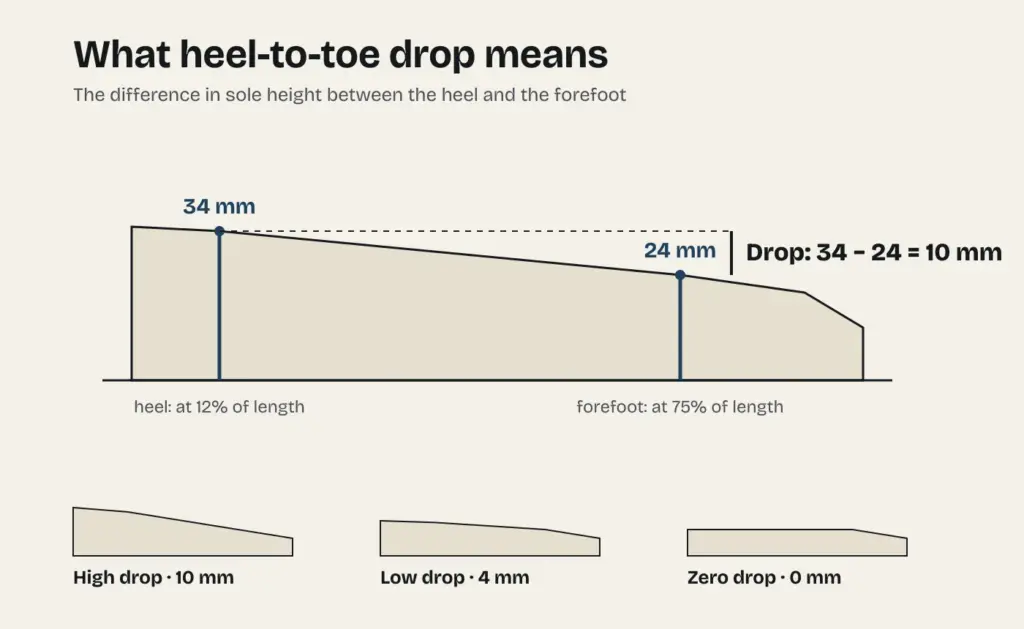
Drop is the difference in sole height between the heel and the forefoot. If a shoe has 34 millimeters of sole under your heel and 24 under the ball of your foot, the drop is 10 millimeters. If the two are the same, the drop is zero and your foot sits level, the way it does when you’re barefoot.
Don’t confuse it with stack height, which is how much sole there is in total. A shoe with 40 millimeters at the heel and 40 at the forefoot has a ton of foam and zero drop. A thin racing flat with 14 millimeters at the heel and 4 up front has very little foam and a 10-millimeter drop. One number tells you how far your foot sits off the ground. The other tells you how much it tilts forward.
The shoe-testing site RunRepeat sorts running shoes into four groups: zero drop, low drop (1 to 4 millimeters), mid drop (5 to 8) and high drop (8 and up). RunRepeat only counts a shoe as zero drop if the two heights are within 0.9 millimeters of each other. In its lab database, high-drop models outnumber zero-drop ones by roughly 18 to 1. Measured drops range from minus 0.8 millimeters, meaning the heel actually sits slightly lower than the toes, up to 16.1.
Where you measure changes the answer
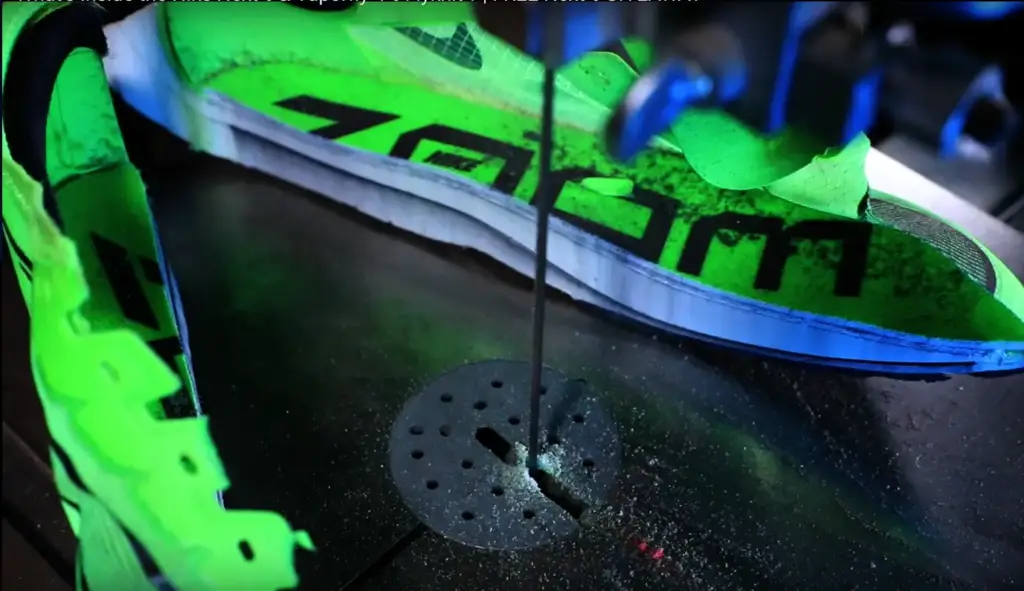
Subtraction is only reliable if everyone subtracts from the same spots. According to RunRepeat, the most widely used reference comes from World Athletics, track and field’s international governing body: heel height is measured at 12 percent of the shoe’s internal length and forefoot height at 75 percent. RunRepeat literally saws shoes in half and measures those two points with calipers.
Doing it that way turns up surprises. In a 2025 analysis of 122 running shoes, the site compared each brand’s stated drop with what its lab measured. A bit more than half landed within a reasonable range, off by 19 percent or less. But 15 models missed by more than 50 percent. The most extreme was a Skechers shoe listed at 6 millimeters of drop that measured 16.1. Going the other way, a New Balance model listed at 8 came in at 3.3. Among brands, New Balance strayed furthest from its own numbers on average, at 34 percent, followed by HOKA and ASICS. Nike and adidas came closest, at 10 and 12 percent.
That’s not necessarily bad faith. Brands can measure at different points, and if you measure the forefoot further back, toward the middle of the foot, the drop comes out smaller. Either way, RunRepeat’s conclusion is blunt: no brand is fully reliable when it comes to drop numbers. The figure on the box is a hint, not a measurement.
The wedge that started it all
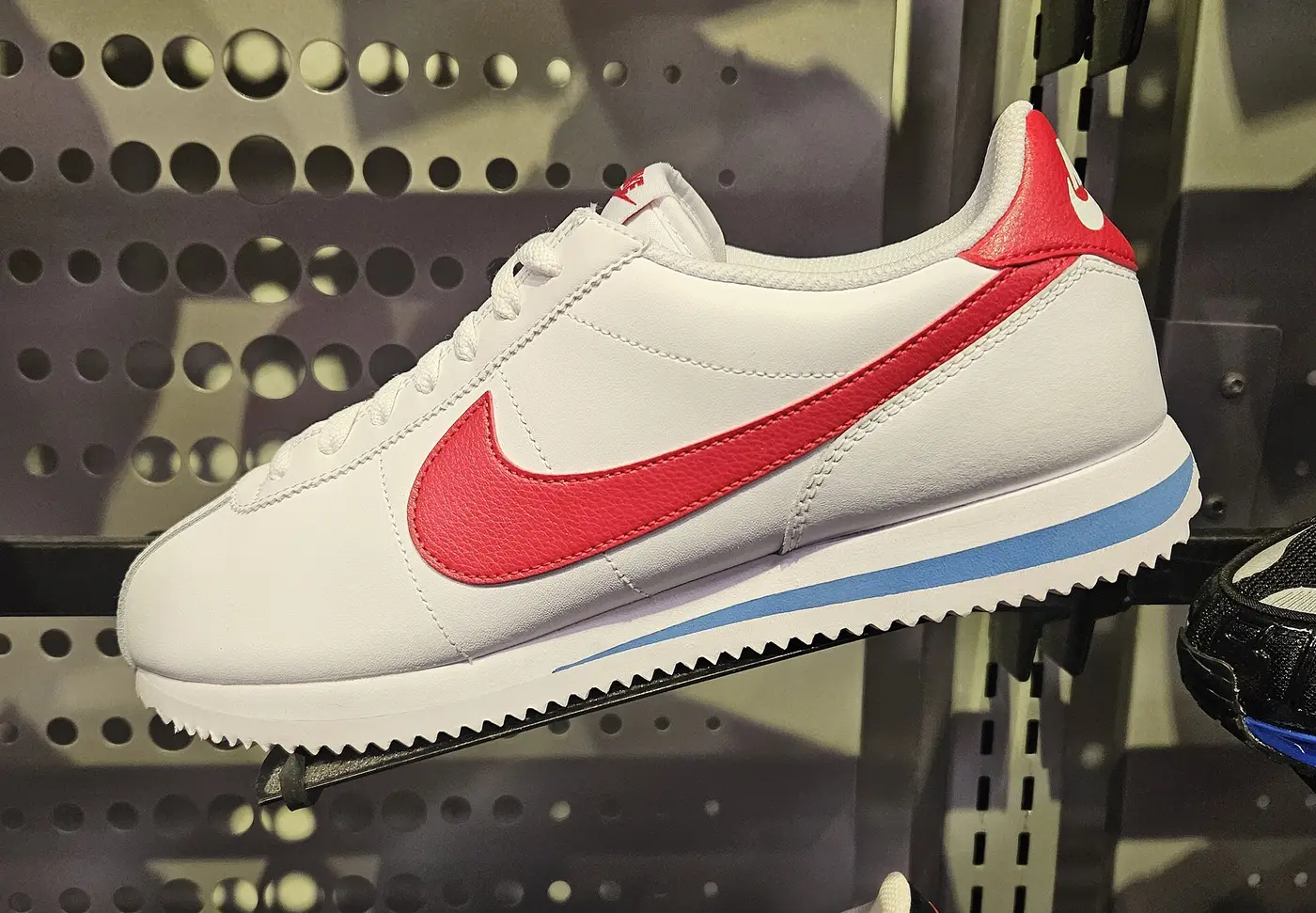
The raised heel in modern running shoes has a father with a name. Bill Bowerman, the University of Oregon track coach who co-founded Nike, was a relentless tinkerer who wanted his runners in lighter, faster shoes. The Nike Cortez, released in 1972, added a dual-density foam wedge under the heel, on top of a rippled rubber outsole for grip. According to the shoe’s history, Bowerman believed that wedge would tip a runner forward and lengthen the stride.
The idea took off, and the thick, cushioned heel became the norm. As the numbers above show, high-drop shoes still dominate the wall at your local running store.
The book that flipped the script
In 2009, journalist Christopher McDougall published Born to Run, the story of the Rarámuri, the long-distance runners of Mexico’s Copper Canyon, who ran in thin sandals. The book was a phenomenon, and it kicked off the minimalist running boom: run barefoot, or in shoes that barely separate you from the ground.
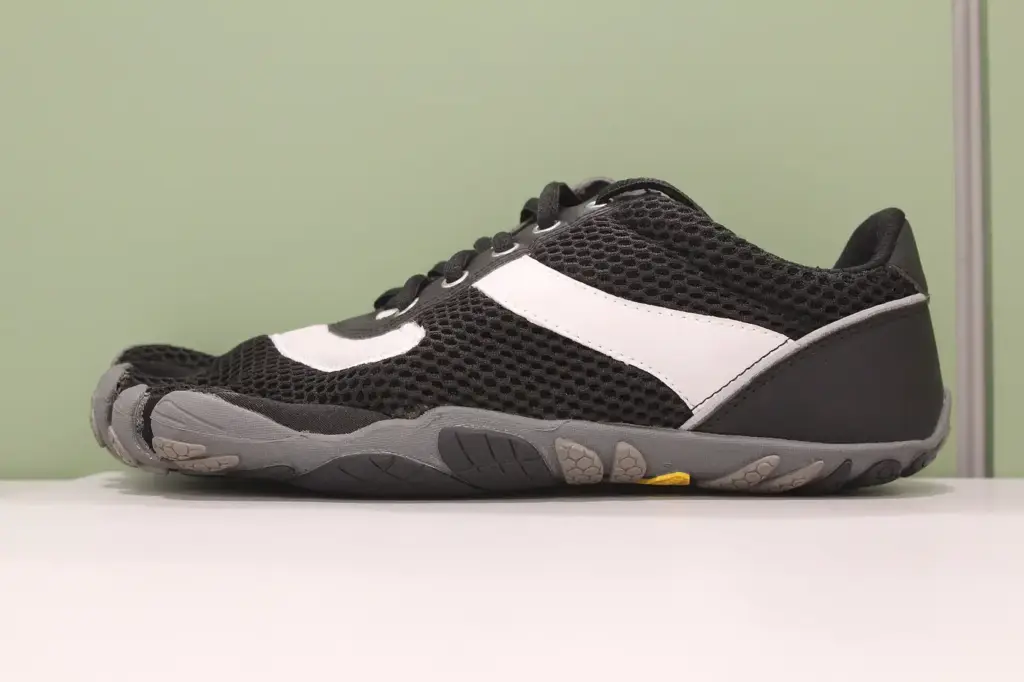
The icon of that era was the Vibram FiveFingers, a shoe with a pocket for each toe and almost no cushioning. Its downfall is the clearest lesson in what a shoe company can’t promise. Vibram advertised that FiveFingers would reduce foot injuries and strengthen foot muscles. A runner named Valerie Bezdek sued, arguing that those claims weren’t backed by science. In 2014, as Rubber News reported, Vibram agreed to pay $3.75 million to settle the class action in federal court in Boston, with buyers eligible for up to $94 a pair, although class members were expected to get somewhere between $20 and $50. Vibram had started marketing FiveFingers as running shoes in 2009, the same year Born to Run came out. The case never decided whether the shoes were good or bad. It settled something simpler: you can’t sell health benefits you can’t prove.
Zero drop was born in a toaster oven
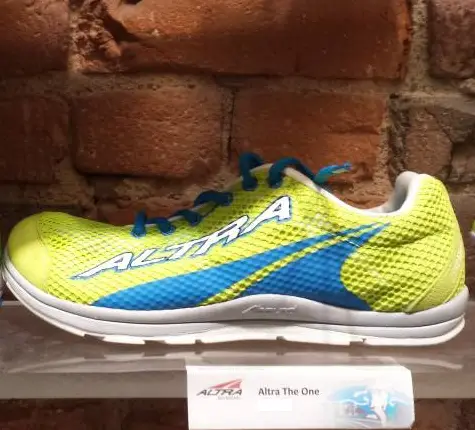
Some of the brands born in that wave are still on the shelves. One started in the back of a running store in Orem, Utah. Golden Harper, whose father owned Runner’s Corner, began cutting up running shoe soles and reshaping them with the help of a toaster oven, shaving the extra foam out of the heel until it sat level with the forefoot. He and his partners pitched the design to established footwear companies and got nowhere, so they started their own. Altra launched in 2009, working with Pulse Labs, an engineering group at Brigham Young University, and contract factories in Asia, and it built the whole brand around a single idea: zero drop.
Around the same time, HOKA arrived, in 2010, with the opposite take on height: enormous, extremely thick soles. Put the two stories side by side and they bust the idea that drop and cushioning go together. You can have tons of foam and no drop, or very little foam and plenty of drop.
What drop actually changes
This is where it pays to slow down and read what the research says, which is a lot less than the ads do.
Start with the obvious mechanics. Raise the heel and your foot tilts forward inside the shoe. With a high drop, the heel reaches the ground first and a heel-first landing tends to come more easily. With a low or zero drop, the foot sits flatter, closer to barefoot, which tends to be associated with landing more toward the midfoot or forefoot. As the researchers themselves point out, that’s exactly why minimalist shoes were designed with lower drops.
The studies are more nuanced. In 2015, a team from Aix-Marseille University and Decathlon’s movement sciences lab published an experiment with twelve runners, all healthy men, in the European Journal of Applied Physiology. Each ran barefoot and in shoes with 0, 4 and 8 millimeters of drop, on a treadmill and over ground. The researchers measured how hard the ground pushes back when the foot lands and how fast that force builds in the first instant of contact, known as the loading rate, along with the angles of the foot, ankle and knee at touchdown. Their conclusion: drop does influence how people run, but its effects on those forces were opposite on the treadmill and over ground, and they urged caution in interpreting them.
The second study is even more interesting because it looks at the long term. In 2017, researchers at the Luxembourg Institute of Health published a double-blind randomized trial in the Journal of Science and Medicine in Sport with 59 recreational runners. Nicolas Chambon, the Decathlon researcher from the first study, was one of the authors. The question this time was whether runners slowly adapt their technique to the shoe they wear week after week. Each got a cushioned shoe with a 10, 6 or 0 millimeter drop. Double-blind means neither the runners nor the people testing them knew which shoe was which. They ran in those shoes for six months or 500 kilometers. On average they logged 332 kilometers, a little over 200 miles. At the end, the researchers found no drop-related changes in stride timing or in joint angles at first contact. The only effect was a small one in a sideways knee movement that didn’t hold up when the groups were compared pair by pair. Their conclusion is cautious but clear: in standard cushioned shoes, drop doesn’t seem to change running mechanics over the long term.
Put together, what you can actually say is short and specific. Drop changes the geometry of your foot inside the shoe and can shift how you land on a given run. Over the long haul, in ordinary cushioned shoes, the evidence so far suggests most runners drift back to the way they already run. Anything beyond that, in an ad or on a forum, deserves the question the FiveFingers case asked: where’s the proof?
Tall foam, a carbon plate and a rulebook
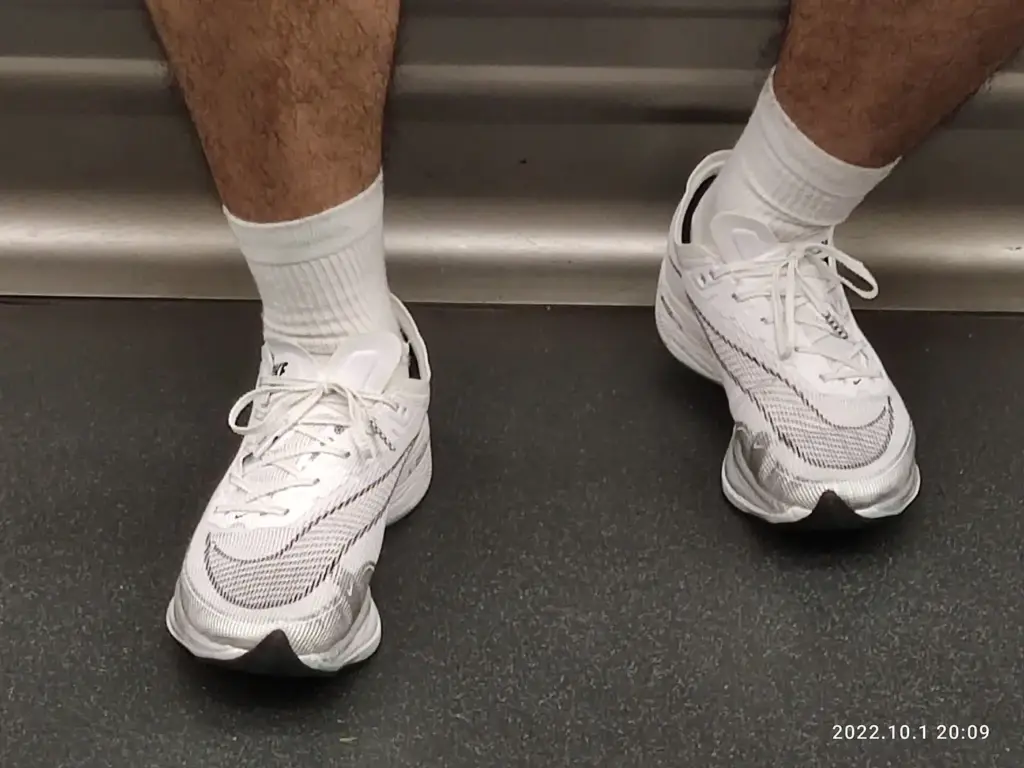
The latest twist came from so-called super shoes: towering stacks of very light foam with a rigid plate, often carbon fiber, sandwiched inside. They took over road racing so fast that the sport had to set limits. In 2020, World Athletics capped competition shoes at a 40-millimeter sole and spikes at 30, and allowed only one rigid plate per shoe. Its president, Sebastian Coe, put it this way: it wasn’t the federation’s job to regulate the entire sports shoe market, but it was its duty to preserve the integrity of elite competition.
Notice what the rule limits: sole height, not drop. A shoe can push right up against 40 millimeters and have an 8-millimeter drop, because what the federation cares about is how much foam sits under the foot, not which way it tilts.
The most argued-about number nobody checks
Drop exists outside running too, even if nobody calls it that. Any shoe with a heel has one in practice: the heel sits higher than the toes. That tilt is decided before the shoe is even made, because the last it’s built on is designed for one specific heel height. A dress shoe with a one-inch heel tilts your foot more than almost any running shoe on the market, and you’ll never see that printed on the box.
What makes running shoe drop special is that it became a selling point. It’s a single number, easy to compare and scientific-sounding. But as you’ve seen, brands don’t always measure it the same way, research finds smaller effects than most runners assume, and the elite rulebook doesn’t even look at it. It’s a useful bit of math for describing a shoe, not a prescription. And if running hurts, that’s a conversation for a healthcare professional, not a spec sheet.
Sources
- RunRepeat, “Heel to toe drop: the ultimate guide” and “How brands’ heel-to-toe drop measurements differ from reality in running shoes” (updated October 9, 2025).
- N. Chambon, N. Delattre, N. Guéguen, E. Berton and G. Rao (2015), “Shoe drop has opposite influence on running pattern when running overground or on a treadmill,” European Journal of Applied Physiology 115(5): 911–918.
- L. Malisoux, P. Gette, N. Chambon, A. Urhausen and D. Theisen (2017), “Adaptation of running pattern to the drop of standard cushioned shoes: a randomised controlled trial with a 6-month follow-up,” Journal of Science and Medicine in Sport 20(8): 734–739.
- Rubber News (May 9, 2014), “Vibram agrees to pay $3.75 million to settle lawsuit.”
- World Athletics, “World Athletics modifies rules governing competition shoes for elite athletes” (2020).
- Wikipedia, “Nike Cortez,” “Altra Running” and “Vibram FiveFingers,” and the references they cite.
Image credits
- Nike Cortez: LeDroider. Public domain (CC0), via Wikimedia Commons.
- Heel-to-toe drop diagram: feetkeepers.
- Nike Vaporfly cut in half: Seth James DeMoor. CC BY 3.0, via Wikimedia Commons.
- Vibram FiveFingers Speed: CascadeUrbanite. CC BY-SA 4.0, via Wikimedia Commons.
- Altra The One: Whoisjohngalt. CC BY-SA 3.0, via Wikimedia Commons.
- Nike Vaporfly Next: Hjfm 003. CC BY-SA 4.0, via Wikimedia Commons.