
How many pairs of shoes do you need? Your closet has an opinion, and so does your credit card statement. Neither gets a vote. The answer is set by water. A shoe you lace up in the morning before it has dried out from yesterday is working wet, and wet leather behaves like a different material: softer, easier to stretch out of shape and easier to tear. The U.S. Department of Agriculture put that in writing nearly a hundred years ago, and modern materials science explains why the department was right.
The number worth knowing is how many pairs it takes for each one to dry out between wears. The math is simple, but first it helps to know where the water comes from and what it does to a shoe.
The water that comes in with every foot
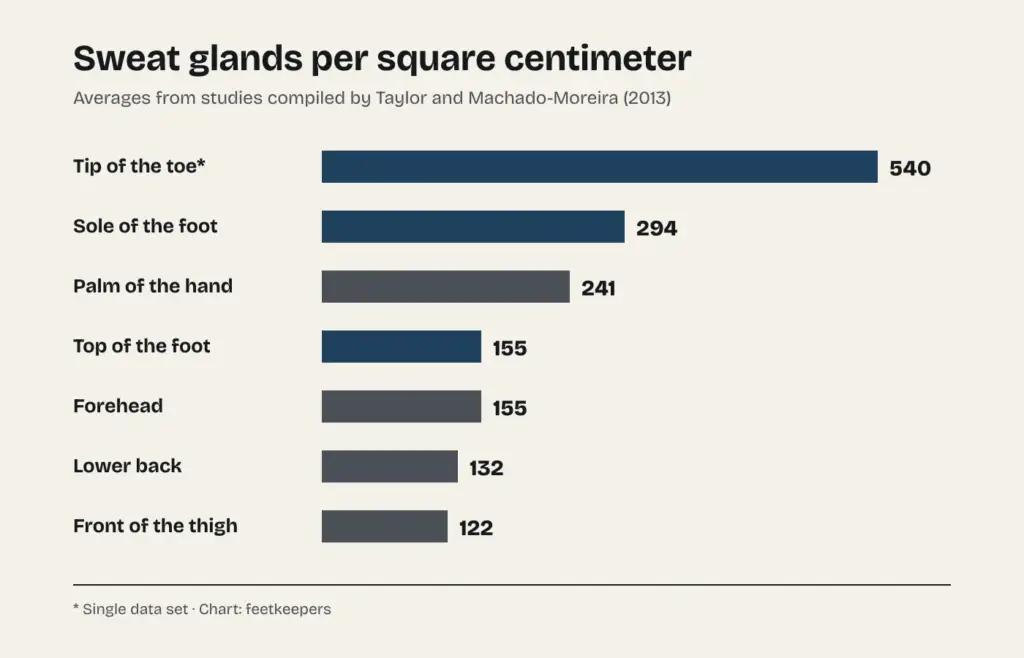
The sole of the foot is one of the most gland-dense patches of skin on the body. In 2013, physiologists Nigel Taylor and Christiano Machado-Moreira of the University of Wollongong in Australia pulled together decades of measurements in a review published in Extreme Physiology & Medicine. Across the studies they compiled, the sole averaged about 294 active sweat glands per square centimeter, more than the palm of the hand at 241 and nearly twice the top of the foot at 155. On the underside of the toe tips, a single data set counted 540.
Here’s the twist: lots of glands doesn’t mean lots of sweat. The same review concluded that when the body heats up at rest, the soles are among the stingiest sweaters of any region, and that the bottom of the foot puts out roughly two-thirds as much sweat as the top. During exercise, the feet produce about 4 percent of the body’s total sweat, in line with their share of skin surface.
You’ll see the claim all over the internet that each foot sweats half a pint a day, sometimes a full pint for the pair. Plenty of podiatry and shoe websites repeat it, but we couldn’t trace it back to a study. What is measured is that feet sweat, that a good share of that moisture stays inside the shoe, and that the shoe has to give it back up before the next time you put it on.
What sweat does to leather
Leather is collagen, the same protein that gives an animal’s skin its structure, tanned so it won’t rot. And collagen changes when it gets wet. In 2019, a team from Massey University in New Zealand and Germany’s Max Planck Institute of Colloids and Interfaces used X-rays to study how leather responds to moisture, publishing in the Journal of the Mechanical Behavior of Biomedical Materials. They conditioned samples at different humidity levels and measured flexibility with a bending test. The more moisture, the more flexible the leather got. Water works its way inside the collagen fibrils, pushes the molecules slightly apart and acts as a lubricant that lets them slide past each other more freely.
That lab result lines up with something every cobbler already knew. A wet shoe gives. And whatever gives under the weight of someone walking around for eight hours stretches, deforms and doesn’t always spring back.
The government pamphlet that told you to buy two pairs
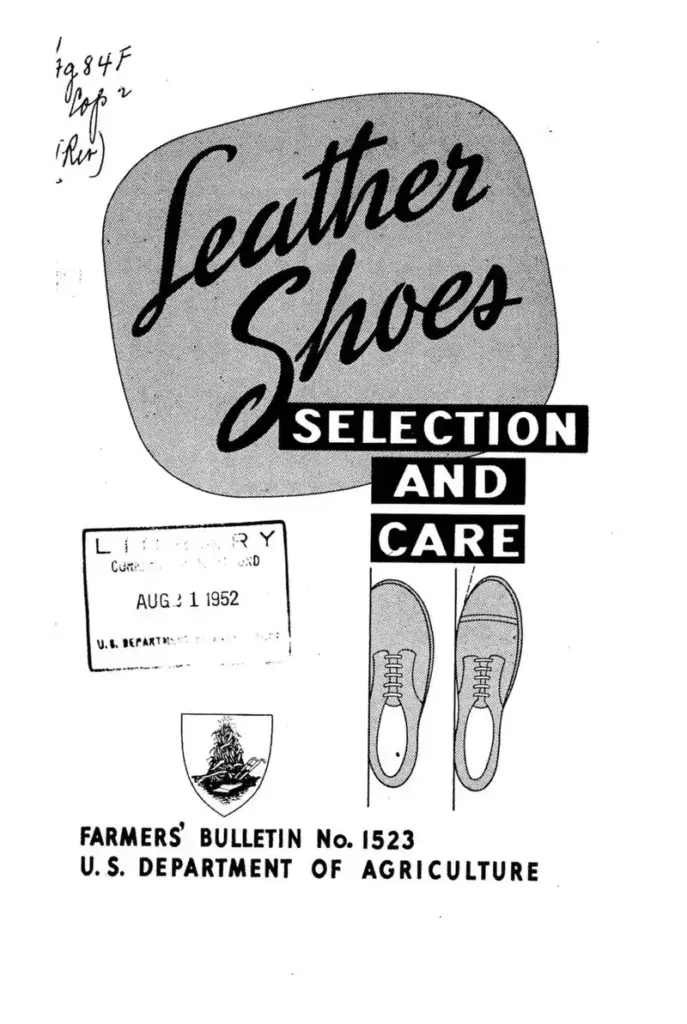
In April 1927, the U.S. Department of Agriculture issued Farmers’ Bulletin No. 1523, Leather Shoes: Selection and Care, written by F. P. Veitch, R. W. Frey and H. P. Holman of the leather and tanning investigations unit at the Bureau of Chemistry. J. S. Rogers and I. D. Clarke of the Eastern Regional Research Laboratory revised it in August 1952. Today it lives on the Internet Archive under a banner warning that it’s a historic document and may not reflect current science. Its advice on water, though, still reads as if it were written last week.
The bulletin pitched it as a money-saver: an economical plan is to have two pairs of shoes for alternate daily wear, so each pair can dry out in between. Its reasoning was blunt. Perspiration is very hard on leather, and uppers that are constantly wet with it may soon crack and rip, especially without an occasional oiling.
On soaked shoes, it got even more specific. Wet leather is soft, so it stretches out of shape easily, stitches cut through it easily and it wears away fast. Drying it out comes with a catch: according to the bulletin, wet leather “burns” much more readily than dry leather, and if it gets hotter than your hand can stand, it’s almost sure to be ruined. Setting wet shoes against hot radiators in streetcars, against steam pipes or stoves, or even inside a hot oven, which apparently some people did, spoiled them. Dried too fast and carelessly, shoes shrank, turned hard and tight, lost their shape, and the sole often cracked and sometimes fell out in pieces. The fix was slow. Wash off the mud with lukewarm water, straighten the counter, heel, vamp and toe, stuff the shoes with crumpled paper to hold their shape and speed things up, then set them somewhere not too warm. And don’t wear them again until they’re completely dry.
The bulletin also captured a turning point in shoemaking. By 1950, nearly half of all shoe soles were made of synthetic materials, and by the end of 1951, leather soles had dropped to 44.9 percent of the total, down from 52.0 percent a year earlier. The authors warned that the new soles ran hotter in summer and colder in winter, and didn’t carry off perspiration as well as leather.
Shoe trees
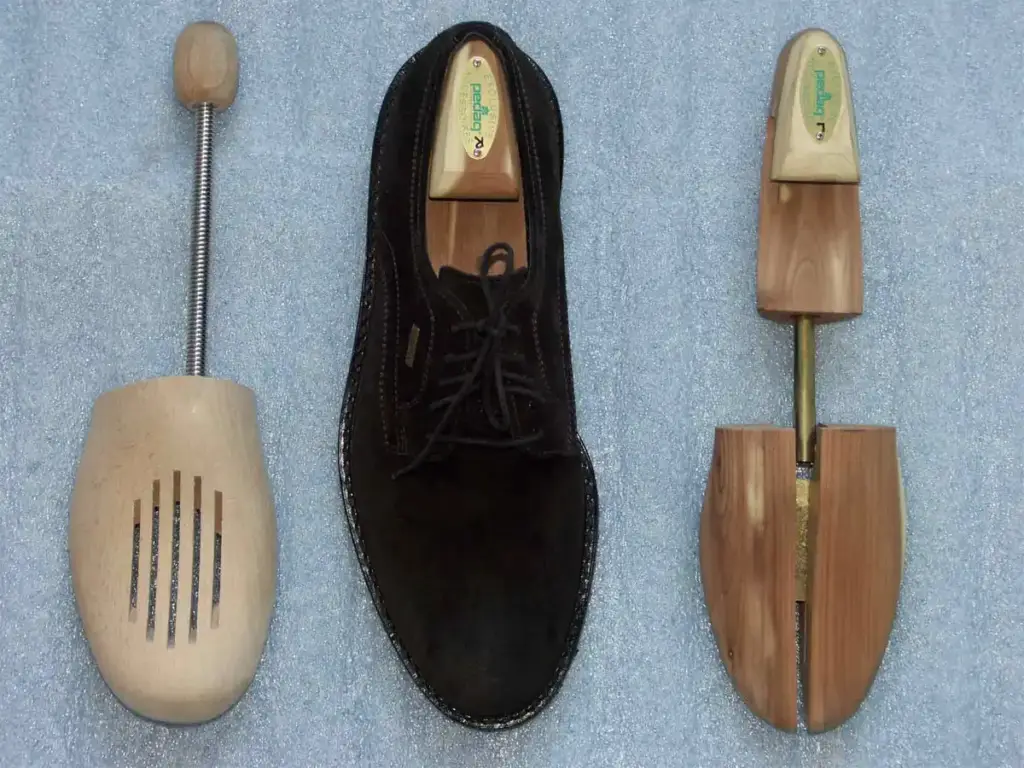
In the same section, the 1952 bulletin recommended shoe trees and called paper pads a fairly satisfactory substitute. Their job, it said, is to help shoes keep their original shape.
A shoe tree, not to be confused with the last a shoe is built on at the factory, is the mechanical answer to the problem the bulletin described: if damp leather is going to give, let it give around the right shape. Plenty of shoe trees are sold in cedar with the promise that the wood soaks up moisture and keeps shoes smelling fresh. That’s a marketing claim we haven’t seen measured in any independent study.
Odor starts with sweat
There’s another reason sweat matters, and your nose already knows it. In 2006, researchers at the labs of the Japanese company Kao published a study on the chemistry of foot odor in the Canadian Journal of Microbiology. The main culprit was isovaleric acid, which forms when Staphylococcus epidermidis, a bacterium that lives normally on human skin, breaks down leucine, an amino acid found in sweat.
In 2015, scientists from Unilever and Loughborough University in England mapped the bacteria on the foot in FEMS Microbiology Ecology. Staphylococci dominated everywhere and made up almost the entire bacterial population on the sole. Isovaleric acid showed up on the sole, but not on the top of the foot. Odor, in other words, has a map: it’s manufactured underneath, where most of the bacteria that make it live.
Neither study looked at shoes. But both make it clear that the raw material for odor is sweat, and sweat that soaks into a shoe doesn’t leave on its own. For how sock fibers fit into the picture, see our story on merino, cotton and synthetics.
In winter, wet boots also steal heat
If you wear boots in the cold, moisture has another price. In 1999, Kalev Kuklane and Ingvar Holmér of Sweden’s National Institute for Working Life, together with Gordon Giesbrecht, measured how much insulation footwear loses when the foot sweats. They used a heated artificial foot that simulated three sweat rates, 3, 5 and 10 grams an hour, and tested five kinds of footwear for an hour and a half. Insulation dropped 9 to 19 percent at the lowest sweat rate and 19 to 36 percent at the highest. The surprise was that the warmest boots lost a bigger share of their insulation than the thin ones. In an eight-hour test, more than half the total loss happened in the first 90 minutes.
A decade later, in a review in Industrial Health, Kuklane summed it up: moisture is the single most important factor in footwear insulation and foot comfort, and combined with movement it can cut protection against cold by 45 percent. A boot that hasn’t dried out from yesterday starts the day already behind.
What rotation won’t fix
Shoe rotation often gets sold with a different argument: that running-shoe foam needs a day or two to “bounce back” between runs. It’s an extremely common idea, but we couldn’t find a study on real shoes that backs it up.
What has been measured is that foam wears out with mileage. In 2004, Raquel Verdejo and Nigel Mills of the University of Birmingham in England studied the durability of EVA midsoles, the most common foam in running shoes, in the Journal of Biomechanics. After 500 kilometers of running, about 310 miles, peak pressure under the foot had risen by an average of 100 percent. Under an electron microscope, after 750 kilometers, roughly 466 miles, the walls of the foam’s cells were wrinkled and in places punctured. What the study tracked was wear by distance. Split your miles across two pairs and each one racks up half as many, but the total doesn’t change. For more on what the foam does, see our story on heel-to-toe drop.
A closet full of clogs in Tokyo
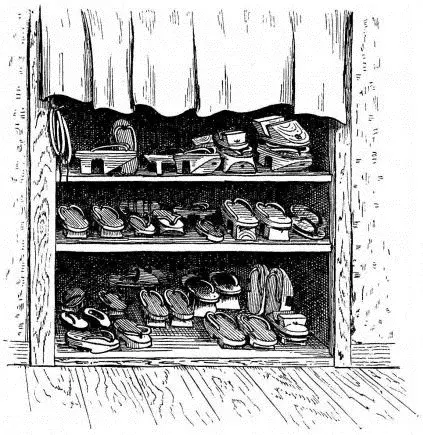
The American zoologist Edward S. Morse lived in Japan in the late 1800s, and in 1886 he published Japanese Homes and Their Surroundings, a book about Japanese houses illustrated with his own drawings. In November 1885, he sketched a wall-mounted shoe closet he found in the narrow entry hall of an old house near Ueno, in Tokyo. A quick look at the clogs inside, he wrote, revealed the same quirks of walking as back home: some were worn down at the heel, others at the sides. There were clogs of every size and kind, from the plain ones the schoolchildren wore, still caked with dried street mud, to the good pairs with lacquered sides and finely matted soles. A set of spare cords hung off to one side, ready for emergencies.
That’s what a full shoe closet really is: a record of how everyone in the house walks, with pairs for each job and each occasion.
Doing the math
Put it all together and the math takes care of itself. A pair you wear every day needs a partner to trade off with, so each one gets a full day to dry. That’s the 1927 USDA rule, and it still holds up. Then multiply by the uses that repeat in your week: work, workouts, rain and snow, dressing up. Anything you do almost daily calls for two pairs. Anything occasional gets by with one, because that shoe rests on its own schedule.
Take someone who commutes to a job five days a week, runs three times a week and lives somewhere with a real winter. Two pairs for work, trading off. One pair for running, which already gets a rest day between runs. One for rain and snow, and one for weddings and job interviews. Five pairs. Fewer than a lot of closets hold, and four more than the person who wears the same pair every single day. When you buy that second work pair, size it the same way you’d size the first, which we cover in our story on why shoes feel tighter in the afternoon.
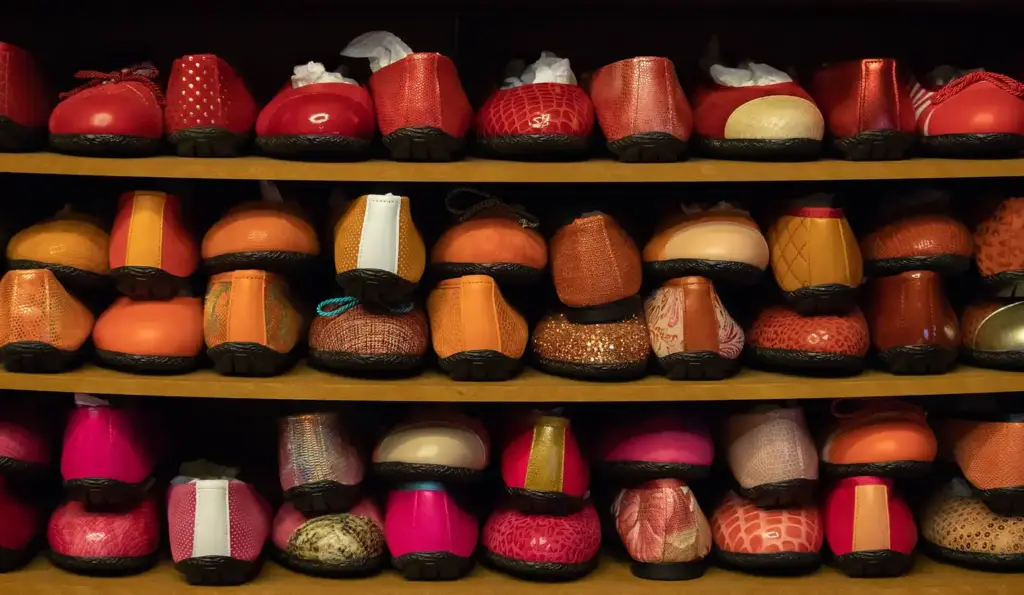
The industry, meanwhile, is producing as if we all needed far more. According to the World Footwear Yearbook from APICCAPS, the Portuguese footwear industry association, the world produced 23.9 billion pairs of shoes in 2024, nearly nine out of ten of them in Asia. North America went through 4.8 pairs per person in that single year. Africa, 1.4.
Sources
- N. A. S. Taylor and C. A. Machado-Moreira (2013), “Regional variations in transepidermal water loss, eccrine sweat gland density, sweat secretion rates and electrolyte composition in resting and exercising humans,” Extreme Physiology & Medicine 2: 4.
- S. J. R. Kelly, R. Weinkamer, L. Bertinetti et al. (2019), “Effect of collagen packing and moisture content on leather stiffness,” Journal of the Mechanical Behavior of Biomedical Materials 90: 1–10.
- F. P. Veitch, R. W. Frey and H. P. Holman, revised by J. S. Rogers and I. D. Clarke, Leather Shoes: Selection and Care, Farmers’ Bulletin No. 1523, U.S. Department of Agriculture (1927, revised 1952).
- K. Ara, M. Hama, S. Akiba et al. (2006), “Foot odor due to microbial metabolism and its control,” Canadian Journal of Microbiology 52(4): 357–364.
- D. Stevens, R. Cornmell, D. Taylor et al. (2015), “Spatial variations in the microbial community structure and diversity of the human foot is associated with the production of odorous volatiles,” FEMS Microbiology Ecology 91(1): 1–11.
- K. Kuklane, I. Holmér and G. Giesbrecht (1999), “Change of footwear insulation at various sweating rates,” Applied Human Science 18(5): 161–168; K. Kuklane (2009), “Protection of feet in cold exposure,” Industrial Health 47(3): 242–253.
- R. Verdejo and N. J. Mills (2004), “Heel-shoe interactions and the durability of EVA foam running-shoe midsoles,” Journal of Biomechanics 37(9): 1379–1386.
- E. S. Morse (1886), Japanese Homes and Their Surroundings.
- APICCAPS, World Footwear Yearbook 2025, 2024 data.
Image credits
- Shoes (1886), Vincent van Gogh, Van Gogh Museum. Public domain, via Wikimedia Commons.
- Sweat gland chart: feetkeepers.
- Cover of Farmers’ Bulletin No. 1523: U.S. Department of Agriculture. Public domain, via Wikimedia Commons.
- Shoe trees: Bettenburg. CC BY-SA 3.0, via Wikimedia Commons.
- Japanese shoe closet (1885): Edward S. Morse. Public domain, via Wikimedia Commons.
- Shoe store in Barcelona: Tomascastelazo. CC BY-SA 4.0, via Wikimedia Commons.