
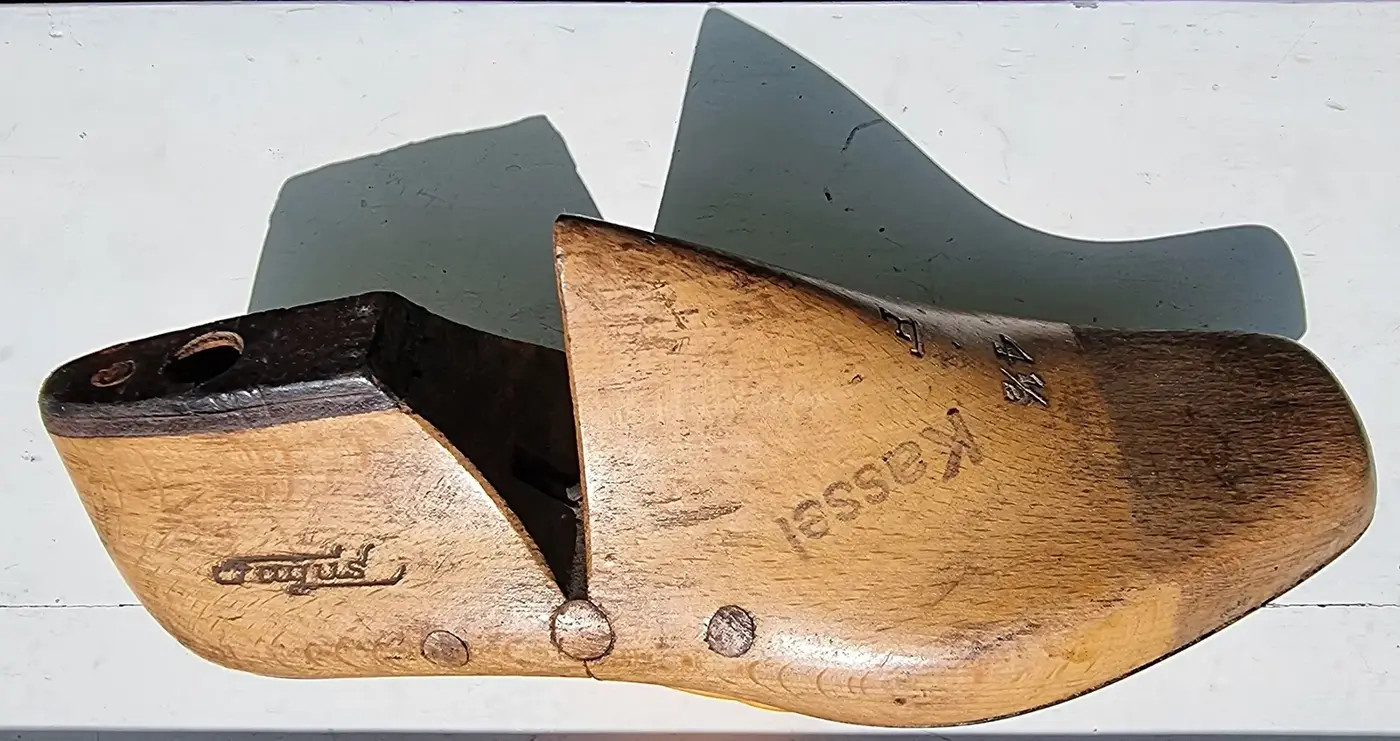
Every shoe you’ve ever loved or hated was built around something you’ve never seen. It’s a solid block shaped roughly like a foot, it sits on a factory shelf, and it’s called a last. By the time a pair lands on the store shelf, the last has already decided whether the toe box will pinch, whether your heel will slip, and whether a size 10 from one brand will feel like a size 10 from another. You’re not trying on a shoe so much as auditioning a last.
The word itself is older than the machines that now make it. According to Douglas Harper’s Online Etymology Dictionary, “last” comes from the Old English læste, and before that from a word meaning “track, footprint, footstep.” The shoemaker’s tool was named after the mark a foot leaves behind.
A foot-shaped form that isn’t your foot
It’s tempting to think of a last as an average foot cast in wood or plastic. That assumption explains a lot of bad shopping trips. A last is an interpretation of a foot, deliberately adjusted so that a shoe can be built on it and then worn. Lastmakers work from a set of measurements and then change them on purpose:
- Length. Measured heel to toe, it usually runs longer than the foot, because your toes need room to move forward as you walk. That extra space is called allowance, and every brand decides how much to give.
- Girths. Instead of thinking only in length and width, the industry wraps a tape around the last at the widest part of the forefoot, at the waist and over the instep. A foot is a volume, not an outline, and girths are how you describe a volume.
- Toe spring. Set a last on a table and the toe won’t touch the surface. It curves up a fraction of an inch so the finished shoe can roll forward as you step, something we’ll dig into in Biomechanics.
- Heel height. A last is designed for one specific heel. SATRA, the British footwear research and testing organization, notes that toe spring and back height are adjusted together when a last is designed. The shoemaker’s rule of thumb is that the lower the heel, the more toe spring the last needs. That’s why a flat oxford and a three-inch pump don’t come off the same form.
There’s another reason a last doesn’t copy the foot: materials give. Leather that feels snug in the store opens up with wear, and a good lastmaker plans for that by keeping certain girths tight on purpose.
The trouble starts when the interpretation drifts too far from real feet. In a 2018 review published in the Journal of Foot and Ankle Research, researchers Daniel Buldt and Hylton Menz pulled together the published studies on footwear fit. Across the studies they examined, between 63 and 72 percent of participants were wearing shoes that didn’t match the width or the length of their feet. Most people, in other words, are walking around inside somebody else’s last.
Cobbler, stick to your last
English has carried the last around in a proverb for centuries: cobbler, stick to your last. Mind your own business, in other words, and don’t weigh in on things you don’t understand. The line goes back to a story told by Pliny the Elder in his Natural History. A shoemaker pointed out a mistake in the way the Greek painter Apelles had painted a sandal. Apelles fixed it overnight. Emboldened, the shoemaker came back the next day and started criticizing the leg. Apelles cut him off: the shoemaker should not judge above the sandal.
In Pliny’s Latin, the word was crepida, a sandal. Somewhere along the way, English swapped it for “last,” as if the shoemaker’s real expertise lived in the form rather than the shoe. Whoever made that swap understood the trade.
Two centuries of shoes without a left or right
For a long stretch of European history, there was no such thing as a left shoe. Not because nobody noticed feet were different. SATRA points out that the difference between left and right had been recognized for thousands of years, and that flat shoes made for each foot were common until heels arrived around 1590. Heeled shoes were easier to produce on a symmetrical form with the tools of the day, and from roughly 1620 on, almost all footwear was made on “straights,” a single last for both feet.
Al Saguto, the master shoemaker at Colonial Williamsburg, has described it as a cost decision. One form made the whole pair, and the shoes broke in to the wearer’s feet over time.
Period sources back this up. In his 1608 comedy Humour out of Breath, English playwright John Day mentions a pair of straight shoes that gentlemen wore “now of one foot, now of another.” According to SATRA’s research, regimental orders published in 1800 told British soldiers of the King’s Shropshire Light Infantry to switch their boots to the opposite feet on alternate days.
The comeback of left and right was slow, and partly American. In the early 1800s, Philadelphia bootmaker William Young is said to have started making boots shaped to each of his customers’ feet. Historians repeat that story with a “said to,” because the documentation is thin. What’s certain is that straight lasts were still in use in the 1890s. The machine that finally made mirror-image lasts cheap didn’t come from a shoe shop. It came from an armory, the kind of twist we collect in History & Oddities.
The gunstock lathe that learned to make feet
At the Springfield Armory in Massachusetts, a musket stock maker reportedly said no machine could ever match his skill at shaping wood. The National Park Service credits that remark with motivating Thomas Blanchard to prove him wrong. In 1819, Blanchard patented a copying lathe. A master form turned while a guide wheel traced its contours, steering a cutter that carved the same shape into a block of wood. The Park Service compares it to a key-cutting machine.
It was built for gunstocks, irregular shapes no ordinary lathe could turn. But a machine that copies a gunstock can copy almost anything, and its uses spread to ax handles, wagon wheel spokes and shoe lasts. It had another trick: it could produce a mirror image of its model. A left and a right last no longer had to be carved separately by hand.
By the mid-1800s, commercial descendants of Blanchard’s lathe could turn out lasts accurately enough for standard sizes to start making sense. Two pairs of the same size, made in two different shops, could finally resemble each other. By the early 1900s, SATRA notes, last-duplicating machines could make more than 1,000 lasts a day.
The man who taught a machine to last a shoe
Identical lasts solved half the problem. The other half was lasting itself: pulling the upper tight over the last, shaping it around the heel and toe, and tacking it down so it would hold its shape. It was the most delicate job in the factory, done by hand lasters who were highly skilled, well organized and well paid. A good laster finished around 50 or 60 pairs a day, depending on the source. Factory owners blamed them for the price of shoes.
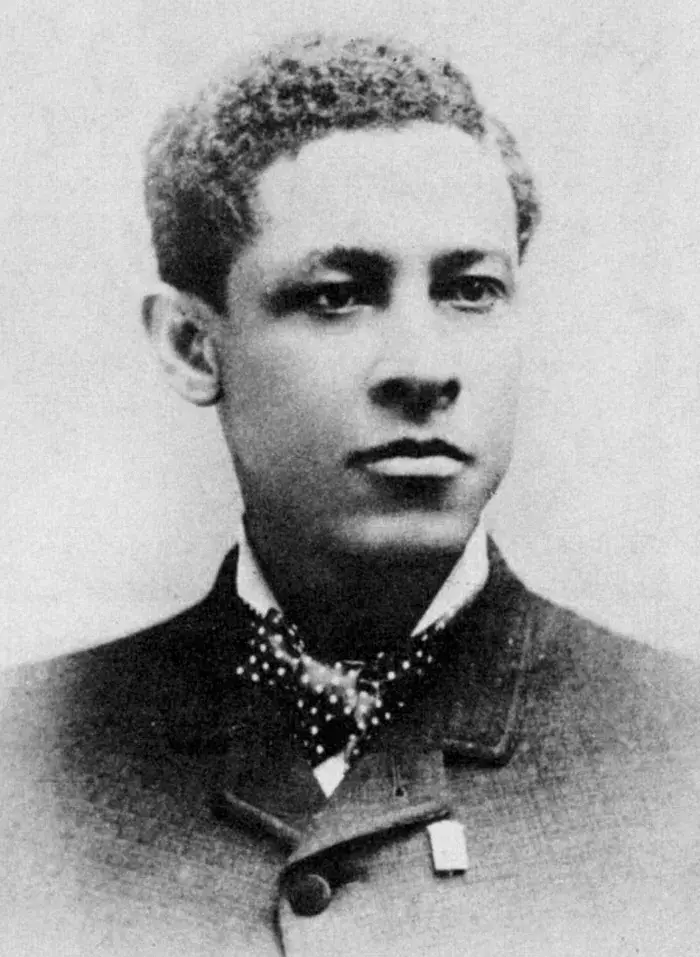
Jan Ernst Matzeliger was born in 1852 in Dutch Guiana, today’s Suriname. He learned mechanics as a boy in his father’s machine shop, went to sea at 19 and ended up in Lynn, Massachusetts, then the heart of American shoe manufacturing. He arrived speaking little English, took a job in a shoe factory, studied at night and built himself a small library of physics and mechanics. He also had to work past the skepticism of coworkers who doubted him because he was Black and foreign.
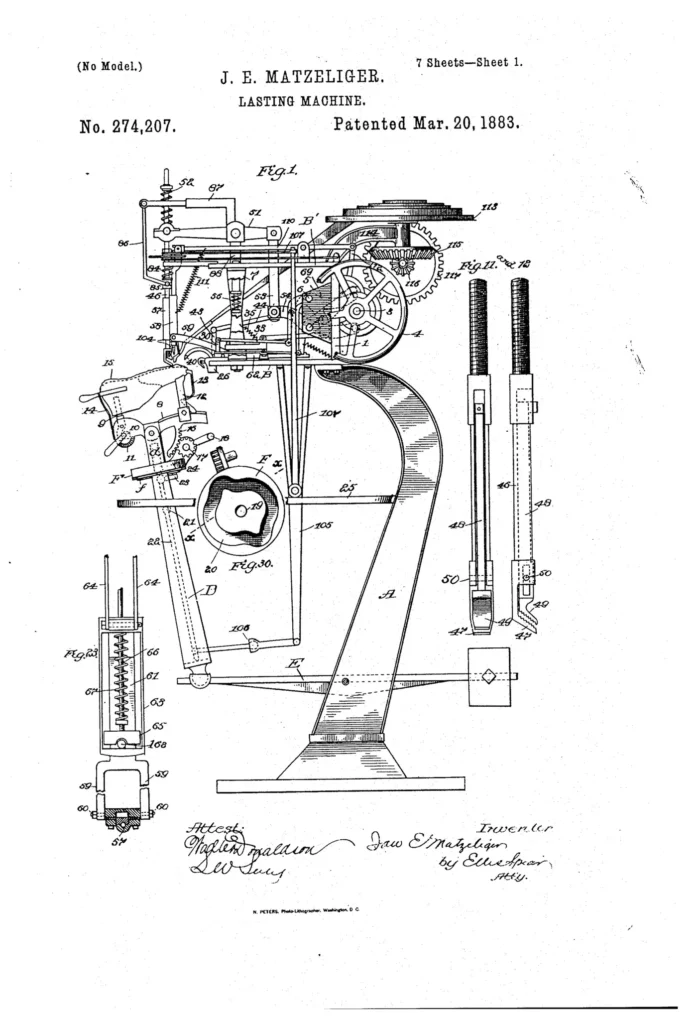
He filed for a patent on January 24, 1882. On March 20, 1883, he received U.S. Patent No. 274,207 for a “Lasting Machine.” The patent describes a jack that holds and turns the last, pincers that pull the leather over its edge, rollers that smooth out wrinkles and a mechanism that drives the tacks, all timed by cams so that an operator without years of training could run it. Biographical accounts say the Patent Office sent a representative to Massachusetts to confirm the machine could really do a hand laster’s job before granting it.
According to Mass Moments, he demonstrated it publicly on May 29, 1885. Improved versions could last around 700 pairs a day. To fund the work, Matzeliger had signed over two-thirds of his profits to investors, and he didn’t live to see what his machine became. He died of tuberculosis in 1889, at 36. He left much of his estate to North Congregational Church, the only church in Lynn that had welcomed him as a member. His patent was sold to the Consolidated McKay Lasting Machine Company, which in 1899 merged with other firms into the United Shoe Machinery Corporation, the company that dominated American shoe machinery for decades.
The last factory that launched modern architecture
If you go looking for the building where modern architecture starts, one of the answers is a factory that made shoe lasts. In 1910, Carl Benscheidt quit as general manager of a last factory in Alfeld, in northern Germany, after a falling-out with the owner’s son. He went to the United States looking for capital and know-how from an American partner in the business, then started his own company. He named it Fagus, the Latin name for beech, one of the classic woods for lasts.
For the building he hired a young architect named Walter Gropius, who designed it with Adolf Meyer. The result had glass walls that seem to hang between the columns, with glass wrapping right around the corners. Gropius put it simply: the walls were reduced to “mere screens stretched between the upright columns.” UNESCO added the Fagus Factory to the World Heritage List in 2011. It describes the ten-building complex as built for every stage of making, storing and shipping lasts for the shoe industry, and calls it a forerunner of the Bauhaus and a landmark of architecture in Europe and North America. It also notes something few monuments can claim: it’s still operating.
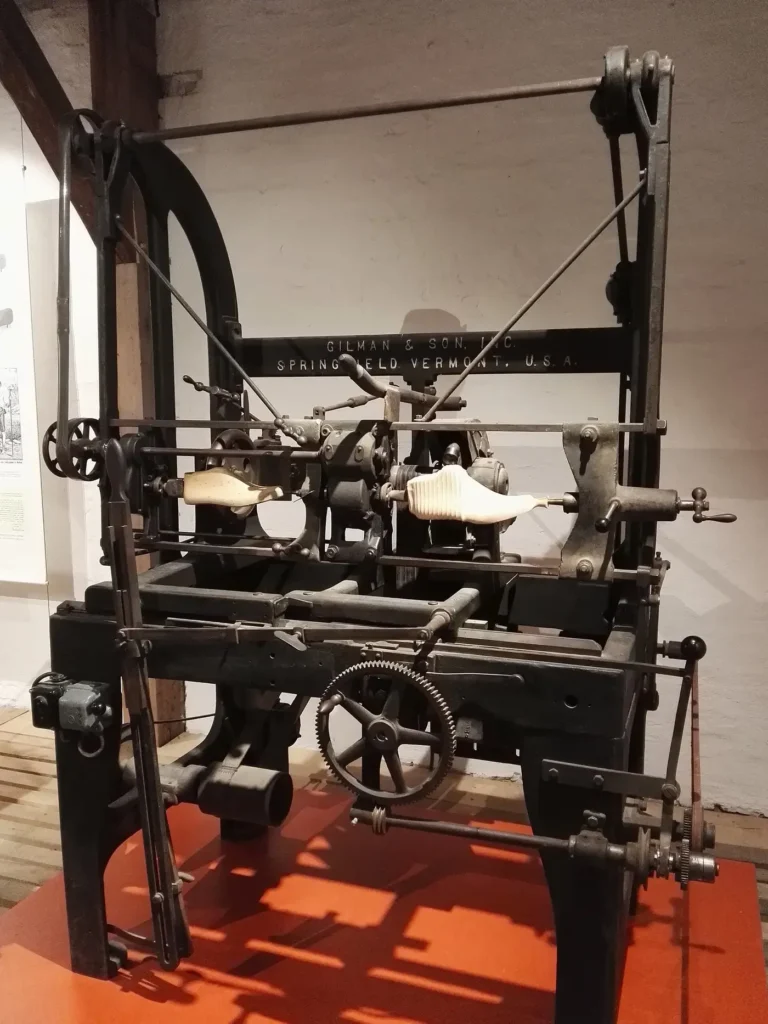
Today the factory’s exhibition includes an American copying lathe from Gilman & Son of Springfield, Vermont, built to turn two lasts at once. Blanchard’s idea, more or less, displayed inside the building that changed how factories were designed.

From beech to plastic: how lasts are made now
Wood ruled for centuries: beech, maple and other dense hardwoods. It wasn’t the only option. According to SATRA, cast iron lasts became standard in 19th-century Europe as the industrial revolution took hold. World War I brought wood back, often maple from Canadian forests. After World War II, manufacturers tried brittle thermoplastics until the early 1960s, when polyethylene was used for the first time. It was tough, took plenty of tacks before it needed repair and, above all, it was predictable. A wooden last could change size with humidity. Plastic didn’t.
Most of the world’s shoemakers now work on high-density plastic lasts, usually hinged so they can be pulled out of a finished shoe. A solid last is hard to get out of a closed shoe, and forcing it can wreck the work you just finished.
Iron hung on in repair shops. Cobblers worked on solid iron lasts that doubled as anvils, like the one pictured below: a single piece with three feet in different sizes, weighing about seven pounds, onto which a shoe was fitted upside down so a new sole could be nailed on.
Design tools have changed too. Computer-aided design reached the footwear industry as early as the 1970s, according to SATRA. Today it’s common to scan a foot in three dimensions and model the last on screen, and a growing body of research describes going straight from a 3D scan to a 3D-printed last for custom shoes. The logic hasn’t changed, though. Somebody still has to decide how much room to leave and where, and that call still comes down to the judgment of whoever designs the last.

Ten thousand feet in a London basement
In bespoke shoemaking, the last really is yours. John Lobb, the London bootmaker founded in 1849, keeps its customers’ lasts in the basement of its shop on St James’s Street. According to the footwear site Shoegazing, roughly 10,000 lasts are packed onto shelves in a room with ceilings about 16 feet high, all belonging to customers who have placed an order in the past 20 years. Older ones move to a separate, even bigger warehouse. The Manufacturer reports that the collection includes lasts for royals, heads of state and famous clients.
It’s about as close to an archive of human feet as exists anywhere.
What the last knows
The shoe is the part everyone sees, photographs and sells. The last is the part that decides. When a pair pinches in the fitting room, your foot isn’t wrong for being the shape it is. A block of plastic, designed with somebody else’s foot in mind, got there first. That’s also why sizes wander from brand to brand: the number on the box measures length, and the last decides everything else. We dig into that in our story on shoe size.
Sources
- Douglas Harper, Online Etymology Dictionary, “last.”
- SATRA Technology, “The development of the modern last” and “When left and right were identical,” SATRA Bulletin.
- D. R. Buldt and H. B. Menz (2018), “Incorrectly fitted footwear, foot pain and foot disorders: a systematic search and narrative review of the literature,” Journal of Foot and Ankle Research 11:43.
- Pliny the Elder, Natural History, Book 35, 85.
- National Park Service, Springfield Armory National Historic Site, “Thomas Blanchard and His Lathe.”
- J. E. Matzeliger, U.S. Patent No. 274,207, “Lasting Machine” (1883).
- Mass Humanities, Mass Moments, “Matzeliger Demonstrates Revolutionary Machine.”
- SATRA Technology, “The birth of the lasting machine,” SATRA Bulletin.
- UNESCO World Heritage Centre, “Fagus Factory in Alfeld.”
- Shoegazing (2019), “The picture: the last room at John Lobb Ltd.”
- The Manufacturer, “John Lobb: the last shall be first.”
Image credits
- “Kassel” series last from the Fagus Factory: Bernd Schwabe, Hannover. CC BY-SA 4.0, via Wikimedia Commons.
- Gilman & Son copying lathe at the Fagus Factory exhibition: Bärbel Miemietz. CC BY-SA 4.0, via Wikimedia Commons.
- Portrait of Jan Ernst Matzeliger: author unknown. Public domain, via Wikimedia Commons.
- U.S. Patent No. 274,207, J. E. Matzeliger. Public domain, via Wikimedia Commons.
- Fagus Factory main building: Ludvig14. CC BY-SA 4.0, via Wikimedia Commons.
- Cobbler’s cast iron last, Sweden: R. Henrik Nilsson. CC BY 4.0, via Wikimedia Commons.