
Your shoe size is a number you’ve been repeating since grade school, and it’s built on a unit of measurement taken from a grain of barley. That’s not a metaphor. Every time a U.S. shoe goes up one size, it gets one barleycorn longer, a third of an inch, because medieval England decided three grains of barley laid end to end made an inch. Then each brand took that ancient ruler and applied it to its own idea of what a foot looks like.
That’s how you end up with a closet full of 10s that don’t agree with each other: one slips at the heel, one crushes your little toe, and one fits so well you’ve had it resoled twice. Your feet didn’t change. The number just never promised what you thought it did.
Your size measures a form, not your foot
A shoe size describes length, and traditionally it describes the length of the last, the solid foot-shaped form the shoe is built around, rather than the length of your foot. The last is always longer than the foot it’s meant for, because your toes need room to move forward when you walk. That extra space is called allowance, and every brand decides how much to give. As we explained in our story on the shoe last, a last isn’t a copy of a foot. It’s an interpretation, longer in the toe, snug in places, curved up at the front and pitched for one particular heel height.
Here’s the catch. The size on the box locks in exactly one measurement of that interpretation: length. Width across the forefoot, instep height, the shape of the toe box and the volume around the heel are all left out. Two shoes can share a size and a last length and have nothing else in common.
Toe shape makes it worse. A round toe and a pointed toe use up allowance very differently. On a pointed last, much of that extra length goes into tapering the front, so your big toe ends up closer to the tip. Same size, same length on paper, completely different feel.
Three barleycorns, round and dry
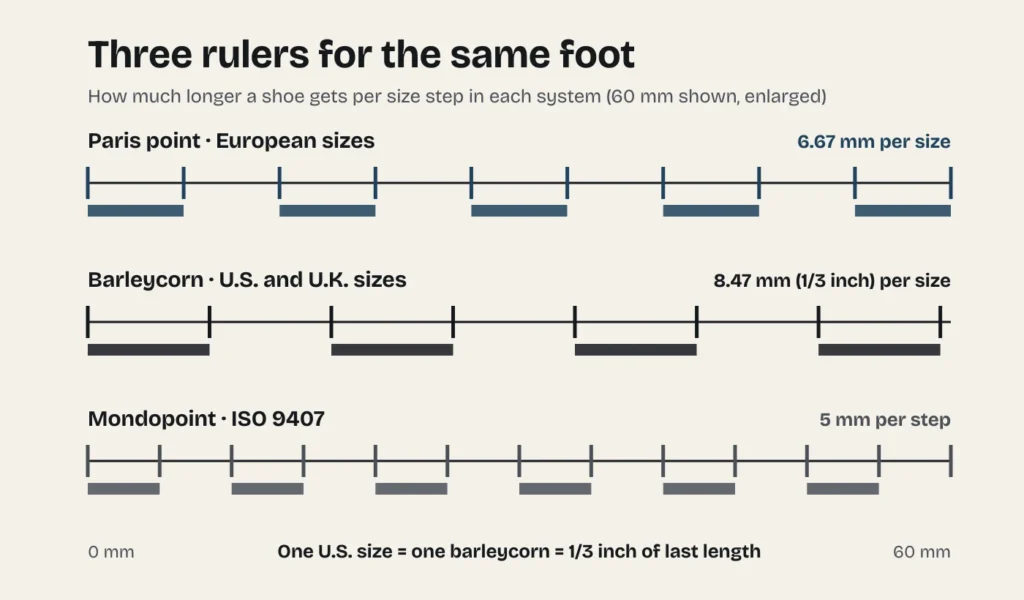
The barleycorn rule is older than shoe sizes by centuries. The 10th-century Welsh Laws of Hywel Dda already said three barleycorns made an inch, and an English statute from around 1300, the Composition of Yards and Perches, put it in writing: three grains of barley, “dry and round,” to the inch. According to the British footwear research organization SATRA, that’s still the foundation of U.S. and U.K. shoe sizes, with each full size equal to a third of an inch, about 8.47 millimeters.
You’ll often read that King Edward II invented shoe sizes in 1324. There’s no evidence for it. At most, Edward is credited with defining the inch, and the barleycorn equation predates him anyway.
Barley, it turns out, is a lousy ruler. Depending on the variety, a single grain can be anywhere from about 4 to 15 millimeters long. Medieval measurers got away with it because the average grain came out close to a third of an inch.
The first written description of an actual shoe sizing system came much later. In The Academy of Armory and Blazon, published in 1688, Randle Holme described the system used by a guild of shoemakers: shoe size was the measure of the shoe’s length, divided into 13 parts for children and 15 for men and women, in steps of a quarter inch, according to accounts such as the one at Today I Found Out. Children’s sizes started at five inches, and an adult 15 reached twelve. No barley required.

Men’s, women’s and the conversion problem
The U.S. didn’t stop at one scale. It runs separate numbering for men and women, which is why the same shoe can be a men’s 8 and a women’s something higher. SATRA gives two examples of how messy conversions get: a U.K. women’s 5 is called a 7 in the U.S., while a U.S. men’s 12 is a U.K. men’s 11. On the Brannock scale that most American stores use, the rule is simpler on paper: a women’s size is the men’s size plus one. Whether a given brand follows that rule is another matter.
Europe, meanwhile, counts in Paris points, a unit French shoemakers came up with in the early 1800s. A Paris point is two-thirds of a centimeter, 6.67 millimeters, so a European 42 means a last 28 centimeters long. Because each step is so small, European sizes never needed half sizes. American sizes, at more than eight millimeters a step, can’t live without them.
Look at the label inside any sneaker and you’ll find all of this stacked into one little table: U.S., U.K., European, centimeters, sometimes more. It looks like a dictionary. It’s closer to a guess. Systems that move in 6.67 mm and 8.47 mm steps only line up now and then, so every conversion involves rounding, and every brand rounds its own way. The centimeter column is the sneakiest, because it looks the most objective. On the label pictured below, a European 43 sits next to 28 centimeters. By the Paris point math, a size 43 last would be closer to 28.7. Most likely those 28 centimeters describe the foot the shoe is meant for, not the last, but the label doesn’t say.

Twenty-six millimeters inside one size
How much can one labeled size vary? The lab at RunRepeat, a site that tests running shoes, measured the internal length of more than a thousand pairs and found that a men’s U.S. size 9 ranged from 255 to 281 millimeters. That’s 26 millimeters, just over an inch, or three full American sizes hiding behind the same number.
The problem isn’t only on the label. It’s in the feet. In 2019, researchers published an analysis of 1.2 million 3D foot scans in Scientific Reports, collected in stores across North America, Europe and Asia. They found statistically significant differences between regions and between men and women, plus a wide spread within every group. Their conclusion amounts to a rejection of one-number sizing: brands would need at least three widths for every length to fit 90 percent of customers, and the grading tables the industry uses to scale lasts from one size to the next should be updated to reflect actual feet today.
In fitting-room terms, a shoe needs at least two numbers to describe a fit. Most brands only give you one.
The silver gadget from Syracuse
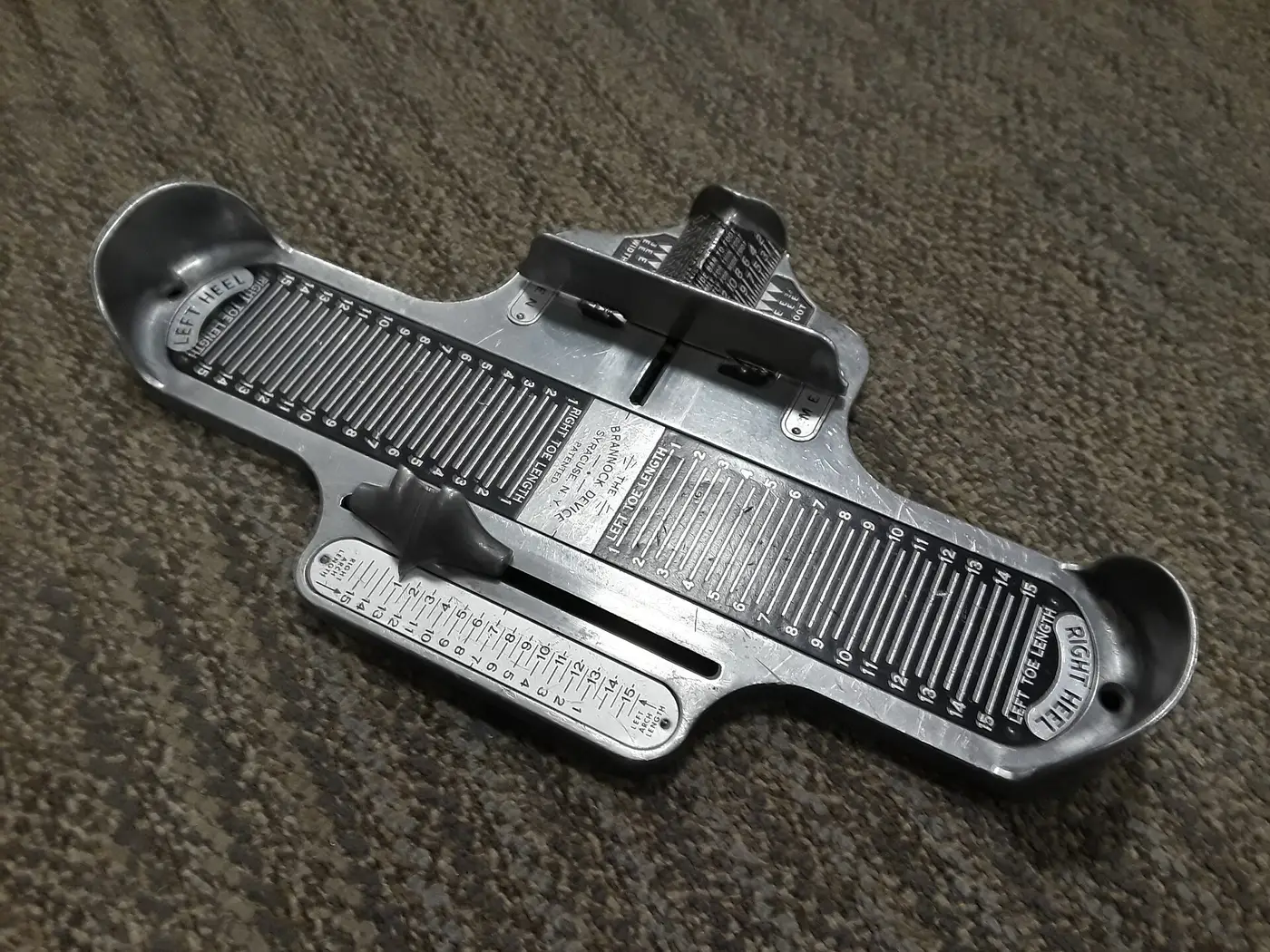
If you grew up in the U.S., chances are you’ve stood on one: a flat metal plate with a heel cup, a sliding bar and a little lever that swings in against the side of your foot. Charles Brannock invented it while working at his father’s shoe store, the Park-Brannock, in Syracuse, New York. He was frustrated with the wooden size sticks salesmen used, the best known of them the Ritz Stick, which only measured length. On November 4, 1925, he filed a patent for an instrument that measured length, width and the distance from the heel to the ball of the foot all at once. U.S. Patent No. 1,682,366 was granted on August 28, 1928. In it, Brannock boasted that the device let “unskilled clerks” find an accurate size.
According to the National Inventors Hall of Fame, which inducted him in 1992, branches of the military adopted the Brannock Device in the 1930s and 1940s, and the design has barely changed since. Its smartest feature is the heel-to-ball measurement, which the industry calls arch length. Two people with the same foot length can have the widest part of the foot in different places, and that’s exactly where a shoe bends. The company’s own fitting instructions tell clerks to compare the two readings and generally go with the larger one. The plate also carries heel cups at both ends, so the clerk measures one foot, turns the whole thing around 180 degrees and measures the other.
Then there’s width, the measurement that never makes it onto most shoe boxes. The Brannock reads it as a letter, on a scale that runs from AAAA at the narrow end to EEEE at the wide end. The company’s current women’s model, for example, covers sizes 3 to 13 and widths from 4A to 2E. In other words, the device has been telling Americans for a century that their feet need two numbers, while most shoe brands keep selling them one.
Brannock ran the company himself until he died in 1992, at 89. A year later, Salvatore Leonardi bought it from his estate and moved manufacturing to a small factory in Liverpool, New York, a few miles from where the first one was made. The company still labels its devices “Made in the U.S.A.”
When shoe stores had X-ray machines
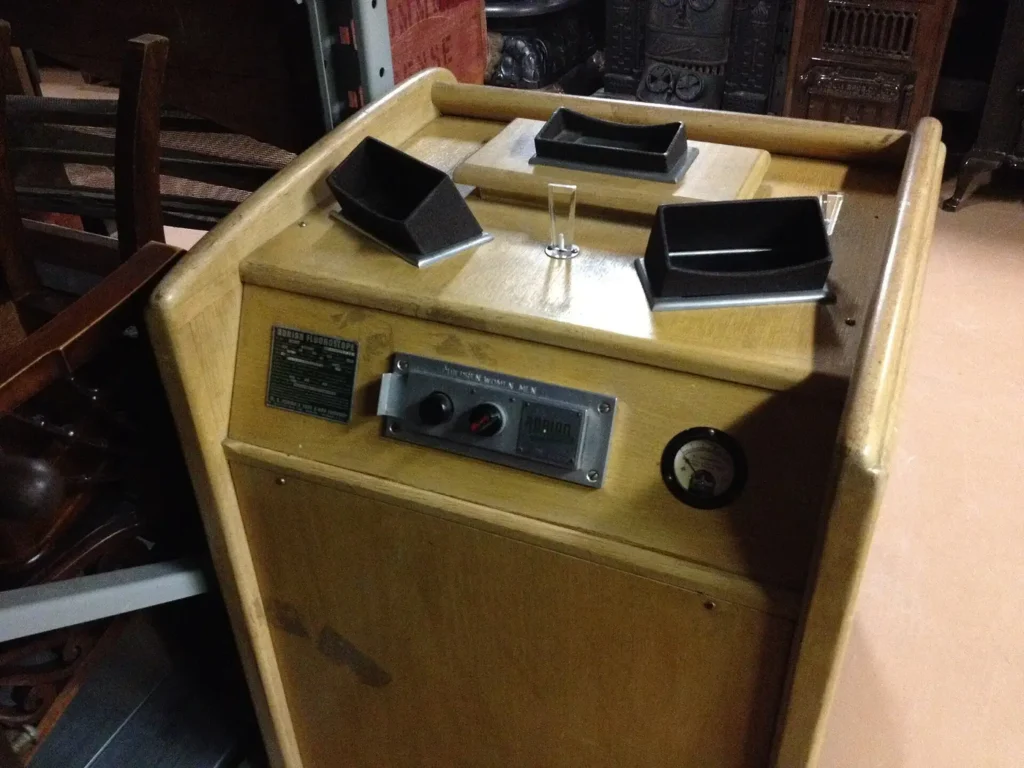
Before the Brannock took over, there was a far more dramatic way to check fit. For decades, shoe stores across the country had an X-ray machine on the sales floor. You stepped up, slid your feet, shoes on, into an opening and looked through a viewer at the bones of your toes wiggling inside the shoe.
Physician Jacob Lowe filed a patent in 1919 and received it in 1927, and assigned the rights to the Adrian Company of Milwaukee, one of the best-known makers of the machines. At their peak in the 1950s there were an estimated 10,000 shoe-fitting fluoroscopes in the U.S., about 3,000 in Britain and roughly 1,000 in Canada. Concerns about radiation finally ended them. In 1957, Pennsylvania became the first state to ban them, and by 1970, 33 states had done the same.
What they were selling is worth noticing: a way to see how a foot actually sits in a shoe. It’s the same promise behind the 3D foot scanners in running stores today, minus the radiation. The number on the box was never enough.

The sizing system that actually measures your foot
There is a size that does exactly what you’d expect a size to do: measure the foot. It’s called Mondopoint, it’s defined by the international standard ISO 9407, and it gives your foot length in millimeters, with width as an optional second number. A 270-millimeter foot is a Mondopoint 270, and there’s nothing to convert.
If you ski, you already know it. Ski boots are sold in Mondopoint, because in a rigid plastic shell there’s no room for guesswork. Almost nowhere else has it caught on. Habits beat logic, and switching would mean relabeling every shoe on every shelf and teaching customers to think in millimeters instead of numbers their grandparents used.
What your size really tells you
Your size tells you one thing reasonably well: the approximate length of the last a shoe should be built on, within a single brand. Everything else comes down to the last. That’s why a 10 from a running brand and a 10 from a dress shoe maker can feel like distant relatives, and why two models from the same brand, built on different lasts, don’t have to match either.
The number you’ve been repeating your whole life is where the conversation starts. The shoe finishes it the moment you put it on.
Sources
- SATRA Technology, “The diversity of footwear sizing systems,” SATRA Bulletin.
- Randle Holme, The Academy of Armory and Blazon (1688), as cited in Today I Found Out, “The pedestrian origins of modern shoe sizes.”
- RunRepeat, “How to measure shoe size.”
- A. Jurca, J. Žabkar and S. Džeroski (2019), “Analysis of 1.2 million foot scans from North America, Europe and Asia,” Scientific Reports 9: 19155.
- C. F. Brannock, U.S. Patent No. 1,682,366, “Foot-Measuring Instrument” (1928).
- National Inventors Hall of Fame, “Charles F. Brannock.”
- The Brannock Device Co., “Instructions & Fitting Tips” and product specifications for the Women’s Brannock Device.
- Wikipedia, “Brannock Device,” and the references it cites.
- Wikipedia, “Paris point,” “Barleycorn (unit)” and “Shoe-fitting fluoroscope,” and the references they cite.
- ISO 9407:2019, Footwear sizing — Mondopoint system of sizing and marking.
Image credits
- Brannock Device: Ser Amantio di Nicolao. CC BY-SA 4.0, via Wikimedia Commons.
- Sizing systems diagram: feetkeepers.
- Barley grains: Sanjay Acharya. CC BY-SA 4.0, via Wikimedia Commons.
- Shoe size label: Mattruffoni. CC BY-SA 4.0, via Wikimedia Commons.
- Adrian shoe-fitting fluoroscope: Maury Markowitz. CC BY-SA 3.0, via Wikimedia Commons.
- Scientific Shoe Fitters postcard: Boston Public Library. CC BY 2.0, via Wikimedia Commons.