
Court shoes vs. running shoes isn’t a question of color or logo. It’s a question of what your foot has to do on top of the sole. Running is moving forward, over and over. Padel, tennis or pickup basketball is braking, launching and switching sides on a small rectangle. Dancing is turning without getting stuck to the floor, and lifting a barbell is not moving at all. A sole that does one of those things well tends to do another badly, and if you want proof that this is serious business, Wimbledon writes the dimensions of the pimples on a player’s shoe into its rulebook, down to the millimeter.
Forward versus sideways
Two University of Calgary researchers, C. Reinschmidt and Benno Nigg, summed up the difference in a 2000 review of running and court shoe design in the German journal Sportverletzung Sportschaden. For running shoes, the debate had long centered on controlling foot motion and cushioning impact. For court shoes, the priorities were different: lateral stability, torsional flexibility, cushioning and traction control. And when it came to performance on court, they concluded, optimal traction seemed to be the key factor. Optimal, not maximal.
The reason is the direction of the forces. A running shoe works almost entirely in one plane, back to front, which is why so much of the conversation is about drop and cushioning, as we explain in our story on heel-to-toe drop. On a court, the foot lands sideways, brakes hard and pivots on the forefoot. The sole has to grip enough to keep the foot from sliding out, but not so much that it stays planted while the body keeps turning.
Padel, a sport of hard stops
Padel, the walled-in racket game that looks like tennis played inside a squash court, is huge in Spain. According to the Spanish government’s 2022 Survey of Sports Habits, 15.8 percent of people who played any sport in the previous year played padel, twice the share for tennis, at 8 percent. Across the whole population it was 9.1 percent, and the survey flagged padel as one of the activities with the biggest jump in yearly participation since 2020.
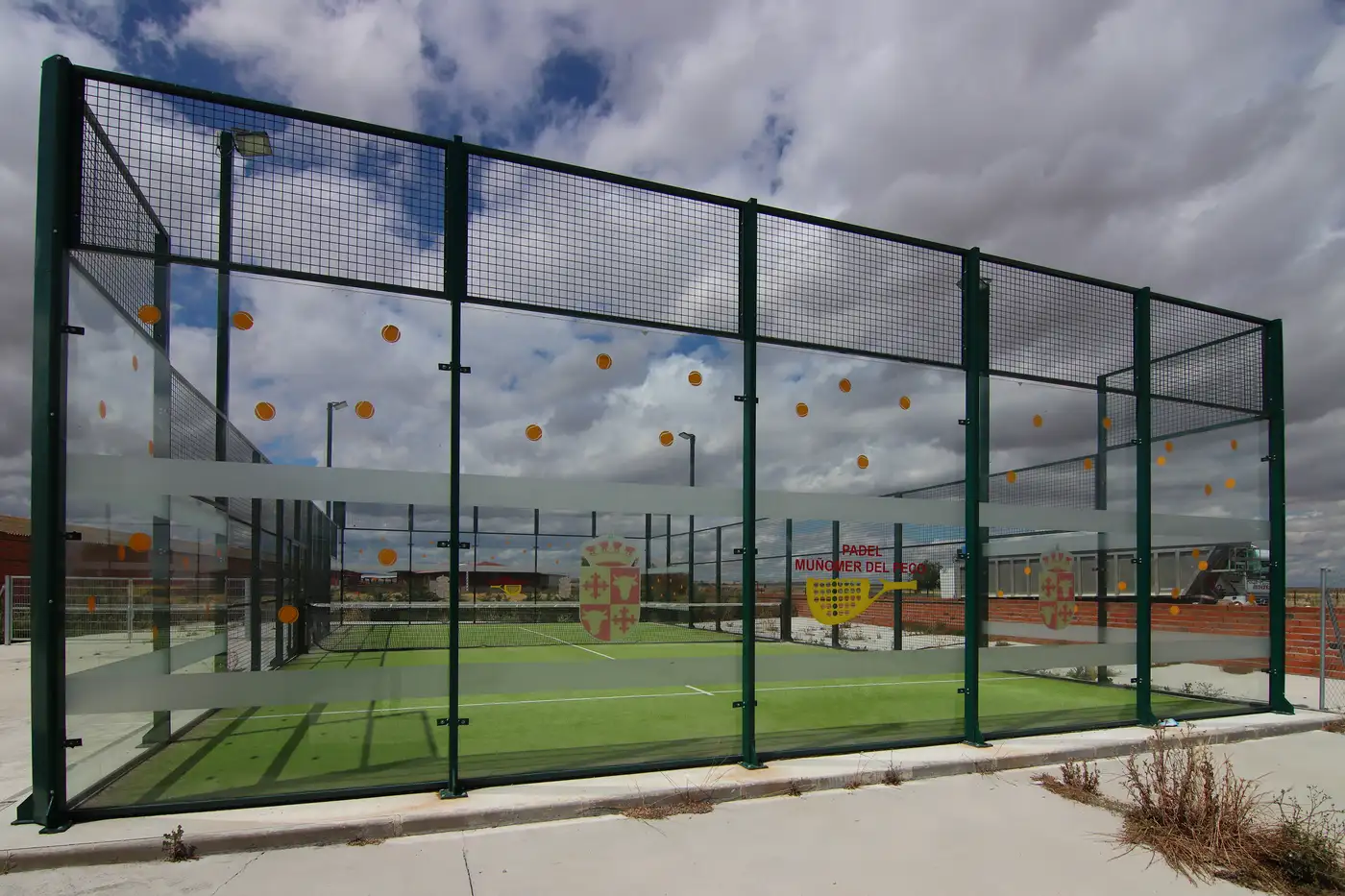
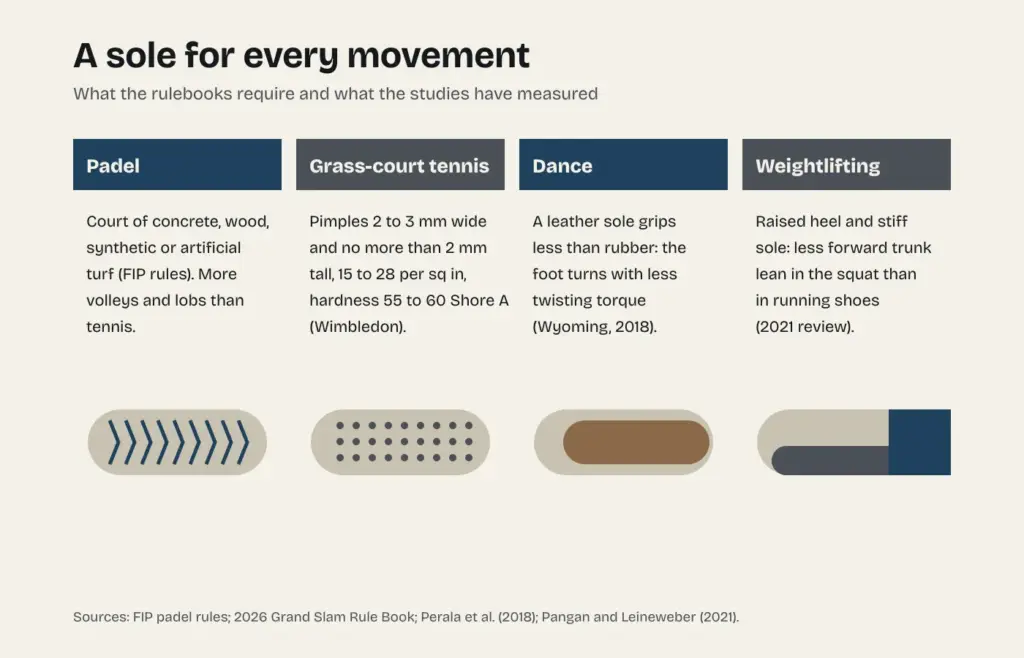
The International Padel Federation’s rules say little about footwear: players must show up in proper sports clothing and shoes, swimsuits aren’t allowed, and players can use whatever shoes they like as long as they meet the rules. They’re more specific about the ground. The court is a 10-by-20-meter rectangle, about 33 by 66 feet, and the surface can be concrete, wood, synthetic material or artificial turf, as long as the ball bounces consistently. On many turf courts, according to the installers who build them, silica sand is spread between the fibers. For the sole, that means there’s no single surface to design for: depending on the club, it may meet fiber, loose sand or concrete.
The movement isn’t mini-tennis either. In 2023, a team from the University of Western Australia compared an hour of padel, singles tennis and doubles tennis in the International Journal of Sports Physiology and Performance, with 12 players wearing GPS units, accelerometers and heart-rate monitors. Singles was the most demanding in heart rate, distance covered and accelerations. Padel looked more like doubles, but with more effective playing time and more volleys, smashes and lobs. Blood lactate stayed low, between 1 and 2 millimoles per liter, in all three formats, and every format left the players’ jumps similarly weaker afterward. And in 2025, researchers in Valencia, Spain, reported in Sensors on 83 professional players across 23 tour matches: players on the left side of the court made more accelerations and decelerations per hour than those on the right.
For the sole, all of that adds up to short bursts, hard stops and sideways plants on a surface that mixes fiber and sand. How a sole’s rubber and tread respond to that kind of footing is the subject of our story on shoe traction.
What Wimbledon’s grass demands
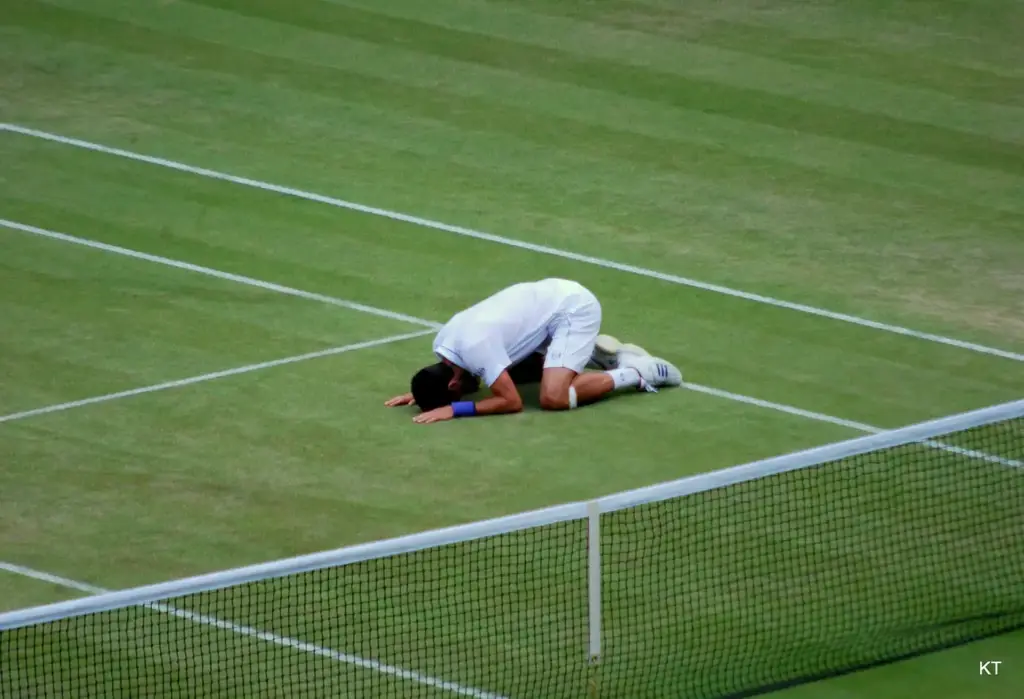
Few sports regulate the sole in as much detail as grass-court tennis. The 2026 Grand Slam Rule Book says that at Wimbledon, no grass-court shoes may be worn other than those with rubber soles, without heels, ribs, studs or coverings. A manufacturer that wants a special model approved has to meet a spec sheet. The pimples or studs on the sole must stand vertically, with a top diameter between 2 and 3 millimeters and a height of no more than 2 millimeters from the base. Their hardness must fall between 55 and 60 on the Shore A scale, and there must be between 15 and 28 of them per square inch. None can be visible when the shoe sits on a flat surface and you look down at it from above. The sidewall around the toes has to be smooth, with only limited contouring on the inner forefoot. The step between forefoot and heel can’t exceed 2 millimeters. And no manufacturer’s identification may appear on the bottom of the sole. Sample shoes have to be submitted at least 90 days before the tournament.
The rulebook also gives the referee real power over footwear. Shoes must be generally accepted as proper tennis attire, damage to a court can include a shoe that leaves more marks than is acceptable, and the referee can order a player to change. At Wimbledon, players must be dressed almost entirely in white from the warm-up on, shoes included. The same rulebook adds two rules that say it all: shoes may not damage the court beyond normal wear in a match, and grass-court shoes may not be worn in a match at Roland-Garros, the clay-court Slam.
Clay is the opposite case: there, players want to slide. In 2013, a University of Exeter team reported in Sports Biomechanics on eight players who performed a side jump and a running forehand on clay and on a cushioned acrylic hard court, a low-friction surface and a high-friction one. The players adjusted how much friction they used to the surface, and that adjustment favored sliding on clay. In the running forehand, their knee was less bent on clay, by about 5.6 degrees at contact and 13.1 degrees at peak flexion, which makes sliding easier. On the hard court, they bent the knee more to brake.
More grip isn’t always better
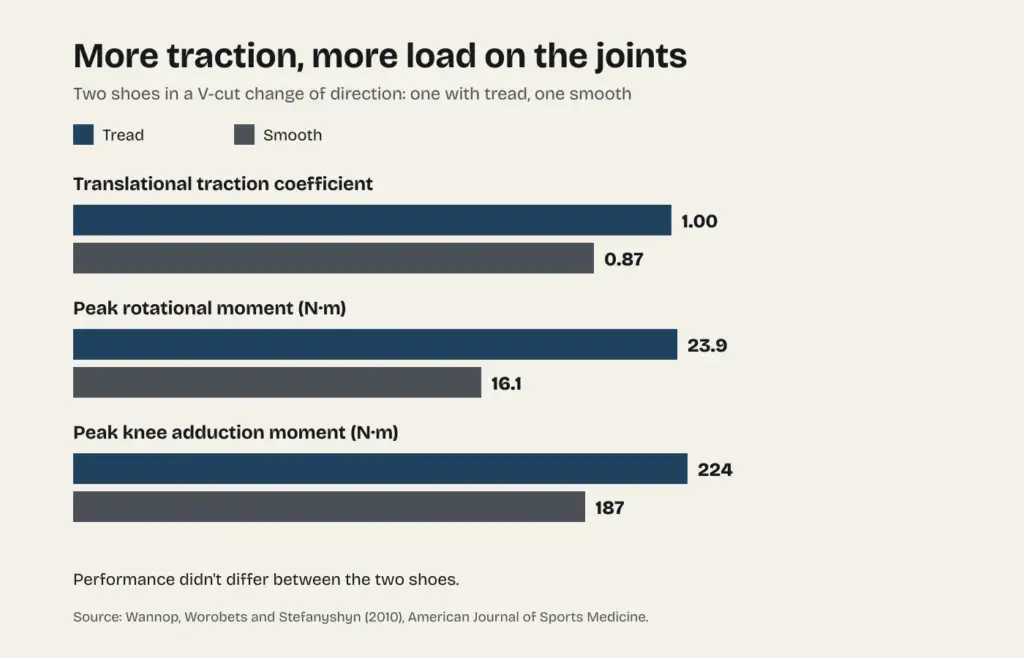
If traction were good without limit, every court shoe would have sticky rubber. A study from the Calgary lab shows why it doesn’t. In 2010, J. W. Wannop, J. T. Worobets and D. J. Stefanyshyn reported in the American Journal of Sports Medicine on 13 recreational athletes who performed a V-shaped cutting move in two shoes on a sample of track surface: one with tread and one smooth. The treaded shoe had a translational traction coefficient of 1.00 versus 0.87 for the smooth one, and a peak rotational moment of 23.87 newton-meters versus 16.12.
In the higher-traction shoe, the ankle and knee had to handle larger moments: peak ankle external rotation moment rose from 80.17 to 89.58 newton-meters, and peak knee adduction moment from 186.8 to 224.0. The kicker: performance on the drill didn’t differ between the two shoes. More grip didn’t make the cut faster. It just loaded the joints more.
Turning without sticking
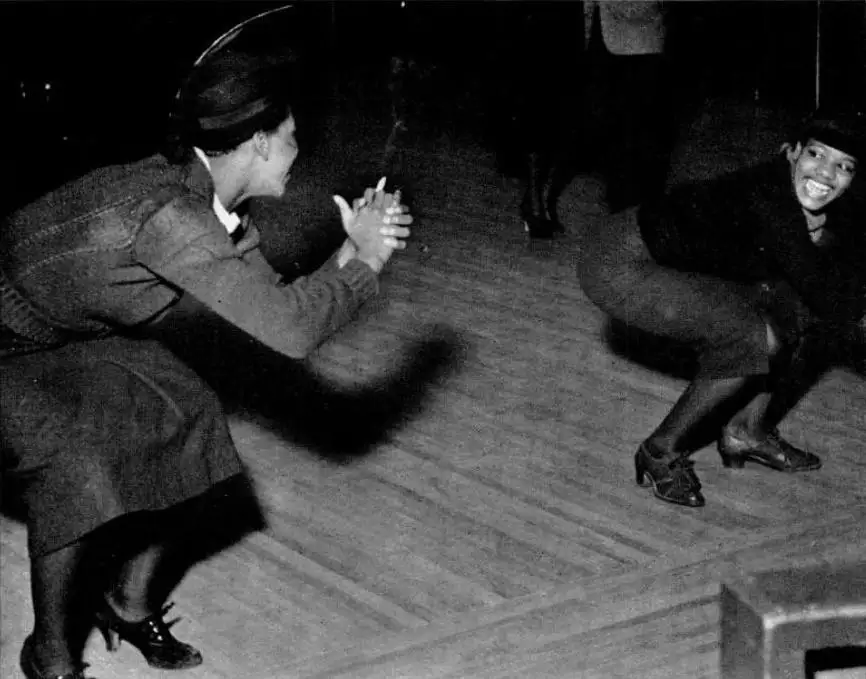
In dance, the grip you need is even less intuitive, because much of what the foot does is spin in place. When you pivot on a planted foot, you create what biomechanists call a free moment: the twisting torque the floor exerts on the foot around a vertical axis. The more the sole grips, the more the floor resists that turn.
In 2018, H. D. Perala, M. A. Wilson and B. Dai at the University of Wyoming measured it in 15 country swing dancers. Country swing, an American partner dance full of turns, makes a good test case, because the feet are constantly pivoting under load. Each one performed a turn barefoot, in rubber-soled boots, in leather-soled boots and in running shoes, on two force plates. They reported in the Journal of Dance Medicine & Science that static friction was higher for the rubber-soled boots and running shoes than for the leather-soled boots. On the turning leg, the free moment was largest in running shoes, in between barefoot and in rubber-soled boots, and smallest in leather-soled boots. The leather sole let the foot turn against less resistance from the floor.
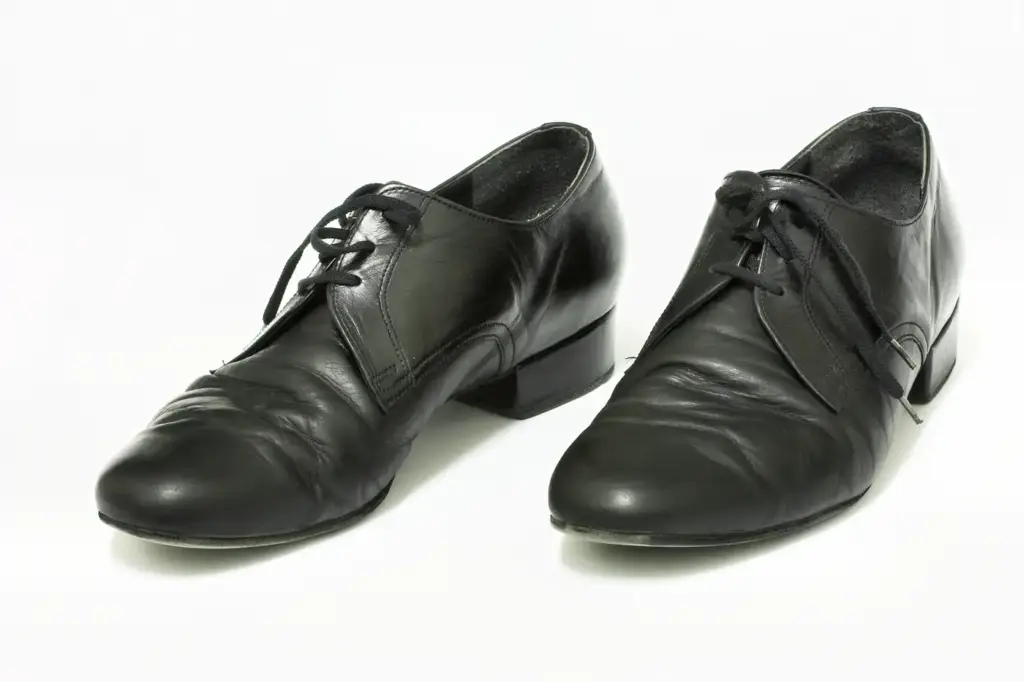
A dance floor and a padel court ask for nearly opposite things: on one, you want the foot to turn freely; on the other, you want it to stop without sliding away.
A heel to sit deeper
The gym has its own oddity: the weightlifting shoe, with a raised heel and a stiff sole that won’t compress under a loaded bar. In 2021, A. M. Pangan and M. Leineweber of San José State University reviewed fourteen studies of footwear in the barbell back squat in the Journal of Biomechanical Engineering. Most showed that footwear changed how lifters moved and the forces involved: in weightlifting shoes, the trunk leaned forward less and the ankle worked in more plantarflexion than in running shoes or barefoot. Raising the heel with an external wedge had similar effects. The authors called for more research on the specific effects of sole stiffness and heel height, and on more women and beginners.
In 2016, D. J. Southwell and colleagues at Nipissing University in Ontario measured 24 experienced lifters, 12 men and 12 women, squatting 80 percent of their one-rep max barefoot, in running shoes and in weightlifting shoes. According to their study in the Journal of Electromyography and Kinesiology, the knee extension moment was larger in either shoe than barefoot, while the hip extension moment was larger barefoot. The footwear didn’t add or remove work. It redistributed it among the joints.
It’s the logic of drop taken to an extreme for a different purpose: here the heel isn’t cushioning a stride, it’s changing the ankle angle so the lifter can sit down with a more upright back. And the stiff sole, which in a running shoe changes how the foot bends, as we explain in our story on stiff vs. flexible soles, is there so the foot doesn’t move at all.
The shoe that does everything badly
The do-everything sneaker is a compromise between needs that contradict each other. The running shoe is built to go forward. The court shoe grips sideways and lets you pivot on the forefoot. The dance shoe barely grips, on purpose. The weightlifting shoe doesn’t bend or squash. From a distance all four look like sneakers, and each would fail at the others’ sport.
The most extreme evidence is on the lawns of southwest London, where the manufacturer doesn’t get to decide how much its sole grips. The rulebook sets the diameter, height, hardness and number of pimples per square inch.
Sources
- C. Reinschmidt and B. M. Nigg (2000), “Current issues in the design of running and court shoes,” Sportverletzung Sportschaden 14(3): 71–81.
- Consejo Superior de Deportes, Encuesta de Hábitos Deportivos en España 2022: Síntesis de resultados.
- International Padel Federation, Rules of Padel.
- C. Armstrong, M. Reid, C. Beale and O. Girard (2023), “A comparison of match load between padel and singles and doubles tennis,” International Journal of Sports Physiology and Performance 18(5): 512–522.
- R. Miralles, J. F. Guzmán, J. Ramón-Llin and R. Martínez-Gallego (2025), “Impact of playing position on competition external load in professional padel players using inertial devices,” Sensors 25(3): 800.
- Grand Slam Board, 2026 Official Grand Slam Rule Book, section on shoes.
- L. Damm et al. (2013), “The effects of surface traction characteristics on frictional demand and kinematics in tennis,” Sports Biomechanics 12(4): 389–402.
- J. W. Wannop, J. T. Worobets and D. J. Stefanyshyn (2010), “Footwear traction and lower extremity joint loading,” American Journal of Sports Medicine 38(6): 1221–1228.
- H. D. Perala, M. A. Wilson and B. Dai (2018), “The effect of footwear on free moments during a rotational movement in country swing dance,” Journal of Dance Medicine & Science 22(2): 84–90.
- A. M. Pangan and M. Leineweber (2021), “Footwear and elevated heel influence on barbell back squat: a review,” Journal of Biomechanical Engineering 143(9): 090801.
- D. J. Southwell et al. (2016), “The effects of squatting footwear on three-dimensional lower limb and spine kinetics,” Journal of Electromyography and Kinesiology 31: 111–118.
Image credits
- Padel court in Muñomer del Peco, Spain: Malopez 21. CC BY-SA 4.0, via Wikimedia Commons.
- Sole diagram and traction chart: feetkeepers.
- Novak Djokovic on Wimbledon’s Centre Court (2011): Carine06. CC BY-SA 2.0, via Wikimedia Commons.
- Ballroom dance shoes: Martin Kozák. Public domain, via Wikimedia Commons.
- Dancing at the Savoy Ballroom (1936): unknown photographer, Life magazine. Public domain, via Wikimedia Commons.