
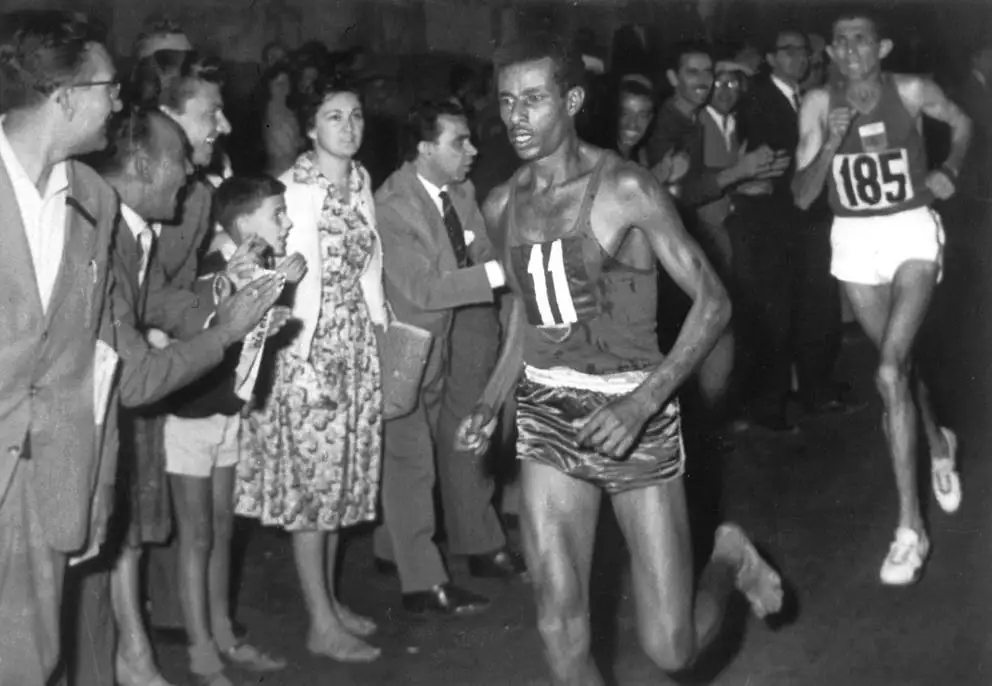
How many miles do running shoes last is a question with an official answer that nobody has proved. The number you hear at running stores and on forums, somewhere around 300 to 500 miles, sounds like a lab result, but we haven’t found a study that sets it as a rule. What has been measured is more interesting: which part of the shoe wears out, how fast, and what runners do when the foam stops responding the way it used to. It’s also worth remembering that the 1960 Olympic marathon in Rome was won by a man who didn’t wear down a single millimeter of sole. Abebe Bikila ran barefoot.
Barefoot, with a world record
Bikila’s story is the best reminder that a running shoe is an aid, not a requirement. As Wikipedia summarizes it from his biographies, he bought new running shoes in Rome that didn’t fit well and decided to race without them. On September 10, 1960, he won the marathon in 2 hours, 15 minutes and 16.2 seconds, eight-tenths of a second under the world record of the time. The finish came after dark, along the Appian Way, which was lined with Italian soldiers holding torches, and right after crossing the line he started touching his toes and jogging in place; he later said he could have run another 10 to 15 kilometers. He ran barefoot again at the Athens marathon the following year, and that was the last time. At Tokyo in 1964 he won gold again, this time in shoes, and again in world-record time.
For everyone else, the shoe does a specific job, and that job erodes with the miles. What erodes depends on the layer.
Three layers, three kinds of wear
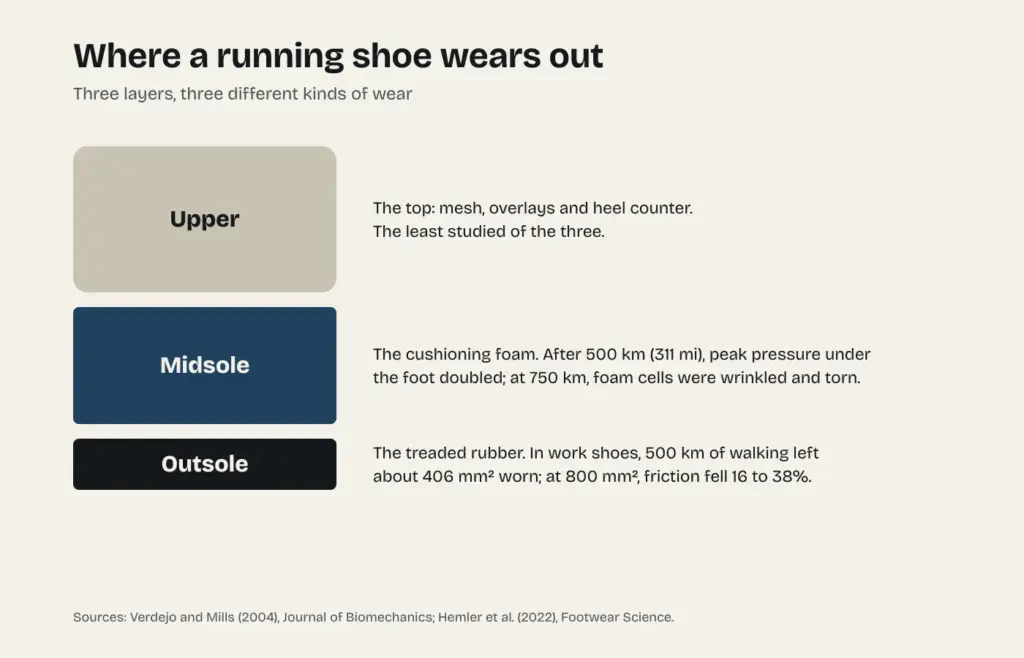
A running shoe has three parts that age differently. On top is the upper, the mesh and overlays that hold your foot. In the middle is the midsole, the cushioning foam, which in many current shoes is EVA or a lighter, bouncier foam such as PEBA. On the bottom is the outsole, the treaded rubber that meets the road. Most of the research has focused on the midsole, because it’s the layer that changes what your body takes on every landing.
Foam gets tired
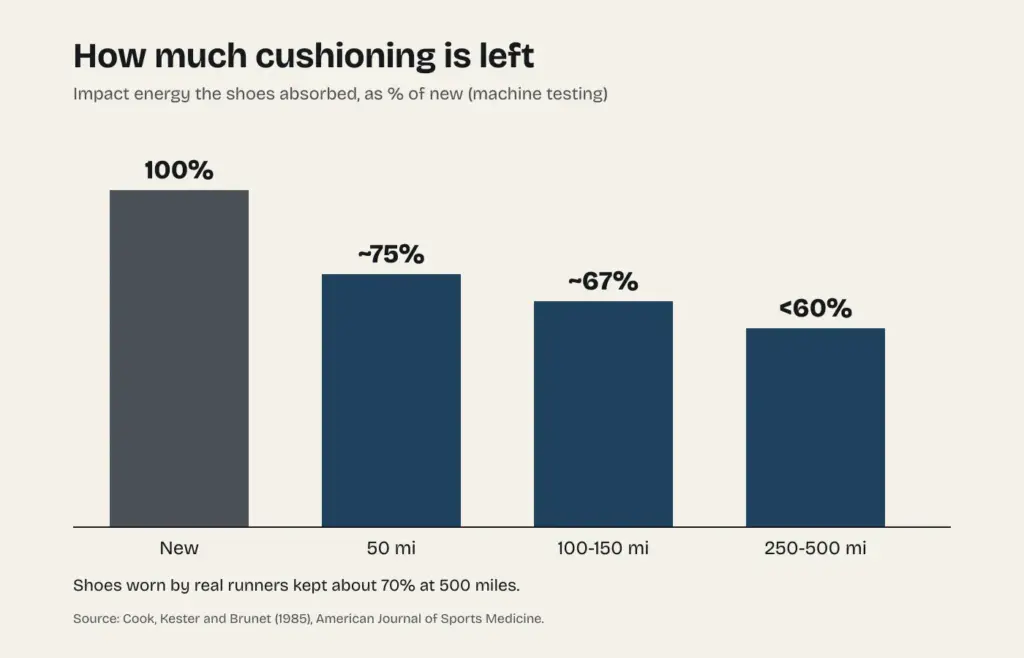
The first major study on the subject dates to 1985. S. D. Cook, M. A. Kester and M. E. Brunet reported in the American Journal of Sports Medicine on running shoes across a range of models and prices. They put them in a machine that mimicked heel strikes and measured how much impact energy the shoes absorbed at the equivalent of 0, 5, 10, 25, 50, 75, 100, 125, 150, 200, 250, 300 and 500 miles. Even when new, models differed by about 33 percent. After the equivalent of 50 miles, the shoes kept about 75 percent of their original shock absorption on average; after 100 to 150 miles, about 67 percent; and between 250 and 500 miles, less than 60 percent. They worked out the absorbed energy from the area under each shoe’s load-deformation curve, the graph of how far the sole squashes as the force on it rises, which is still the basic way labs describe cushioning.
Two more findings from that 1985 study still matter today. First, they found no differences based on price or model. Second, shoes worn by real runners in training also lost cushioning with mileage, but less than in the machine: at 500 miles, they kept about 70 percent.
Nearly two decades later, Raquel Verdejo and Nigel Mills of the University of Birmingham looked inside the foam. In their 2004 study in the Journal of Biomechanics, peak plantar pressure had risen by an average of 100 percent after 500 kilometers, about 311 miles, of running, and under the electron microscope, after 750 kilometers, the cell walls of the EVA foam were wrinkled and some had holes. A foam is, after all, a mass of gas bubbles locked in plastic, and every landing squashes them and lets them spring back. Over time, some stop springing back. Their computer model of the heel also made a point about anatomy: the fat pad under the human heel starts out far softer in shear than the shoe foam, with an initial shear modulus of about 100 kilopascals versus 1,050 for the foam, but it resists compression more as it is squeezed. Your heel brings its own cushion, and the shoe adds another one on top of it. Pressure measurements inside running shoes, the authors reported, confirmed what the computer model predicted.
What the runner does
Foam losing cushioning doesn’t necessarily mean your body takes a harder hit, because runners change too. In 2009, P. W. Kong, N. G. Candelaria and D. R. Smith reported in the British Journal of Sports Medicine on 24 runners, 14 men and 10 women, who each logged 200 miles of road running in the same pair. Before and after, the researchers measured them running at 4.5 meters per second, about 10 miles per hour, along a 20-meter lab runway with a force plate and motion capture. In the worn shoes, ground contact time went up, the torso leaned forward less, and the ankle flexed upward less and pointed more at toe-off. External forces, however, stayed the same. The authors concluded that as cushioning declines, runners modify their mechanics to keep external loads constant, and that the adaptation was the same across the three cushioning technologies they compared.
In a follow-up analysis of the same data, published in 2011 in Human Movement Science, contact time in the worn shoes rose by about 7 milliseconds, and the adaptation wasn’t identical in the dominant and non-dominant legs, though most of the differences were small.
Fast foam fades faster
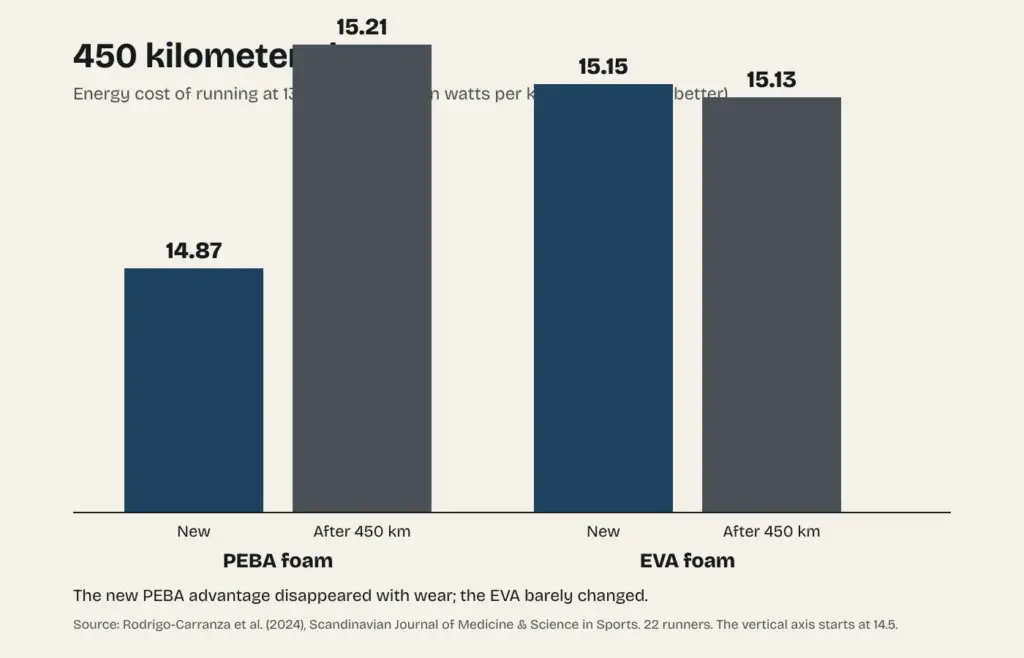
The foams in recent racing shoes add a twist. In 2024, a team at the University of Castilla-La Mancha in Spain, working with Wouter Hoogkamer of the University of Massachusetts Amherst, reported in the Scandinavian Journal of Medicine & Science in Sports on 22 trained male runners. They tested two versions of a plated shoe that were nearly identical except for the foam, one PEBA and one EVA, both new and after 450 kilometers, about 280 miles, of wear on asphalt, while the runners ran at 13 kilometers per hour, about 8.1 miles per hour, and the researchers measured how much energy they burned.
New, the PEBA shoe won: energy cost was 14.87 watts per kilogram, versus 15.15 in the EVA shoe. After 450 kilometers, though, the PEBA shoe rose to 15.21, while the EVA shoe stayed essentially the same at 15.13. The increase from new to worn was 0.32 watts per kilogram for PEBA and only 0.06 for EVA, along with changes in step frequency and step length. The authors’ conclusion was clear: PEBA has a definite running economy advantage over EVA when the shoes are new, but after 450 kilometers of use, the two were about the same. We explain how that combination of foam and plate works in our story on stiff vs. flexible soles.
Why the fast foam wears faster has a materials explanation. In 2024, a team led by A. Aimar reported in Footwear Science on fatigue in five commercial midsole foams. They first scanned each foam’s internal structure with X-ray microtomography, essentially a CT scan for materials, then put the samples through repeated compressions close to running conditions. All of them densified quickly, losing stiffness, cushioning and rebound. The lightest foam, very porous with cell walls twisted by the manufacturing process, cushioned best but also degraded fastest. The densest foam had poorer properties but degraded very slowly.
That trade-off between lightness and bounce showed up in the earliest measurements of super shoes. In the mechanical testing that accompanied Hoogkamer and colleagues’ 2018 study in Sports Medicine, the PEBA prototype returned 87 percent of the energy put into it with each compression, versus 75.9 and 65.5 percent for two marathon racing shoes of the time, and because it deformed more, it returned 7.46 joules per step versus roughly 3.4 to 3.6. For context, the authors noted that at 16.2 kilometers per hour, about 10 miles per hour, the arch of the foot returns about 17 joules and the Achilles tendon about 35. The foam helps, but the main spring is still inside your body.
The outsole, the part that warns you
The part you can see best is the bottom. Tread mainly gives water a way out from under the rubber, as we explain in our story on shoe traction, and it fades with use. The most detailed data we know of on that wear come from work shoes, not running shoes. In 2022, a University of Pittsburgh team followed workers’ shoes for months and reported in Footwear Science that after about 500 kilometers of walking, the worn area of the outsole was around 406 square millimeters, and that at 800 square millimeters of wear, friction dropped by 16 to 38 percent. The authors argued that the size of that worn patch is the best measure of wear, because the rate at which soles wear varies so much from person to person and from surface to surface.
The number nobody has proved
So how many miles? The studies give clues, not a rule. In 1985, machine-measured cushioning had already dropped below 60 percent between 250 and 500 miles. EVA foam showed damage under the microscope at about 466 miles. Fast foam lost its energy advantage by about 280. But shoes worn by real runners kept more cushioning than machine-tested ones, runners adapt, and not every foam, outsole and stride wears the same way. The familiar range of 300 to 500 miles fits these data, but we haven’t seen it established in any study as a limit, so we treat it as retail guidance rather than a finding.
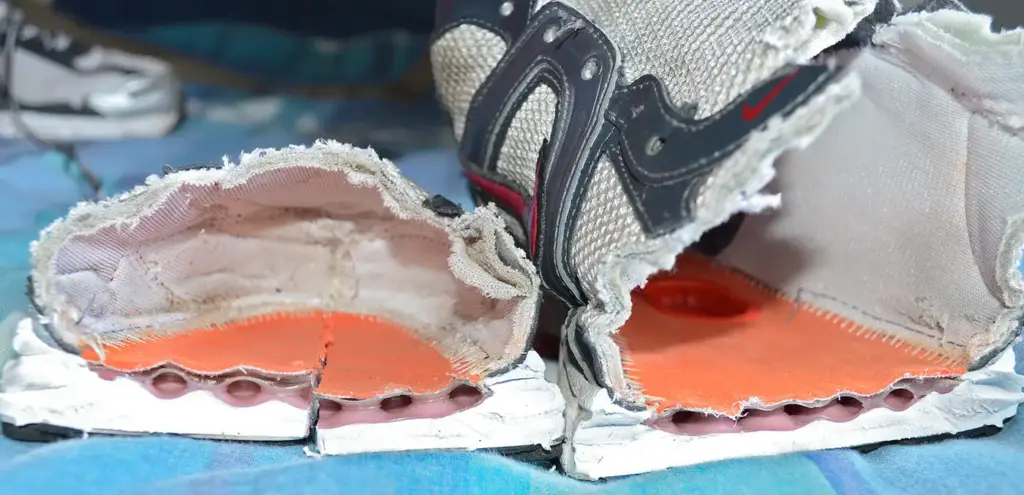
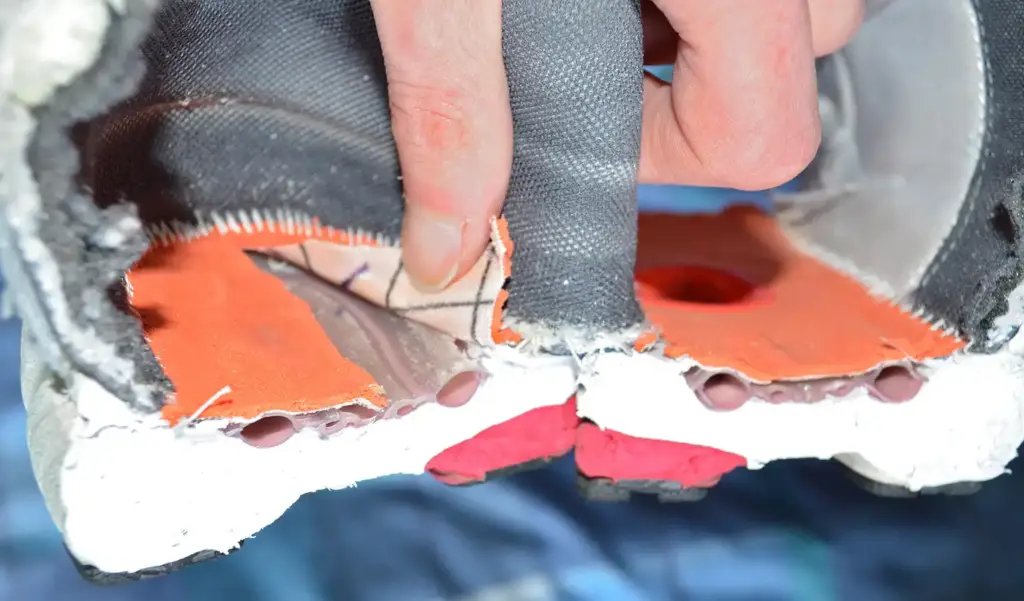
What you can do is look. An outsole with smooth patches where the tread used to be, especially at the heel or under the forefoot, has lost some of its ability to channel water away. Deep creases along the sides of the midsole are often read as the visible version of the foam fatigue Verdejo and Mills saw under the microscope, though no study we know of has measured that link. And logging your mileage lets you compare one pair with the next. If you rotate two pairs, each one racks up half the miles, but the total is the same, as we explain in our story on how many pairs of shoes you need.
Abebe Bikila won in Rome without breaking in a sole. Four years later in Tokyo, he won in shoes and ran faster. Neither of those records tells us how long his shoes lasted, and that’s exactly the number that still hasn’t been measured well.
Sources
- S. D. Cook, M. A. Kester and M. E. Brunet (1985), “Shock absorption characteristics of running shoes,” American Journal of Sports Medicine 13(4): 248–253.
- R. Verdejo and N. J. Mills (2004), “Heel-shoe interactions and the durability of EVA foam running-shoe midsoles,” Journal of Biomechanics 37(9): 1379–1386.
- P. W. Kong, N. G. Candelaria and D. R. Smith (2009), “Running in new and worn shoes: a comparison of three types of cushioning footwear,” British Journal of Sports Medicine 43(10): 745–749.
- P. W. Kong, N. G. Candelaria and D. Smith (2011), “Comparison of longitudinal biomechanical adaptation to shoe degradation between the dominant and non-dominant legs during running,” Human Movement Science 30(3): 606–613.
- V. Rodrigo-Carranza et al. (2024), “Influence of different midsole foam in advanced footwear technology use on running economy and biomechanics in trained runners,” Scandinavian Journal of Medicine & Science in Sports 34(1): e14526.
- A. Aimar et al. (2024), “Compression fatigue of elastomeric foams used in midsoles of running shoes,” Footwear Science 16: 93–103.
- W. Hoogkamer et al. (2018), “A comparison of the energetic cost of running in marathon racing shoes,” Sports Medicine 48(4): 1009–1019.
- S. L. Hemler et al. (2022), “Effects of natural shoe wear on traction performance: a longitudinal study,” Footwear Science 14(1): 1–12.
- Wikipedia, “Abebe Bikila,” and the references it cites.
Image credits
- Abebe Bikila in the Rome Olympic marathon (1960): ANSA. Public domain, via Wikimedia Commons.
- Layers diagram and cushioning and foam charts: feetkeepers.
- Worn running shoe cut in half (two photos): Yottanesia. Public domain (CC0), via Wikimedia Commons.