
Why do soccer players cut holes in their socks? American fans watching the 2026 World Cup on home soil had every right to ask, because the tournament played in the U.S., Canada and Mexico is one of the few places where a FIFA rule explicitly says socks must not look cut. And yet the habit has spread through the Premier League, La Liga and the England team, where some of the best-paid athletes on the planet take scissors to kits designed down to the last stitch. It isn’t laziness and it isn’t quite fashion. It’s a three-way fight between a fabric that squeezes, a calf that doesn’t want to be squeezed and a rulebook that almost nobody enforces.
A short history of famous holes
The press usually credits Gareth Bale as the first star to make it visible. In March 2016, coming back from six weeks out, he came off the bench for Real Madrid and scored the seventh goal in a 7-1 rout of Celta Vigo. According to sports coverage at the time, which cited the Spanish daily AS, he did it in socks with holes at the back of the leg. Several outlets quote his explanation, which shows up in nearly every story on the subject: it was to “release” his calves, to take the tension off.
Kyle Walker, the Manchester City and England defender, is probably the most recognizable case, thanks to the polka-dot pattern his holes make. In 2021, he told the website SPORTbible that the socks were too tight and were putting pressure on his calves, so he cut holes in them, had a few decent games and decided he was keeping it. That mix of physics and superstition turns out to be the whole story in miniature.
At Euro 2024, Jude Bellingham headed England’s winner against Serbia, and viewers noticed holes in the back of his socks. According to Britain’s PA news agency, Conor Gallagher and Bukayo Saka had them too. Each player has his own style: according to journalist Andrew Martin of Planet Football, Walker goes for polka dots, Bellingham usually cuts two or three big holes, and Gallagher and Saka two.
Jack Grealish took a different route to the same place. He doesn’t cut his socks; he rolls them down to mid-calf, with tiny children’s shin guards underneath. According to PA, he told GQ in 2021 that it started when he was 15 or 16 because his training socks kept shrinking.

The physics of a sock that squeezes
To understand what the scissors are for, think of a soccer sock as what it is: a tube of elastic knit fabric, narrower than the leg, that stretches to go on and pulls back once it’s on. That tension is what keeps the sock up without garters or tape. It’s also what squeezes.
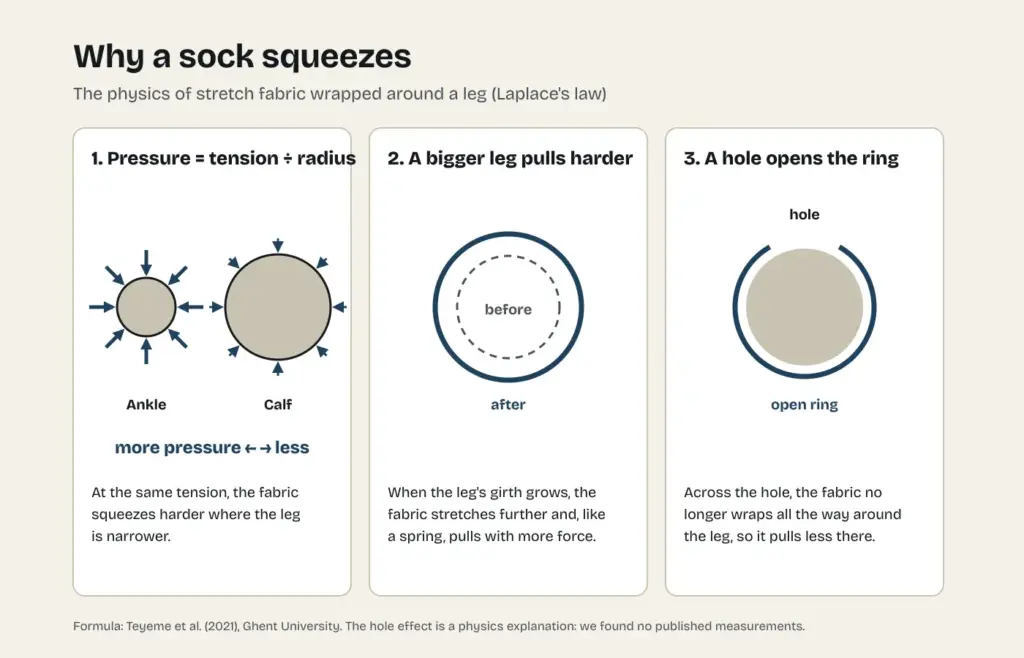
The link between that tension and the pressure your leg feels is described by a piece of physics used to design compression garments, Laplace’s law. A team at Ghent University in Belgium tested it in 2021 on four different knit fabrics stretched over cylinders and found that calculated and measured pressures matched closely. In its simplest form, the law says that pressure equals the tension in the fabric divided by the radius of the surface it wraps around.
Three consequences follow, and you can feel all of them on your own leg. First, at the same tension, fabric squeezes harder where the leg is narrower: if one part of the leg has twice the radius of another, the pressure there is half as much. Second, when the leg’s girth grows, the fabric stretches further and, like a spring, pulls harder. The Ghent team built that stretch into their version of the formula for exactly that reason: tension isn’t fixed, it depends on how far the fabric is stretched. Third, the same study found that washing significantly changed the pressure a fabric exerted, so the same sock doesn’t squeeze the same way brand-new as it does after several trips through the laundry.
And the hole? Here we’re offering a physics explanation of our own, because we found no study that has measured the pressure of cut soccer socks. The tension that squeezes is the tension that runs around the leg, like a hoop. A hole in the calf breaks that hoop across the band where it sits: the threads that used to go all the way around now end at the edge of the hole, so at that height the fabric pulls less. A cluster of small holes works a bit like opening a valve. The sock still holds on above and below, but across the calf it stops behaving like a cuff.
What the medical people say, and don’t
What physics doesn’t tell you is whether any of this does anything beyond feeling better. Players talk about pressure, tightness, a leg that can “breathe.” British physiotherapist Nicki de Leon told PA in 2024 that players feel socks that are too tight act like compression garments, and that elite athletes will always look for a little extra edge. A senior member of the medical staff at a Premier League club, quoted by talkSPORT, was blunter: many players find today’s socks too tight, but there isn’t any hard evidence that cutting them changes anything.
That’s where the line is. No study has shown that cutting socks improves performance or has any effect on muscles. What there is, is basic physics, which explains why a brand-new tight sock is more noticeable on a big calf, and the experience of players who, like Walker, have a couple of good games and don’t dare change.
Socks that squeeze to hold shin guards
The reason soccer socks are so tight is what’s inside them. Shin guards arrived in soccer in 1874 with Sam Weller Widdowson, who played cricket for Nottinghamshire and soccer for Nottingham Forest. According to Wikipedia, he cut down a pair of cricket pads and strapped them over his stockings with leather straps. He was laughed at, but the idea caught on, and by around 1900 shin guards had gotten smaller and moved inside the socks.
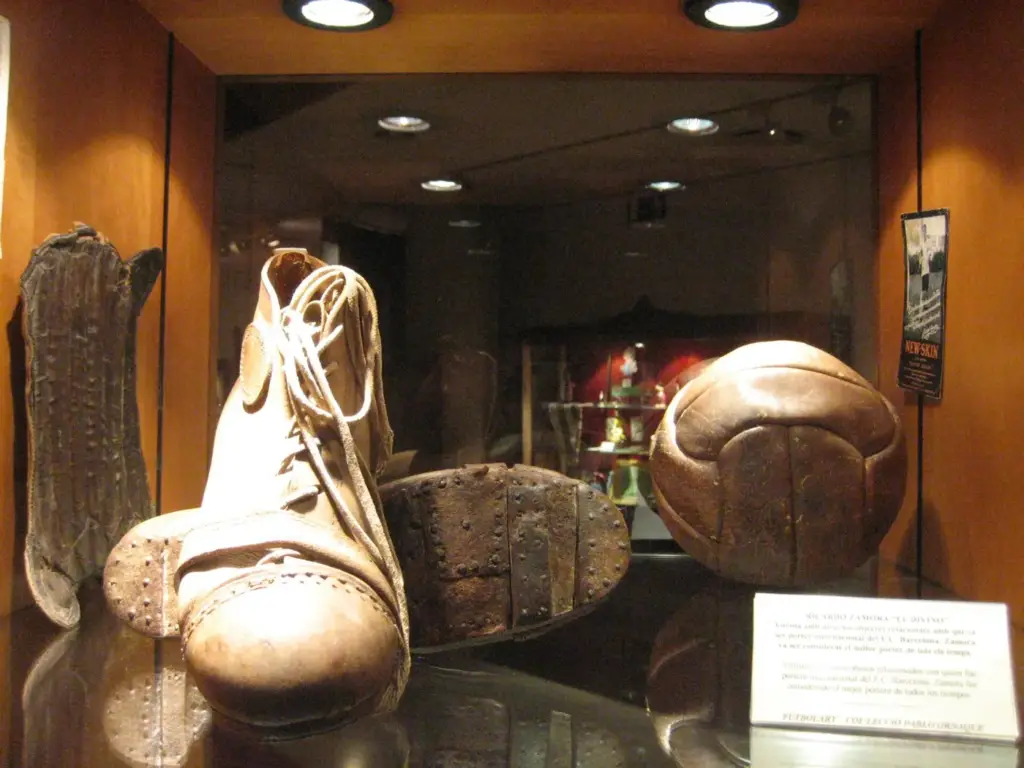
It took more than a century for them to become compulsory. According to a 2025 review of protective equipment in soccer by researchers at the University of Padua and other Italian institutions, that didn’t happen until 1990. Today, Law 4 of the Laws of the Game, written by the IFAB, the body that maintains the sport’s rules, says shin guards must be made of a suitable material, be of an appropriate size to provide reasonable protection, and be covered by the socks. That last condition is the key. The sock doesn’t just dress the leg; it holds the shin guard. That’s why it has to squeeze.
For decades, players made do. According to Andrew Martin, players of earlier generations tied ribbons around the top of their socks to keep them up, and in the late 1990s and early 2000s many wrapped them in tape to keep their shin guards from sliding. Synthetic fibers, which don’t soak up water and hold their shape, as we explained in sock fibers: cotton, merino or synthetic, solved part of the problem, and elastic knit did the rest. The price of a sock that stays up without tape is a sock that squeezes for 90 minutes.
Tape in the same color
Tape eventually became a rulebook issue. At the IFAB’s annual general meeting in February 2009, in Newcastle, Northern Ireland, the Scottish Football Association proposed that any tape applied outside the stockings be the same main color as the stockings. According to the minutes, the reason was that more and more players were using tape to keep shin guards in place, in varying widths, and it often changed the dominant color of the sock. The proposal was not approved.
It took a few more years. Similar wording finally entered the Laws for the 2016-17 season, and today Law 4 says tape or any material applied or worn externally must be the same color as the part of the sock it’s applied to or covers. The point is for referees and players to tell teams apart by their legs, too, which is exactly what the earliest clubs did: at an 1875 match in Glasgow between Queen’s Park and Wanderers, according to Wikipedia, the program identified players by the colors of their caps or stockings, because shirts had no numbers.

The FIFA rule almost nobody enforces
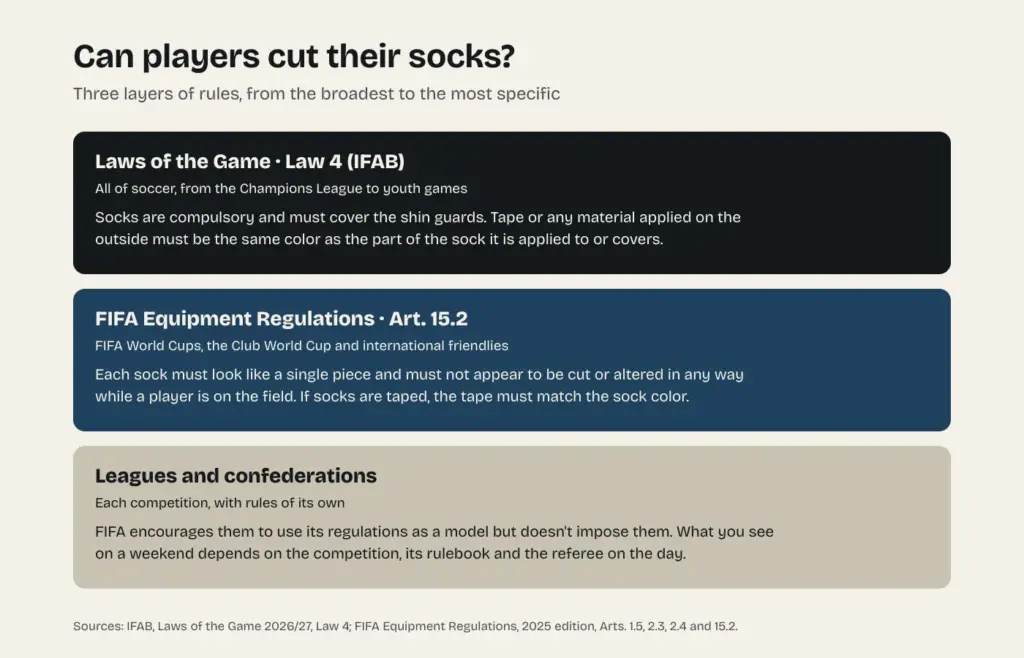
Here’s the paradox. There is a rule that bans exactly what Walker and Bellingham do. It’s in the FIFA Equipment Regulations, whose 2025 edition the FIFA Council approved on October 3, 2024, effective January 1, 2025. Article 15.2 says each sock in a pair must visually constitute a single piece of material and must not appear to be cut or altered in any way when worn by a player during a match. It adds that if socks are covered by tape, the tape must be the same color as the socks. According to the kit-news site Footy Headlines, similar wording was already in the 2022 edition.
The regulations even split the sock in two: the foot area, which isn’t visible when boots are on, and the leg area, which is. That distinction matters in practice. According to Andrew Martin, for about a decade many pros have worn grip socks underneath, with the team sock cut off at the ankle like a sleeve. As long as the visible part looks like one piece and the tape joining it matches the sock, it looks like an ordinary sock.
So why do we see holes? Because those regulations don’t apply everywhere. The text says they apply in full to FIFA’s final competitions, such as the men’s and women’s World Cups and the Club World Cup, and to international friendlies, but not to competitions run by confederations, such as UEFA, which ran Euro 2024. For everything else, Article 1.5 says FIFA encourages confederations and national associations to use the regulations as a model for their own rules. Encourages, not requires. And IFAB’s Law 4, which covers all of soccer, says nothing about holes: it only requires that equipment not be dangerous and that tape match the sock.
The real test was the 2026 World Cup, which is a FIFA final competition where Article 15.2 applies in full. During the tournament, outlets such as Britain’s LBC and the website Bolavip ran stories on the holes and mentioned Bellingham or Saka, but illustrated them with photos from other matches. We couldn’t confirm which players, if any, took the field in cut socks during a World Cup match, or whether any match commissioner reported it. That’s what the regulations provide for: the commissioner reports to FIFA, may confiscate the item, and FIFA decides whether to open disciplinary proceedings.
Referees, coaches and pundits
In practice, what happens in a given match comes down to the referee. According to PA, Argentine center back Ezequiel Garay, while at Valencia, was once made to change his socks because the referee decided they had too many holes; we couldn’t find the date or the match. British broadcaster Richard Keys, who called on his blog for an end to the trend, wrote that Spain had outlawed it. We found no Spanish rule that says so, from La Liga or the Spanish federation, and Planet Football didn’t verify it either.
The habit has critics on the bench, too. José Mourinho posted a photo of hole-riddled socks on Instagram with a sarcastic caption about beautiful socks for the beautiful game, approved by the football authorities. The joke landed squarely on the gap between what the rulebook says and what officials let slide.
A sock from another era
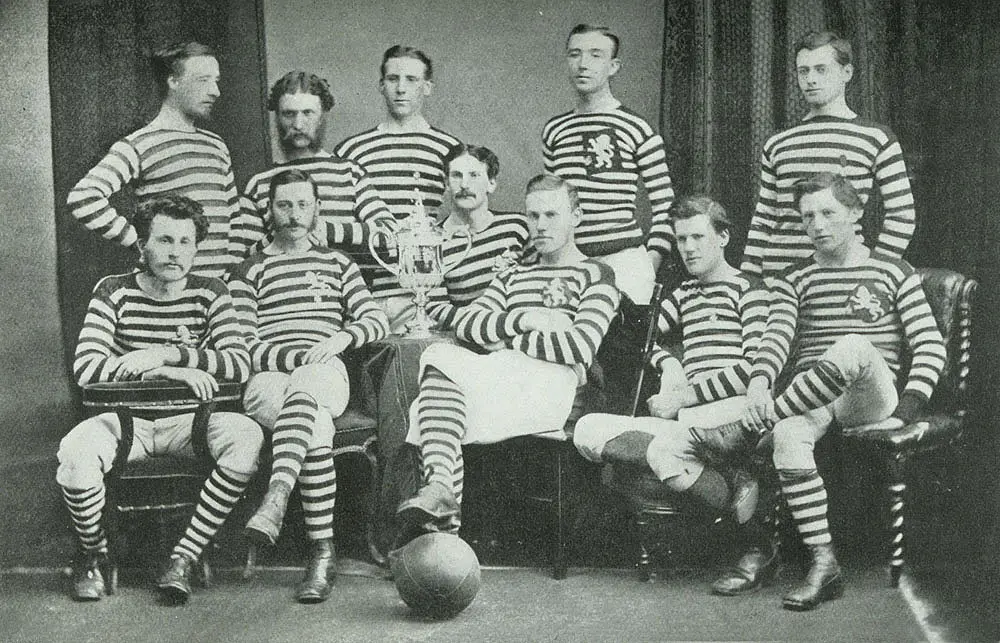
Seen from a distance, all this is fairly new. The socks of the earliest teams looked like those of the Queen’s Park side posing with the Scottish Cup in the 1874 photo at the top of this story: thick, hooped from top to bottom, held up by nothing but their own knit or a ribbon. Synthetic fibers and elastic knitting, which we covered in how socks are made, changed that, and in doing so changed the problem. It used to be that the sock wouldn’t stay up. Now, for plenty of players, it stays up too well.

The scissors, in the end, are a cheap way to customize a garment that arrives the same for everyone. Former England defender Gary Neville asked in 2024 why players would cut kits and boots that are made to measure for them, and it’s a fair question: the shoes for each sport, as we explained in court shoes vs. running shoes, are engineered in detail, but the sock is still an elastic tube that has to fit very different legs. Bale, Walker and Bellingham didn’t invent anything. They did what anyone does with a sock that pinches, only in front of millions of viewers and with a FIFA regulation telling them not to. As long as nobody enforces it, the scissors will stay in the locker room.
Sources
- FIFA (2025), FIFA Equipment Regulations, 2025 edition, Arts. 1, 2 and 15.
- IFAB (2026), Laws of the Game 2026/27, Law 4: The Players’ Equipment, published by the English FA.
- IFAB (2009), Minutes of the 123rd Annual General Meeting, Newcastle, Feb. 28, 2009.
- Teyeme, Y., et al. (2021), “Predicting Compression Pressure of Knitted Fabric Using a Modified Laplace’s Law,” Materials, 14(16), 4461.
- Vecchiato, M., et al. (2025), “Protective Equipment in Football: A Review of History, Evolution, Materials, and Contemporary Use,” Sports, 13(11), 392.
- PA (2024), “Why have the England players cut holes in their socks for the Euros?”, June 18, 2024.
- Martin, A. (2024), “A deep dive into the ‘holes in football socks’ phenomenon,” Planet Football, July 12, 2024.
- LBC (2026), report on holed socks at the World Cup, June 22, 2026.
- Flashscore, “Exploring the popular trend of footballers cutting holes in their socks”.
- Footy Headlines (2025), report on FIFA’s sock rule.
- Wikipedia: Kit (association football)) and Shin guard.
Image credits
- Queen’s Park FC in 1874: unknown author. Public domain, via Wikimedia Commons.
- A player’s legs in the South Korean league: Explicit. CC BY-SA 4.0, via Wikimedia Commons (cropped, with the club crest blurred).
- Ricardo Zamora’s boots and shin guard: Electro07. CC BY 3.0, via Wikimedia Commons.
- 1966 Bermuda stamp: Victor Whiteley. Public domain, via Wikimedia Commons.
- Gray knit sock at the Skagit County Historical Museum: Joe Mabel. CC BY-SA 3.0, via Wikimedia Commons (cropped, with the brand label blurred).
- Fabric pressure and rules diagrams: feetkeepers.