
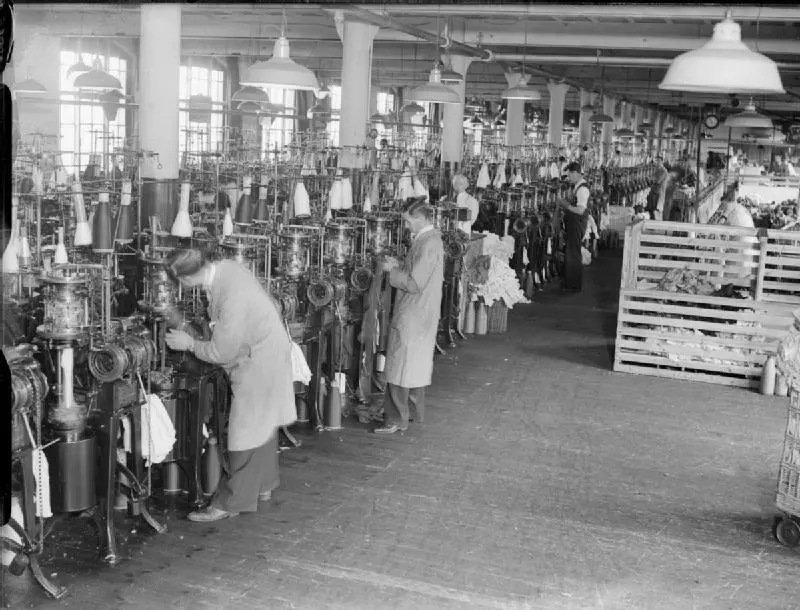
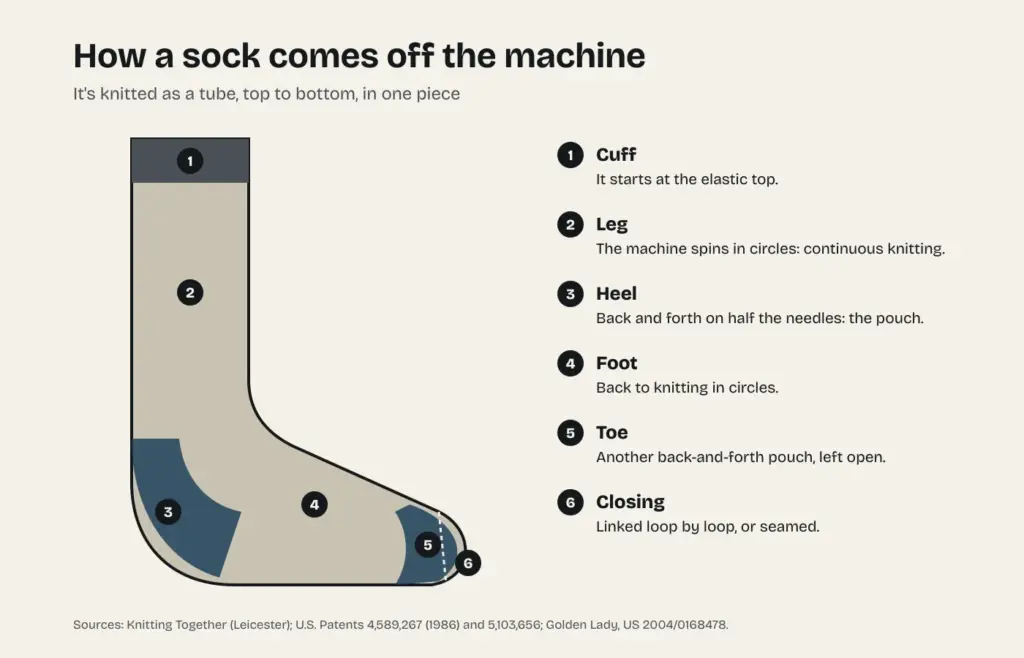
How socks are made sounds like a dumb question until someone shows you the machine. A sock isn’t cut and sewn like a shirt. It’s knitted whole, as a tube, top to bottom, in a few minutes, on a machine that spins in circles and every so often switches to rocking back and forth to build the heel. What separates a one-dollar sock from a ten-dollar one is almost never the pattern. It’s three or four factory decisions you can’t see on the shelf and can feel on the first step.
A machine from 1589
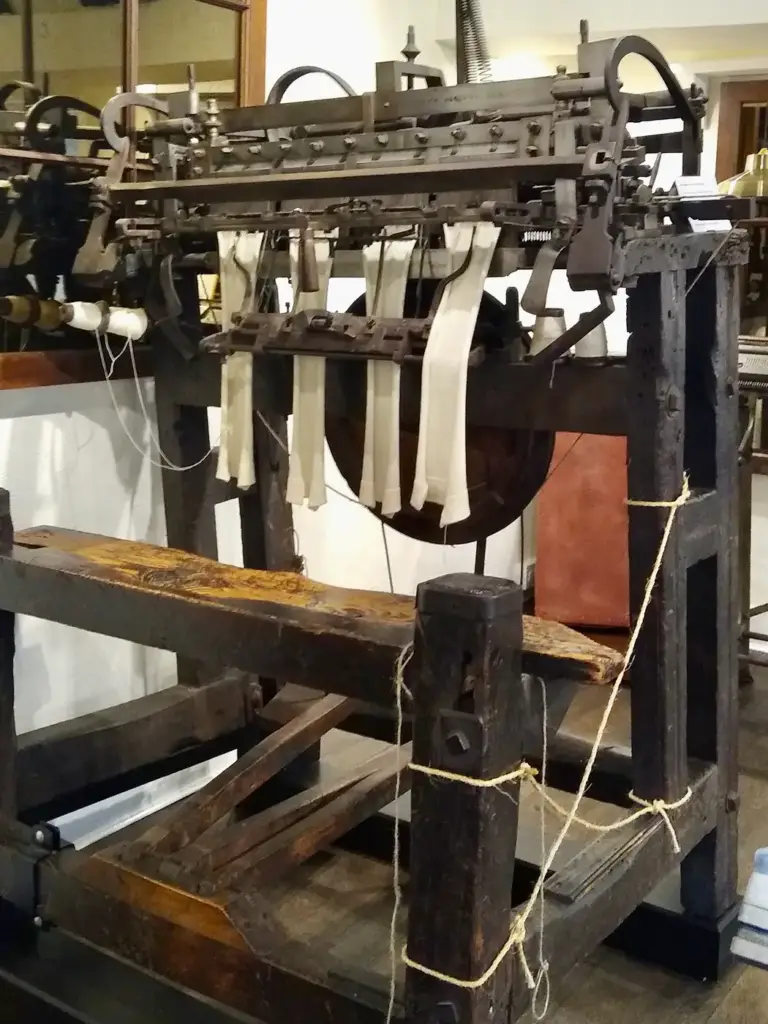
The story starts with a contraption that looks like a medieval torture device. According to Wikipedia, the English inventor William Lee built the stocking frame, the first knitting machine, in 1589 in Calverton, near Nottingham. It had a steel needle for every stitch, each with its tip bent into a hook, known as a bearded needle. The first model had eight needles per inch, good enough for coarse wool; later versions reached 16 and then 20, fine enough for silk.
Tradition says Queen Elizabeth I refused him a patent twice, worried the machine would put the kingdom’s hand knitters out of work, and that Lee ended up in Rouen, France, under the protection of Henry IV. Wikipedia itself cautions that modern scholarship rejects some of the popular stories about Lee, so take that one with a grain of salt. What’s beyond dispute is that his frame was the first major step in mechanizing textiles, about two centuries before the Industrial Revolution.
The needle that changed everything
The leap that made industrial socks possible was a needle. According to Knitting Together, an archive of the knitting industry in Leicester, England, Matthew Townsend, a Leicester manufacturer, invented the latch needle, which changed the industry dramatically. The date wobbles between sources: the same archive gives 1849 on one page and 1847 on another, and we haven’t been able to settle which is right. How it works, though, is clear.
A latch needle has a hook at the tip and, just below it, a small hinged flap called the latch, which opens and closes on its own. As the needle rises, the old loop slides down the shank and flips the latch open. The hook catches new yarn. As the needle drops, the old loop pushes the latch up, closing the hook, and slides over the new yarn, which becomes the next stitch. Lee’s bearded needles needed a bar to press their tips shut on every row. The latch needle doesn’t, and that made it possible to knit in the round and far faster. According to the same archive, it’s still used in most hosiery mills around the world.

The machine that goes around
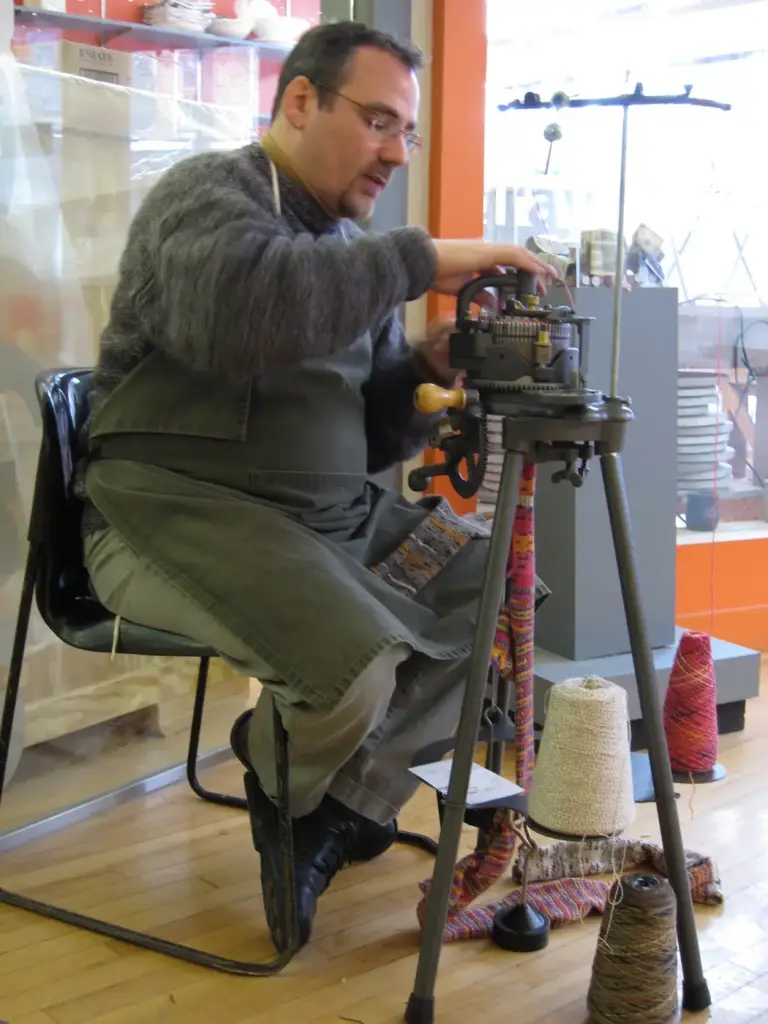
A modern sock machine is circular: a metal cylinder cut with vertical slots, a latch needle in each slot, and a set of cams that lift and lower the needles as the cylinder turns. Yarn feeds in at one or more points around the cylinder, and the fabric comes out through the middle, at the bottom, already shaped as a tube.
Knitting Together traces its evolution through the collection of a former Hinckley machine mechanic, Bill Partridge. The early domestic machines had 84 needles, and, as the archive puts it, grandmothers still had to pick up hand needles to do heels and toes. On semi-automatic machines, the operator had to change needles and switch the machine into reciprocating mode by hand to knit the heel. Fully automatic machines came next, and in England William Bentley introduced the Komet, a revolving-cylinder machine that Italian and Japanese makers later copied and developed into today’s machines, driven by electric motors and compressed air.
In Italy, that story has a family name. According to a 2026 piece in the trade publication Knitting Industry, Francesco Lonati set up his first production unit for circular sock machines in 1946 in Rezzato, near Brescia. Today, the Hinckley mill described in the English archive knits its socks on Bentley Komet, Lonati and Busi machines.
The heel: the machine that rocks back and forth
The mechanical problem with a sock is that a foot isn’t a tube. It bends at the heel. To knit that pouch, the machine stops spinning and starts going back and forth on only half its needles. U.S. Patent 5,103,656, granted in 1992, spells it out: a group of needles is taken out of action, the machine switches to reciprocating motion and, on each pass, needles are dropped out one at a time to narrow the fabric into the first half of the pouch; then they’re brought back in to widen it into a mirror-image second half. The seam between the two halves runs as a diagonal line through the point of the heel. The toe is made the same way, at the end.
That rocking motion costs money. A 1986 patent, number 4,589,267, assigned to Speizman Industries, explained that knitting heels and toes this way is relatively expensive, because it requires special machine preparation, and slower than knitting in the round. It also noted that athletic socks with no knitted heel or toe had become popular precisely because they cut production costs and prices. That’s the tube sock. As we explain in our story on socks and sandals, the sock has a much longer history than it gets credit for. The tube sock is the budget edition.
The seam you can’t see
When the machine finishes, the sock comes off with the toe open. Closing it is the step that most separates a cheap sock from an expensive one. Knitting Together describes two methods. In linking, the toe is placed on the needles of a linking machine, which passes a thread through every loop of the sock to join them, and the excess is trimmed off. Seaming is much faster because it doesn’t pick up every stitch; it simply oversews the edge to close it.
A 2004 patent application from the Italian company Golden Lady lays out the dilemma bluntly. Linking requires hooking each loop of a row onto its own hook, work that has to be done by staff with particularly sharp eyesight, and the cost and difficulty of finding such staff make it hard to sustain. In return, it produces a practically faultless, especially smooth closed toe. Mechanized seams, which are cheaper, place their stitches more or less randomly and leave a thick seam. That thick seam is the ridge you feel across your toes in a lot of cheap socks.
The industry has spent years trying to get both. In 2016, Knitting Industry reported that Lonati had won a case in a Milan court against the Taiwanese manufacturer Da Kong for copying its automatic toe-closing system, which links the sock right on the knitting machine. The court ordered the copied machines pulled from the market.
After the knitting
A freshly knitted sock isn’t a store-ready sock yet. At the Hinckley mill described by the archive, socks often come off the machine in strings joined by a few fine threads, as in the 1940 photo at the top of this story, taken at a Nottinghamshire factory. A machine separates them by pulling them down a hollow tube, which turns them inside out along the way. Then the toe is closed, air blows them right side out, they’re dyed in machines that work like a washing machine, and they’re dried.
Next comes boarding: the socks are pulled over flat forms shaped like a leg and foot. Natural fibers such as wool are steamed in a chamber; synthetic fibers are exposed to around 130 °C, about 265 °F, which softens them just enough to take the shape of the board. Finally, a machine scans each sock, finds its best match on the conveyor by shape and size, pairs them and folds them. Without the machine, pairing is done by hand.
The rise and fall of the Sock Capital
For Americans, the economics of socks have a hometown. According to Wikipedia, at the start of the 21st century Fort Payne, Alabama, had more than 7,000 people working in over 100 hosiery mills, produced more than half the socks made in the United States and called itself the “Sock Capital of the World.” Then NAFTA and the Central American free trade agreement lowered tariffs on imported textiles, and a huge, highly efficient sock cluster grew up around Datang, in China’s Zhejiang province, where raw materials and even the machines were made locally. The contrast the article draws is brutal: a Fort Payne mill might wait two months for a replacement machine part from Italy, while a Datang factory waited half an hour for one from a local supplier. By 2005, Fort Payne’s hosiery employment had fallen to about 5,500, and several mills had closed.
Why one sock costs ten times more
With all that in mind, the price stops being a mystery. The first difference is the fiber. In early September 2026, the benchmark for the Australian wool market, the Eastern Market Indicator, closed at 1,350 U.S. cents per kilogram of clean wool, about $13.50 a kilogram, according to Australian Wool Innovation’s weekly report. That same month, the U.S. Department of Agriculture forecast the 2026/27 upland cotton farm price at 78 cents a pound, roughly $1.70 a kilogram. The comparison is only a rough guide, since those prices are taken at different points in the supply chain, but it shows the scale: the raw material in a merino sock costs several times more than in a cotton one. What each fiber does with sweat is covered in our story on sock fibers.
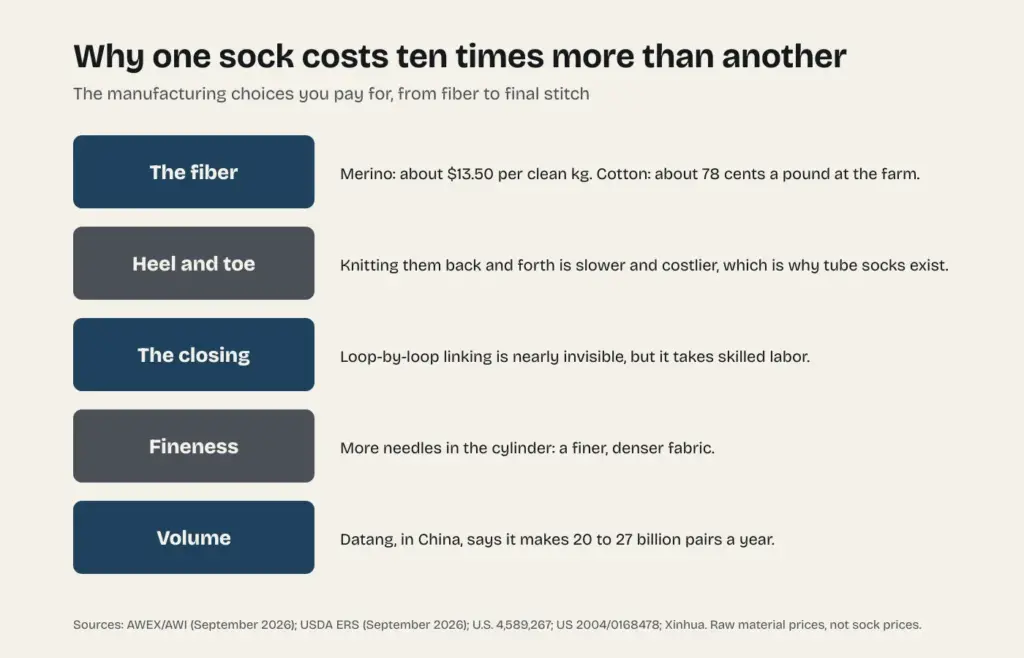
The second difference is construction. A back-and-forth heel costs more than a tube, and a toe linked loop by loop costs more than one seamed by machine. The third is fineness: machines differ in cylinder diameter and needle count, and the more needles packed into the same cylinder, the finer and denser the fabric. The fourth is volume. In 2022, the Xinhua news agency reported, in a story carried by China Daily, that Datang made about 27 billion pairs of socks a year, worth 75 billion yuan, roughly $11 billion, accounting for 70 percent of China’s market and 35 percent of the world’s, according to official figures. It all started in the late 1970s, when locals converted old hosiery equipment into hand-operated machines and began selling socks. At that scale, a penny saved per pair is a fortune.
How the final price splits between materials, labor and brand is a separate calculation, which we ran for shoes in expensive vs. cheap shoes. With socks, what you pay extra for is usually something you can touch: a smooth toe, a heel that hugs your foot without bunching and the fiber underneath it all.
Sources
- Wikipedia, “William Lee (inventor),”) “Stocking frame” and “Fort Payne, Alabama.”
- Knitting Together, “Matthew Townsend (1817–1879),” “Socks” (Bill Partridge archive) and “Manufacturing a pair of socks.”
- Knitting Industry, Lonati history (2026), and “Lonati successfully defends automatic toe closing patents” (November 10, 2016).
- N. M. Hanson II (NK Mills), U.S. Patent 5,103,656, “Split-heel sock” (1992).
- J. C. Barbee (Speizman Industries), U.S. Patent 4,589,267, “Method and apparatus for producing hosiery article” (1986).
- P. Conti (Golden Lady), U.S. patent application 2004/0168478 (2004).
- Australian Wool Innovation, weekly price report, week 10 (September 2026).
- USDA Economic Research Service, Cotton and Wool Outlook, CWS-26i (September 2026).
- Xinhua, “East Chinese town of Datang socks it to world,” China Daily, June 2, 2022.
Image credits
- Sock factory in Nottinghamshire, 1940: British Ministry of Information. Public domain, via Wikimedia Commons.
- Stocking frame at the Godalming Museum: Mertbiol. Public domain (CC0), via Wikimedia Commons.
- Latch needle: C. Nilsson. CC BY-SA 3.0, via Wikimedia Commons.
- Hand-cranked circular sock machine: jhritz. CC BY 2.0, via Wikimedia Commons.
- How a sock comes off the machine diagram: feetkeepers.
- Why one sock costs more diagram: feetkeepers.