
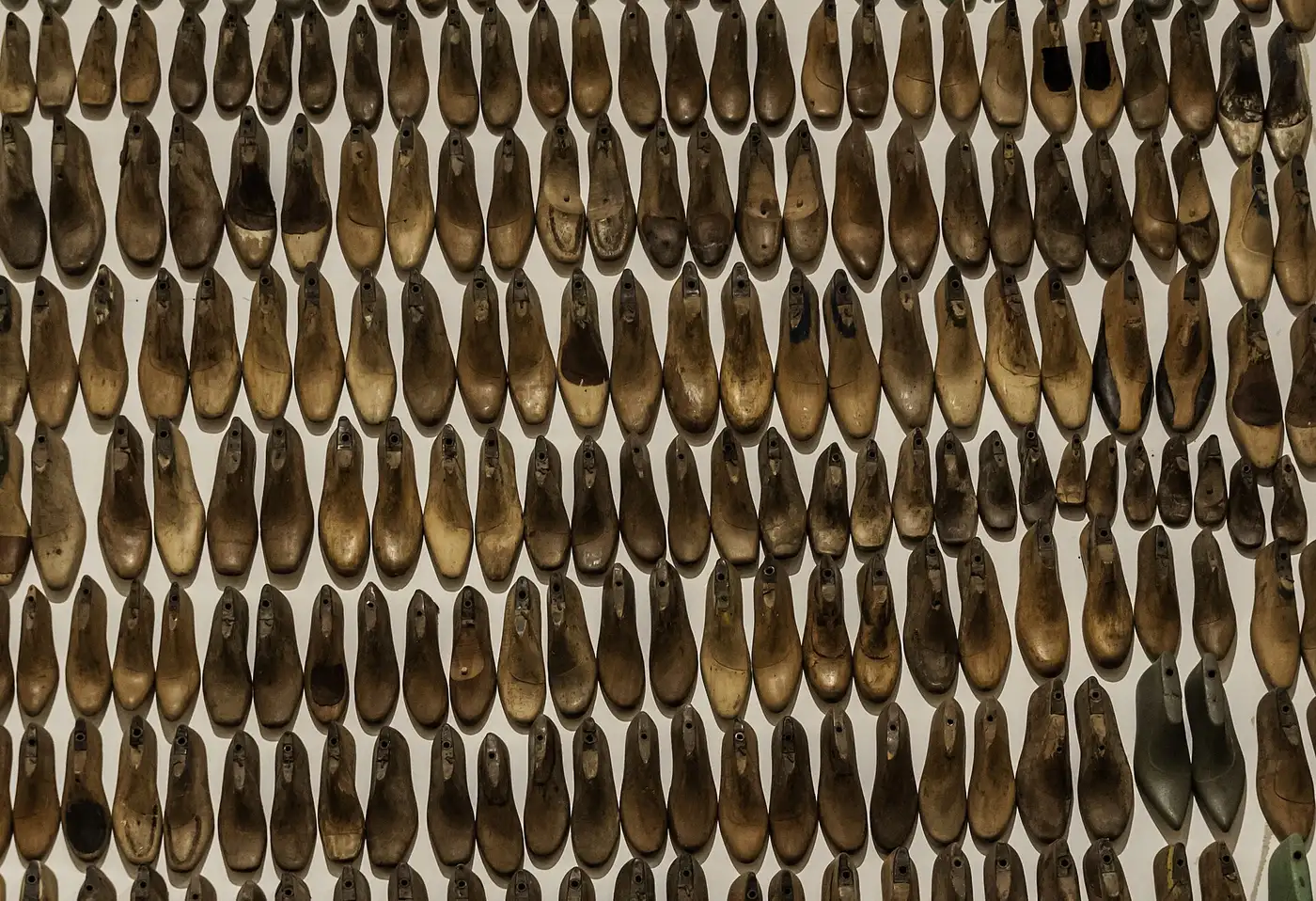
How shoes are made is a question almost nobody asks standing in front of a store display, and it’s the one that explains the price tag. In 1916, a Boston vocational guide counted 210 separate processes in making an ordinary shoe: 174 machine operations on 154 different machines, plus 36 done by hand. Plenty of shoes take fewer steps today, but the underlying sequence hasn’t changed. You cut, you stitch the top, you pull it over a last, you attach a sole and you finish it. And in one of those steps, the sole, nearly everything about the shoe gets decided: how much it weighs, how much it flexes, what it costs and whether it can be repaired once it wears out.
Before the leather: lasts and patterns
Every shoe starts with a last, the foot-shaped form it’s built around, whose history we cover in our story on the shoe last. From the last come the patterns: the flat pieces that, once stitched together, form the top of the shoe, called the upper. There’s the vamp over the instep and toes, the quarters wrapping the heel, the counter, linings and reinforcements. Every piece is graded for every size, because a size 11 vamp isn’t a size 7 vamp blown up on a copier.
Frederick J. Allen’s The Shoe Industry, published in 1916 by the Vocation Bureau of Boston to steer young people into the trade, already describes that system. Factories that cut by machine needed one die for every design and every size, which meant an enormous stock of dies. Most of those machines, he wrote, had been invented by shoe workers themselves, often after long toil over a particular process. Allen also counted about 7,000 U.S. patents on shoe machinery since the Patent Office opened in 1836, and noted that while he was writing that chapter, in November 1914, nineteen new ones had been announced in a single week.
Cutting: reading a hide
A hide isn’t fabric. Its thickness, firmness and stretch change from one area to the next, and it comes with scars, scratches and veins. A leather cutter has to read it. According to Allen’s guide, a hand cutter laid each pattern on the skin so that every area went to the part of the shoe it suited best, then drew a short, razor-sharp knife around the pattern’s metal edge on a hardwood block he kept smooth and oiled. The finest work took years of practice. Cutters alternated patterns and sizes to squeeze the most out of each skin, and the tiny scraps left over were sold off to make leather substitutes or for the oil they contained.
The machine that changed all that was the clicking machine. A heavy arm swings over the cutting block, the operator sets a steel die on the leather just where a hand cutter would set a pattern, and the arm drives it through in one stroke. Allen called it one of the most important recent innovations in shoemaking: one swing of the arm did what took a hand cutter a good while with a knife, and every piece came out identical. For linings and cloth, his guide put the cost of die cutting at roughly a tenth of cutting by hand.
In many factories today, cutting is done with computer-guided blades or lasers, but the logic is the same: get the pieces out of the best part of the hide with as little waste as possible.
Stitching the upper
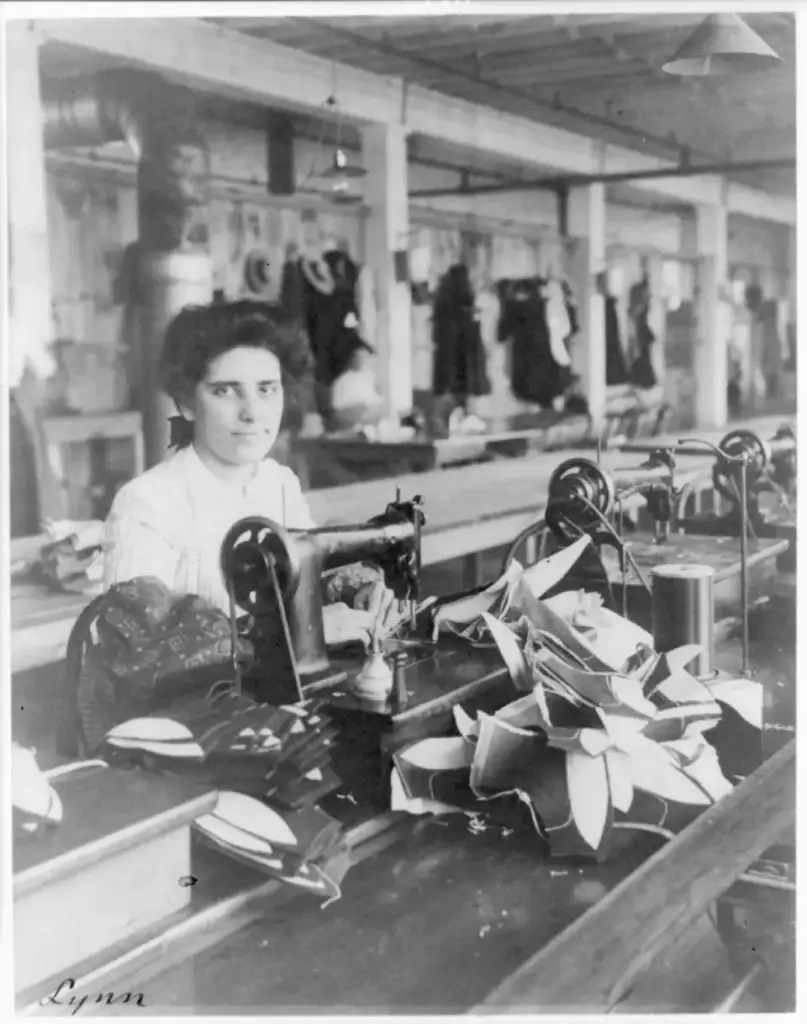
Once the pieces are cut, they’re stitched together, along with their linings and reinforcements, into the upper. First the leather edges are skived, shaved thinner so the seams won’t be bulky, then the pieces are marked and temporarily glued in position. Then come the sewing machines, with one or more needles, working on a piece that’s already nearly three-dimensional. In the American trade, this was the stitching room. In Spain, where the same job has a social history of its own, it’s called aparado, and the women who do it call themselves aparadoras.
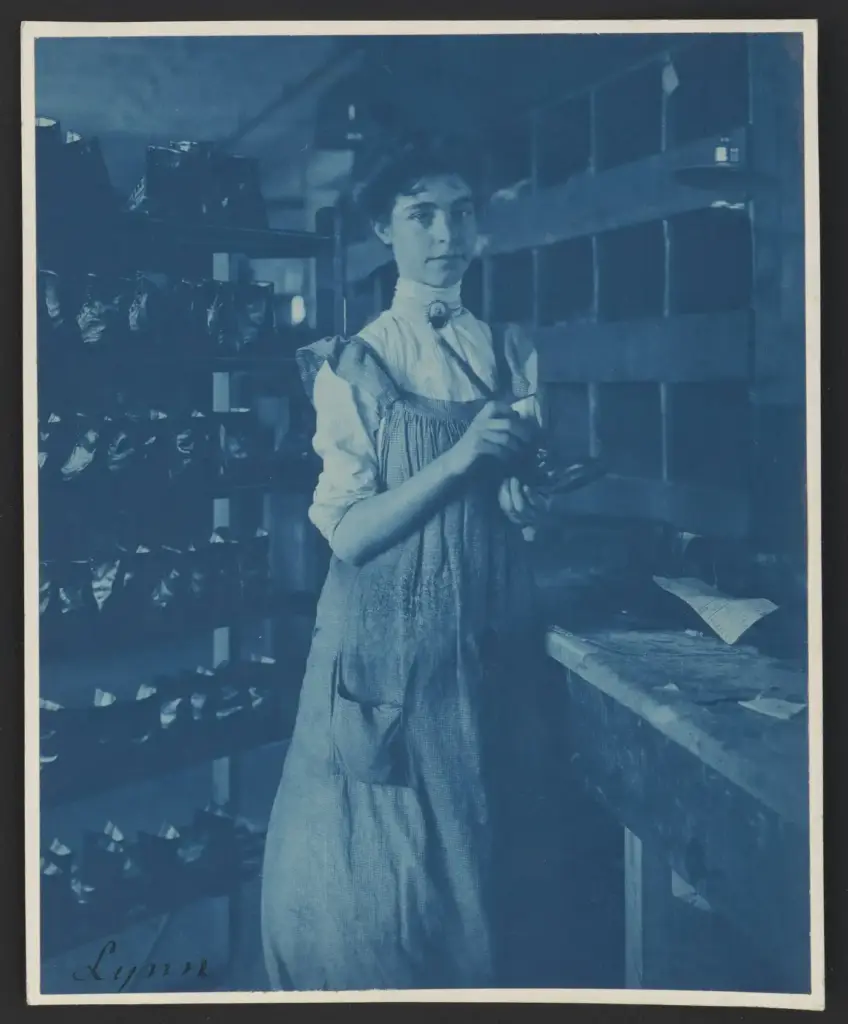
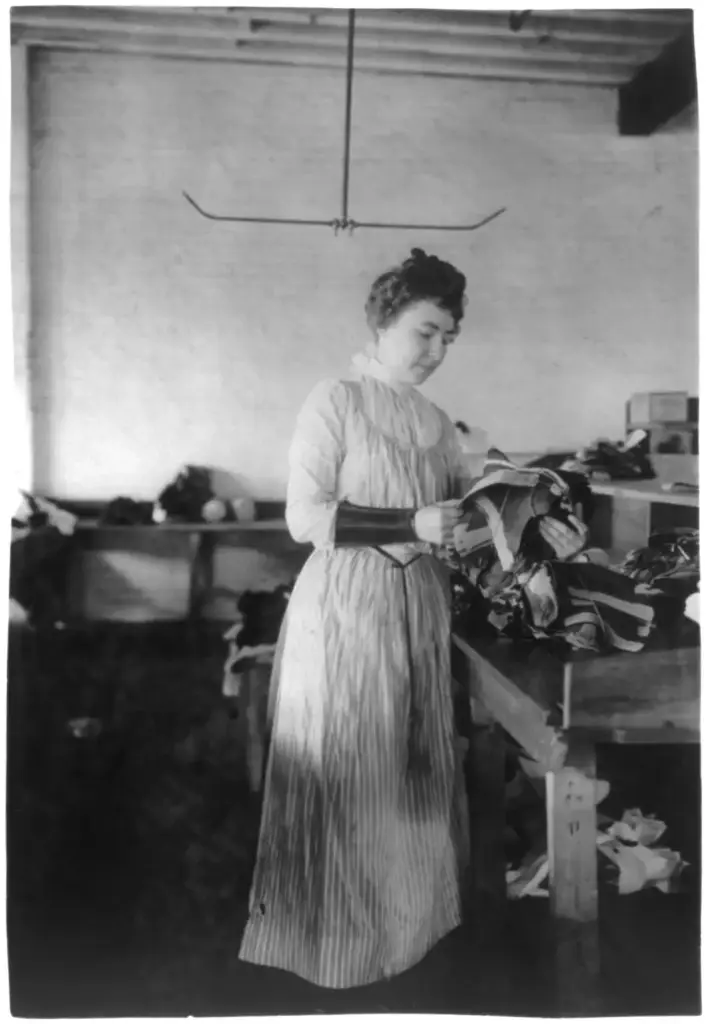
At the end of the 1800s, Lynn, Massachusetts, was at the heart of the American shoe industry, and as Wikipedia’s history of Gordon McKay notes, Lynn and the towns around Boston still relied on skilled hand labor organized into elaborate putting-out systems, with work handed out to be done at home. In 1895, photographer Frances Benjamin Johnston documented the women who stitched linings and uppers in Lynn’s factories. Her cyanotypes and prints, now held by the Library of Congress, are some of the best visual records of the trade at that moment.
The story didn’t end in Massachusetts. A 1996 study by geographers Ana Melis Maynar and Gregorio Canales Martínez of the University of Alicante, published in Investigaciones Geográficas, traced how stitching uppers became the first stage to move out of the factories when the shoe industry around Elche, in southeastern Spain, decentralized, precisely because it required little training and no complicated machinery. In one farming town they studied, it began in the mid-1960s, when a local man started bringing shoe work home for women to sew by hand. By the end of that decade there was a building with 120 stitchers, and by the early 1990s the researchers counted 19 workshops tucked into ground-floor rooms, empty houses and warehouses. The first stitchers, they told the researchers, saw it as natural: their mothers and grandmothers had worked hemp.
Lasting: the upper becomes a shoe
A stitched upper is still floppy. In lasting, it’s pulled over the last, with an insole tacked to the bottom, and stretched hard so it takes on the last’s shape: toe first, then the sides and heel. The edges of the upper are folded underneath and fastened to the insole with tacks, staples, thread or adhesive. This was the last step in shoemaking to be mechanized, and the story of the man who cracked it, Jan Ernst Matzeliger, is in our shoe last story.
After lasting, the shoe sits on the last for a while to set its shape. It now looks like a finished shoe. It’s still missing the most important part: the sole.
The sole: stitched or cemented
This is where shoes really part ways. There are many constructions, but three account for most of what you’ll see in a leather shoe store.
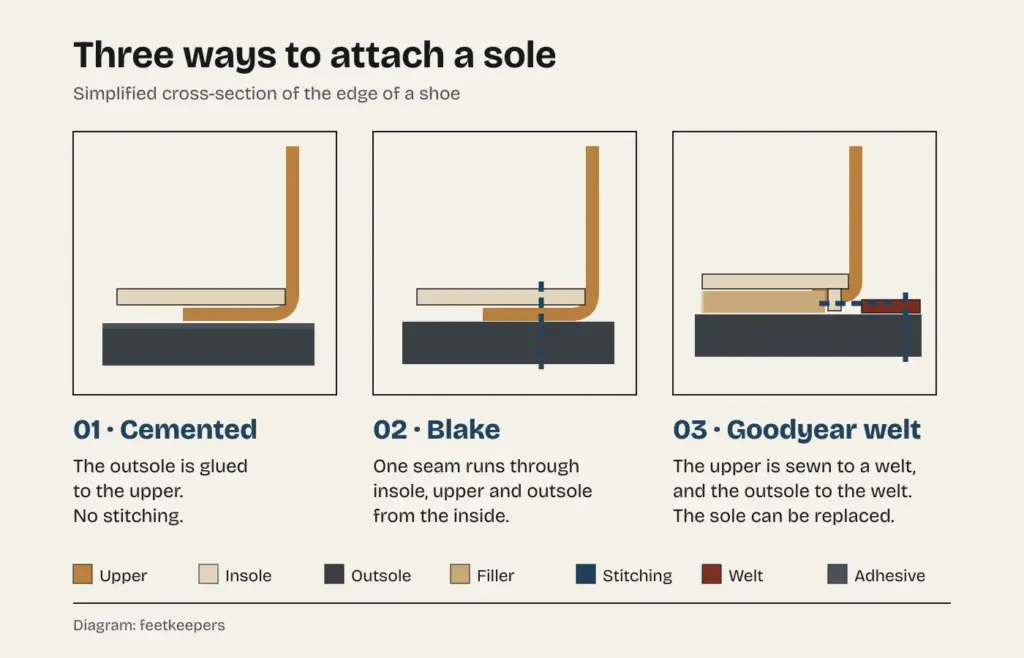
Blake stitching. On July 6, 1858, Lyman Reed Blake, a Massachusetts shoemaker who had worked setting up Isaac Singer’s sewing machines in shoe factories, received a U.S. patent for a machine that could sew a sole to an upper. In a Blake-stitched shoe, a single seam runs from inside the shoe through the insole, the edge of the upper and the outsole. The result is light and flexible, and it’s especially associated with Italian shoemaking. The drawback is that the seam sits inside the shoe, visible if you pull out the footbed.
Blake sold his patent to Gordon McKay, a Massachusetts businessman, for $8,000 in cash and another $62,000 out of future profits, according to Wikipedia’s account of its sources. McKay’s real stroke of genius was the business model. Instead of selling the machines, he leased them to factories for a low upfront fee and collected a small royalty on every pair produced. The machines had built-in counters. At the height of the system, around 1876, the royalties brought in about $500,000 a year. In 1895 alone, more than 120 million pairs were tallied on McKay machines, over half of all U.S. production. Part of the legal work behind the leases was handled by Gardiner Greene Hubbard, who later became the first president of the Bell Telephone Company. When he died, McKay left most of his fortune to Harvard University to train engineers.
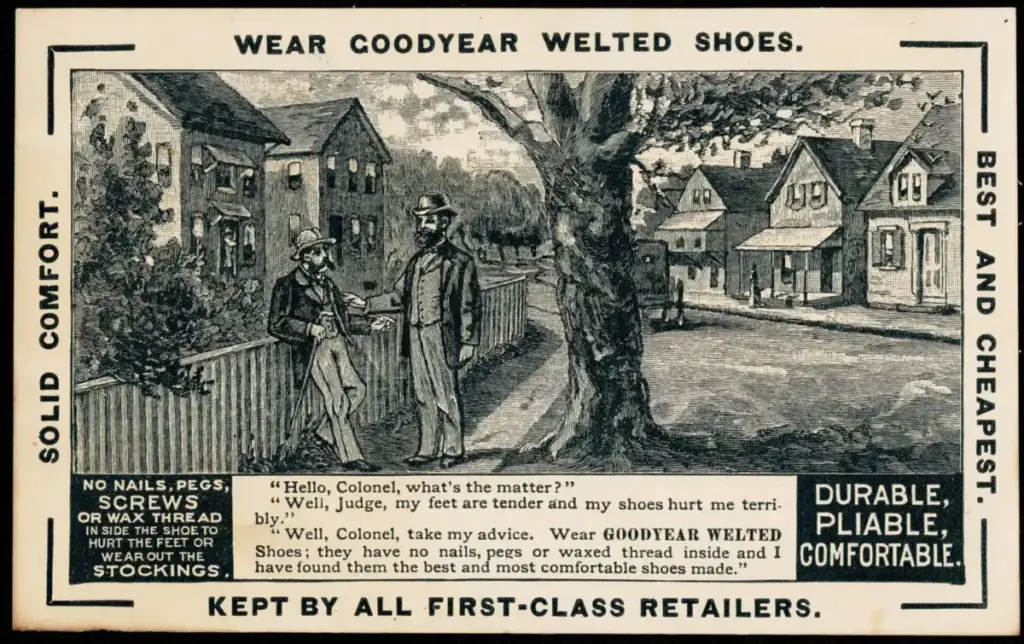
Goodyear welt. The other great stitched construction has a name that sounds like tires, and for good reason. According to the same source, the basic principle behind the machine was invented in 1862 by Auguste Destouy, who designed a curved needle for stitching shoes. Starting in 1869, Destouy and, above all, the English mechanic Daniel Mills improved it, both of them working for Charles Goodyear Jr., son of the Charles Goodyear who patented the vulcanization of rubber. In a Goodyear-welted shoe, the upper and insole are stitched to a strip running around the perimeter called the welt, and the outsole is then stitched to that welt. The space between insole and outsole gets filled with cork or another material. Because the outsole isn’t sewn directly to the upper, it can be replaced again and again as long as the upper holds up. It’s also more expensive to make than a shoe with a mass-produced molded sole.
American makers in the late 1800s pitched it with lines that would fit right into a late-night infomercial. A trade card from the period, now in the public domain, shows two gentlemen chatting on a sidewalk. One complains that his feet are tender and his shoes hurt terribly. The other recommends Goodyear welts. Along the edge runs the sales pitch: no nails, pegs, screws or wax thread in the bottom to hurt the feet or wear out the stockings.
Cemented. The third route puts no stitches in the sole at all. The bottom of the lasted upper is roughed up, adhesive is applied to both surfaces and the sole is pressed on. It’s the fastest and cheapest construction, the one that makes the lightest and most flexible shoes possible, and the one that dominates world production today. You’ll often read that 95 percent of the world’s shoes are made this way. It’s a widely repeated figure, but we couldn’t track down the original data behind it. What can be said is that a cemented shoe is usually harder to resole than a welted one.
Athletic shoes often use a variant with its own name, Strobel construction. Instead of lasting the upper over a rigid insole, it’s sewn to a flexible piece of fabric that closes the bottom of the shoe like a sock, and then the sole is cemented on. The name comes from the German sewing machine maker J. Strobel, which says it was founded in Munich in 1883.
Finishing
Once the sole is on, the shoe comes off the last. The edges are trimmed and buffed, the sole edges are stained and waxed, the leather is cleaned and dressed with creams and waxes, the footbed and laces go in, and the pair gets inspected. In Allen’s 1916 guide, finishing filled entire departments, with a job title for every operation. In a modern factory many of those steps run together on a single line, but they’re all still there.
And it’s only here, at the very end, that the shoe becomes what you see in the window. By then almost everything has already been settled: the last determined the fit, the cutter decided which part of the hide went where, and the sole construction set the weight, the flex and the lifespan. What all that means for the price is the subject of our story on expensive vs. cheap shoes.
Sources
- F. J. Allen (1916), The Shoe Industry, The Vocation Bureau of Boston.
- A. Melis Maynar and G. Canales Martínez (1996), “El trabajo a domicilio en la Vega Baja del Segura (Alicante): origen y desarrollo en un municipio agrícola,” Investigaciones Geográficas 16: 137–154.
- L. R. Blake, U.S. Patent 20,775, “Improvement in sewing-machines” (July 6, 1858).
- Wikipedia, “Lyman Reed Blake,” “Gordon McKay,” “Goodyear welt,” “Blake stitch” and “Shoemaking,” and the references they cite.
- Strobel Spezialmaschinen, company history.
- Library of Congress, Frances Benjamin Johnston’s photographs of the Lynn shoe factories (1895).
Image credits
- Shoe lasts at the Museu Afro Brasil, São Paulo: Wilfredor. Public domain (CC0), via Wikimedia Commons.
- Shoe factory in Lynn (1895): Frances Benjamin Johnston, Library of Congress. Public domain, via Wikimedia Commons.
- Lining stitcher in Lynn (1895): Frances Benjamin Johnston, Library of Congress. Public domain, via Wikimedia Commons.
- Sole construction diagram: feetkeepers.
- Goodyear welt trade card (late 1800s): unknown artist. Public domain, via Wikimedia Commons.
- Distributing work in a Lynn factory (1895): Frances Benjamin Johnston, Library of Congress. Public domain, via Wikimedia Commons.