
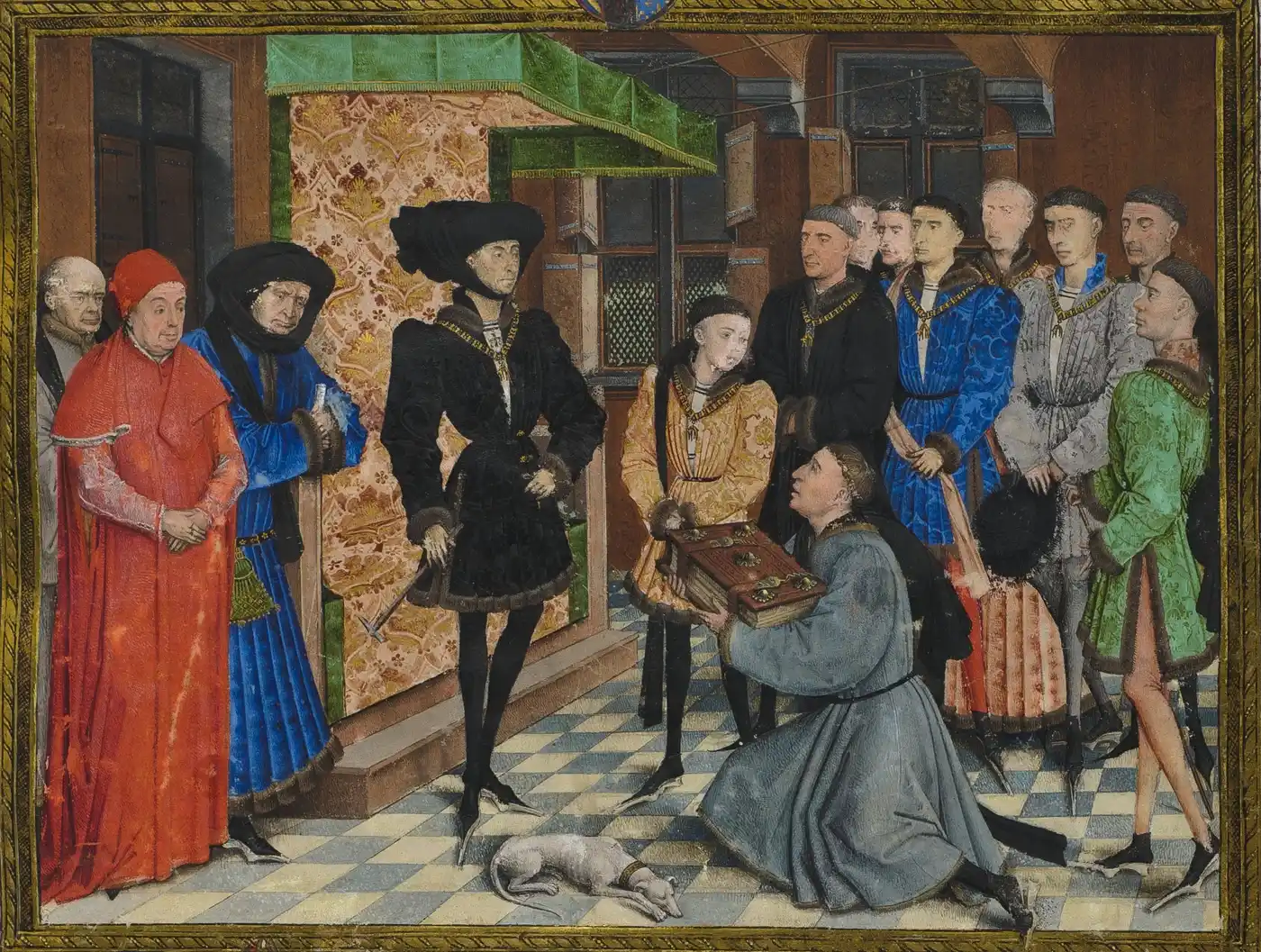
Poulaines are proof that no fashion is too ridiculous if the right people wear it. For well over a century, Europe’s most stylish men walked around in shoes whose toes stretched inches past their actual toes, stuffed with moss so the tips wouldn’t flop. An English monk called them devils’ claws. The Church banned pointed shoes for its clergy. And England’s Parliament ended up legislating how many inches of point a person could wear, with fines for the wearer who went too far and for the shoemaker who made the pair. The best part is that most of this survives in the documents of the time, and some of the stories everyone repeats about it don’t.
A name from Poland
The name itself tells you where people thought the fashion came from. According to the etymology Wikipedia gives, drawing on the Oxford English Dictionary, poulaine comes from the Middle French souliers à la poulaine, shoes in the Polish fashion. In England they were called crakows, after Kraków, then the capital of Poland. And 15th-century English laws simply talk about pikes, and about poleyns.
A shoe with a beak wasn’t a new idea. In 1215, the Fourth Lateran Council, one of the great assemblies of the medieval Church, devoted its Canon 16 to how clergy should dress and behave. In the translation published by Fordham University’s Medieval Sourcebook, it forbade them red or green garments, curiously sewn gloves, beak-shaped shoes, gilded bridles, saddles, pectoral ornaments for horses, spurs, or anything else indicating superfluity. A century and a half before the craze took off, a pointed toe already meant vanity.
“Devils’ claws,” according to a monk in 1362
The liveliest testimony comes from an English monastery. The Eulogium historiarum, a chronicle written by an anonymous monk of Malmesbury Abbey, includes in its entry for 1362 an angry inventory of the latest fashions. In the Latin text edited by F. S. Haydon for the Rolls Series, the chronicler writes that people wear shoes with beaks a finger long, which they call crakowes, and that they look more like the claws of demons than the ornaments of men. Then he turns on the people wearing them: you’d take them, he writes, for fiddlers and good-for-nothings rather than barons, actors rather than knights, mimes rather than squires. Lions in the hall, hares in the field. In Latin, the key line is even harsher: potius judicantur ungulae daemonum quam ornamenta hominum.
In the same entry, the monk is just as scandalized by belts of gold and silver. The rich wore ones worth 20 marks, he says, and middling people such as squires wore ones worth five marks or twenty shillings, even if they didn’t have twenty pence in their purse. His Victorian editor noted in the preface that the description seemed considerably exaggerated, and that you might detect in it the bitterness of a man barred from the very vanities he condemned. Still, the key facts are the date and the measurement. In 1362, the point was a finger long, and the fashion already had a Polish name.
The queen who didn’t bring them
The most repeated story about poulaines in England says they arrived with Anne of Bohemia, the wife of King Richard II. Its written source is John Stow, the antiquarian behind the Survey of London, a street-by-street description of the city whose 1603 text survives. Describing Bread Street ward, Stow says that since the fifth year of Richard II, that is, since 1382, when the king married Anne, daughter of the King of Bohemia, the English had worn piked shoes by her example, tied to their knees with silk laces or with chains of silver and gilt.
The problem is the timeline. If the Malmesbury monk was already complaining about crakowes in 1362, the fashion was in England twenty years before the wedding. What Stow does provide, with no contemporary source we’ve found to back it up, is an unforgettable image: points so long they had to be tied to the leg so you could walk. Stow wrote two centuries later, so read him for what he is: a record of what was told in his day, not an eyewitness.
Moss, leather and a point over four inches long
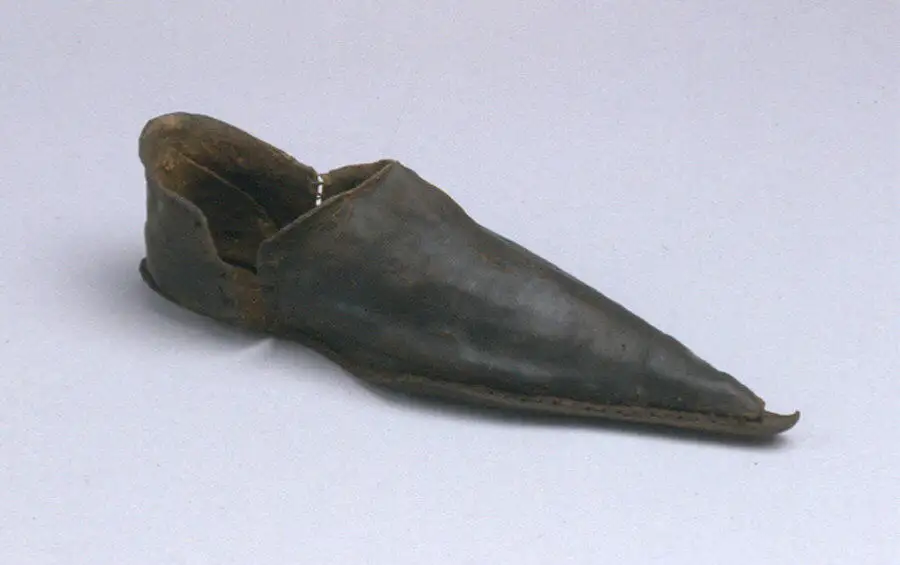
London’s archaeology lets you look at the real thing. The London Museum holds a poulaine from the late 14th century found at Baynard’s Castle, on the Thames waterfront near the old Royal Wardrobe, so some of the shoes found there may have had royal connections. Only the upper survives, probably calfskin, with a side latchet fastening and suede bands that divide the decoration into a lattice of panels. It measures 315 millimeters long, a little over 12 inches. According to the museum, shoes with long points had to be stuffed with moss or hair to keep their shape, and some points reached more than 100 millimeters, about four inches.
A shoe like that is more than a sole with a spike. There’s no foot inside the point, so it’s an empty leather tube that, unstuffed, would bend and drag along the ground with every step. The moss acted as a permanent last inside it. We explain how shoes of that era were sewn, using the turnshoe method, in our story on how shoes are made, and the history of the last that gives the toe its shape in our story on the shoe last.
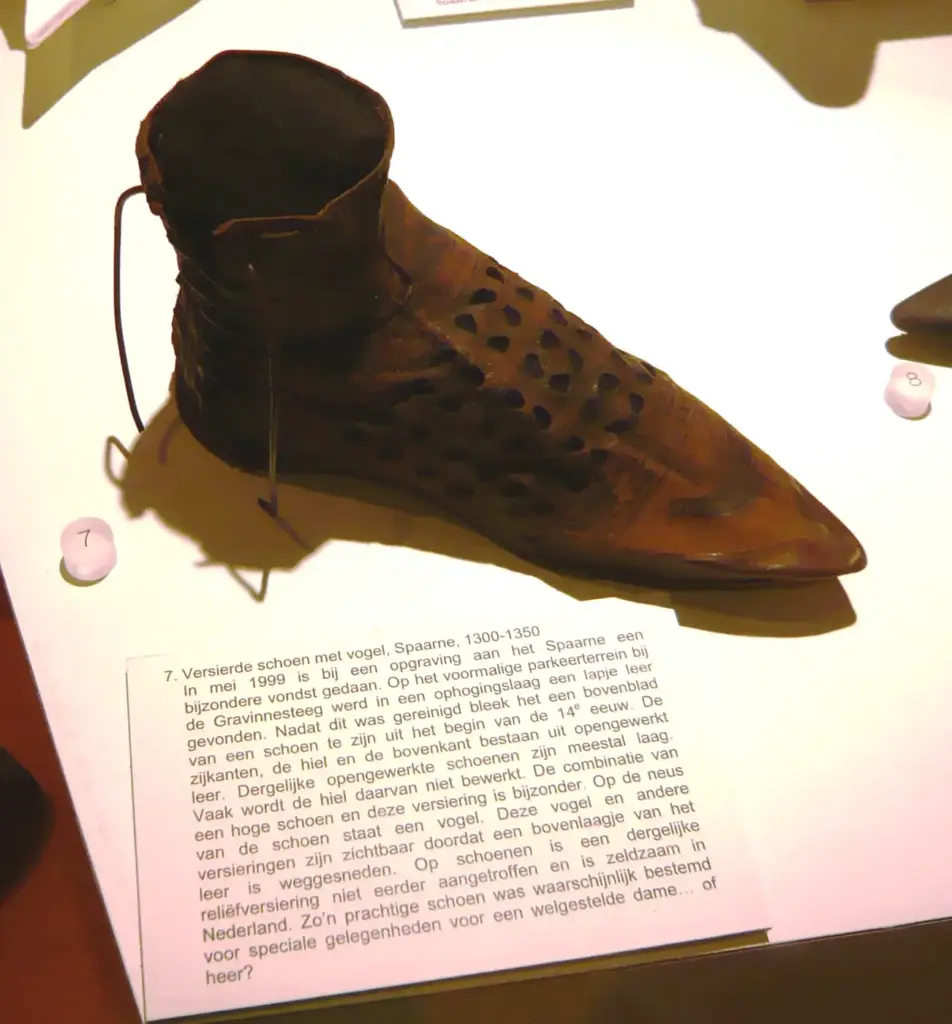
The Archaeological Museum in Haarlem, in the Netherlands, shows how far the whim could go. According to its exhibit label, a decorated shoe found in May 1999 during an excavation along the Spaarne River dates to between 1300 and 1350, with an openwork upper and a bird in relief on the toe, a kind of decoration never before found in the Netherlands. The museum thinks it was probably made for special occasions, for a well-to-do lady or gentleman.
Two inches and not one more
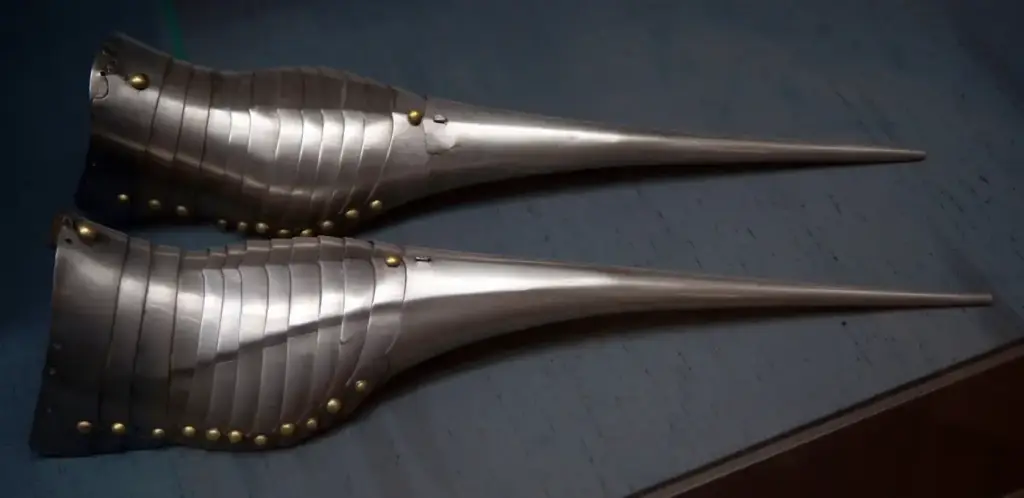
The fashion even went to war, or at least to the tournament. In the arms and armor collection of Vienna’s Kunsthistorisches Museum are the armored shoes of Emperor Maximilian I, made by the armorer Lorenz Helmschmied around 1485: articulated steel sabatons that end in extremely long steel points.
By then, England had decided to cap it. In the Parliament that opened on April 29, 1463, Edward IV approved an act of apparel, one of the sumptuary laws that set out what each social rank was allowed to wear. According to the text in the Statutes of the Realm, the official collection of English statutes, no knight under the rank of a lord, no esquire, gentleman or other person could wear, after the Feast of Saint Peter, shoes or boots with pikes longer than two inches, on pain of paying the king three shillings and fourpence for every offense. A shoemaker who made such pikes for any of those people would also be fined, at a rate the text gives as four shillings and fourpence. In other words, the law didn’t ban the point. It reserved it for lords.
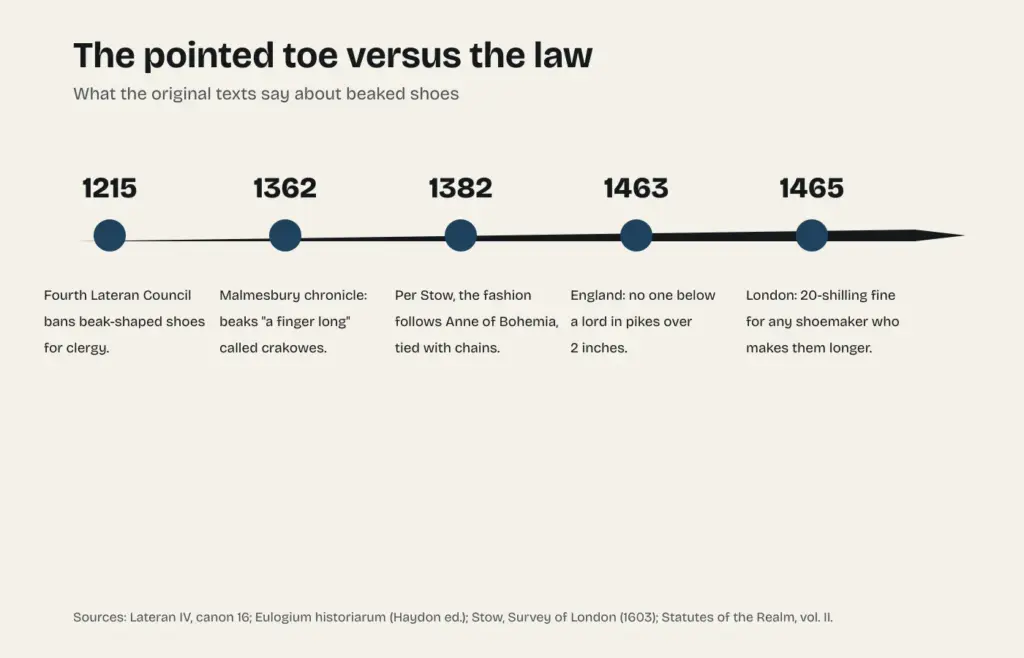
Two years later, the law went straight for the workshop. An act from the fourth year of Edward IV’s reign barred every cordwainer or cobbler in the City of London, or within three miles of any part of it, inside its liberties or outside them, from making, after Easter 1465, any shoes, galoshes or boots with a pike or poleyn longer than two inches, as judged by the wardens of the shoemakers’ guild. The same act banned selling shoes, or putting shoes on anyone’s feet, on Sundays and on the feasts of Christmas, the Ascension and Corpus Christi. The fine was 20 shillings per offense, split into three equal shares of six shillings and eightpence: one for the king, one for the governors of the cordwainers’ guild and one for whoever discovered and proved the violation. The informer earned exactly as much as the Crown. And the act made the fine easy to collect: anyone who wanted to sue for it could bring an action of debt by writ or by complaint, whichever they preferred, and the accused shoemaker was not allowed to “wage his law,” the old medieval way of clearing yourself by swearing an oath of innocence backed by others. On paper, that made every customer and every rival in the trade a potential inspector with a financial stake in measuring someone else’s points.
There’s one last detail that sums up the England of the day. The 1465 act carved out the dean and chapter of the royal chapel of St Martin-le-Grand in London, and anyone living inside its precinct, which had its own privileges. Within those streets, the two-inch rule didn’t apply.
Curses included
Stow, who knew his city’s laws well, added an ingredient to his account that doesn’t appear in the statute text we’ve quoted. According to his Survey of London, in the fourth year of Edward IV it was ordained and proclaimed that the beaks of shoes and boots should not pass two inches, on pain of cursing by the clergy and, by Parliament, of paying 20 shillings for every pair, and that every cordwainer who shod any man or woman on a Sunday should pay 30 shillings. The threat of a church curse isn’t in the statute, so we’re leaving it as what it is: what Stow reported more than a century later.
In France, a number of shoe histories credit King Charles V with an ordinance against poulaines in Paris in 1368. We haven’t been able to find the text of that ordinance, so we’re flagging it as unverified.
Done in by boredom
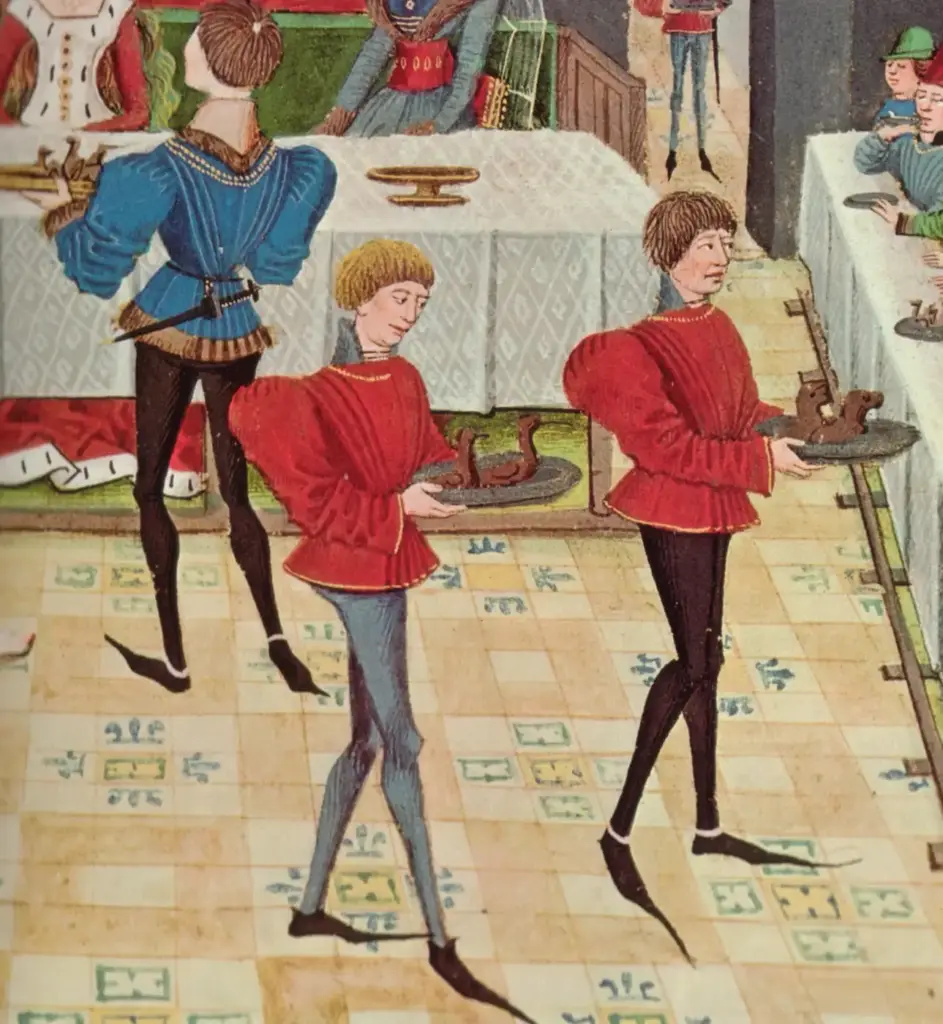
The laws didn’t kill the point. The presentation miniature of the Chronicles of Hainaut at the top of this page, attributed to Rogier van der Weyden and painted in the mid-15th century, shows the court of the Duke of Burgundy, then the most stylish court in Europe, in very long poulaines. And in a manuscript of Renaud de Montauban from around 1467 to 1469, the servants carrying dishes to a banquet walk on extremely long points.
The fashion ended the way most fashions do: replaced by its opposite. According to Wikipedia, the poulaine gave way to the broad-toed duckbill shoe, fashionable in the 15th and 16th centuries, which in turn ended up stuffed, exaggerated and regulated by sumptuary laws. From beak to bill, fashionable Europe swung from one extreme to the other without ever passing through a shoe shaped like a foot. The heel came later, with a different story, which we tell in our piece on when high heels were for men.
London’s poulaines are still in the museum, a reminder that there was a time when elegance was measured in inches of empty leather out past the toes, and it took an act of Parliament to trim them.
Sources
- Fourth Lateran Council (1215), Canon 16, in the translation published by Fordham University’s Medieval Sourcebook.
- F. S. Haydon (ed.), Eulogium (historiarum sive temporis), vol. 3, Rolls Series, London (1858–1863), entry for 1362, p. 231, and preface.
- J. Stow, A Survey of London, 1603 text, ed. C. L. Kingsford (1908), “Bredstreete warde.”
- Statutes of the Realm, vol. II (1377–1509), 3 Edw. IV c. 5 (1463) and 4 Edw. IV c. 7 (1464–1465).
- London Museum, poulaine from Baynard’s Castle, late 14th century.
- Metropolitan Museum of Art, Crakows, British, 1300–1450, accession number 29.158.914.
- Archeologisch Museum Haarlem, exhibit label for the decorated Spaarne shoe (1300–1350).
- Kunsthistorisches Museum, Vienna, Collection of Arms and Armor, armored shoes of Maximilian I (A 62).
- Wikipedia, “Poulaine” and “Duckbill shoe,” and the references they cite.
Image credits
- Presentation miniature of the Chronicles of Hainaut, attributed to Rogier van der Weyden, Royal Library of Belgium (KBR 9242). Public domain, via Wikimedia Commons.
- Crakows, Metropolitan Museum of Art. Public domain (CC0), via Wikimedia Commons.
- 14th-century shoe at the Archaeological Museum in Haarlem: Jane023. CC BY 3.0, via Wikimedia Commons.
- Armored shoes of Maximilian I: Sandstein. CC BY 3.0, via Wikimedia Commons.
- Timeline: feetkeepers.
- Banquet in a manuscript of Renaud de Montauban (around 1467–1469). Public domain, via Wikimedia Commons.