
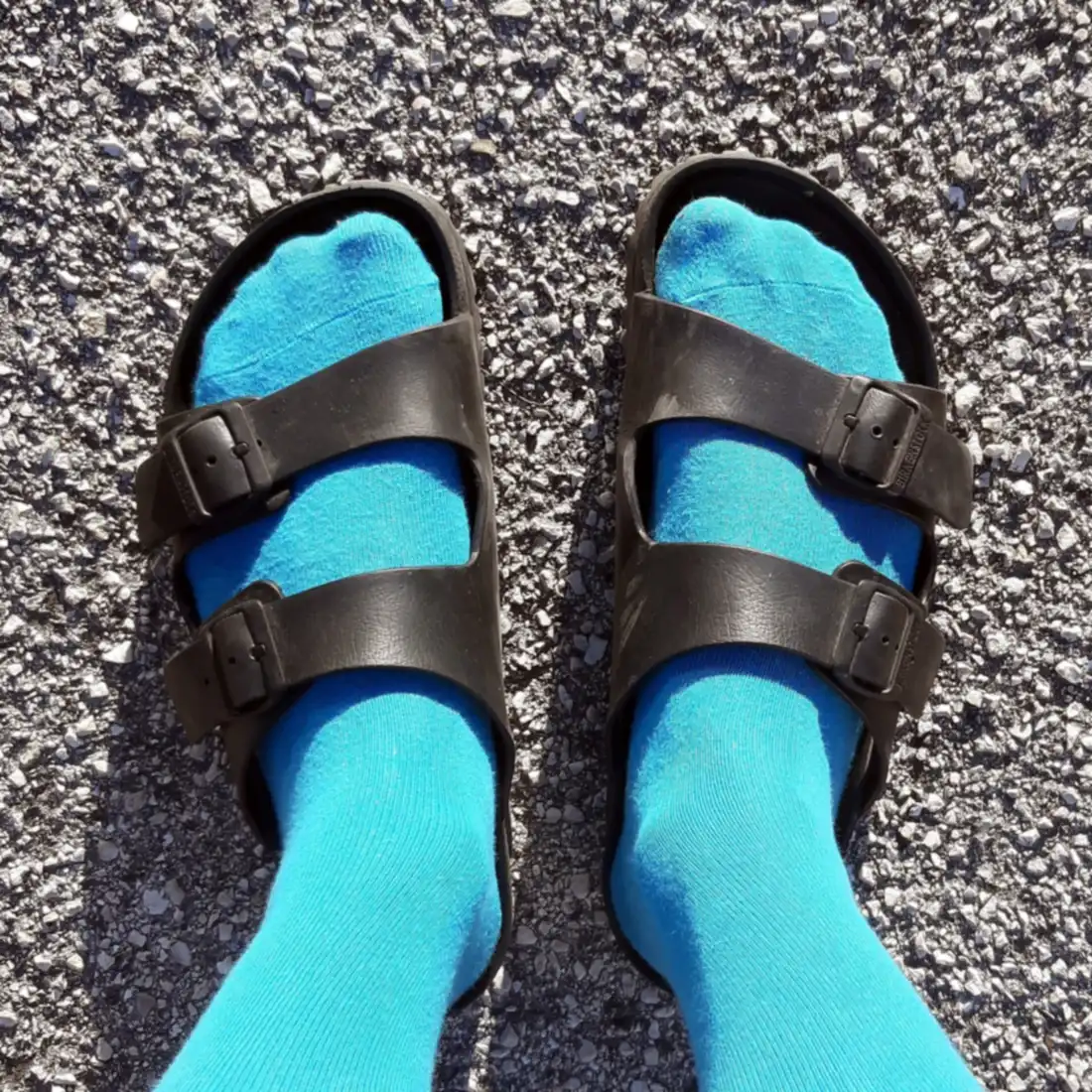
Socks and sandals might be the most reliable insult in American fashion. It’s shorthand for the dad at the barbecue, the tourist who gave up, the engineer who hasn’t seen daylight since the last product launch. Post a photo of a stranger in white tube socks and slides and the internet knows exactly what to do with it.
Here’s the problem with the joke: almost nobody in history thought it was funny. Roman soldiers on the northern edge of the empire wore socks with their sandals. So did people in fourth-century Egypt. In Japan, the combination isn’t a fashion mistake at all. It’s formal wear. The real question isn’t why anyone would do it. It’s when, exactly, we decided it was wrong.
Rome did it first
At Vindolanda, a Roman fort just south of Hadrian’s Wall in northern England, archaeologists have pulled hundreds of wooden writing tablets out of the waterlogged ground, letters and lists written in ink nearly 2,000 years ago. One of them reads like a care package from home. In the translation published by English Heritage, it says: “I have sent (?) you … pairs of socks from Sattua, two pairs of sandals and two pairs of underpants.” Socks and sandals, in the same sentence, from the Roman frontier.
The Romans had a word for them: udones. They were made from pieced cloth or from wool worked with techniques like nålbinding, a kind of single-needle knitting, and some left the toes and heels open. If you’ve ever been to northern England in July, you already understand why. The Greek geographer Strabo described Britain as rainy and foggy, with only a few hours of sun on a clear day. A soldier from the Mediterranean, in open sandals studded with iron nails, had every reason to cover his feet.
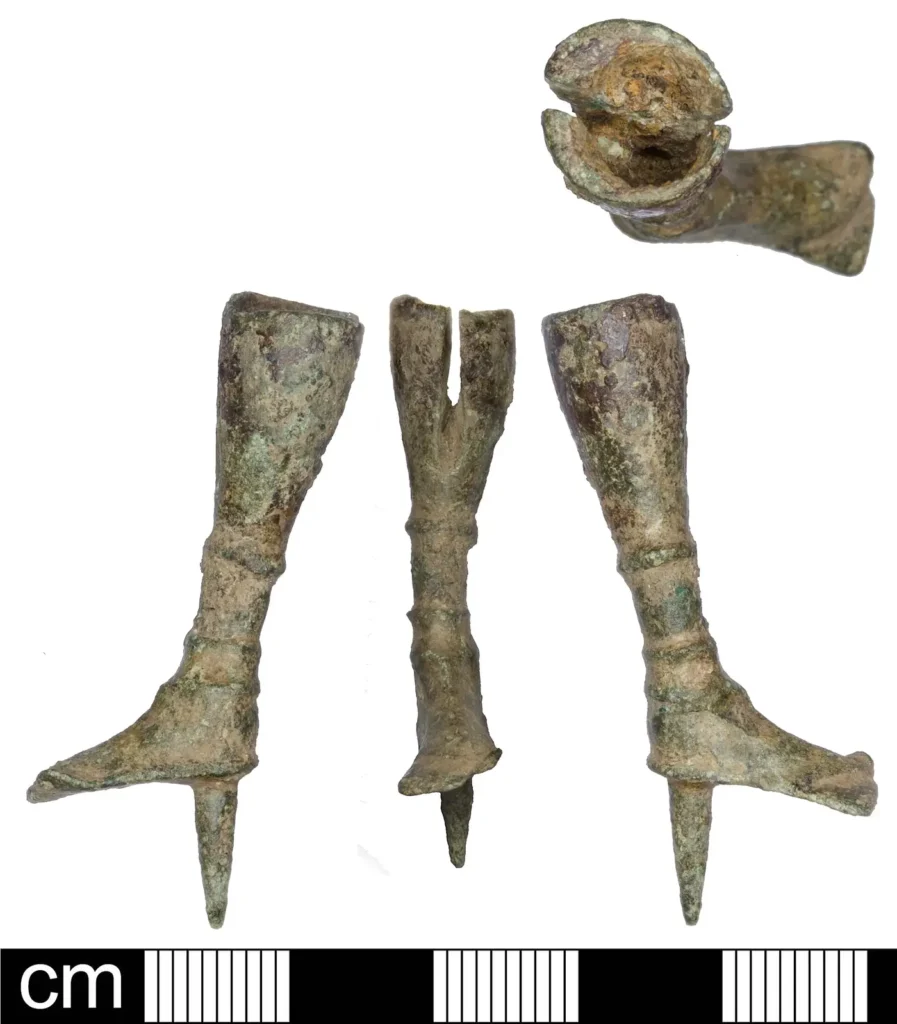
The archaeology backs it up from several directions. At Healam Bridge in North Yorkshire, along the old Roman road now followed by the A1 highway, a sandal sole turned up with the imprint of woollen cloth preserved in the rust of its hobnails. Excavations for the highway upgrade found similar traces in a number of graves. The Romans even depicted themselves this way. Bronze knife handles shaped like a human leg, found in England, show an open sandal laced over a sock in careful detail, and a bronze foot from a statue found in Southwark, in London, clearly shows socks under the straps.

The oldest socks had a split toe
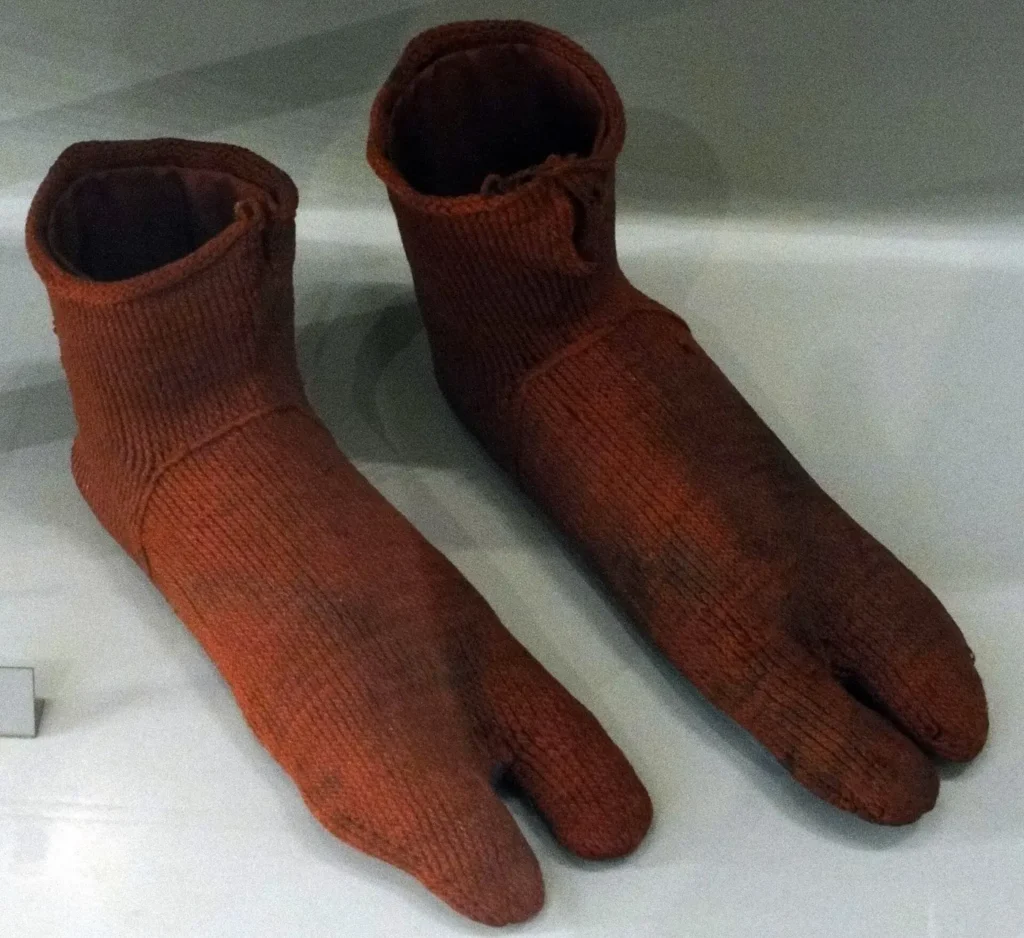
London’s Victoria and Albert Museum has a pair of bright red socks that are roughly 1,600 to 1,700 years old. According to the museum’s catalog, they were made in Egypt between AD 250 and 420 and excavated from burial grounds at Oxyrhynchus, an ancient city on the Nile. They’re three-ply wool, made with nålbinding, and stand about ten inches tall.
Look at the feet. Each sock has the big toe split off from the others, like a mitten. That’s a design decision, not a quirk. They were made to be worn with thong sandals, the same strap-between-the-toes setup your flip-flops use. The museum calls them the earliest knitted items in its collection. In other words, one of the oldest pairs of socks anyone has found was made specifically to wear with sandals.
In Japan, it’s etiquette
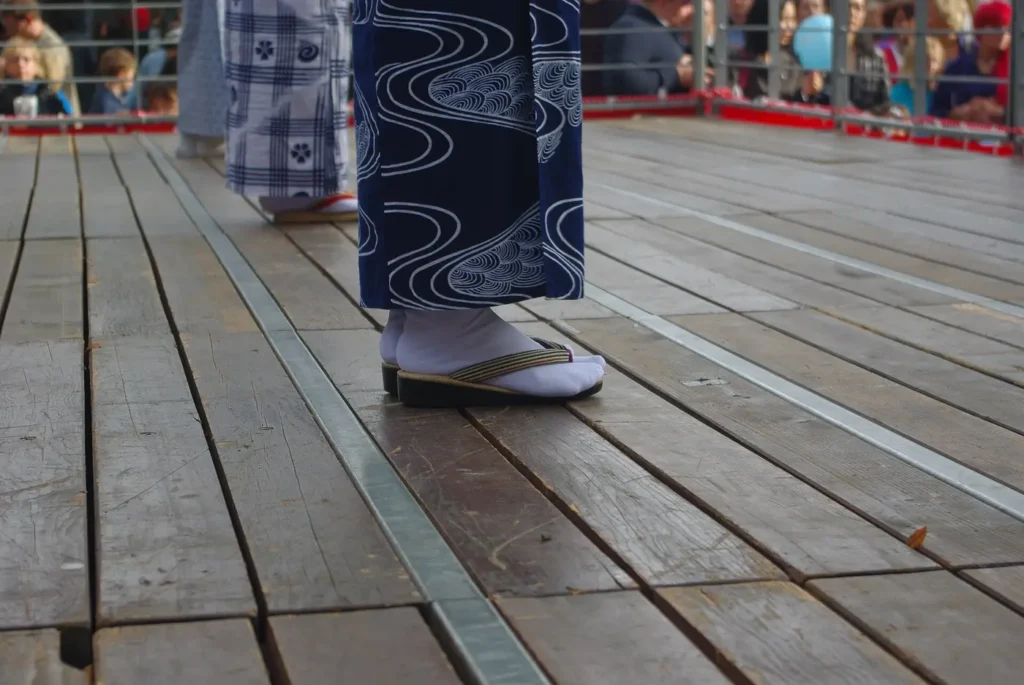
If you want to see socks and sandals treated with total seriousness, look at Japan. Tabi are split-toe socks worn with traditional thong sandals like zori and geta. According to Japan House Los Angeles, the Japanese government’s cultural center, they emerged somewhere between the late Heian period, in the 12th century, and the Muromachi period, which ended in the 16th. They started out as leather. When cotton farming spread across Japan during the Edo period, starting in the 17th century, cotton took over.
Tabi came with their own dress code. In the Muromachi period, samurai wore white or smoked leather, and women wore purple. Over time, white settled in as the color for formal and ceremonial occasions, while travelers and laborers wore darker colors that hid road dust. Put on a formal kimono today and you’ll be expected to wear white tabi with your sandals. Socks and sandals, mandatory.
The story takes an industrial turn. In 1922, brothers Tokujirō and Shōjirō Ishibashi created jika-tabi, tabi with glued-on rubber soles for farm and construction work. The name means “tabi that touch the ground.” Shōjirō learned to vulcanize rubber making those soles, and in 1930 his tabi company’s tire division produced its first tire. A year later he founded a company named after himself, translated into English. Ishibashi means “stone bridge.” The company was called Bridgestone.
Tabi also gave the fashion world one of its most argued-about shoes. Belgian designer Martin Margiela introduced split-toe boots inspired by Japanese tabi in the late 1980s. According to Highsnobiety, at his debut show for Spring/Summer 1989, models walked down a white cloth with red paint on the soles of their boots, leaving a trail of split, hoof-like footprints. More than three decades later, the Tabi is still the house’s signature, and still splits a room: some people would wear nothing else, others think it’s a prank. Which is exactly the conversation socks and sandals have been having for decades. Sneakers got in on it too: Japan House notes that Nike echoed the split-toe silhouette in its Air Rift running shoe in 1996.
How it became a punchline
There’s no single date when socks and sandals went from habit to crime. What there is, is a stock character. In Europe it’s the German tourist on a beach in southern Europe, in orthopedic sandals and white tennis socks. Germans have even turned the stereotype on themselves. In 2017, when Interior Minister Thomas de Maizière published ten theses on German Leitkultur, or “guiding culture,” Twitter fired back with jokes. One widely shared post, reported by The Local, simply read: “Socken in Sandalen.” Socks in sandals.
Other countries have their own versions. In Israel, for example, the pairing is stereotypically associated with immigrants from the former Soviet Union. In the U.S., the look has its own home turf. In the Pacific Northwest, it’s practically a regional trait. In 2007, Seattle insurer PEMCO built an ad campaign around a character known as the “Sandals & Socks Guy,” a local type everybody recognized.
And it has its own patron saints: tech founders. For years, Mark Zuckerberg was rarely seen in public in anything other than Adidas slides. According to The Daily Beast, he wore them sometimes with bare toes and sometimes with “nubby white tube socks peeking out.” In 2007, the tech gossip blog Valleywag ran an entire slideshow in tribute to the slides, and The Social Network turned them into a symbol: the founder walking into investor meetings dressed for the pool, because he could. That may be the key to the whole thing. Socks and sandals say “I don’t care what you think.” On someone with power, that’s a statement. On anyone else, it reads as giving up.
The numbers are shifting
Polls show the verdict still stands, but the jury is getting younger. Back in October 2016, a YouGov survey on fashion rules found that 47 percent of U.S. adults said they don’t wear socks with sandals, with a big gender gap: 60 percent of women steered clear, compared with 35 percent of men. In the same survey, 46 percent of men said they don’t consciously follow any fashion rules at all, which may explain a lot. In July 2024, YouGov surveyed 5,015 U.S. adults and found that only 18 percent prefer socks with their sandals. Among Gen Z, adults born in 1997 or later, it was 25 percent, more than any other generation. Among baby boomers, just 9 percent preferred socks with sandals, and 83 percent preferred going sockless.
Britain shows the same split. In a 2022 YouGov poll commissioned by English Heritage, 73 percent of U.K. adults said they wouldn’t wear socks and sandals. But 24 percent of men said they would, and so did 32 percent of 18- to 24-year-olds, compared with 12 percent of people aged 45 to 54. English Heritage, the charity that looks after hundreds of historic sites, leaned all the way in. On July 8, 2022, the 1,900th anniversary of the start of work on Hadrian’s Wall, it held the first National Socks and Sandals Day: anyone who posted a photo of themselves in the look got free entry to its Roman sites that day, from forts on the Wall to Lullingstone Roman Villa in Kent.
Birkenstock and the revenge of the ugly shoe
A good share of the blame, or the credit, goes to one brand. In 1966, Margot Fraser, a German-born dressmaker living in California, started importing Birkenstock’s cork-footbed sandals into the U.S. Shoe stores wouldn’t take them, so she ended up selling them through a health food store in San Rafael. From there they found their way onto the feet of the counterculture, and the brand picked up the image that followed it for decades: comfortable, German, practical and deeply unsexy. Exactly the kind of shoe you’d wear with socks.
The ugly duckling grew up. In October 2023, Birkenstock went public on the New York Stock Exchange at $46 a share, a price that valued the company at about $8.6 billion. The sandal once sold next to granola bins had become one of the most valuable footwear brands around, without ever really changing its shape.
For years that was an insult. Then fashion decided practical and ugly might be the most interesting thing in the room. Miu Miu sent socks and sandals down the runway in 2010. For Spring/Summer 2013, Phoebe Philo at Céline showed a sandal modeled on Birkenstock’s Arizona and lined in fur, which the fashion press nicknamed the “Furkenstock.” Other luxury houses followed. By the time English Heritage threw its socks-and-sandals day, its Hadrian’s Wall curator, Frances McIntosh, could name David Beckham and Rihanna among the celebrities who had worn the combination without apology.
The case nobody wants to hear
The argument for socks and sandals is mostly practical, and it’s the same one the Romans had. An open sandal leaves your foot exposed to cold, rain and the direct rub of the straps. A sock adds a layer between skin and shoe, keeps your feet warmer when it’s chilly and soaks up some of the sweat. English Heritage puts it plainly: Roman soldiers likely wore them to protect their feet from chafing and to keep warm.
That’s why the combination never really disappeared from places where practicality rules: hiking in sport sandals, chilly houses in cold climates, Japanese ceremonies. What moves is the line of what’s acceptable, and it moves depending on who’s wearing it and where.
When a habit has outlasted Roman legions, the people of Oxyrhynchus, the samurai and every style column ever written, maybe the socks were never the problem.
Sources
- English Heritage, Mark Griffin, “Roman socks and sandals: fashion or faux pas?”
- English Heritage (July 8, 2022), press releases on the first National Socks and Sandals Day and YouGov polling.
- Victoria and Albert Museum, “Pair of socks,” museum number 2085&A-1900.
- Japan House Los Angeles, “Tabi: toe socks, boots and an ancient craft.”
- Bridgestone, “Origin of Bridgestone’s name.”
- Highsnobiety, “Tabi or not tabi: Margiela’s signature shoe exists in all dimensions.”
- The Local (May 3, 2017), “Socks in sandals: what Germans really think of their guiding culture.”
- The Daily Beast (September 28, 2010), “Mark Zuckerberg in The Social Network: fashion icon.”
- YouGov (October 12, 2016), “Footwear fashion faux pas,” and (July 2024), “What’s up with Gen Z’s socks?”
- Fortune (October 11, 2023), “Birkenstock IPO.”
- Wikipedia, “Socks and sandals” and “Birkenstock,” and the references they cite.
Image credits
- Blue socks with sandals: Niccolò Caranti. CC BY-SA 4.0, via Wikimedia Commons.
- Roman leg-shaped handle: Somerset County Council, Laura Burnett (Portable Antiquities Scheme). CC BY-SA 2.0, via Wikimedia Commons.
- Vindolanda tablets at the British Museum: Mike Peel (www.mikepeel.net). CC BY-SA 4.0, via Wikimedia Commons.
- Egyptian socks at the Victoria and Albert Museum: Fæ. CC BY-SA 3.0, via Wikimedia Commons.
- Tabi and zori: Clément Bucco-Lechat. CC BY-SA 3.0, via Wikimedia Commons.
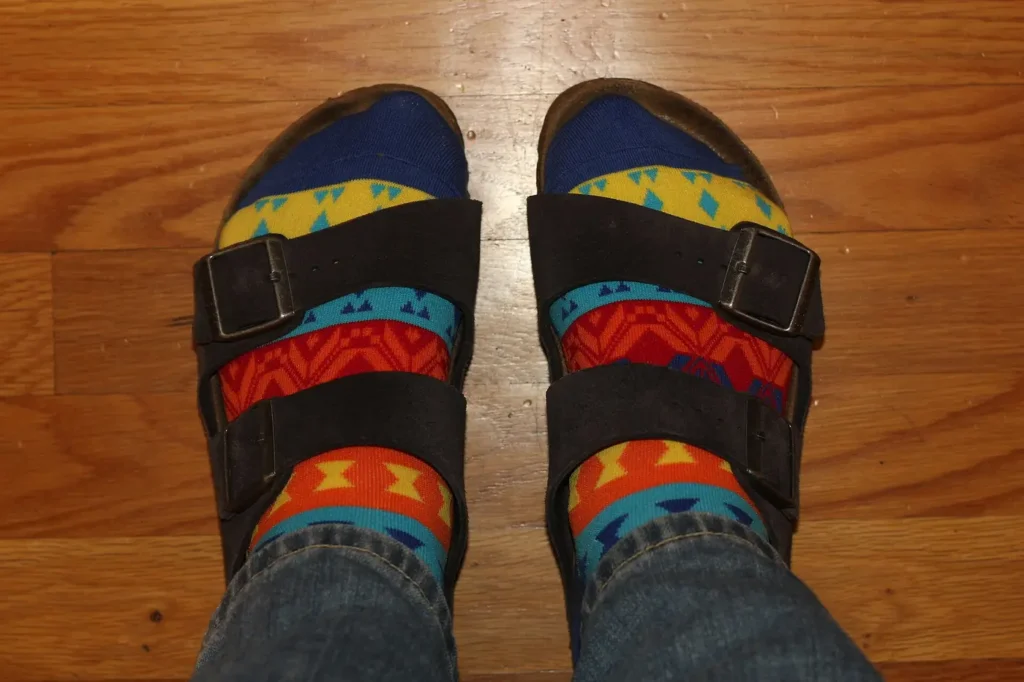
- Colorful socks with Birkenstocks: Eli Christman. CC BY 2.0, via Wikimedia Commons.