
Two out of three American workers spend a big chunk of the day standing. In the 2016 National Health Interview Survey, run by the CDC, 66.6 percent of people working at least 20 hours a week said they stood frequently on the job, according to a report from the European Agency for Safety and Health at Work. The same report cites research estimating that in North America, 45 percent of workers spend more than three quarters of their working time on their feet, and that 40 percent of them can’t sit down when they want to. Line cooks, servers, bartenders, retail associates, nurses, hairdressers, warehouse workers, assembly-line crews: a huge share of the workforce earns a living on the soles of its shoes. The EU-OSHA report’s own list of jobs where long standing is common also includes pharmacists, schoolteachers and childcare workers, physical therapists, security staff, library assistants and lab technicians, and it notes that many of the people who have to stand at work are in low-paid jobs.
Europe shows how much this varies by country. In 2017 Eurostat data cited in the same report, 19.9 percent of workers across the 28 countries then in the European Union said they spent most of their working time standing. In Spain, it was 43.1 percent, the highest in the bloc. In the Netherlands it was 9.8 percent, and in Finland 8.3. Ask the question differently and the number climbs: in the 2010 European Working Conditions Survey, 69 percent of workers said they stood or walked for at least a quarter of the time.
Yet almost nobody stops to ask how a shoe that has to handle all that is actually made. A work shoe isn’t a regular shoe that happens to look tough. It’s built against a written list of requirements that somebody turned into lab tests. Every letter on the label stands for a specific trial the shoe had to pass.
Two families: with a safety toe and without
In the U.S., the benchmark for protective footwear is ASTM F2413, the standard the Occupational Safety and Health Administration references in its foot protection rule, 29 CFR 1910.136. OSHA decides when workers need protective footwear. ASTM decides how that footwear has to perform. A safety toe rated I/75 and C/75 has to survive an impact of 75 foot-pounds and a compressive load of 2,500 pounds.
Europe splits work footwear into two families. Safety footwear falls under EN ISO 20345, revised in 2022, and its defining feature is a protective toe cap. Occupational footwear falls under EN ISO 20347 and doesn’t need a toe cap, but does need other protections such as a slip-resistant or antistatic outsole. Think restaurant kitchens, dining rooms and hospital corridors.
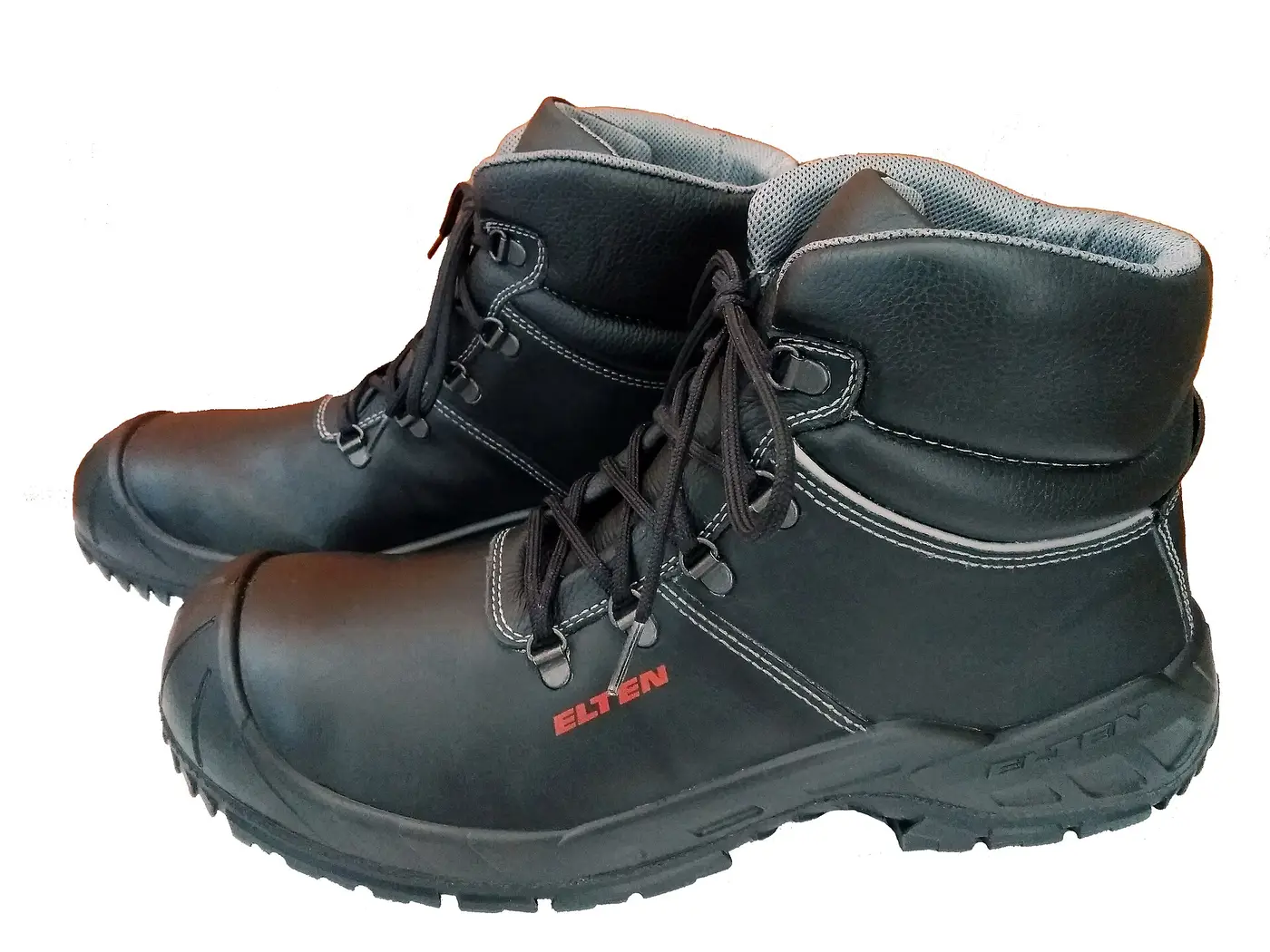
The European safety classes stack on top of each other, as explained in a technical guide from the manufacturer uvex. The basic class, SB, requires only the toe cap and slip resistance. S1 adds a closed heel, antistatic properties and heel energy absorption. S2 adds water resistance in the upper. S3, one of the most common classes on construction sites and in industry, combines all of that with a puncture-resistant insert and a cleated outsole. Two new classes introduced in 2022, S6 and S7, focus on keeping water out of the entire shoe.
The toe cap: 44 pounds from about three feet
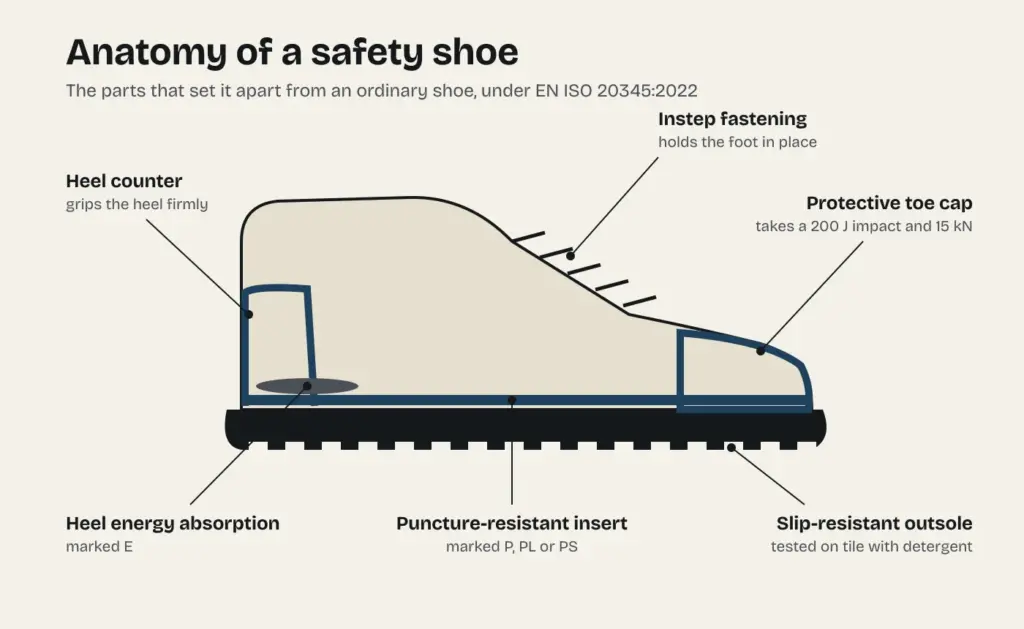
The European toe-cap test is exactly as dramatic as it sounds. According to uvex, the standard requires the toe cap to withstand a 200-joule impact, the equivalent of dropping a 20-kilogram weight, about 44 pounds, from roughly one meter, a little over three feet. It also has to survive 15 kilonewtons of static pressure, about 1,500 kilograms, or roughly 3,300 pounds. After the hit, what gets measured is how much room is left inside for the toes. The 2022 revision introduced two impact test types, A and B, with different minimum clearances afterward. Type B is the tougher one.
Toe caps can be steel or non-metallic, made from composites or engineered plastics. The standards don’t require one material over the other: they require the result to pass. The material does change other things, like weight or how the toe responds to cold and heat, which is why different trades lean one way or the other.
The outsole: tested on soapy tile
If there’s one hazard almost every standing job shares, it’s a slick floor. In the 2022 European revision, slip resistance became a basic requirement for all safety footwear instead of an optional extra. The old SRA, SRB and SRC markings were dropped, and a single additional marking, SR, now goes on footwear that passes an extra test on ceramic tile with glycerine.
The lab test is a strange little ritual. As testing company Eurofins describes it, a machine sets the shoe on a reference surface, tile or stainless steel, coated with a standard lubricant. The heel touches down at a 7-degree angle to mimic the moment a foot lands while walking, and the machine applies a 500-newton load, roughly the weight of a 110-pound person. Then it slides the shoe and measures how hard it resists. The lubricant in the basic European test is a solution of sodium lauryl sulfate, a detergent. The machine is, in other words, re-creating a freshly mopped floor. There are two main versions of the test, SATRA’s TM144 and the international ISO 13287, and they differ in the details: in TM144 the shoe starts sliding the instant the load reaches 500 newtons and friction is read 0.1 seconds in, while ISO 13287 allows a pause of up to 0.3 seconds and averages friction between 0.3 and 0.6 seconds of sliding.
The British footwear technology center SATRA doesn’t sugarcoat it when it talks about kitchen footwear. Workers can slip on dirty floors covered in spilled food or liquid, and on freshly cleaned floors where soap residue remains. And in a kitchen, a fall doesn’t happen in empty space: SATRA notes recorded cases of workers who, grabbing for something as they fell, plunged their hands into boiling oil or pulled a deep fryer down on themselves.
The insert that stops a nail
Between the insole and the outsole, many safety shoes carry a layer that keeps sharp objects from punching through. It can be metal or not. The 2022 European standard uses three codes for it. P is the metal version. PL and PS are non-metallic, and they differ by the test nail: 4.5 millimeters in diameter for PL and 3 millimeters for PS. The thinner the nail, the harder it is to stop, so PS indicates the more demanding protection.
Weight is paid for at the feet
A work shoe can be extremely protective and still be a burden. And weight on the feet is expensive. In 1969, researchers Richard Soule and Ralph Goldman published a classic study in the Journal of Applied Physiology on the energy cost of carrying loads on different parts of the body. As the studies that cite it report, the same weight carried on the feet cost between 4.7 and 6.3 times as much energy as carried on the torso, depending on walking speed. A pound in your boots is not a pound in your backpack.
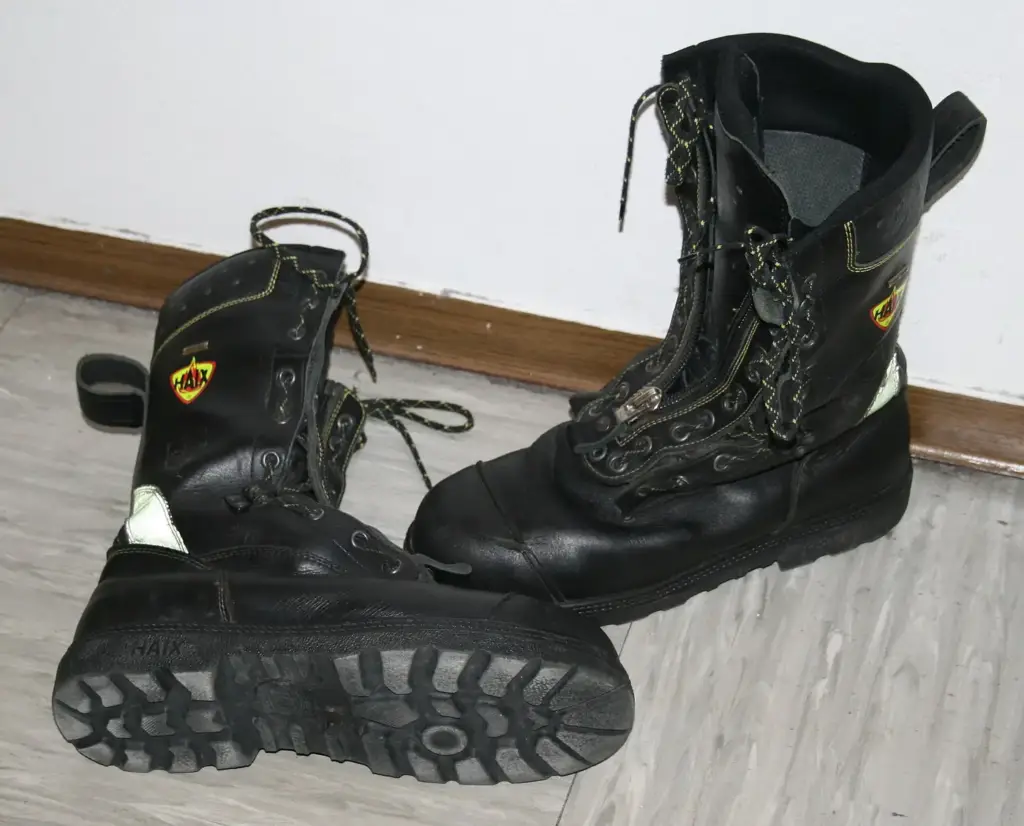
Firefighting boots offer an extreme example. These are boots loaded with protections: the pair pictured here carries, besides the S3 class, the markings HRO, HI and CI, additional requirements under the standard related to heat and cold. In a 2020 study in the journal Fashion and Textiles, seven young men walked in full firefighting gear wearing boots that weighed 3.2, 3.9, 4.6 and 5.3 kilograms per pair, roughly 7 to nearly 12 pounds. Body temperature and energy expenditure didn’t differ significantly between the boots, but heart rate climbed more in the heaviest pair, and the feeling of discomfort in the feet showed up before any measurable physiological change. The authors suggested capping boot weight at 5 percent of the wearer’s body weight, and noted that discomfort in the feet works as an early warning sign.
The shape: what a shoe needs for standing all day
Beyond the safety standards, there’s fairly broad agreement about the shape a shoe needs for long hours on your feet. The European agency’s report on prolonged standing reproduces a checklist from the Canadian Centre for Occupational Health and Safety. It says the inside edge of the shoe should run straight from the heel to the end of the big toe. The shoe should grip the heel firmly and leave the toes room to move. It should have a fastening across the instep that keeps the foot from sliding forward as you walk, and a low, wide-based heel.
The checklist also includes buying advice that lines up with what we explain in our story on why shoes feel tighter in the afternoon: don’t expect a tight shoe to stretch with wear, have both feet measured, buy for the larger foot and shop late in the afternoon. The same report points out that dress codes requiring heels higher than 5 centimeters, about 2 inches, change normal posture and how the leg muscles work, and it recommends that dress codes allow comfortable shoes and that workers be consulted. It also notes a view that standing work may have become more common in some customer-facing jobs simply because it’s thought to look better to customers.
Hygiene: no seams to hide in
In food plants and kitchens there’s one requirement most people never connect with shoes: cleanliness. SATRA stresses that all footwear in those settings has to be wipeable or washable. That’s why one-piece rubber boots are so common in food processing: no seams means no crevices where scraps of food and microorganisms can collect. Here, the shoe’s design answers a question that has nothing to do with the foot.
A full shift in a label
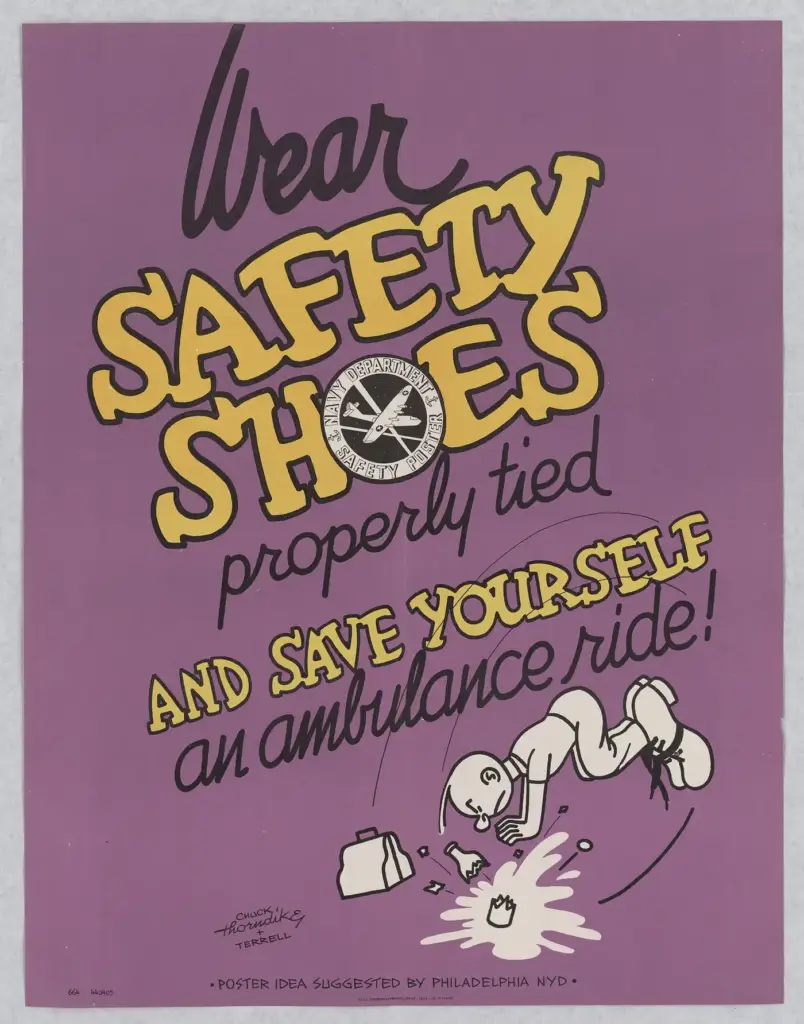
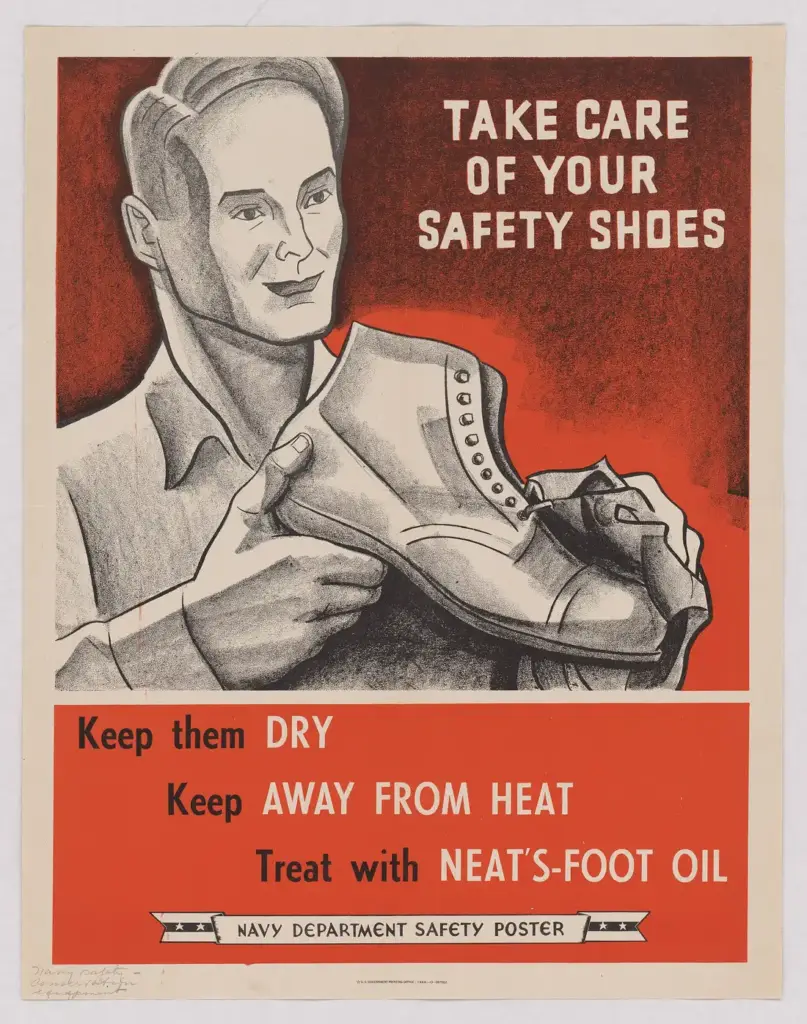
Safety shoes were a matter of national effort during World War II. The U.S. Office of War Information and the Navy Department put out posters telling workers to wear their safety shoes properly tied, and to look after them like any other tool: keep them dry, keep them away from heat, treat them with neat’s-foot oil. Today, all of that fits on a label made of letters and numbers.
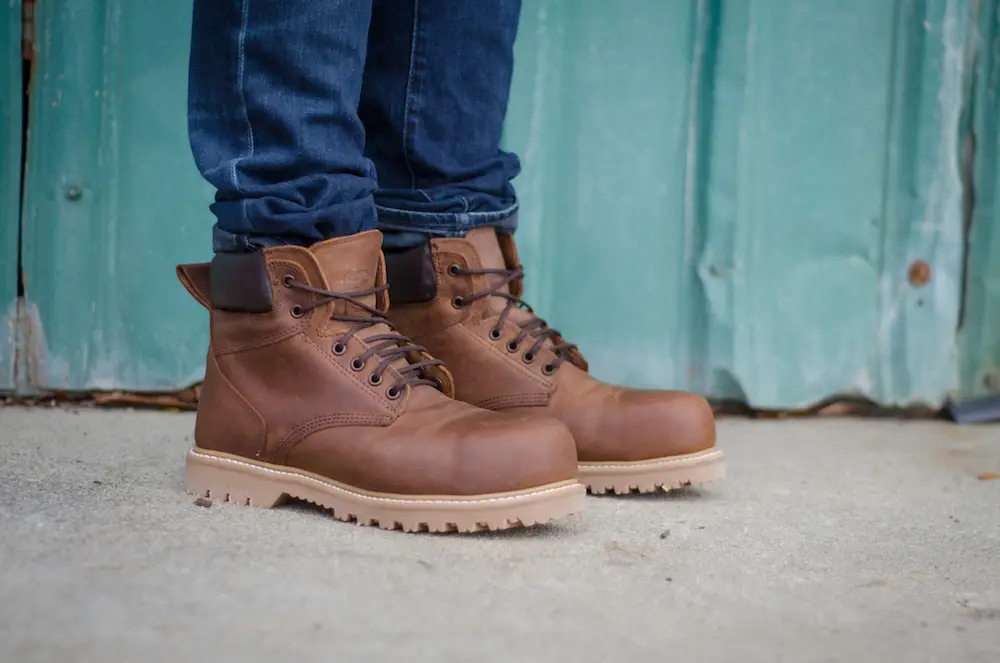
Learning to read it changes how you look at work shoes. An S3 boot isn’t “a tough boot.” It’s a boot with a toe cap tested at 200 joules, an insert that stops a nail, a cleated sole that held up on a soapy floor and an upper that keeps water out. A slip-resistant kitchen shoe isn’t “a white clog.” It’s footwear without a safety toe but with an outsole tested against slipping. And none of those letters tells you whether it fits. That’s still up to the last.
Sources
- K. Peereboom, N. de Langen and A. Bortkiewicz, Prolonged constrained standing at work: health effects and good practice advice, European Agency for Safety and Health at Work (EU-OSHA), citing the 2016 U.S. National Health Interview Survey (CDC), Messing et al. (2015) and a checklist from the Canadian Centre for Occupational Health and Safety (CCOHS).
- ASTM F2413, protective footwear standard, as referenced in OSHA’s 29 CFR 1910.136.
- uvex safety, “Guide to EN ISO 20345:2022”; Heckel, “Safety standards guide: footwear.”
- Eurofins, “Footwear slip resistance testing: SATRA TM144 and ISO 13287 explained.”
- SATRA Technology, “Footwear for food preparation personnel,” SATRA Bulletin.
- R. G. Soule and R. F. Goldman (1969), “Energy cost of loads carried on the head, hands, or feet,” Journal of Applied Physiology 27(5): 687–690.
- S. Roh, Y. Ko and J.-Y. Lee (2020), “Physiological and subjective burden when wearing fire protective boots between 3.2 and 5.3 kg,” Fashion and Textiles 7.
Image credits
- Class S3 safety boots: Francis Flinch. CC BY-SA 4.0, via Wikimedia Commons.
- Safety shoe diagram: feetkeepers.
- “Wear safety shoes properly tied” poster: U.S. Office of War Information. Public domain, via Wikimedia Commons.
- Firefighting boots: Pascal Rehfeldt. CC BY-SA 3.0, via Wikimedia Commons.
- “Take care of your safety shoes” U.S. Navy poster: U.S. Office of War Information. Public domain, via Wikimedia Commons.
- S3 safety boot: Thefabgeo. CC BY-SA 4.0, via Wikimedia Commons.