
You try on a pair at 10 a.m., they fit like a dream, and by 6 p.m. you want to throw them out the window. The shoes didn’t shrink, and you didn’t suddenly forget how to shop. Your foot at 10 isn’t the same foot at 6, and it isn’t the same sitting down as it is standing up. Here’s the twist: the explanation everyone repeats, that feet grow “up to a full size” by late afternoon, is the most exaggerated part of the story. The part that really matters almost never gets mentioned.
Yes, feet change. Less than you’ve been told
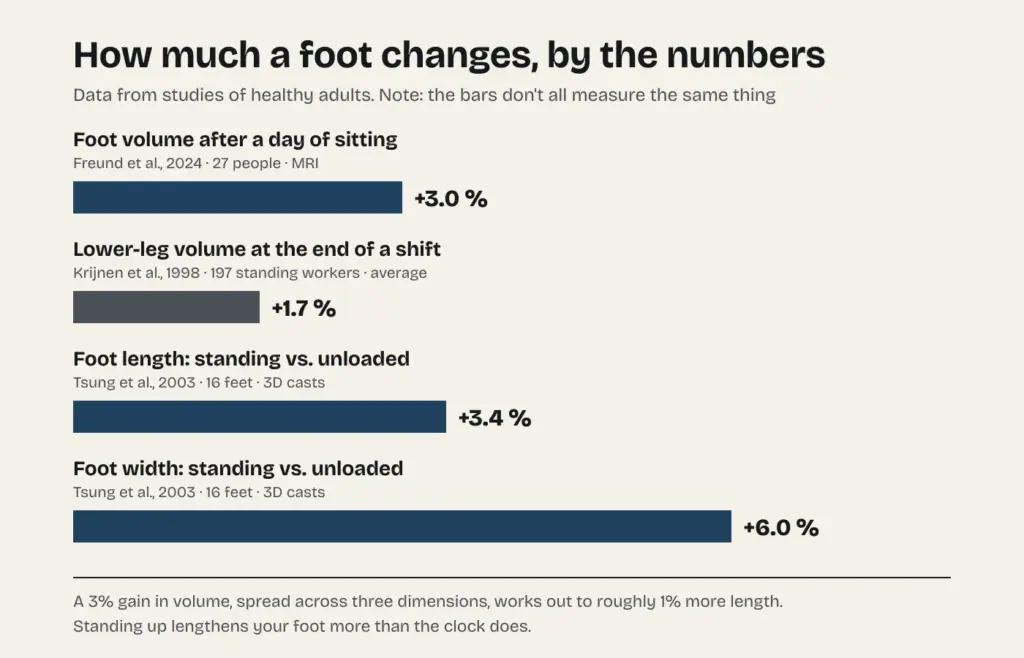
Start with the numbers, because this topic is full of folklore. In 2024, a team led by radiologists at University Hospitals Ulm in Germany published a study of 27 healthy volunteers in BMC Musculoskeletal Disorders. They scanned participants’ feet with MRI at the start and end of a day spent sitting at work. The foot left in a normal position gained about 14 milliliters on average, roughly 3 percent of its volume. Which foot got propped up was chosen at random. The other foot, kept elevated during the day, did the opposite and lost about 6 milliliters. Same person, same day, different position, different result. And the measuring was tight: when the researchers repeated the volume calculations, results differed by less than 1 percent.
If you work on your feet instead, the trend looks similar. In 1998, researchers at the Free University Academic Hospital in Amsterdam measured the lower legs of 197 healthy men whose jobs kept them standing, at the beginning and end of a full workday. Before including anyone, they ruled out vein problems with a physical exam and a Doppler ultrasound, so these were genuinely healthy legs. Lower-leg volume rose by an average of 1.8 percent on the left and 1.6 percent on the right. The more interesting finding was that the increase was common, not universal. Almost half the legs, 46 percent, gained more than about 50 milliliters, averaging around 141. But in nearly one leg out of five, volume didn’t change in any meaningful way, and the researchers concluded that the daily swing could be considered a normal physiological event in healthy people. Another detail stands out: 64 percent of the workers reported some kind of leg discomfort at the end of the day, but it showed up just as often in people whose legs gained volume as in those whose legs didn’t. Feeling “swollen” and what a measuring device records don’t always line up.
And some studies find nothing at all. In 2001, two researchers at a Dublin hospital measured the foot and ankle volume of 20 healthy people four times a day, taking three readings of each foot every time, with half of them walking around and half lying in bed for nine hours, and found no statistically significant change across the day. It wasn’t a precision problem. Their device, a volumeter that measures how much water a foot displaces, produced extremely consistent readings. With small samples and different methods, the honest summary is this: feet tend to gain a little volume over the day, in modest amounts, and not equally for everyone.
Why it isn’t “a full size”
The claim that feet swell by up to a full shoe size by late afternoon shows up in plenty of shoe-buying guides. We couldn’t find a single measurement that backs it up, and a bit of quick math shows why it’s unlikely.
A 3 percent gain in volume is not a 3 percent gain in length. Volume grows in three directions at once, length, width and height, so if the increase were spread evenly, each dimension would grow by about 1 percent. On a 10-inch foot, that’s about a tenth of an inch. As we explain in our story on shoe size, one U.S. size equals one barleycorn, a third of an inch. So even in a best-case scenario, we’re talking about less than a third of a size. The math is an approximation, because fluid doesn’t spread evenly through the foot, but it puts the myth in perspective.
None of this means you’re imagining it. A snug shoe doesn’t need a full size to start pinching. A few millimeters in the wrong place, across the instep or the widest part of the forefoot, is plenty.
Why it happens: gravity
The basic explanation is physics. When you spend hours standing or sitting, your feet sit below the rest of your body, and gravity encourages some fluid to collect in the lower legs. That’s why position matters as much as the hours on the clock.
The Ulm study shows it about as clearly as you could want: on the same day, in the same person, the foot in a normal position gained volume and the foot propped up lost it. Change the position and you change the foot.
What changes your foot most isn’t the time of day. It’s standing up
This is the part that rarely makes it into the advice. Your foot changes far more between sitting and standing than between morning and evening.
In 2003, researchers at Hong Kong Polytechnic University published a study that took 3D casts of the soles of 16 healthy feet, digitized with an optical scanner, under three conditions: no weight, half weight and full body weight. Going from no weight to full weight, feet got 3.4 percent longer and 6 percent wider on average. The heel area widened by 8.7 percent, the contact area of the sole grew by 60 percent and arch height dropped by 20 percent, while the angle of the arch flattened by about 41 percent. Even at half weight, feet were already 2.7 percent longer than unloaded. The authors flagged this directly as something to consider when choosing a shoe size and designing shoes and insoles.
In inches, that 3.4 percent on a 10-inch foot is about a third of an inch, a full U.S. size, just from standing up. On a foot four inches wide, the 6 percent adds roughly a quarter inch. Your arch works like a spring that flattens under your body weight, and as it flattens, the foot stretches out and spreads.
You can see it over the course of a workday, too. A 2024 study in the journal Healthcare used a pressure platform to measure the feet of 36 assembly-line workers, six of them women, before and after an eight-hour standing shift, and asked them to rate their discomfort with a standard questionnaire. By the end of the day, the total area of the sole in contact with the ground had grown significantly, and so had the foot discomfort the workers reported. What didn’t change was pressure, at the heel, the forefoot or overall. Their feet covered more ground but spread the load about the same way.
What the foot-measuring people say
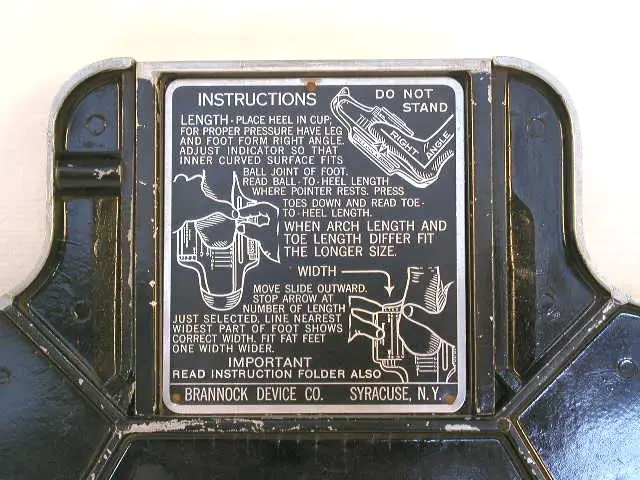
Nobody has measured more feet than the company that makes the Brannock Device, the silver plate you’ve probably stood on in a shoe store. Charles Brannock filed the patent for it in Syracuse, New York, in 1925, and it was granted in 1928. It reads length, width and the distance from heel to the ball of the foot in one go, it has heel cups at both ends so the clerk can spin it around for the other foot, and branches of the U.S. military adopted it in the 1930s and 1940s. Its fitting instructions boil all of the above down to three rules.
First, measure standing up. “The customer should stand with equal weight on both feet to ensure that the foot being measured has elongated and spread to its maximum size.” Second, measure both feet and fit the larger one, because “it is common to have feet of different sizes.” Third, mind the clock: “Have footwear fitted at a similar time as when you will be wearing the footwear. For daily footwear go when you’ve been on your feet all day your feet have expanded.”
The instruction plate on older Brannocks says it in raised letters: when the arch length and the toe length point to different sizes, fit the longer size.

So when should you buy shoes?
With all that on the table, the usual advice to shop in the afternoon holds up, just not for the reason usually given. Your feet don’t grow a full size. They’re simply at their largest of the day by then, so a shoe that fits in the afternoon won’t squeeze you later.
What matters even more is trying shoes on standing and walking, not sitting on the store bench. Sitting down, your foot is shorter and narrower than it will be when you’re actually wearing the shoe. It also helps to walk a few steps on a hard floor, not just the carpet in front of the mirror, so the shoe has to deal with your foot the way it will on the street. Bring the socks you plan to wear, too, because a thick sock and a thin one take up very different amounts of room. The Brannock instructions make a point of it: socks should be snug against the toes, without pulling them back, for an accurate measurement.
If a shoe only pinches late in the day, pay attention to where. If it’s across the instep or along the sides, the issue probably isn’t the size but the shape, and that’s down to the last the shoe was built on. Going up a size to buy width usually trades one problem for another: a shoe that’s too long.
The deeper issue is that most brands offer only one width per size. In 2019, researchers analyzed 1.2 million foot scans from stores across North America, Europe and Asia in Scientific Reports and found statistically significant differences between regions and between men and women, plus a wide spread of measurements even among people with the same foot length. They concluded that it would take at least three widths per length to fit 90 percent of customers. If your foot sits at one end of that spread, the small afternoon gain is exactly what turns a snug shoe into a tight one. It doesn’t help that length isn’t consistent either: the shoe-testing lab at RunRepeat measured more than a thousand pairs and found that a men’s size 9 ranged from 255 to 281 millimeters inside. That’s a gap of just over an inch, or about three full U.S. sizes hiding behind the same number on the box.

When it’s not about shoes
Everything above describes healthy people and small changes. If your feet or ankles swell a lot, if the swelling doesn’t go down overnight, if it shows up in only one foot or comes with pain, it isn’t a footwear question. See a physician or podiatrist.
Sources
- J. Freund, S. Wikstroem, A. Wunderlich, U. Schuetz and M. Beer (2024), “Sitting foot: posture dependent changes of volume, edema and perfusion of the foot. A prospective interventional study with 27 volunteers,” BMC Musculoskeletal Disorders.
- R. M. Krijnen, E. M. de Boer, H. J. Adèr and D. P. Bruynzeel (1998), “Diurnal volume changes of the lower legs in healthy males with a profession that requires standing,” Skin Research and Technology 4(1): 18–23.
- K. Moholkar and G. Fenelon (2001), “Diurnal variations in volume of the foot and ankle,” The Journal of Foot and Ankle Surgery 40(5): 302–304.
- B. Y. Tsung, M. Zhang, Y. B. Fan and D. A. Boone (2003), “Quantitative comparison of plantar foot shapes under different weight-bearing conditions,” Journal of Rehabilitation Research and Development 40(6): 517–526.
- A. Rabal-Pelay, C. Cimarras-Otal, B. Lacárcel-Tejero, A. Alcázar-Crevillén et al. (2024), “Changes in baropodometric evaluation and discomfort during the workday in assembly-line workers,” Healthcare 12(7): 761.
- The Brannock Device Co., “Instructions & Fitting Tips.”
- C. F. Brannock, U.S. Patent No. 1,682,366, “Foot-Measuring Instrument” (1928), and National Inventors Hall of Fame, “Charles F. Brannock.”
- A. Jurca, J. Žabkar and S. Džeroski (2019), “Analysis of 1.2 million foot scans from North America, Europe and Asia,” Scientific Reports 9: 19155.
- RunRepeat, “How to measure shoe size.”
Image credits
- Shoe store in Łódź, Poland: Rakoon. Public domain (CC0), via Wikimedia Commons.
- Foot change chart: feetkeepers.
- Cribb & Foote department store, Ipswich, 1949: State Library of Queensland. No known copyright restrictions, via Wikimedia Commons.
- Brannock Device instruction plate: Auckland Museum. CC BY 4.0, via Wikimedia Commons.
- Rhodes Department Store, Seattle, around 1925: Kenneth S. Brown. Public domain, via Wikimedia Commons.
- Shoe store in Białystok, Poland: Rakoon. Public domain (CC0), via Wikimedia Commons.