
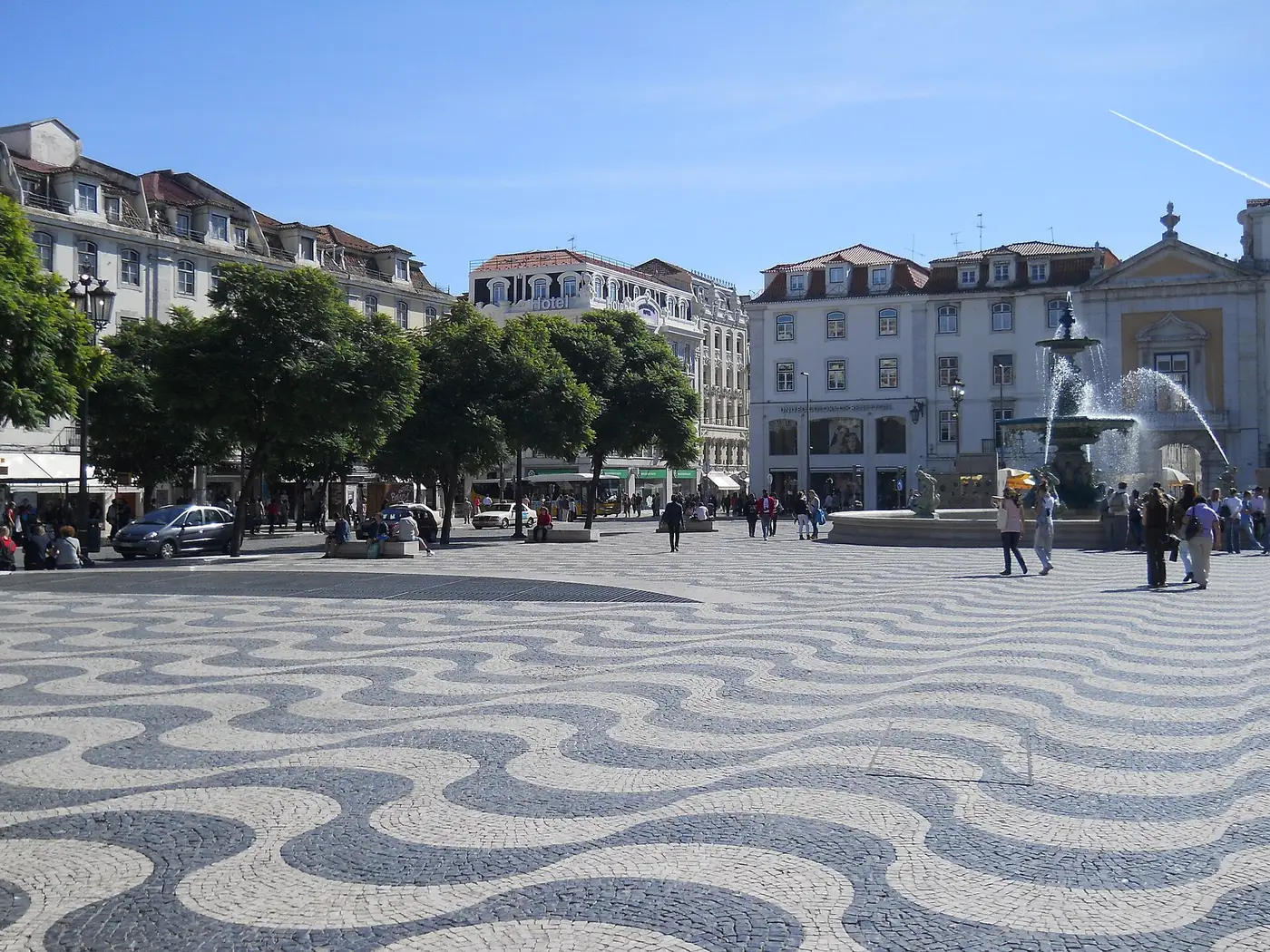
Every summer, the same scene plays out in Lisbon, Rome and every old European quarter that ends up on a travel feed. Visitors in thin flat sandals, sometimes plain flip-flops, leave the hotel at nine and get back at ten at night after covering half the city on stone. The next morning, their feet let them know about it. Hardly anyone stops to wonder what that half inch of rubber between foot and cobblestone was doing all day, or failing to do. It turns out researchers have measured a surprising amount of it, from heel speed to slip velocity, and the answers aren’t the ones you’d guess.
What a sole actually does
A sole has three jobs. The first is protection: keeping out whatever is on the ground, from a loose pebble to the heat of the asphalt. The second is cushioning: when your foot hits the ground, the force doesn’t appear all at once but builds over a split second, and a material that compresses a little softens that rise. The third, easy to forget, belongs to the upper: holding the foot, so the sole moves with you instead of lagging behind.
A thin flat sandal handles the first job reasonably well on a clean surface and the other two poorly. The question is how much that matters. And here the research gives more nuanced answers than the usual warnings suggest.
Pressure: flip-flops land between sneakers and bare feet
In 2008, two researchers from the podiatric medicine program at Midwestern University in Arizona compared the pressure on the sole of the foot in ten women walking in flip-flops, in athletic shoes and barefoot. They used in-shoe sensor insoles that record, step by step, how much pressure each area of the foot carries. All the women wore a women’s size 7 and had a body weight in the normal range, so differences would come from the footwear rather than the feet. Of the 18 comparisons the researchers made across foot regions and footwear, nine were statistically significant. In every one of them, flip-flops produced higher peak pressures than athletic shoes but lower pressures than bare feet.
The authors described it as a minor protective role: flip-flops act as a small shock absorber compared with bare feet. In other words, a flip-flop cushions a little, but a lot less than a sneaker. It isn’t the same as going barefoot, and it isn’t the same as wearing something with a midsole designed to absorb impact either.
The heel comes down twice as fast
In 2014, a team at the University of Salford in England published a gait analysis in the Journal of Foot and Ankle Research. Forty people, 20 men and 20 women with an average age of about 35, walked barefoot and in flip-flops across a force plate while reflective markers on their legs tracked every movement in 3D. The researchers also tested a flip-flop-style sandal with a wider strap set closer to the ankle and a thicker midsole made of several foam densities.
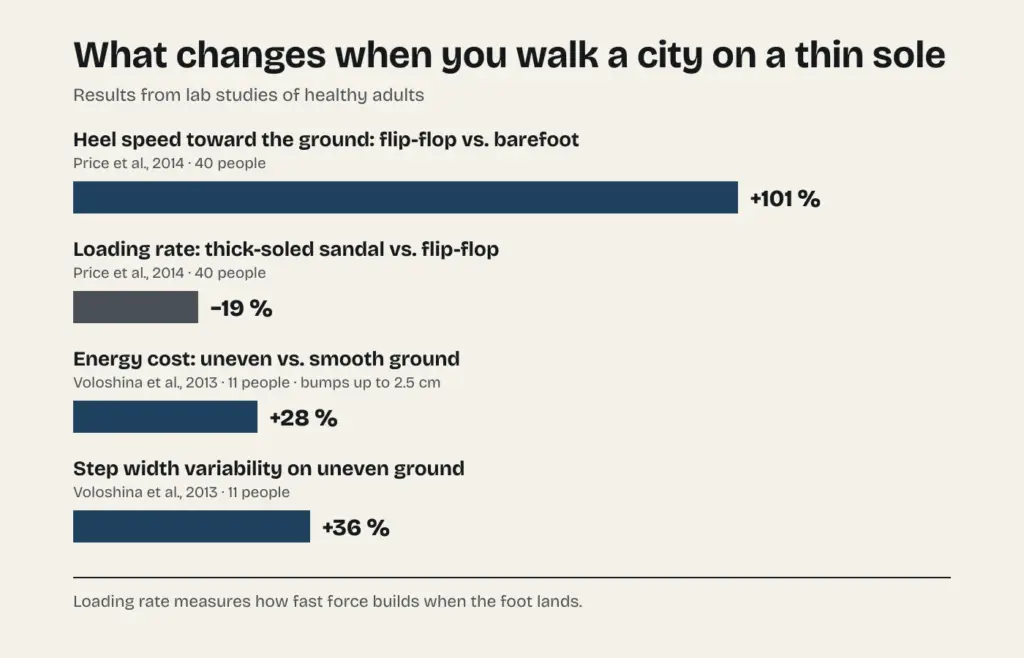
The results were specific. In flip-flops, the heel traveled toward the ground at 0.342 meters per second, compared with 0.170 barefoot: twice as fast. Interestingly, the thicker sandal with the wider strap didn’t fix that. Its heel came down at 0.326 meters per second, almost as fast as the flip-flop. The foot lifted higher while swinging through the air, with 7.6 degrees of peak ankle flexion versus 6.7 barefoot, and the tibialis anterior, the muscle that lifts the front of the foot, worked harder at the end of that swing. The sandal with the wider strap also reduced the inward roll of the ankle during stance: 3.5 degrees, versus 4.4 in the flip-flop and 4.3 barefoot. And it cut the maximum loading rate, meaning how fast force builds as the foot lands, by 19 percent compared with the flip-flop.
One reasonable explanation, though the study doesn’t test it directly, is that in a flip-flop the foot also has to keep the sandal attached. What’s measured is that the heel arrives in more of a hurry.
But it’s not all worse
Before declaring war on flip-flops, read the next study. In 2018, researchers at Hong Kong Polytechnic University published a study of ten healthy men in PLoS One. The men walked over ground at their own chosen pace, barefoot, in sports shoes and in flip-flops, and the team fed their data into a computer model of the musculoskeletal system to estimate the forces inside the joints. They checked that the model’s output lined up in time with the electrical activity they measured directly in the muscles.
Compared with sports shoes, the men walked more slowly in flip-flops, their ankles moved through a bigger range, and one of the forces in the ankle joint, the sideways one, was higher. But compared with walking barefoot, the researchers found no significant differences in muscle co-activation, joint motion or the forces at the knee and ankle. They suggested that the slower walking speed and the design of the sandal itself might explain the resemblance to barefoot walking, and concluded that it remains unclear whether walking in flip-flops is harmful.
Put the three studies together and the picture is consistent and cautious. A thin sole behaves more like bare feet than like a sneaker. That changes how you walk, but it doesn’t make flip-flops dangerous on its own. What the city adds is what you’re walking on, and for how long.
Cobblestones change the rules
Most gait studies happen in a lab, on perfectly flat, uniform floors. An old city is something else: stone, joints, dips, curbs and hills. In 2013, a team at the University of Michigan published an experiment on walking over uneven terrain in the Journal of Experimental Biology. They built a treadmill covered with blocks that created bumps of up to 2.5 centimeters, about an inch, and had eleven healthy people walk on it at a steady 1 meter per second, about 2.2 miles per hour.
On the uneven surface, participants shortened their steps by 4 percent and kept the same average step width, and their stepping became far less consistent: step length variability rose 22 percent and step width variability 36 percent. Positive work at the knee rose 28 percent and at the hip 62 percent, braking work at the knee rose 26 percent, and seven muscles in the lower leg and thigh became more active. The bottom line was a 28 percent jump in the energy it took to walk at the same speed, much of which the researchers traced to that extra knee and hip work.
A rough cobblestone street, or a sidewalk full of heaved-up pavers, is an everyday version of that terrain. Every step is a little different from the last, and your body keeps making adjustments. With a thin, flexible sole, those irregularities reach the bottom of your foot almost unfiltered, so the foot has to adapt to every stone instead of resting on a surface that spreads them out.
Polished stone and rain: the Lisbon problem
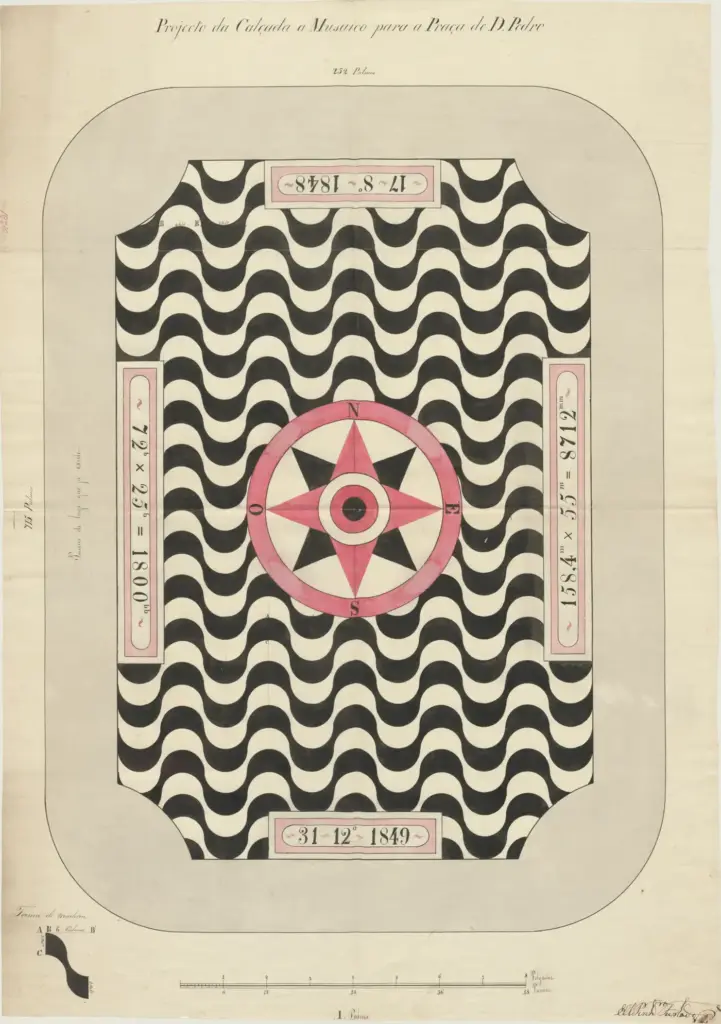
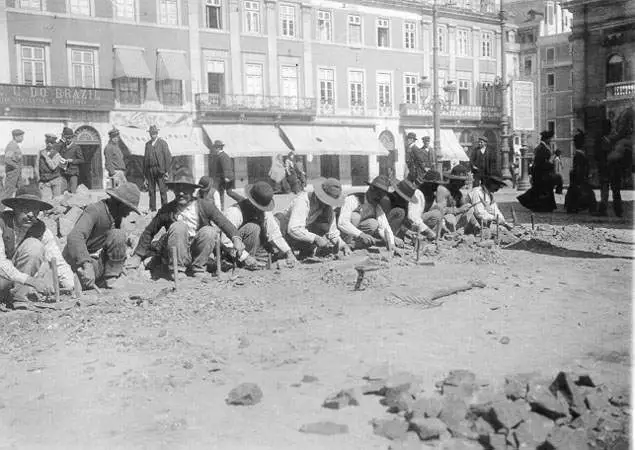
Few cities tell this story better than Lisbon. Its famous calçada portuguesa, the mosaic of small white and black stones covering its squares and sidewalks, was first used in its current form between 1840 and 1846, during repairs at São Jorge Castle directed by the military engineer Eusébio Pinheiro Furtado. In 1848, Furtado paved Rossio Square in a wave pattern honoring the sea crossed by Portuguese sailors, and the style spread across the country. Furtado’s original plan for the square, dated to around 1850, survives and is now in the public domain; it’s reproduced below. It reached Barcelona’s Salón de San Juan in 1896 and Brazil in 1901, first in the Amazon city of Manaus, where it would eventually become the famous wave-patterned promenade along Avenida Atlântica in Copacabana.
It’s gorgeous, and it has a well-known downside. According to Wikipedia, drawing on its sources, the pavement is especially slippery, a condition made worse by wear, which polishes the stone, and by rain. Porto in 2005 and São Paulo in 2007 replaced significant stretches with modern materials. Stepping on polished, wet limestone in a smooth, thin sole is exactly the scenario slip-resistant outsoles are designed for, as we explain in our story on work shoes.
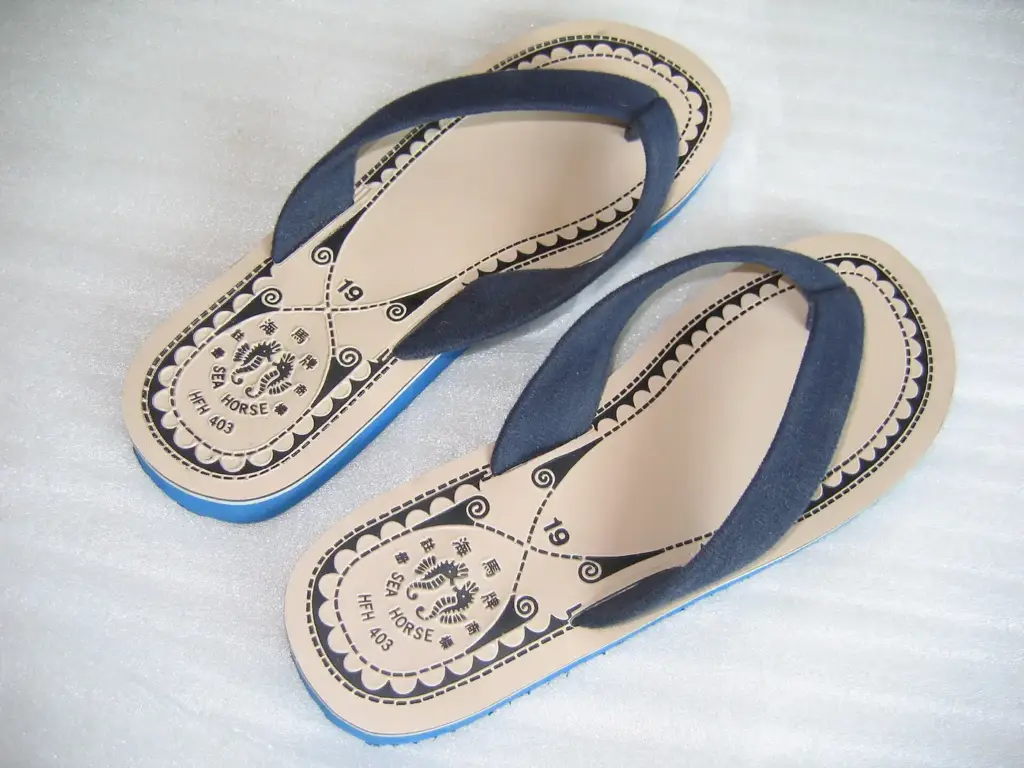
Flip-flops add a wrinkle. In a study published in 2021, a team at the University of Waterloo in Canada triggered controlled slips in people wearing flip-flops on dry and wet tile, with 40, 50 or 60 percent of their body weight on the slipping foot. On wet tile, the more weight on that foot, the faster it slid, up to about one meter per second faster. They also saw something that doesn’t happen with a closed shoe: when the foot lost contact with the floor, the flip-flop could slip off the heel. That decoupling happened most often when the tile and the footbed were both dry or both wet. The researchers even tested a condition with a wet footbed on wet tile, the realistic version of a summer storm. They concluded that in flip-flops, a slip can happen in two places at once, between the foot and the sandal and between the sandal and the floor.
Ground that burns
In summer, the problem isn’t only the shape of the ground. It’s the temperature. According to the U.S. Environmental Protection Agency, conventional pavements like asphalt can reach surface temperatures of up to 152°F at midday. So-called cool pavements, designed to reflect more sunlight, stayed 10 to 16 degrees cooler in the measurements the agency cites. With a sole only a few millimeters thick, all that separates the bottom of your foot from that surface is that material and how long the heat takes to work its way through.
What to look for in a sandal for walking a city
None of this means giving up sandals for the summer. It means they don’t all do the same job. Based on the research, three design features make a difference.
The first is how it holds on: a strap that grips the instep or the heel keeps the sandal attached to the foot, which a single toe post doesn’t. The second is the sole: in the Salford study, the sandal with a wider strap and a thicker, multi-density midsole cut the loading rate by 19 percent compared with the flip-flop. The third is the tread pattern, which decides how well the sole grips polished, wet stone.
A thin, flat, loose sandal is comfortable at the beach, by the pool or for a quick errand. A city of stone, hills and rain is different terrain, and it asks for a different sole. If your feet still hurt days after a long walk, that’s no longer a footwear question: see a podiatrist or physician.
Sources
- T. J. Carl and S. L. Barrett (2008), “Computerized analysis of plantar pressure variation in flip-flops, athletic shoes, and bare feet,” Journal of the American Podiatric Medical Association 98(5): 374–378.
- C. Price, V. Andrejevas, A. H. Findlow, P. Graham-Smith and R. Jones (2014), “Does flip-flop style footwear modify ankle biomechanics and foot loading patterns?,” Journal of Foot and Ankle Research 7: 40.
- T. L. Chen, D. W. Wong, Z. Xu et al. (2018), “Lower limb muscle co-contraction and joint loading of flip-flops walking in male wearers,” PLoS One 13(3): e0193653.
- A. S. Voloshina, A. D. Kuo, M. A. Daley and D. P. Ferris (2013), “Biomechanics and energetics of walking on uneven terrain,” Journal of Experimental Biology 216: 3963–3970.
- L. M. Tennant, D. J. Fok, D. C. Kingston et al. (2021), “Analysis of invoked slips while wearing flip-flops in wet and dry conditions: does alternative footwear alter slip kinematics?,” Applied Ergonomics 92: 103318.
- U.S. Environmental Protection Agency, “Using cool pavements to reduce heat islands.”
- Wikipedia, “Portuguese pavement,” and the references it cites.
Image credits
- Rossio Square, Lisbon: David Holt. CC BY-SA 2.0, via Wikimedia Commons.
- Study chart: feetkeepers.
- Flip-flop: WikiCantona. CC BY-SA 3.0, via Wikimedia Commons.
- Rossio paving plan (1850), Eusébio Cândido Pinheiro Furtado. Public domain, via Wikimedia Commons.
- Paving workers in Lisbon (1907): Joshua Benoliel. Public domain, via Wikimedia Commons.
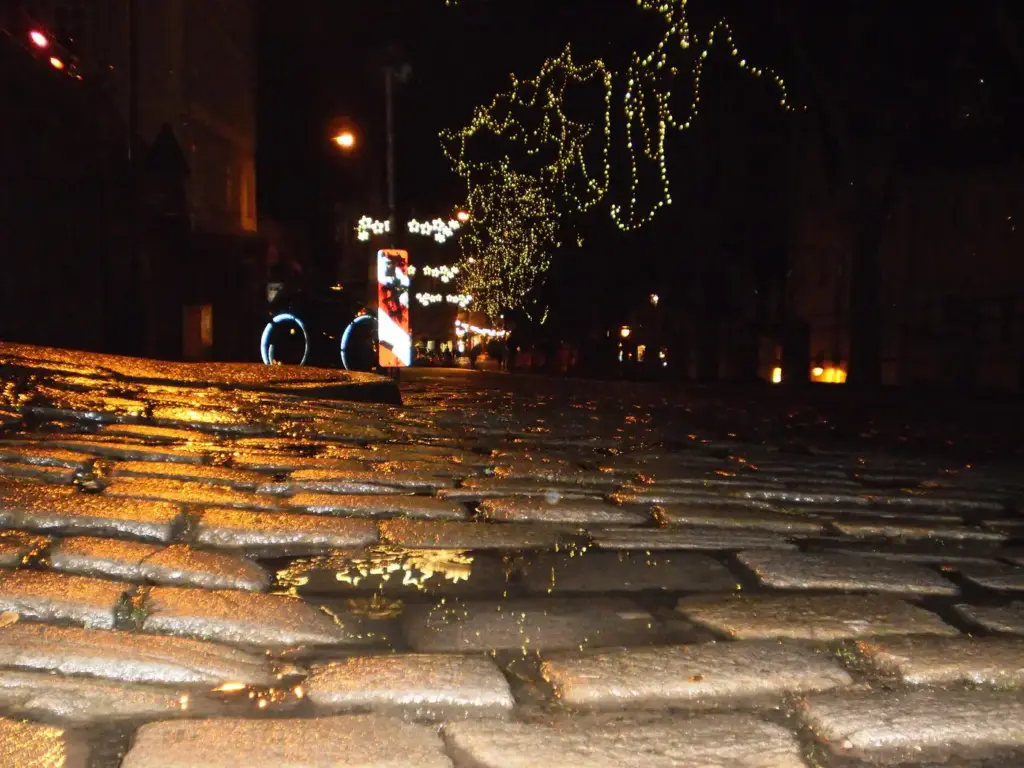
- Cobblestone street in Marburg: Ludwig Sebastian Micheler. CC BY-SA 4.0, via Wikimedia Commons.