
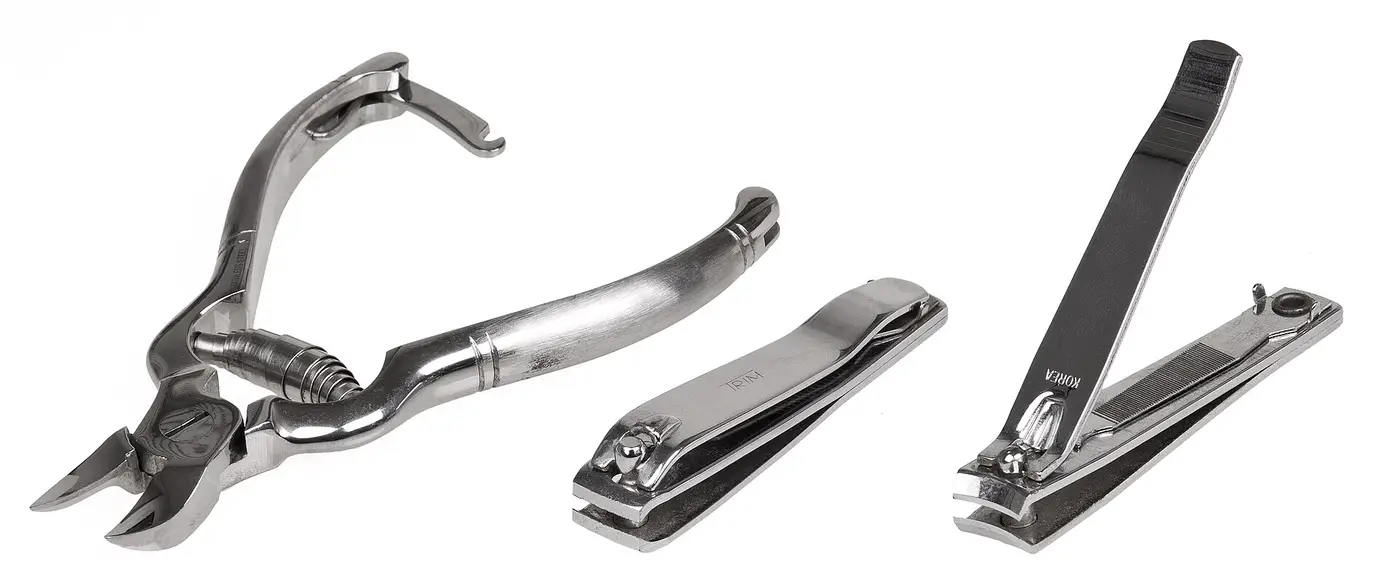
The 18-piece pedicure kit sitting in a gift box at the drugstore is mostly theater. Pull everything out of its velvet slots and sort it by what it does instead of what it looks like, and the kit collapses. Nearly every tool in there either cuts, abrades or rasps. For each of those three jobs, you usually own two or three tools doing the same thing in slightly different shapes.
This isn’t a how-to. It’s the part the packaging skips: how each tool works, what it’s made of and where it came from. A few of them have better origin stories than most famous inventions. There’s a Cincinnati patent with a glove hook, a Greek island that supplied the world’s abrasive for two thousand years, a pair of royal manicurists in ancient Egypt, a woodworking rasp from Arkansas that ended up in the kitchen and then the bathroom, and a Minnesota Twins pitcher who got caught with an emery board on the mound.
Three ways to take material off
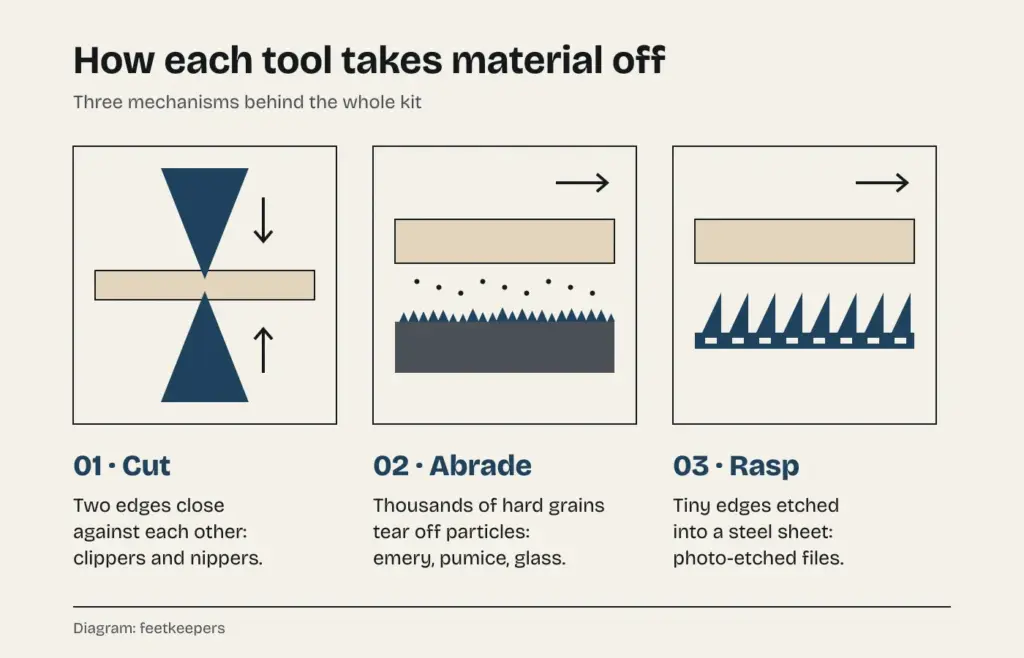
Everything in a pedicure kit exists to remove a little nail or a little skin. With a hand tool, there are only three ways to do that.
You can cut. Two edges move toward each other until they meet, and the material separates along a clean line. That’s how clippers and nippers work. Scissors cut too, but differently: their blades don’t collide, they slide past each other, and the material fails by shearing, the way paper does.
You can abrade. A surface covered in grains harder than the material you’re working on tears off tiny particles with every stroke. Each grain behaves like a microscopic blade, and what your fingertip reads as “rough” is really thousands of little cutting points. Emery boards, glass files and pumice all work this way.
Or you can rasp. Instead of loose grains glued to a backing, a rasp has tiny cutting edges formed right into a sheet of metal, all identical and all facing the same way. That’s the principle behind metal files and the photo-etched foot rasps that migrated into the bathroom from a woodshop.
Keep those three categories in mind and the kit starts to read very differently.
What’s on the other side of the blade
It helps to know what you’re cutting. Encyclopaedia Britannica describes the nail as a horny, translucent plate made of keratin and built from highly specialized epithelial cells. It’s the human version of a claw, hoof or talon. All of a nail’s growth happens at its base, where new cells form and push the older ones forward. The plate is attached to the nail bed underneath, a tissue rich in blood vessels that supplies it with nutrients, and the front edge turns white once it loses contact with that bed. The pale half-moon at the base, the lunula, isn’t attached to the bed either. The nail’s main job is protecting the tips of the fingers and toes, which is exactly what the toe cap does in a safety boot.
Toenails also run on a slower clock. In a study published in 2010 in the Journal of the European Academy of Dermatology and Venereology, researchers at the University of North Carolina at Chapel Hill had 22 healthy young adults mark their nails with a file near the base, following a standard protocol, and record how far the mark had traveled one to three months later. Fingernails grew an average of 3.47 millimeters a month. Toenails grew 1.62, less than half as fast. The big toenail outpaced the other toes. The authors also noted that their numbers were higher than estimates made decades earlier. That slower pace is why a pedicure comes around far less often than a manicure.
Nail clippers: one lever pushing another
Before clippers, people trimmed their nails with small knives. In his Epistles, written around 20 BC, the Roman poet Horace describes a freshly shaved man sitting in an empty barber’s booth, calmly cleaning his nails with a penknife. The clipper on your keychain is far younger. The first U.S. patent for an improvement in “finger-nail trimmers” was filed by Valentine Fogerty in 1875, followed by William C. Edge in 1876 and John H. Hollman in 1878.
The 1881 entry is the one worth reading. Eugene Heim and Celestin Matz, two inventors from Cincinnati, patented a trimmer whose jaws were formed from a single plate of spring steel and closed by a lever with a cam-shaped head. According to the patent itself, the device also carried a filing surface and a hook suitable for buttoning gloves. This was an era when buttoning your gloves called for a dedicated tool, and somebody figured it might as well ride along with the thing that trimmed your nails.
More patents piled up. George H. Coates filed one in 1885 for a “finger-nail cutter,” and the Hungarian inventor David Gestetner filed another in 1886. Chapel S. Carter, then secretary of the H. C. Cook Company in Ansonia, Connecticut, patented improvements in 1905 and again in 1922 with Hedley P. Carter. Around 1928, by then the company’s president, Carter claimed its “Gem” clipper had been introduced in 1896, a date that comes from the company itself. In 1947, William E. Bassett launched the “Trim” clipper, building on the jaw-style design that had been around since the 1800s.
The keychain clipper is a neat bit of engineering. It’s a compound lever: two levers in a chain. The top lever, the one you press with your thumb, bears down on the upper jaw very close to the pivot that jaw swings on. Your thumb travels a long way while the jaw moves only a little, and that trade is exactly what multiplies the force. The upper jaw is itself a second lever, closing against the lower one. The result is that a casual squeeze becomes a lot of pressure concentrated on two short edges meeting head-on, which is also why those edges only travel a few millimeters.
The shape of those edges isn’t random. As Wikipedia summarizes from its sources, clippers with a convex cutting head are meant for toenails, and concave heads are meant for fingernails. Some have the head set parallel to the handle instead of perpendicular to it, a layout meant to make toes easier to reach. Then there’s the plier-style nipper: two long handles that close like a pair of pincers, with even more leverage and a wider mouth. Most clippers of both kinds are made of stainless steel.
Scissors and nippers bite differently
Scissors and nippers look like cousins, but they cut in different ways. In nippers and clippers, the two edges travel in the same plane until they touch, like two teeth biting down, and the nail splits under compression between them. In scissors, the blades cross. Each has a sharpened edge that slides past the other’s, and the material breaks at the precise point where the two edges meet. That’s why scissors need their blades snug at the pivot screw. If the blades drift apart, whatever is between them bends instead of cutting.
A typical kit holds all three: clippers, curved scissors and nippers. All three cut. What changes is the size of the mouth, the leverage and how much control you feel. The job is the same.
Emery boards, from a Greek island to a pitcher’s pocket
The classic file is the emery board. Emery is a dark, granular rock made mostly of corundum, which is aluminum oxide, mixed with other minerals such as magnetite. Because it’s a mixture, it has no single hardness. Corundum rates a 9 on the Mohs scale, just below diamond’s 10, while some of the minerals mixed in with it sit closer to 6. Crushed, or naturally eroded into what’s known as black sand, it becomes the abrasive on emery boards and emery cloth. For centuries, the Greek island of Naxos was the main source. Emery has been mined on its eastern side for more than two thousand years, and Pliny the Elder mentions it in his Natural History. Today, Turkey and Greece are the leading suppliers.
The disposable emery board has New York roots. It’s usually credited to J. Parker Pray, a New England podiatrist who made a fortune selling foot powders and cosmetics, and to Mary E. Cobb, his wife at the time. In 1878, Cobb had opened a manicure salon in Manhattan called “Mrs. Pray’s Manicure,” and she went on to run branches in Chicago, Washington, Boston and Philadelphia. The exact year of the design filing is unclear: sources give either 1883 or 1884, and we weren’t able to examine the original document.
The numbers printed on files refer to grit size. The higher the number, the smaller the abrasive particles and the finer the finish. A two-sided file with a different number on each face is really two tools glued back to back.
Then there’s the emery board story no beauty catalog will tell you. On August 3, 1987, during a game against the California Angels in Anaheim, umpires asked Minnesota Twins pitcher Joe Niekro to empty his pockets. When his hands came out, an emery board and a piece of sandpaper went flying. According to the UPI report, American League president Bobby Brown suspended him for doctoring baseballs. Niekro’s defense was that he sometimes had to file his fingers between innings, and that he carried sandpaper as a backup because the emery board stopped working once it got wet. Teammate Tommy John filled in the details: knuckleball pitchers filed their nails so the edge was straight across, which put more nail in contact with the ball. On a ballfield, a nail file was a work tool. Apparently it was also something else.
Glass files: Czech glass with no grains to shed
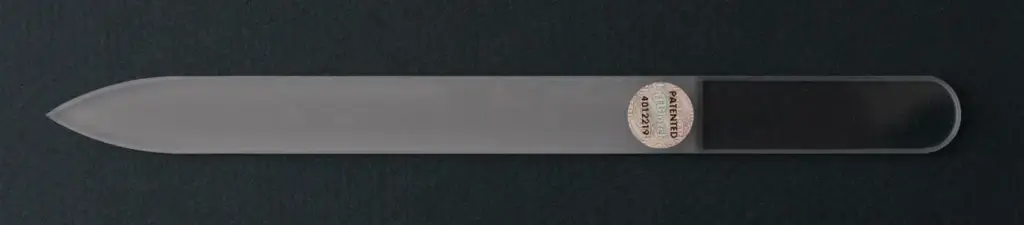
A glass file abrades like an emery board, with one key difference: there are no grains glued onto a backing. The rough surface is etched into the glass itself. The Czech company Blažek, which says it invented and patented the glass nail file in 1997, describes using heat-hardened Bohemian glass with an acid-etched filing area. Because the abrasive is the glass, there are no particles to break loose from a backing over time, which is what eventually happens to cardboard. The invention and the date come from the manufacturer; we couldn’t locate them in a public patent record.
Pumice: the oldest tool in the kit
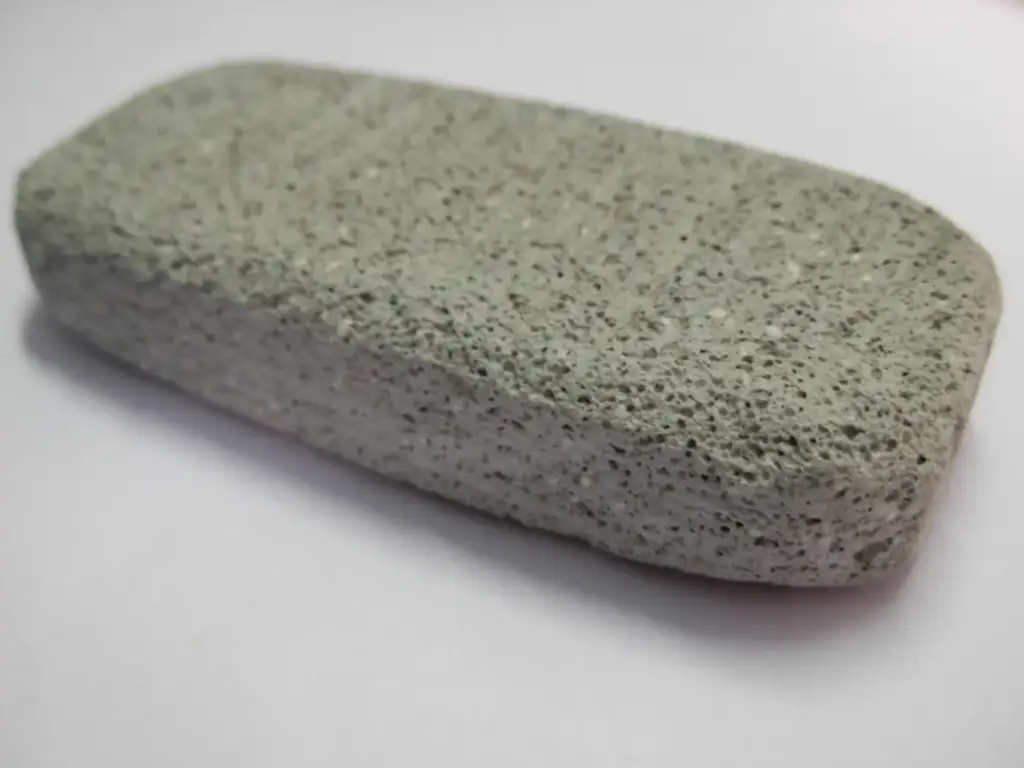
Pumice is the elder statesman of the kit. The U.S. Geological Survey describes it as a highly porous volcanic glass. Those pores are what make it so light, and when you rub it, the rims of the open pores act as the abrasive, the same way the grains on a file do. In 2023, the United States produced about 310,000 metric tons of pumice and pumicite from 10 operations in five states, and a small share of that went into abrasives and cosmetic exfoliants.
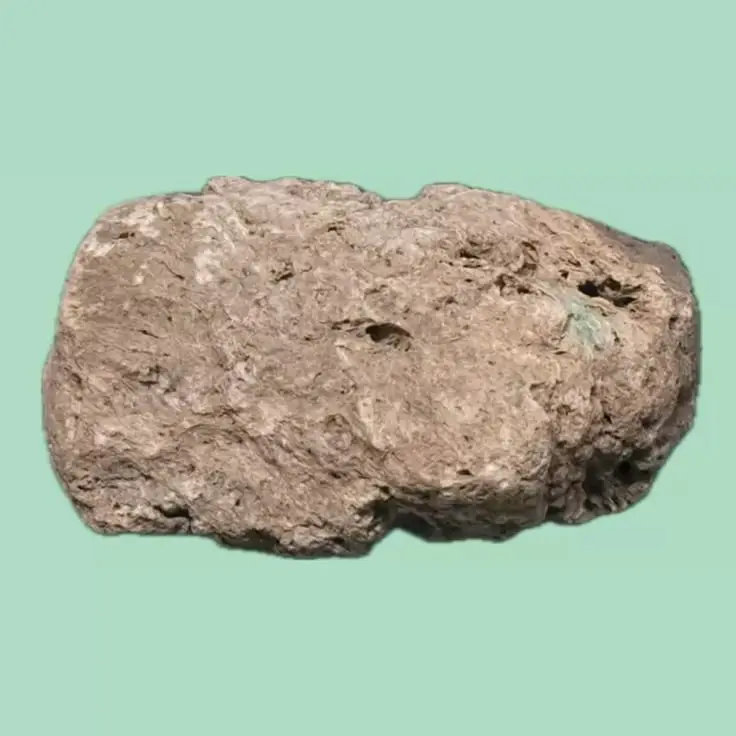
People have been using it on their bodies for a very long time. Oxford’s Ashmolean Museum holds a pumice stone found in the tomb of a woman named Maket at Lahun, in Egypt, dated to the 18th Dynasty, which makes it more than 3,000 years old. Egypt also preserves an even older record of the trade itself. In the necropolis of Saqqara lies the tomb of Niankhkhnum and Khnumhotep, two court officials under the pharaoh Nyuserre of the Fifth Dynasty, roughly 4,400 years ago. Among their titles, according to Wikipedia’s summary of the scholarship on the tomb, was “overseer of the manicurists in the palace.” Looking after the king’s nails was a job with its own title, carved in stone.
From the woodshop to the kitchen to your feet
The metal rasp has the strangest résumé in the kit. In 1990, brothers Richard and Jeff Grace, who owned Grace Manufacturing in Russellville, Arkansas, came up with a woodworking rasp they called the Microplane. Their company had spent almost two decades making parts for the printer industry using photochemical machining, and this was the first product of its own design.
That manufacturing process is why the rasp cuts so cleanly. A steel sheet is coated with a resist that reacts to ultraviolet light and exposed through a stencil carrying the pattern of the teeth. Where the light hits, the resist hardens; where it doesn’t, it washes away. Then a heated acid dissolves the exposed metal. What’s left is hundreds of identical cutting edges, without the burrs a stamping press leaves behind.
For its first three years, the rasp sold so poorly that the Graces considered making something else. The turn came in 1994, when Lorraine Lee, a home cook in Ottawa, used one to zest an orange for an Armenian orange cake. The result impressed the Canadian tool retailer Lee Valley enough that it rewrote the product description in its catalog, and a woodworker’s rasp became a kitchen classic. A decade later, in 2004, the company started getting calls from women who were using its kitchen graters on their feet. Its answer was a foot file with 95 tiny photo-etched files on a single piece. Same edges, same process, same factory in Arkansas.
It’s the clearest example of the kit’s third family: edges formed into metal, all facing one way, cutting only on one direction of the stroke.
The redundant half
With the three families sorted, a typical kit breaks down like this. For cutting: clippers, scissors and nippers. For abrading: an emery board, sometimes a glass file, and a pumice stone. For rasping: a metal file. Alongside them sit the tools for pushing back the skin at the base of the nail, which move material rather than remove it, plus a pair of tweezers.
Within each family, the tools do the same job with different geometry: a wider mouth, a curved blade, a finer grit. Measured by function, one tool from each family covers everything the full kit does. The rest are variations in size, curve and comfort, and in an 18-piece kit that’s easily more than half of it.
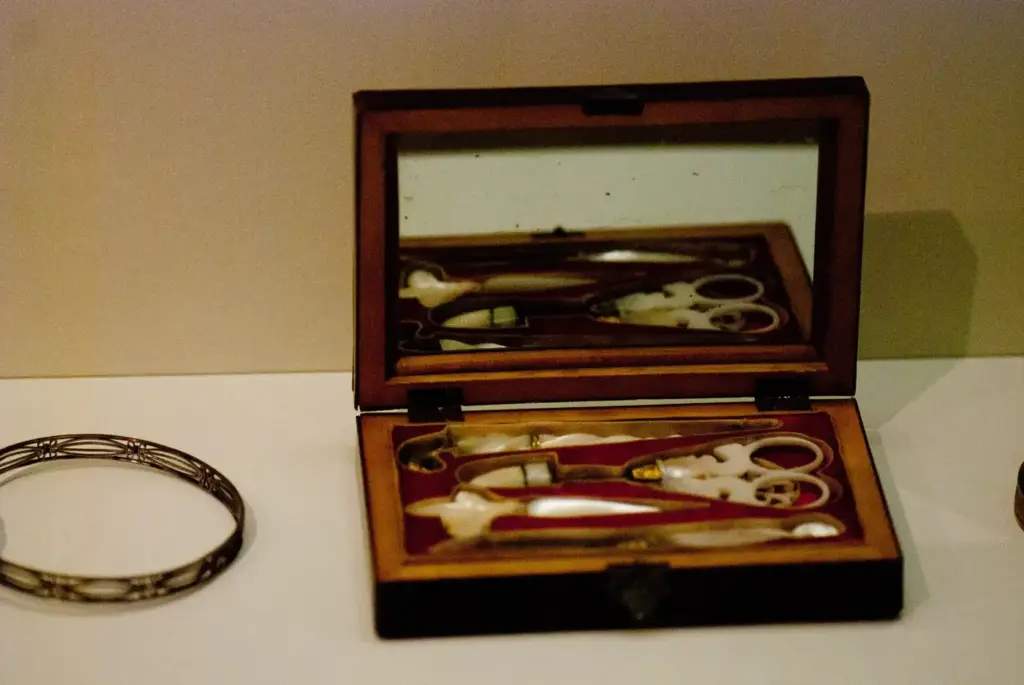
Grooming sets with lots of pieces are nothing new. European museums hold antique manicure sets with scissors, files and tweezers fitted into lined cases, like the one below, on display in Leipzig.
Which tools earn a place in your drawer comes down to your hands, your eyesight and your habits. If you have diabetes or circulation problems, or any question at all about the skin or nails on your feet, that’s a job for a podiatrist or physician.
Sources
- Encyclopaedia Britannica, “Nail (anatomy).”
- S. Yaemsiri, N. Hou, M. M. Slining and K. He (2010), “Growth rate of human fingernails and toenails in healthy American young adults,” Journal of the European Academy of Dermatology and Venereology 24(4): 420–423.
- E. Heim and C. Matz, U.S. Patent 244,891, “Nail-trimmer” (1881).
- Wikipedia, “Nail clipper,” “Emery (rock),” “Nail file,” “Mary E. Cobb,” “Niankhkhnum and Khnumhotep” and “Photochemical machining,” and the references they cite (USPTO patents, Pliny the Elder, New York’s Great Industries, 1885).
- UPI, “Minnesota pitcher Joe Niekro was suspended Wednesday…” (August 5, 1987).
- Blažek, manufacturer information on the glass nail file.
- U.S. Geological Survey, Mineral Commodity Summaries 2024, “Pumice and pumicite.”
- Only in Arkansas, “Microplane: from woodworking to pedicures,” and press coverage of Grace Manufacturing’s history.
Image credits
- Assorted nail clippers: Evan-Amos. Public domain, via Wikimedia Commons.
- Tool mechanisms diagram: feetkeepers.
- Glass nail file: 0x6d64. CC BY 3.0, via Wikimedia Commons.
- Pumice stone: Ambuj Saxena. CC BY 2.0, via Wikimedia Commons.
- Pumice stone from the tomb of Maket, Ashmolean Museum: SpeakingArch. CC BY-SA 4.0, via Wikimedia Commons.
- Antique manicure set: Thomas Quine. CC BY 2.0, via Wikimedia Commons.