
Shoe insoles get bought as if they were one thing. They’re a sandwich. Under your foot sits a top cover that touches your skin, a foam that squashes and springs back, and a base that sets the shape, and each of those layers is made from a material picked for a specific physical property. That’s what this story covers: materials, shapes and how each part works. It doesn’t cover which insole helps with which condition, because that question doesn’t get answered on a website. It gets answered by a podiatrist.
Three things called an insole
The word insole covers at least three different parts. The first one you never see: the insole board, the layer the upper is lasted onto at the factory, which the edges of the leather are fastened to and, in some shoes, the sole gets stitched to. We cover it in our story on how shoes are made.
The second is the removable footbed, or sockliner, that comes in almost every shoe and sneaker. It’s a thin piece of foam with fabric on top, and its job is to put a soft, comfortable layer between your foot and whatever’s below.
The third is the insoles you buy separately to slip into a shoe, and the ones custom-made from the shape of a particular person’s foot. Custom devices are professional work, designed and fitted by a podiatrist for each case. What we can talk about here, for all of them, is what they’re made of and the physics behind them.
Three layers, three jobs
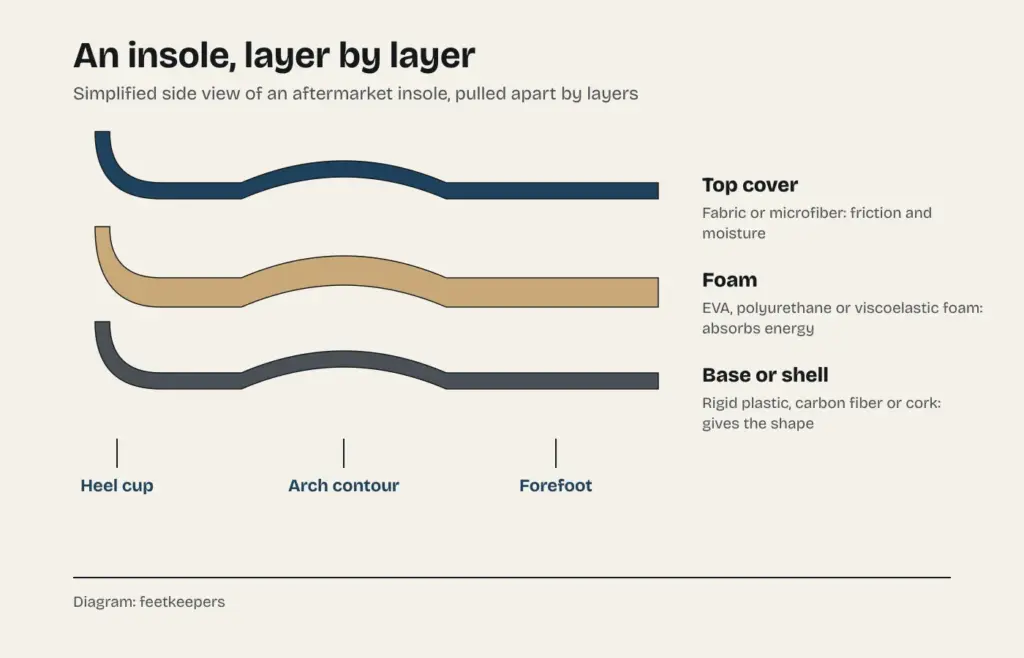
A typical aftermarket insole has three layers, though sometimes they’re fused into a single piece.
On top is the top cover, the part that touches your foot or sock. It’s usually a fabric, a microfiber or, in more traditional designs, a thin leather. Its job is to manage friction and moisture: how slippery or grippy the surface is and how it behaves when your foot sweats, something we get into in our story on merino, cotton and synthetic socks.
In the middle is the foam, which deforms under your weight and then recovers. That’s where nearly everything we call cushioning happens.
At the bottom is the base, or shell, the layer that gives the insole its shape. It can be rigid plastic, carbon fiber or cork, and it’s where the contours get molded in: a heel cup that wraps the heel, a contour that rises under the arch and a flatter area under the forefoot, where the foot has to bend at push-off.
The physics of spreading the load
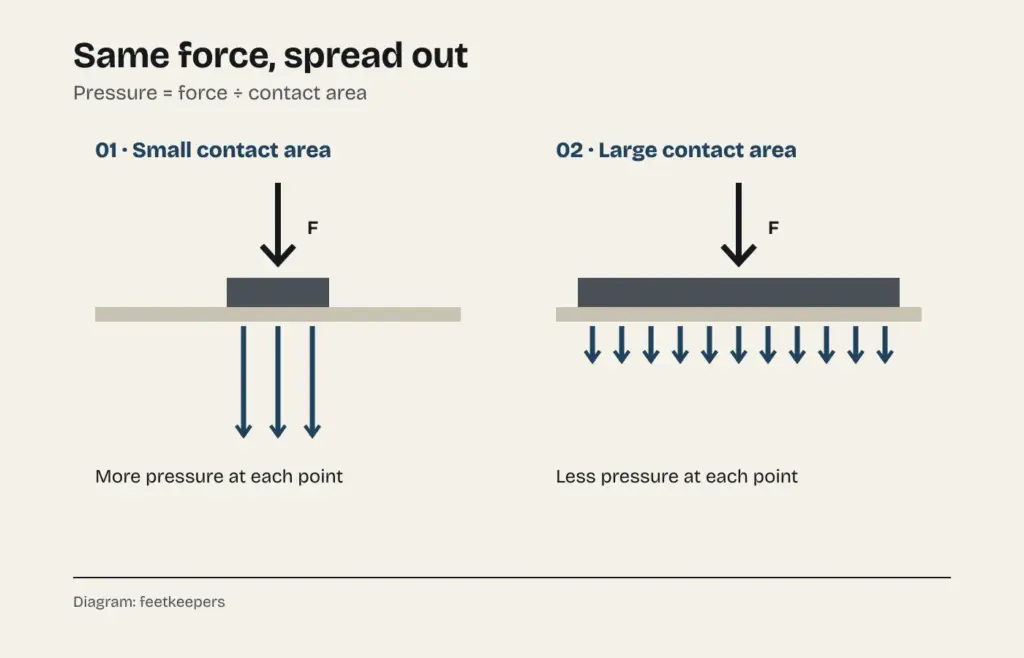
A contour that fits the sole of the foot works through basic physics. Pressure is force divided by the area it’s applied over. Your body weight is the same with or without an insole, so if the contact area between your foot and what’s beneath it grows, the pressure at each point drops. A flat insole mostly touches the heel and forefoot. A contoured one also touches the arch area and spreads the same force over more square inches.
Studies have measured this in healthy people. In 2019, a team from Jilin University in China published a test in Medical Science Monitor with 30 healthy men who walked across a pressure plate in three different heel inserts. The one 3D-printed from a scan of each man’s sole, with a contour rising under the arch, lowered peak pressure under the heel compared with the other two, without a significant increase in pressure under the midfoot. What came off the heel had been spread out.
Cushioning means absorbing energy
When your heel hits the ground, your body brakes suddenly, and that energy has to go somewhere. A cushioning material absorbs it by deforming, then returns part of it as it springs back and dissipates the rest as heat. The more it dissipates, the less it bounces.
A 1999 study in Gait & Posture measured exactly this with British Royal Marine recruits. Eleven of them marched at 3 miles per hour carrying a 70-pound pack and ran at 8 miles per hour in their gear, with four different insoles in their military boots and with none, while sensor insoles recorded the pressure between foot and boot. All four significantly reduced peak pressures at heel strike and under the forefoot. The best performer was a viscoelastic polyurethane: when running, mean peak heel pressure fell from 494 to 377 kilopascals, a 27 percent drop, and when marching from 395 to 303. Under the forefoot, the differences between insoles were much smaller.
The foam that came from an airplane seat
The best-known viscoelastic material in insoles has an unexpected backstory. According to NASA’s technology transfer program, in 1966 the agency’s Ames Research Center contracted Stencel Aero Engineering of Asheville, North Carolina, to develop a safer seating system for commercial aircraft. Aeronautical engineer Charles Yost, who had helped build the recovery system for the Apollo command module in 1962, created an open-cell polymeric foam for the project with unusual viscoelastic properties: it absorbed a lot of energy and was soft at the same time. The research was written up in a NASA report whose title leaves no doubt about the point of it all: Human Survival in Aircraft Emergencies.
The foam molded itself to whatever pressed into it and returned to its original shape once the pressure was gone. In 1969, Yost founded Dynamic Systems to sell it as “temper foam.” According to NASA, it went on to pad the helmets of the Dallas Cowboys through the 1970s and 1980s and the insoles of thousands of shoes. Today we call it memory foam.
There’s a reason it behaves the way it does. It’s mostly polyurethane with additives that raise its viscosity and density, and its cells are open, so air moves through it. It’s slow to spring back because three effects fight its expansion: the time it takes air to flow back into the pores, a slight stickiness between internal surfaces pressed together and, above all, the fact that the material sits close to its glass transition temperature, which limits how freely it can move. That’s also why it’s temperature-sensitive: higher-density memory foam softens in response to body heat and molds to a warm body within a few minutes, while newer formulations are designed to recover their shape more quickly.
EVA and polyurethane, the workhorses
Most mass-market insoles use one of two foam families. EVA, short for ethylene-vinyl acetate, is a copolymer of ethylene and vinyl acetate with rubber-like softness and flexibility, and it’s the same foam found in plenty of sneaker midsoles. Its properties depend on how much vinyl acetate it contains, usually anywhere from 1 to 40 percent. One detail anyone who has opened a box of new EVA sandals will recognize: the material has a distinctive, vinegar-like smell. Polyurethane is a huge family of polymers that can be made into denser, more durable foams, or into viscoelastic versions like NASA’s.
Foams don’t last forever. With wear they lose thickness and their ability to recover, the same thing that makes an EVA midsole cushion less with every mile, as we explain in our story on how many pairs of shoes you need.
Cork, the original foam
Long before synthetic foams, there was a natural one. Cork is the outer layer of the bark of the cork oak, Quercus suber, a tree native to southwestern Europe and northwestern Africa. It’s made mostly of suberin, a water-repelling substance, and its cells are filled with a gas mixture similar to air. They act like tiny cushions, which is what lets cork bounce back after being compressed.
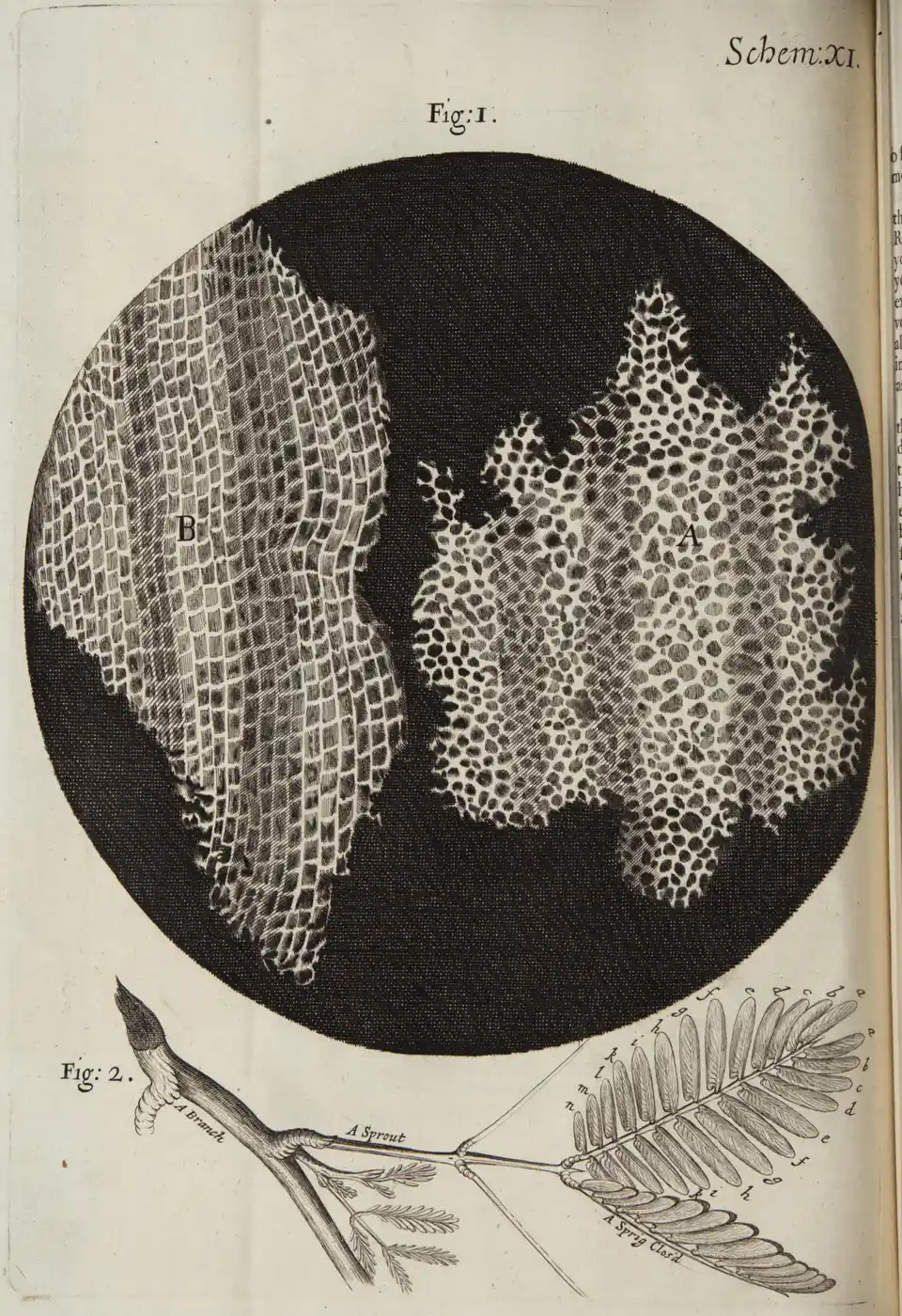
It was while looking at cork under a microscope that Robert Hooke saw little chambers that reminded him of a monastery’s cells, and gave them the name cells. He published it in 1665 in Micrographia, the Royal Society’s first major publication, and his drawing of cork is the image at the top of this story.
Cork is mostly a Mediterranean story. According to figures compiled on Wikipedia, of the roughly 2.2 million hectares of cork oak forest in the Mediterranean basin, 34 percent is in Portugal and 27 percent in Spain. Portugal produces about half the cork harvested each year worldwide, and a tree only gets stripped every nine years, sometimes up to thirteen, the time it takes the bark to grow back thick enough. The first harvests from a young tree don’t become wine stoppers: that coarser bark goes into flooring, insulation and, yes, shoes.

Hardness, by the numbers
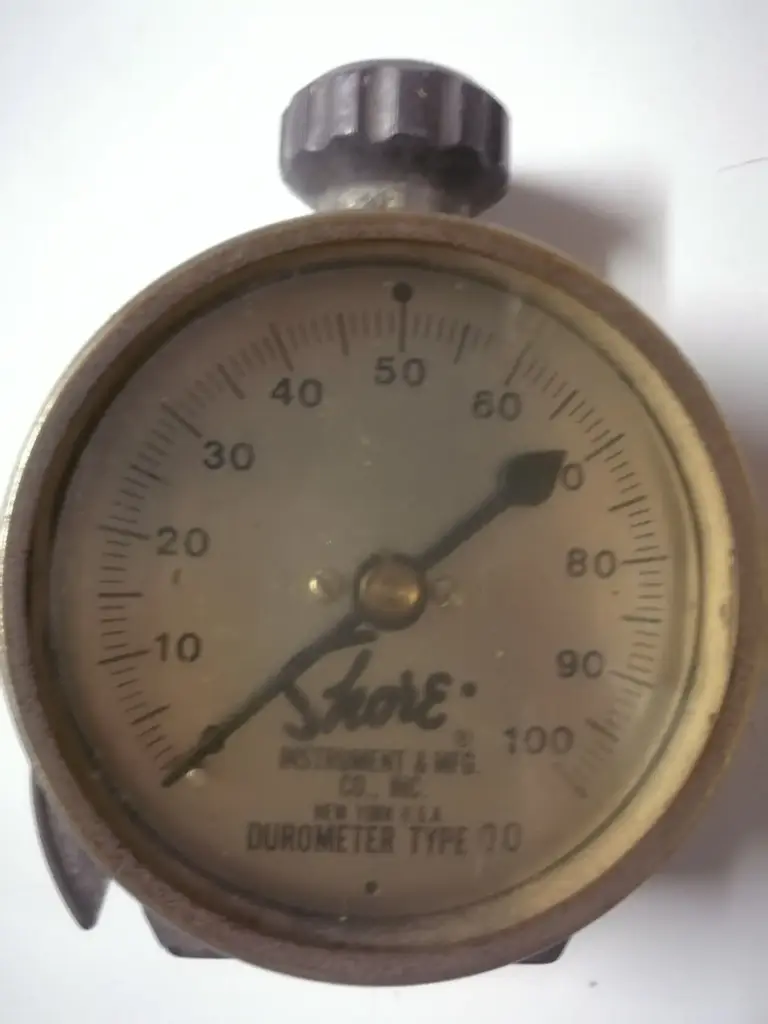
How do you know whether a foam is soft or firm? With a durometer. The scale most widely used for polymers was defined in the 1920s by Albert Ferdinand Shore, who developed a device to measure it. His wasn’t the first hardness tester, or even the first instrument to be called a durometer, but today the name almost always refers to Shore hardness. It works by pressing a point into the material and measuring how far it sinks: the higher the number, the more the material resists indentation and the harder it is. The ASTM D2240 standard lists twelve different scales, but the two most common are Type A, for softer materials, and Type D, for harder ones.
Insoles from centuries past
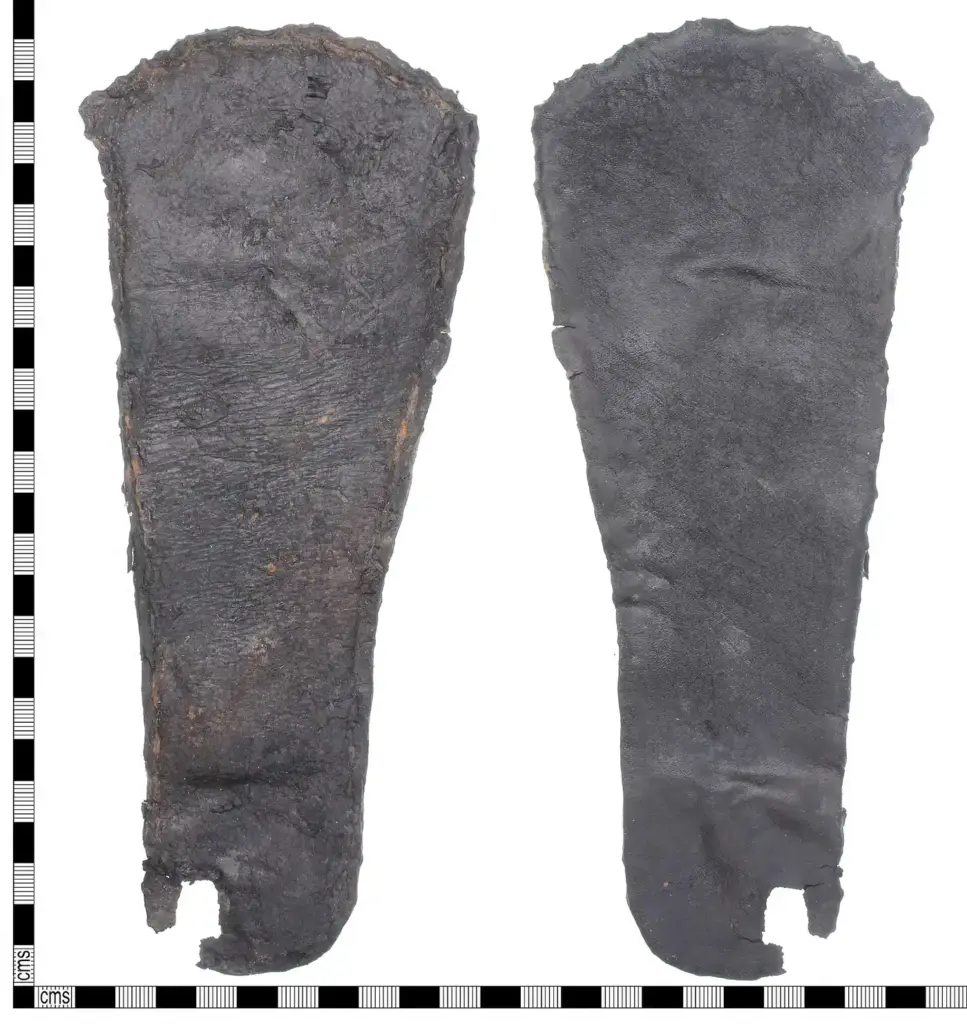
Insoles aren’t a modern invention. Their sophistication is. In Kent, England, archaeologists recorded a leather insole from a Tudor shoe dating to between 1500 and 1550, probably from an adult man. According to its record, it has a broad toe flaring into “ears” and straight sides tapering evenly to the heel, so it’s impossible to tell whether it was for the right foot or the left. For centuries, plenty of shoes were made on straight lasts, identical for both feet, as we explain in our story on the shoe last.
The insole as a consumer product has a famous American name attached to it. According to his Wikipedia biography, William Mathias Scholl, who worked evenings in a shoe store while studying medicine in Chicago, invented and patented an arch support in 1904 and founded the company that bears his name. Born in La Porte, Indiana, one of 13 children, he practiced medicine in Chicago from 1905 to 1946 while running the business, and his brother Frank took it overseas, setting up a manufacturing company in London in 1910. He went on to develop more than 1,000 foot products, employed over 300 people at his Chicago plant by 1918, and was known for his marketing savvy, right down to inventing a “Foot Comfort Week.”
What an insole isn’t
Put it all together and an insole comes into focus as a piece of materials engineering, with layers that spread force, absorb energy and manage friction. What it isn’t, on its own, is a fix for any health problem. If your feet hurt, if you have a diagnosed condition or diabetes, or if you’re unsure whether you need an insole at all, that’s a call for a podiatrist or physician.
Sources
- H. Jin, R. Xu, S. Wang and J. Wang (2019), “Use of 3D-printed heel support insoles based on arch lift improves foot pressure distribution in healthy people,” Medical Science Monitor 25: 7175–7181.
- C. M. Windle, S. M. Gregory and S. J. Dixon (1999), “The shock attenuation characteristics of four different insoles when worn in a military boot during running and marching,” Gait & Posture 9(1): 31–37.
- NASA Spinoff (2005), “Forty-year-old foam springs back with new benefits.”
- Wikipedia, “Memory foam,” “Ethylene-vinyl acetate,” “Cork (material),” “Micrographia,” “Shore durometer” and “William Mathias Scholl,” and the references they cite.
- Portable Antiquities Scheme, record of the Tudor insole found in Kent.
Image credits
- Cork under the microscope, Micrographia (1665): Robert Hooke. Public domain, via Wikimedia Commons.
- Layer and pressure diagrams: feetkeepers.
- Cork oak forest near Ubrique: Wavering. CC BY-SA 3.0, via Wikimedia Commons.
- Shore durometer: Encik Tekateki. Public domain (CC0), via Wikimedia Commons.
- Tudor insole from Kent: Kent County Council, Portable Antiquities Scheme. CC BY 2.0, via Wikimedia Commons.