
Stiff vs. flexible soles is an argument where everyone has a side and almost nobody knows what’s being measured. Your foot bends at one specific spot, the ball of the foot, with every step you take. Whatever sits under it decides whether that hinge works freely, gets braced, or gets replaced by a lever. Biomechanics labs have been slipping carbon-fiber plates into shoes for almost thirty years to find out what happens, and the answer doesn’t match the pitch from either the barefoot crowd or the super-shoe ads. A stiffer sole can make walking cost you more energy, or less, depending on how fast you’re going.
Stiff how, exactly?
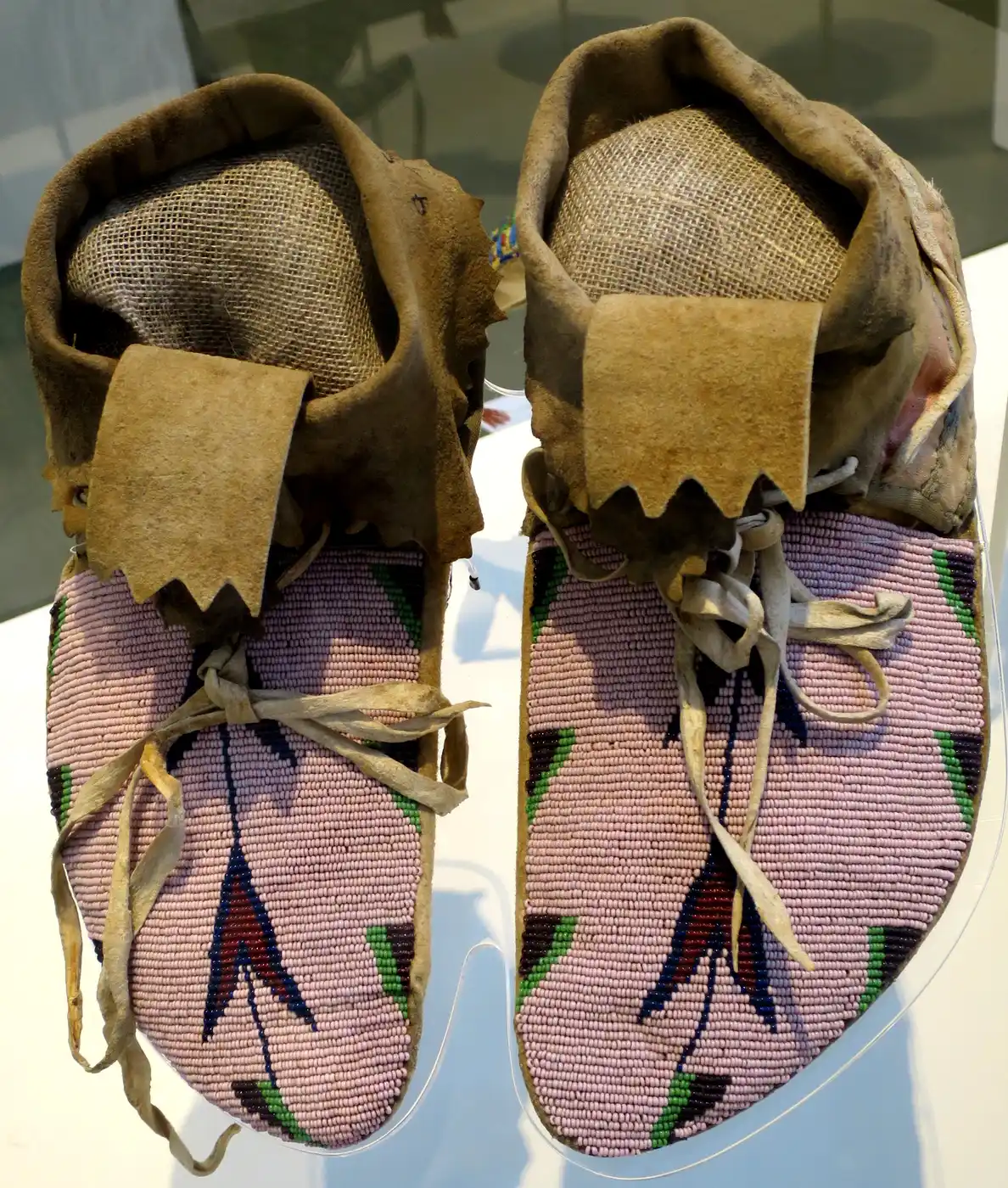
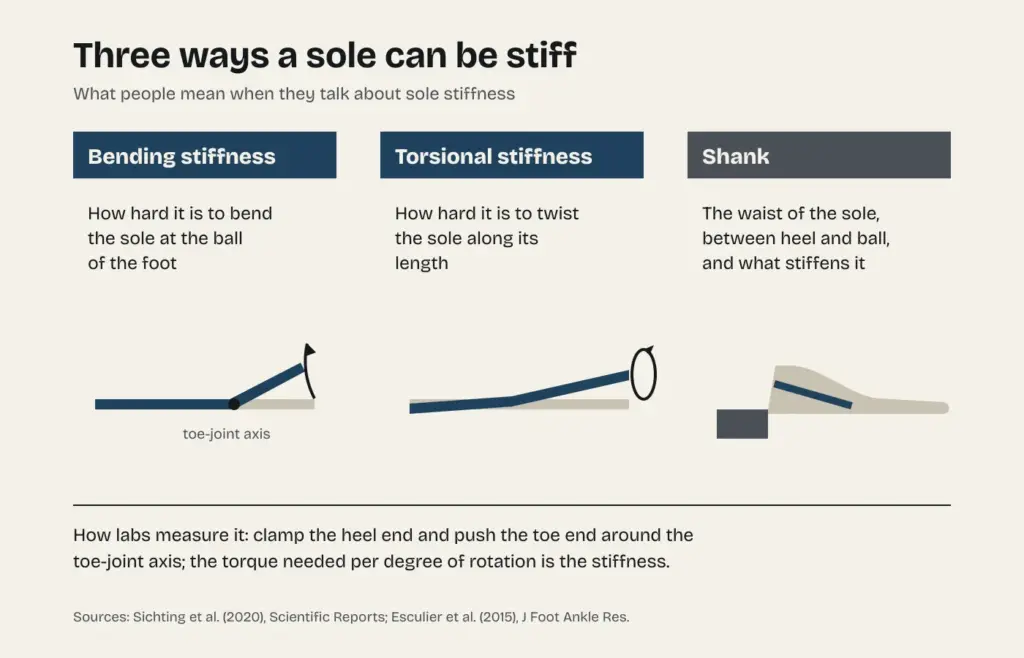
The moccasins at the top of this page, made by Blackfoot people in the late 19th century from tanned deer hide, glass beads and cotton, according to the Honolulu Museum of Art, sit at one end of this story. A carbon-fiber plate sits at the other. In between, “stiff” gets used for three different things.
The first is bending stiffness, sometimes called longitudinal bending stiffness: how hard it is to flex the sole at the ball of the foot, the motion your foot makes as it peels off the ground. It’s the one researchers study most. In the lab, a machine clamps the heel end of the shoe and pushes the toe end up around the axis of the toe joints. A team from Chemnitz University of Technology in Germany and Harvard described its setup in 2020: force applied 50 millimeters, about 2 inches, ahead of that axis, with the toe end lifted and lowered 40 millimeters. From the force and the angle you get torque, and stiffness is how much torque it takes per degree of bend.
The second is torsional stiffness: how hard it is to twist the sole along its length, the way you’d wring out a towel.
The third is the shank, the narrow waist of the sole between the heel and the ball. In many shoes it hides a reinforcing piece so it won’t sag or flex where it shouldn’t.
The first two matter enough that in 2015 an international panel of 42 experts from 11 countries wrote them into the definition of a minimalist shoe. According to the study, published in the Journal of Foot and Ankle Research by a team from Laval University in Quebec City, 95 percent of participants signed off on this definition: footwear that interferes as little as possible with the natural movement of the foot thanks to its high flexibility, low heel-to-toe drop, low weight and stack height, and the absence of motion-control and stability devices. In the team’s Minimalist Index, flexibility is one of five categories, each weighted equally at 20 percent, and it’s split into two parts: bending and torsional. Drop, another of the five, gets its own story: heel-to-toe drop.
A hinge that leaks energy
To understand what a stiff sole does, start with the hinge above it. The metatarsophalangeal joints, or MTP joints, connect the long bones of the foot, the metatarsals, to the toes. Late in each step your heel lifts and your toes bend upward. That’s the same motion that tightens the plantar fascia and drives the windlass mechanism we explain in our story on how the foot walks.
In 1997, Darren Stefanyshyn and Benno Nigg of the University of Calgary’s Human Performance Laboratory measured how much energy moves through that joint. They studied ten trained athletes, five distance runners and five sprinters, and published the results in the Journal of Biomechanics. Because the toes bend upward for most of the time the foot is on the ground, while the load pushes back against them, the joint soaked up a lot of energy: 20.9 joules per step on average when running and 47.8 when sprinting. And it gave almost none back. The toes didn’t snap back down hard at takeoff, so that energy was lost in the structures of the foot and the shoe.
That finding set the agenda for the next three decades. If the toe joint is an energy sink, a sole that keeps it from bending as much might plug the leak.
Carbon plates, long before super shoes
The carbon-fiber plate didn’t arrive with the marathon shoes of the past few years. The same Calgary lab was already testing it in the late 1990s.
In 2000, Stefanyshyn and Nigg reported in Medicine & Science in Sports & Exercise on carbon plates inserted into shoe midsoles. The plates didn’t make the toe joint store and return more energy, but they did cut how much was lost there, in both running and jumping. In a group of 25 people, vertical jump height was 1.7 centimeters, about two-thirds of an inch, higher on average in the stiff shoes.
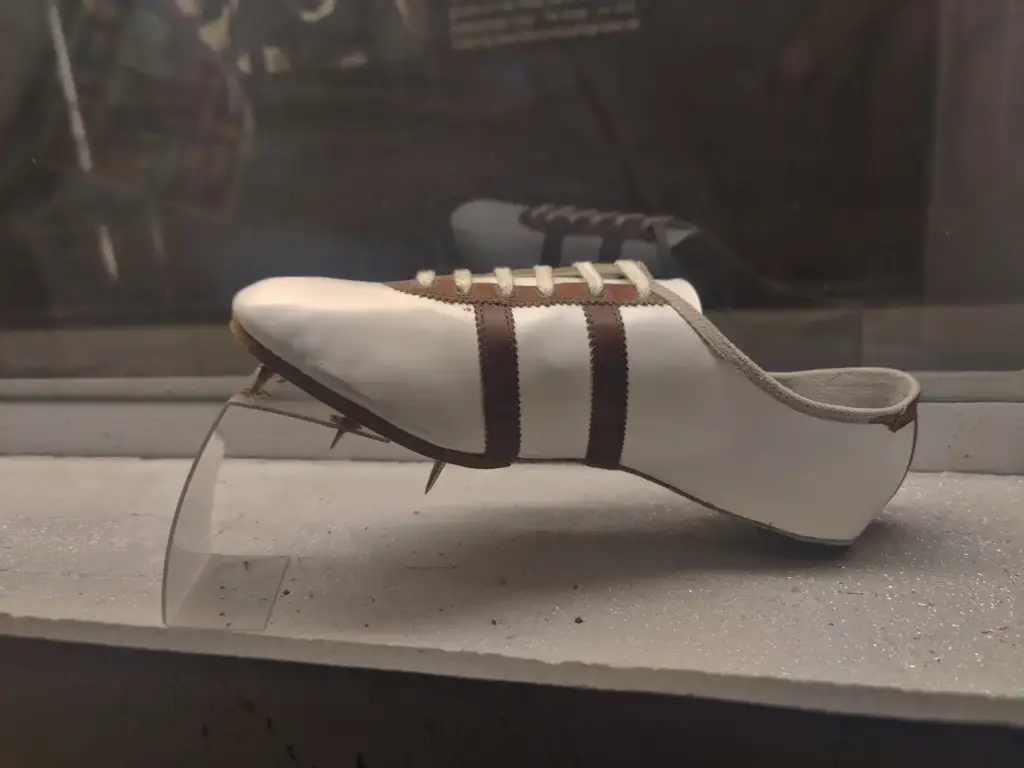
In 2004, Stefanyshyn and C. Fusco took the idea to the track. They tested 34 athletes in their own spikes and in three progressively stiffer versions, timing them between 20 and 40 meters of an all-out 40-meter sprint. On average, more stiffness meant faster times. But they found a catch that still holds: the stiffness at which each athlete ran fastest was different, and it didn’t track with body weight, height, shoe size or skill level. The authors speculated that individual differences in how the calf muscles work might explain it.
In 2006, J. P. Roy and Stefanyshyn measured running economy, which is how much oxygen a runner burns at a given pace. Across 13 subjects, the stiff midsole saved about 1 percent of metabolic energy, and heavier runners saved more. Oddly, the plate didn’t reduce the energy absorbed at the toe joint, so the reason for the savings stayed unclear.
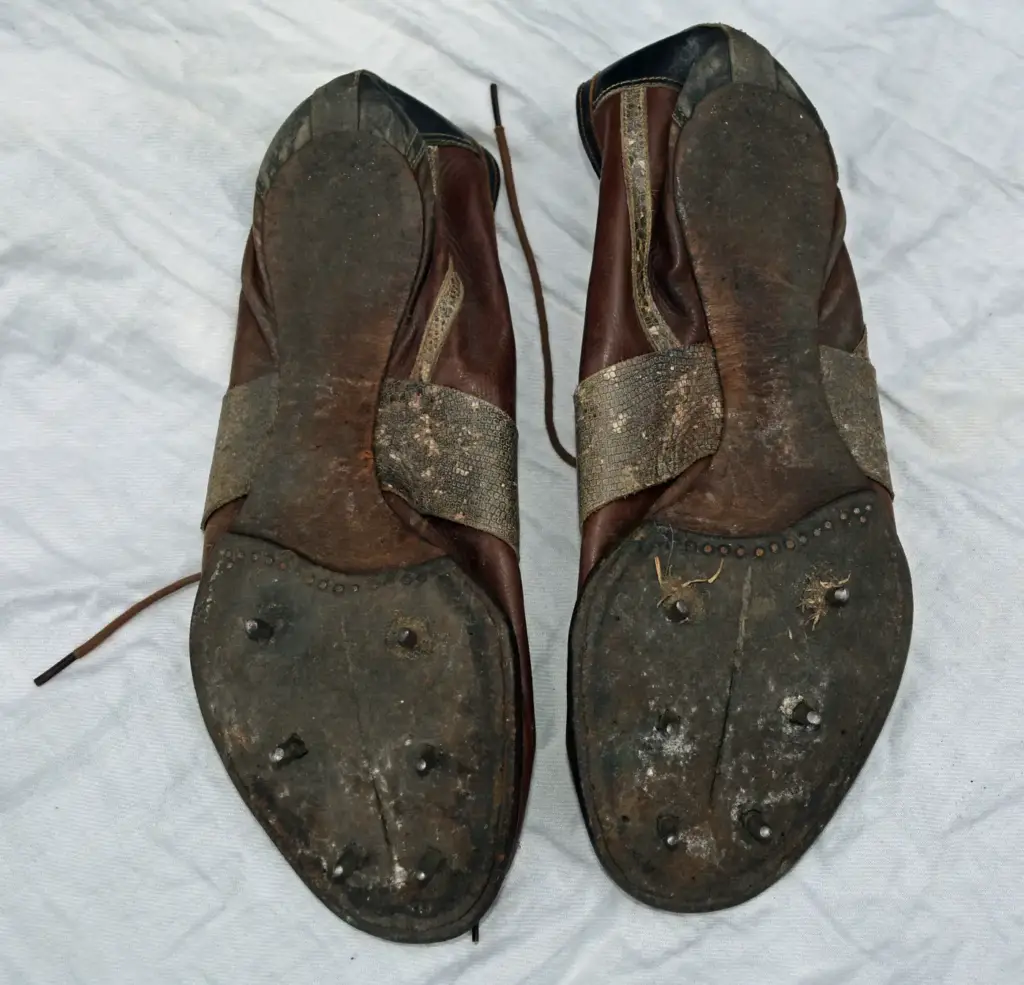
Twelve years later came the number that made headlines. In 2018, a University of Colorado Boulder team led by Wouter Hoogkamer reported in Sports Medicine that prototype shoes pairing a new, highly compliant and resilient foam with a stiff plate cut the energy cost of running by 4 percent on average for 18 high-caliber runners, compared with two established marathon racing shoes, with shoe weight matched. The authors predicted the shoes could help top athletes run the first sub-two-hour marathon. It’s worth knowing who paid: the study was supported by a contract between Nike and the university, two of the authors were Nike employees, and another was a paid Nike consultant. In 2022, the same group found that the savings in those shoes dropped to 2.8 percent uphill and 2.7 percent downhill, versus 3.8 percent on level ground. The effect comes from foam and plate together, not the plate alone. The rules that followed to cap these soles in competition are in our drop story.
So what does the plate do to the mechanics of your legs? Less than you’d think. A 2026 systematic review and meta-analysis in Frontiers in Sports and Active Living, pooling 15 studies, found no consistent changes with carbon-plated shoes in leg stiffness or in the power produced at the knee, the hip or the toe joints. The only signal was a borderline drop in ankle power. The authors called the adaptations subtle.
An extra gear for the ankle
The most interesting explanation came from a lab that studies walking, not running. Think of a bike. Your foot works as a lever, and a stiff sole moves the point where the foot pushes on the ground farther forward. That changes the ratio between what your calf muscle does and what reaches the ground, like shifting gears.
The foot has had gears of its own for a long time. In 1979, Danish anatomist F. Bojsen-Møller described two ways of pushing off in the Journal of Anatomy. In what he called high-gear push-off, the forefoot rotates to load the big-toe side more, the midfoot joint locks, the plantar fascia tightens more effectively, and the foot becomes a rigid lever for propulsion. In low-gear push-off, the sole tilts inward, that joint stays loose, and the load runs along the outer edge of the foot.
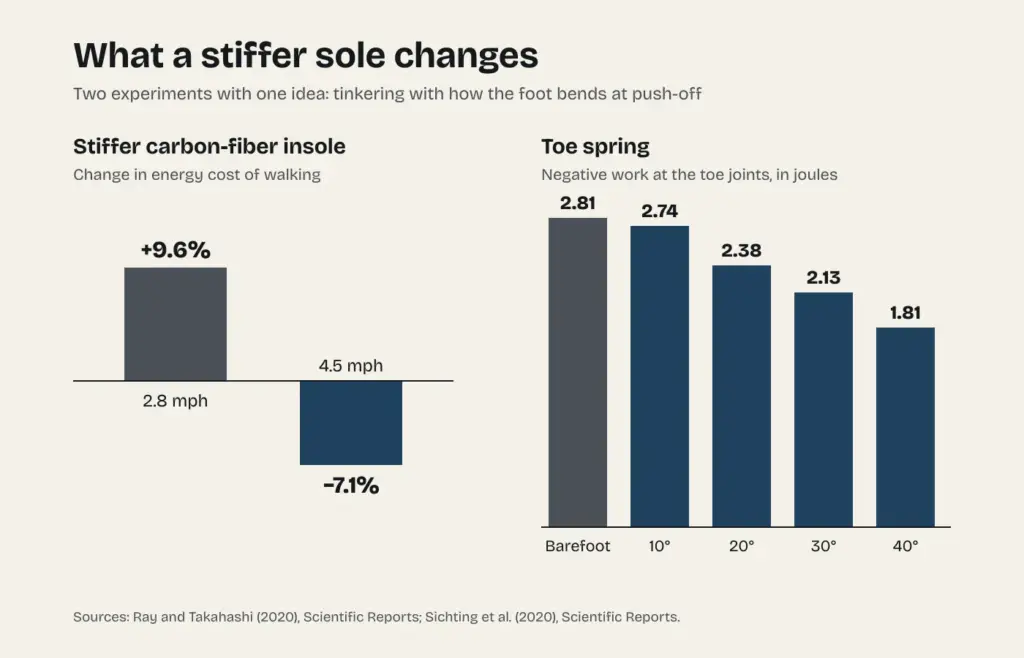
In 2020, S. F. Ray and K. Z. Takahashi of the University of Nebraska Omaha added a gear the foot doesn’t have. In Scientific Reports, they described an experiment with carbon-fiber insoles of different stiffness at three walking speeds. Stiff insoles increased the foot’s leverage on the ground and raised the average force of the soleus, one of the calf muscles, by 15.9 percent. Energy cost did something nobody who believes in one good sole and one bad sole would expect. With the stiffest insoles, walking at 1.25 meters per second, about 2.8 miles per hour, cost 9.6 percent more energy. At 2 meters per second, about 4.5 miles per hour, it cost 7.1 percent less. Same sole: a penalty at a stroll, a boost when you’re hustling.
Takahashi’s group, now at the University of Utah, kept pulling the thread. In 2025, in the Journal of Applied Physiology, it reported that the soleus’s extra force with insoles 1.6 and 3.2 millimeters thick didn’t significantly raise the muscle’s own estimated energy cost, probably because its fibers were shortening more slowly. And in 2026, in PeerJ, it tested stiff insoles on 19 older adults, average age 70, walking on flat ground and slopes. Peak ankle moment rose about 10 percent in the stiffest condition, but knee and hip mechanics and overall metabolic power didn’t change consistently.
The curve at the toe
There’s another way to deal with a sole that won’t bend: curve it. Set a shoe on a table and the toe won’t touch the surface; it tips up. That’s toe spring, and in our story on the shoe last, we explain that it comes from the last itself and that shoemakers adjust it along with heel height. The usual claim is that it helps the foot roll forward. Almost nobody had measured it.
In 2020, F. Sichting, N. B. Holowka, O. B. Hansen and Daniel Lieberman, from Chemnitz, the University at Buffalo and Harvard, published the first controlled experiment in Scientific Reports. They built sandals with a fiberglass plate curving up under the toes at four angles, 10, 20, 30 and 40 degrees, matched to the stiffness of commercial shoes, and had 13 people aged 19 to 33 walk on a treadmill barefoot and in each pair.
The numbers are clear. Barefoot, the toes bent about 41 degrees at push-off; in any of the sandals, about 31. And the more curve at the toe, the less work the toe joints had to do: negative work, the energy the joints absorb, fell from 2.81 joules barefoot to 1.81 with the 40-degree curve. The authors said this helps explain why toe spring has been a feature of shoes for centuries: the curve does part of the job the toes would otherwise do.
Push that idea to the limit and you get a rocker sole, curved underneath like the base of a rocking chair. A 2026 systematic review in the Journal of Bodywork and Movement Therapies pooled 28 studies, mostly of walking, and found that with rocker soles the foot spends less time on the ground, steps come quicker and shorter, and the ankle moves through a smaller range and produces less power at push-off. That’s what you’d expect: if the sole rolls for you, the ankle has less to do.
The shank, the shoe’s waistline
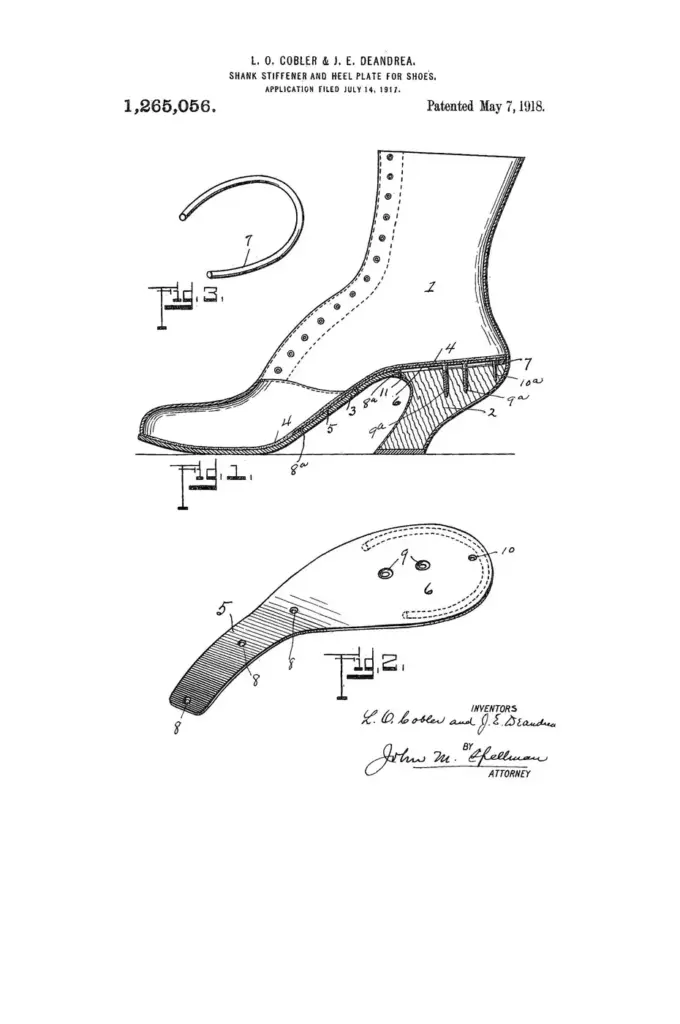
The third kind of stiffness, in the shank, has a shop-floor history. It’s the part of the sole that hangs in the air on a heeled shoe and has to carry weight without caving in. On May 7, 1918, the U.S. Patent Office granted L. O. Cobler and J. E. Deandrea Patent No. 1,265,056 for a shank stiffener and heel plate, meant for use both in making shoes and in repairing them. According to the catalog description of the document, it was designed to keep heels from buckling, loosening and breaking off because shanks made of leather, compressed paper or steel hadn’t always been able to support the heel.
Inside the factory, stiffness also came down to what the sole was made of. The 1952 USDA bulletin we cite in our story on how many pairs of shoes you need warned that waxed chrome-tanned soles might be stiff at first, that the stiffness usually disappeared after the shoes had been worn for a short time, and that they were too stiff for dress shoes. We cover the different sole leathers in our story on how leather is made.
On the trail, the shank becomes a full plate. In our story on hiking boots vs. trail shoes, we describe the University of Wollongong study in which people walking on gravel preferred a stiff sole paired with a flexible shaft.
Pedaling on a board
There’s one sport where nobody argues about a stiff sole: cycling. A cycling shoe doesn’t need to bend, because the foot isn’t rolling over it. It’s pushing on a pedal.
In 2003, N. E. Jarboe and P. M. Quesada of the University of Louisville compared two pairs of cycling shoes in Foot & Ankle International. They were the same size and from the same manufacturer, and identical except for the outsole: one carbon-fiber composite, the other plastic. The carbon sole was 42 percent stiffer in longitudinal bending and 550 percent stiffer in a three-point bending test. Pedaling seated at a fixed 400 watts, peak pressure under the forefoot was 18 percent higher in the carbon shoes: 121 kilopascals versus 103.
Forty-one degrees
Put it all together and the firm conclusions are few, with plenty of fine print. The toe joints absorb energy with every step and return almost none. A stiffer or more curved sole cuts the work those joints do and moves the foot’s lever forward. In some studies, that has meant higher jumps, faster sprints and more economical running. But the best stiffness varies from person to person, and in walking it has turned out to help at a brisk pace and hurt at a casual one. A carbon plate on its own doesn’t reorganize how your legs work. The big numbers showed up when it was paired with new foams.
A bare foot bends its toes about 41 degrees as it pushes off. Everything you put under it starts by deciding how many of those degrees it gets to keep.
Sources
- D. J. Stefanyshyn and B. M. Nigg (1997), “Mechanical energy contribution of the metatarsophalangeal joint to running and sprinting,” Journal of Biomechanics 30(11–12): 1081–1085.
- D. J. Stefanyshyn and B. M. Nigg (2000), “Influence of midsole bending stiffness on joint energy and jump height performance,” Medicine & Science in Sports & Exercise 32(2): 471–476.
- D. Stefanyshyn and C. Fusco (2004), “Increased shoe bending stiffness increases sprint performance,” Sports Biomechanics 3(1): 55–66.
- J. P. Roy and D. J. Stefanyshyn (2006), “Shoe midsole longitudinal bending stiffness and running economy, joint energy, and EMG,” Medicine & Science in Sports & Exercise 38(3): 562–569.
- W. Hoogkamer et al. (2018), “A comparison of the energetic cost of running in marathon racing shoes,” Sports Medicine 48(4): 1009–1019.
- C. S. Whiting, W. Hoogkamer and R. Kram (2022), “Metabolic cost of level, uphill, and downhill running in highly cushioned shoes with carbon-fiber plates,” Journal of Sport and Health Science 11(3): 303–308.
- S. Giachetti Martin et al. (2026), “Carbon plates in running shoes biomechanics: a systematic review and meta-analysis,” Frontiers in Sports and Active Living 8: 1764338.
- F. Bojsen-Møller (1979), “Calcaneocuboid joint and stability of the longitudinal arch of the foot at high and low gear push off,” Journal of Anatomy 129(1): 165–176.
- S. F. Ray and K. Z. Takahashi (2020), “Gearing up the human ankle-foot system to reduce energy cost of fast walking,” Scientific Reports 10: 8793.
- D. J. Davis et al. (2025), “Propulsion without penalty,” Journal of Applied Physiology 139(2): 509–516.
- D. J. Davis et al. (2026), “Can increasing footwear bending stiffness ameliorate age-related mechanical and metabolic deficits in walking?,” PeerJ 14: e21563.
- F. Sichting, N. B. Holowka, O. B. Hansen and D. E. Lieberman (2020), “Effect of the upward curvature of toe springs on walking biomechanics in humans,” Scientific Reports 10: 14643.
- M. Arazpour et al. (2026), “The impact of custom-made rocker sole shoes on biomechanical parameters of the lower limb during gait and running: a systematic review,” Journal of Bodywork and Movement Therapies 46: 80–98.
- J. F. Esculier et al. (2015), “A consensus definition and rating scale for minimalist shoes,” Journal of Foot and Ankle Research 8: 42.
- N. E. Jarboe and P. M. Quesada (2003), “The effects of cycling shoe stiffness on forefoot pressure,” Foot & Ankle International 24(10): 784–788.
- L. O. Cobler and J. E. Deandrea, U.S. Patent No. 1,265,056, “Shank-stiffener and heel-plate for shoes” (1918).
- F. P. Veitch, R. W. Frey and H. P. Holman, Leather Shoes: Selection and Care, Farmers’ Bulletin No. 1523, U.S. Department of Agriculture (1927, revised 1952).
Image credits
- Blackfoot moccasins (late 19th century), Honolulu Museum of Art: Hiart. Public domain (CC0), via Wikimedia Commons.
- Stiffness diagram and experiments chart: feetkeepers.
- Replica of Jesse Owens’s spikes (1936), German Sport and Olympic Museum: New York-air. CC BY-SA 4.0, via Wikimedia Commons.
- Vintage running spikes: SovalValtos. CC BY-SA 4.0, via Wikimedia Commons.
- U.S. Patent No. 1,265,056 (1918): L. O. Cobler and J. E. Deandrea, U.S. Patent Office. Public domain, via Wikimedia Commons.