
Shoe traction isn’t a property of a shoe. It’s what happens when one particular rubber meets one particular floor with one particular layer of water, grease or ice in between, and change any of the three and the sneaker that held fine on the sidewalk skates across the hotel’s marble lobby. Travelers learn this without trying: the cobbled square after a downpour, the subway stairs that were just mopped, the frozen sidewalk in a northern city in January. Knowing what’s going on under your sole is useful in a very practical way. It tells you where to look before you step, and what to check on the bottom of your shoes before you leave.
Two forces you can’t see
Rubber grips mainly in two ways. The first is adhesion: wherever the rubber is in real contact with the floor, the molecules of the two surfaces attract each other. The second is hysteresis, and it’s less intuitive. Rubber is viscoelastic, so when it slides over the tiny bumps in a floor, it deforms around them and doesn’t snap back instantly. Every time it deforms, it loses a bit of energy, and that lost energy is friction.
The most widely used model of that second part comes from physicist B. Persson. It calculates friction from two inputs: the floor’s roughness at many scales, from coarse to microscopic, and how the rubber responds over time. In 2025, a University of Pittsburgh team published one of the few direct experimental tests of the model in the Journal of Tribology, using three shoe designs, ten porcelain tiles and canola oil as the contaminant. The model got the trends right but overestimated friction by an average of 1,050 percent when every scale of roughness was included. It did much better when the very smallest features were left out. In other words, not every bump on a floor counts for grip.
The practical upshot is simple. A floor grips when it has roughness the rubber can feel, and a film of liquid takes that roughness away from the rubber.
Why wet marble betrays you
Britain’s workplace safety regulator, the Health and Safety Executive, puts numbers on it. Its technical sheet on assessing the slip resistance of floors notes that slips and trips are the most common cause of injury at work, causing over a third of all major injuries and over 40 percent of reported injuries to members of the public, and that most of those slips happen on floors contaminated with water, talc or grease.
For water-wet floors, the agency uses a roughness measure called Rz, the average of several peak-to-valley measurements across the surface. Below 10 microns, slip potential is high; from 10 to 20, moderate; above 20, low. And it adds a rule of thumb that explains a lot: the thicker the contaminant, the more roughness it takes to keep the grip. Oil needs more than water.
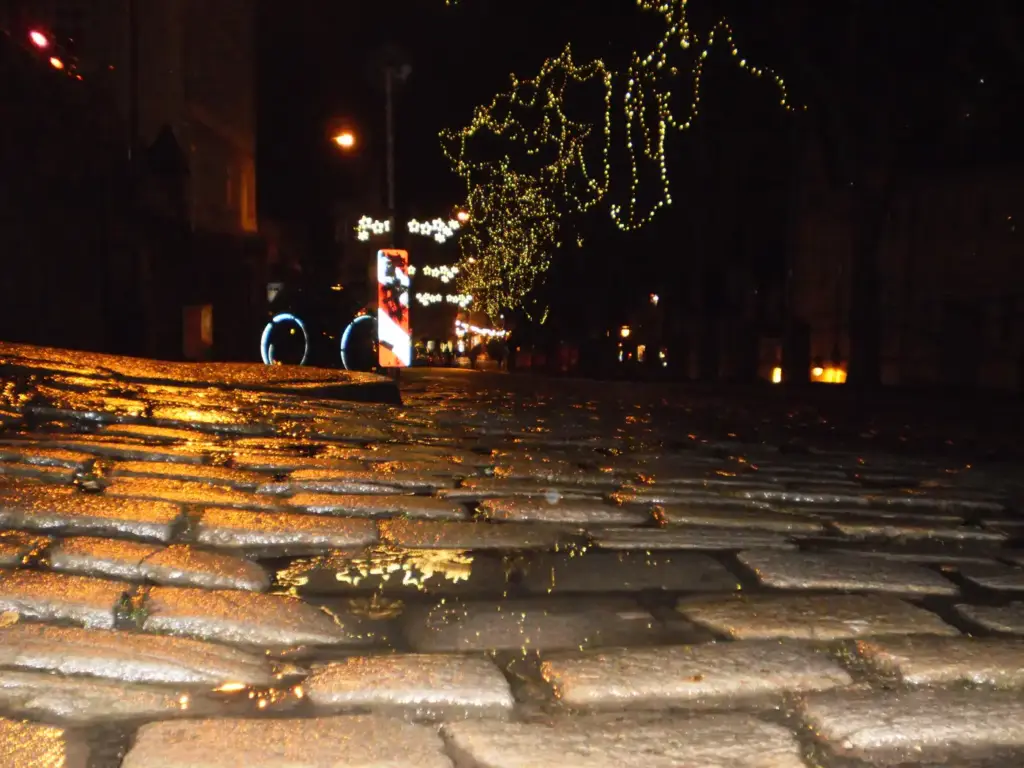
Polished marble and polished limestone are made specifically so you can’t feel the roughness. Dry, the rubber’s adhesion may be enough. Wet, the water fills in what little texture is left and the rubber stops feeling the floor. That’s the story we tell in our piece on flat sandals on cobblestones, about Lisbon’s famous mosaic sidewalks, whose reputation for slipperiness gets worse with rain and with the polish that centuries of foot traffic leave behind. The same physics applies to asphalt and to marble alike: what counts is the microscopic roughness at the surface, not what the material is called.
A rubber heel on a pendulum
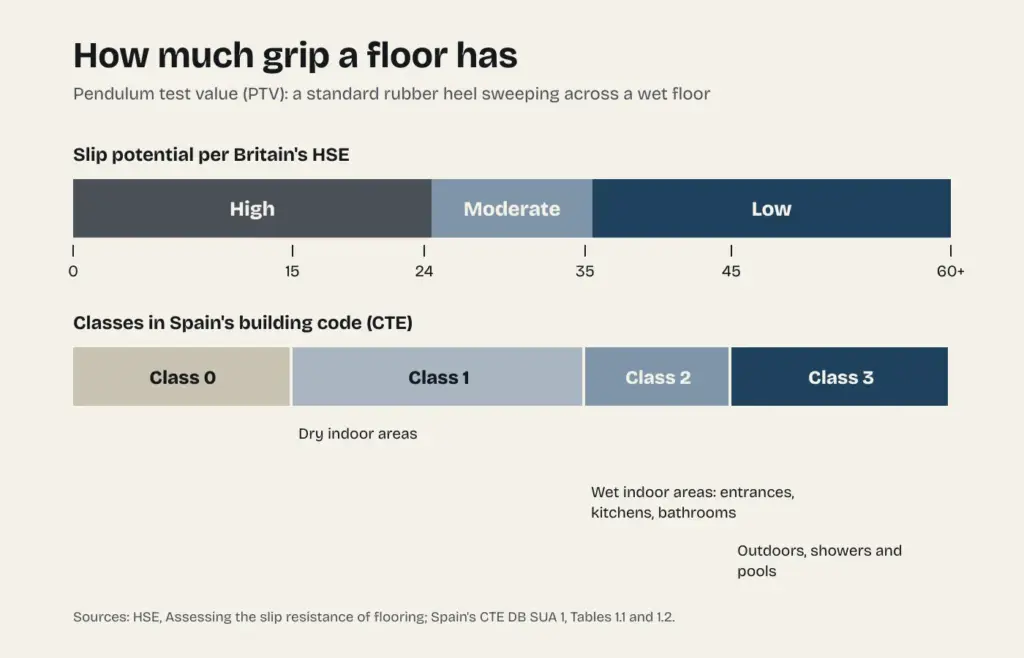
How do you measure how much grip a floor has? In Britain, and in Spain, with the same instrument: the pendulum. The Health and Safety Executive describes it as a swinging imitation heel, faced with a standard rubber sample, that sweeps across a set patch of floor in a controlled way. The grippier the floor, the more it slows the heel and the lower the pendulum swings on the far side. That gives a pendulum test value, or PTV, which the agency calls its preferred method. It reads the results like this: 0 to 24, high slip potential; 25 to 35, moderate; 36 and up, low.
Spain’s national building code uses the same pendulum and turns it into law. It sorts floors into four classes by their slip resistance, which is the pendulum value: Class 0 up to 15, Class 1 above 15 to 35, Class 2 above 35 to 45, and Class 3 above 45. Then it sets a minimum class by location, in buildings such as hotels, hospitals, schools, stores, offices and public venues. Dry indoor areas need Class 1. Wet indoor areas, such as building entrances from the street, bathrooms and kitchens, need Class 2, rising to Class 3 on ramps with a slope of 6 percent or more and on stairs. Outdoor areas, showers and pools need Class 3. The test is run on a wet sample, and the class has to hold for the floor’s whole working life.
In 2021, Spain took the requirement out onto the street. A national order on accessible public spaces, Orden TMA/851/2021, issued on July 23, says the paving on accessible pedestrian routes must be hard and stable, with no loose pieces and no ridges over 4 millimeters, and must meet the building code’s slip-resistance requirement for outdoor areas. An accessible walkway built in Spain today has to grip, on the pendulum scale, at least as well as a pool deck.
Rubber matters, and so does tread
The floor is half the story. The other half is the sole, and two things count: what it’s made of and how it’s shaped.
In 2020, K. E. Beschorner’s lab at the University of Pittsburgh tested 58 footwear designs sold as slip-resistant, using a robotic device to measure friction on floors coated with canola oil. Writing in Applied Ergonomics, the team reported that three outsole features, tread surface area, heel shape and rubber hardness, together with the type of floor, explained 87 percent of the differences in grip between designs. Two years earlier, the same lab had tested twelve shoes labeled slip-resistant across five floor types and three contaminants and found significant differences in grip among them. The label doesn’t guarantee the same performance across the board.
Tread does most of its work when the floor is wet, because it gives liquid a way to escape from under the sole. In 2006, K. W. Li and colleagues reported in Applied Ergonomics on test soles with grooves 3 or 9 millimeters wide and 1 to 5 millimeters deep, tried on terrazzo, steel and vinyl. On water-wet floors and on floors with water and detergent, deeper grooves gripped better: every extra millimeter of depth added between 0.018 and 0.108 to the coefficient of friction, depending on groove width, floor and liquid.
A smooth leather sole sits at the other extreme. The 1952 USDA bulletin we cite in our story on how many pairs of shoes you need warned that unwaxed chrome-tanned sole leather wasn’t suited for outdoor wear in wet weather, because water passed through it quickly and it was very slippery when wet.
What a worn sole gives up
A sole doesn’t grip the same way its whole life, and the Pittsburgh group has measured that from several angles. In 2020, in the Journal of Biomechanics, it reported on 57 people who were made to slip unexpectedly in their own shoes. The bigger the worn patch on the sole, the more often they slipped: each extra millimeter in the worn region’s characteristic length, the geometric mean of its length and width, was linked to about a 10 percent rise in slip risk. The mechanism checked out. A bigger worn patch traps more fluid pressure underneath, that pressure cuts friction, and less friction means more slips.
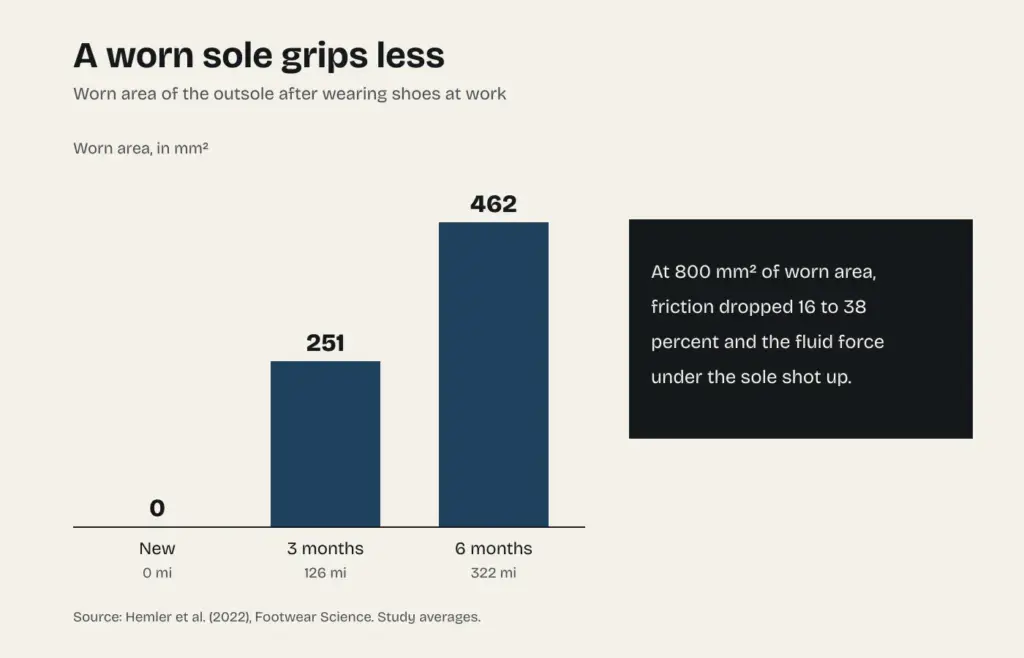
In 2022, the same team followed workers’ shoes for up to 11 months, with pedometers tracking distance. According to its study in Footwear Science, three months of wear left an average worn area of 251 square millimeters after about 126 miles, or 203 kilometers, of walking, and six months left 462 square millimeters after about 322 miles. At 800 square millimeters of wear, friction dropped 16 to 38 percent and the fluid force under the shoe rose 286 to 528 percent.
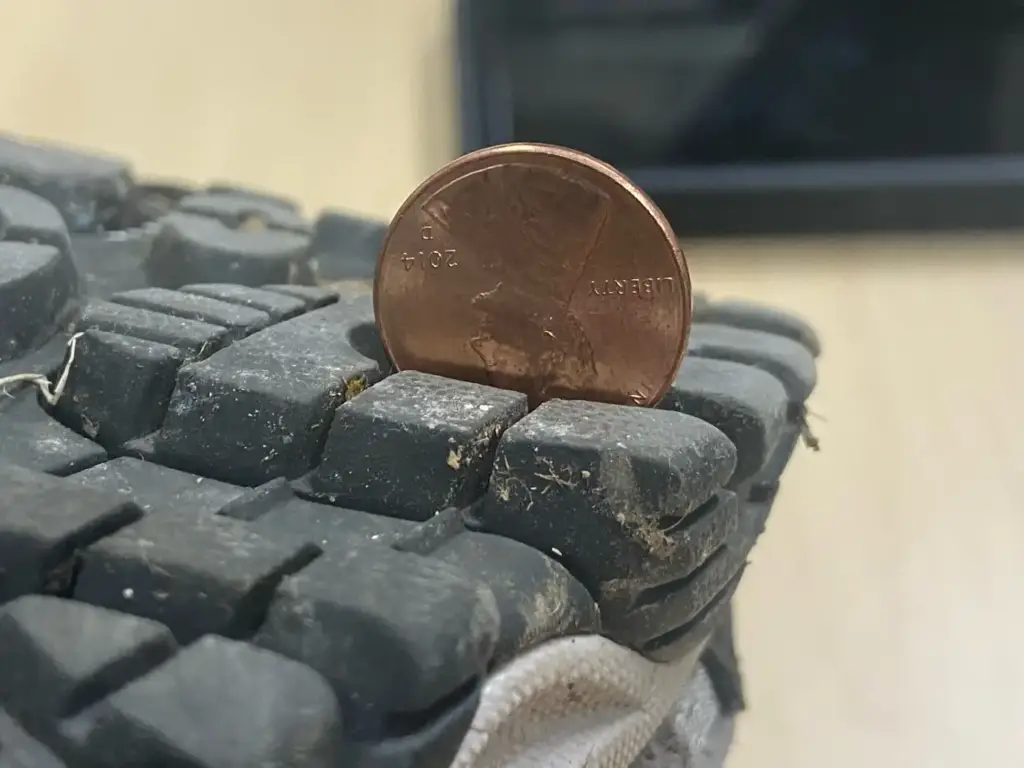
You don’t need a lab to check tread depth. The National Park Service, for one, requires tread at least a quarter inch deep for one of its introductory cave tours, and illustrates it with a penny standing on edge between the lugs of a boot.
How much friction a step needs
Whether a floor is slippery also depends on how much grip the person walking needs. Each step pushes forward against the floor as the heel lands and backward as the foot pushes off. That horizontal force divided by the vertical force is the friction the step requires. In 1999, J. P. Hanson, M. S. Redfern and M. Mazumdar of the University of Pittsburgh had five people in safety harnesses walk down a ramp at 0, 10 and 20 degrees on tile or carpet, dry, wet or soapy. They reported in Ergonomics that slips and falls became more frequent as the gap grew between the friction a step required and the friction the shoe and floor could supply. A slope demands more than level ground, which is also why Spain’s code requires a higher class on ramps and stairs.
How you measure friction matters too. In 2001, an international group of researchers led from the Liberty Mutual Research Center for Safety and Health in Hopkinton, Massachusetts, the insurer’s research arm, concluded in Ergonomics that static friction measured by a traditional drag-type device is only suitable for dry, clean surfaces. On contaminated floors, they said, you need dynamic methods that reproduce the sliding speed, contact pressure and how fast the foot loads up during a real slip.
Ice, the great equalizer
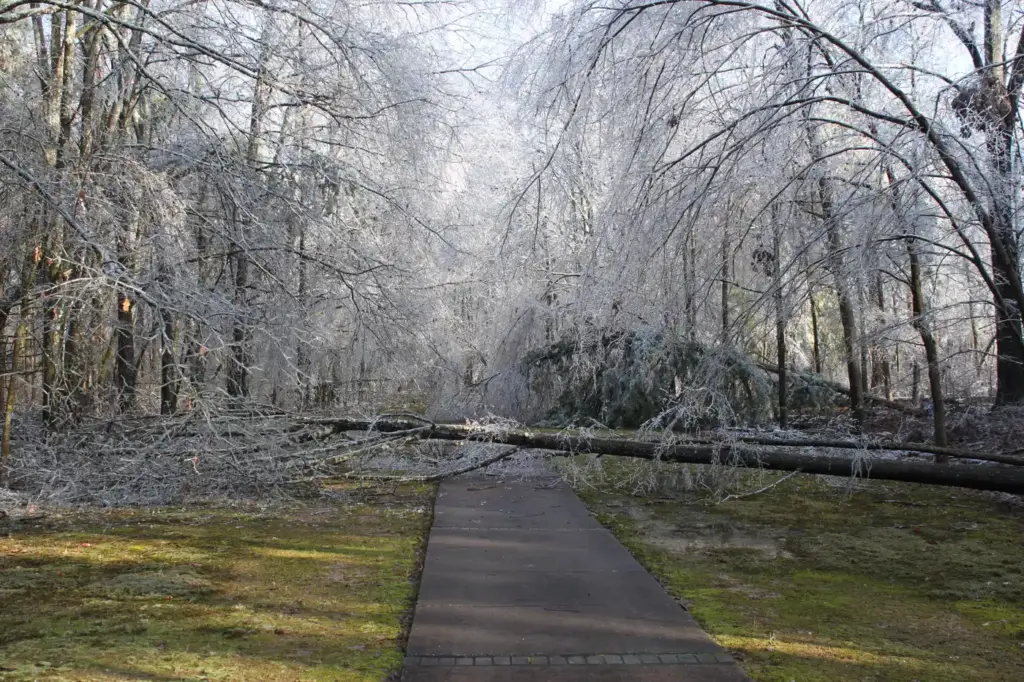
Then there’s ice. At the Toronto Rehabilitation Institute, which also offers slip-resistance testing of winter footwear to manufacturers, researchers have spent years rating boots with a test called the maximum achievable angle: the steepest icy slope a person can walk without slipping. In a 2026 study in Applied Ergonomics, D. Dadkhah, H. Ghomashchi and T. Dutta had 27 people walk on level ice in 11 different boots and recorded 8,503 steps, 999 of which were slips, or 11.8 percent. In the lowest-rated boots, scored at 0 degrees, 36 percent of steps slipped. In the best, scored at 9 and 10 degrees, it was still 4 to 5 percent: about one slip every 20 to 25 steps. Their conclusion was that even the best soles don’t eliminate the risk on ice, and that other measures are needed, from better ice clearing to heated and porous pavements.
Reading the ground before you step on it
With all that in mind, a city reads differently. A polished, shiny floor, whether it’s marble, granite or stone worn smooth by centuries of footsteps, has little roughness to offer once it’s wet, and the sheen on cobblestones after rain is exactly that warning. Building entrances are wet zones by definition, because that’s where the rain comes in on people’s shoes, and Spain’s code asks more grip of them than of the rest of the interior. Ramps and stairs demand more friction than flat ground. Grease, on a street lined with food stalls, needs more roughness than water does. And a sole worn smooth at the heel has lost exactly the part that does the work at the start of every step.
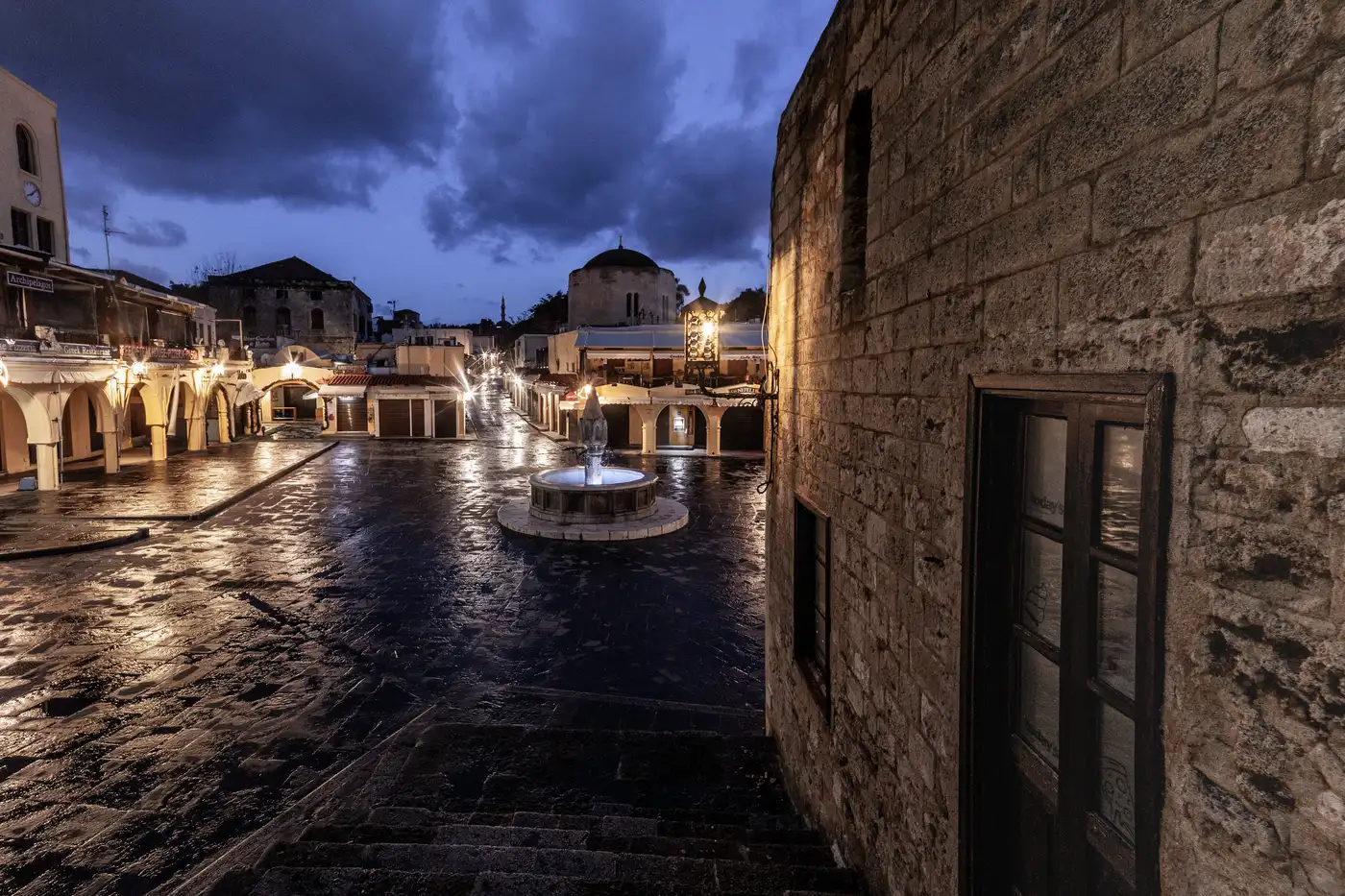
Hippocrates Square in the medieval town of Rhodes, at the top of this page, has had centuries of cobblestones and footsteps on it. After a downpour it shines like a mirror, and that shine is the first thing anyone crossing it should notice.
Sources
- Health and Safety Executive, Assessing the slip resistance of flooring, technical information sheet GEIS2.
- Spanish Ministry of Public Works, Código Técnico de la Edificación, Basic Document SUA, Section SUA 1, Part 1, Tables 1.1 and 1.2; and support document DA DB-SUA/3, Resbaladicidad de suelos (2014).
- Orden TMA/851/2021, July 23, Article 11, Boletín Oficial del Estado.
- H. Ing et al. (2025), “Validation of a multiscale hysteresis mechanics model in predicting oily shoe-floor friction across surfaces with varying finishes,” Journal of Tribology 147(9): 091111.
- A. Iraqi, N. S. Vidic, M. S. Redfern and K. E. Beschorner (2020), “Prediction of coefficient of friction based on footwear outsole features,” Applied Ergonomics 82: 102963.
- T. Jones, A. Iraqi and K. Beschorner (2018), “Performance testing of work shoes labeled as slip resistant,” Applied Ergonomics 68: 304–312.
- K. W. Li, H. H. Wu and Y. C. Lin (2006), “The effect of shoe sole tread groove depth on the friction coefficient with different tread groove widths, floors and contaminants,” Applied Ergonomics 37(6): 743–748.
- V. H. Sundaram et al. (2020), “Worn region size of shoe outsole impacts human slips: testing a mechanistic model,” Journal of Biomechanics 105: 109797.
- S. L. Hemler et al. (2022), “Effects of natural shoe wear on traction performance: a longitudinal study,” Footwear Science 14(1): 1–12.
- J. P. Hanson, M. S. Redfern and M. Mazumdar (1999), “Predicting slips and falls considering required and available friction,” Ergonomics 42(12): 1619–1633.
- W. R. Chang et al. (2001), “The role of friction in the measurement of slipperiness, Part 1: friction mechanisms and definition of test conditions,” Ergonomics 44(13): 1217–1232.
- D. Dadkhah, H. Ghomashchi and T. Dutta (2026), “Determining the risk of slipping on level ice using winter footwear with varied maximum achievable angle slip-resistance performance,” Applied Ergonomics 131: 104678.
- F. P. Veitch, R. W. Frey and H. P. Holman, Leather Shoes: Selection and Care, Farmers’ Bulletin No. 1523, U.S. Department of Agriculture (1927, revised 1952).
Image credits
- Hippocrates Square in Rhodes after the rain (2019): Aneza Palaiou. CC BY-SA 4.0, via Wikimedia Commons.
- Wet Steinweg street in Marburg (2017): LudwigSebastianMicheler. CC BY-SA 4.0, via Wikimedia Commons.
- Pendulum scale and wear chart: feetkeepers.
- Boot tread depth: National Park Service. Public domain, via Wikimedia Commons.
- Walkway after the ice storm at Arkansas Post (2023): Phil Slattery. CC BY-SA 4.0, via Wikimedia Commons.