
Comfortable high heels do exist, and a gel insert grabbed at the drugstore checkout has very little to do with it. Whether a heel is wearable gets settled on the designer’s bench long before anyone tries the shoe on. Two pumps with exactly the same heel height can feel like completely different objects depending on how long and how steep the seat under your heel is, how the stiff piece under your arch is curved, how thick the heel base is and whether there’s a platform up front. All of that has been measured in labs. Height matters a lot. It just isn’t the whole story, and the rest of the story is engineering.
What a heel does with your weight
To see why one heel feels manageable and another doesn’t, start with what any heel does: it tips the foot forward. In 1994, R. E. Snow and K. R. Williams of the University of California, Davis, had 11 women walk in shoes with three heel heights, 1.91, 3.81 and 7.62 centimeters, or roughly three-quarters of an inch, an inch and a half and three inches. They published the results in the Archives of Physical Medicine and Rehabilitation. While standing, the force on the forefoot, the part of the sole under the toes and the ball of the foot, rose as the heel got higher. While walking, the ankle stayed more and more pointed, and the forces against the ground went up. One finding that gets mentioned far less often: they found no significant differences in average lower-back curvature or pelvic tilt across the three heights.
A later paper from the Hong Kong University of Science and Technology summed up that classic result in a single line: a 75-millimeter heel, about three inches, can shift the load on the forefoot from around 39 percent of body weight to around 57 percent. Put plainly, in a three-inch heel more than half your weight is riding on the front of your foot.
In 2005, researchers at China Medical University in Taiwan tested 20 young women in a flat shoe, a 3.8-centimeter heel and a 7.6-centimeter heel, about an inch and a half and three inches, and reported the results in Foot & Ankle International. The discomfort the women reported climbed with heel height. In the high heel, pressure that the heel and midfoot normally carry moved to the inner side of the forefoot. Three measurements, the peak pressure in that area, the impact force and the first peak of the vertical ground force, explained 75.6 percent of the differences in comfort when walking in heels. In other words, comfort can be measured, and it depends on where your foot takes the load and how hard.

The heel seat: length and angle
If the heel pushes weight forward, design can push some of it back. The key part is the heel seat, the inside surface of the shoe your heel actually sits on. In 2009, the Hong Kong team of C. P. Witana and Ravindra Goonetilleke studied it with a device they built themselves, a footbed simulator that let them change the shape of the supporting surface at will, and published the work in the journal Ergonomics. Thirty-two women tried different combinations of heel height, seat length and seat tilt, which designers call the wedge angle.
What felt best depended on heel height. With a 25-millimeter heel, about an inch, the preferred angle was 4 or 5 degrees. With 50 millimeters, about two inches, it was 10 or 11 degrees. With 75 millimeters, about three inches, it was 16 to 18 degrees. Their statistical model explained about 80 percent of perceived comfort from just three things: how much of the foot touched the footbed, the peak pressure on the sole and the share of force on the forefoot. Both the wedge angle and the seat length, the authors concluded, play an important role in how a high heel feels.

Two years later, Thilina Weerasinghe and Goonetilleke refined the idea with 12 women standing on the same simulator at heel heights of 50 and 75 millimeters. They compared a short seat, 45 millimeters long, with one matched to each woman’s actual heel length, which in that group ran from 62 to 67 millimeters. The heel-length seat gave more contact area and lower peak forefoot pressure, and the best-rated combination used it. They also found that comfort rose the farther back the center of pressure sat, meaning the point where weight concentrates on the sole. Their explanation was anatomical. The foot only bends at its joints, so a footbed has to fit not just the skin but the bones underneath. On a 45-millimeter seat, the heel simply doesn’t land right.
The shank, the hidden bridge
Between the heel seat and the spot where the ball of the foot rests, a high-heeled shoe has a stretch that’s suspended in midair, called the waist. To keep it from sagging, it carries a stiff internal piece, the shank, that acts as a bridge. SATRA, the British footwear research center, describes the shank in one of its bulletins as a hidden source of support. It has to be stiff enough to hold its shape under load but not brittle, and it has to survive the repeated loading and unloading of every step without breaking. SATRA even has a dedicated test, TM97, for the fatigue resistance of steel shanks: the shank is clamped at its rear end, the way it sits in a shoe, and bent back and forth again and again.

It’s an old problem. On May 7, 1918, Lee Ora Cobler and Joseph E. Deandrea of Dallas, Texas, received U.S. Patent 1,265,056 for a shank stiffener and heel plate. Their starting point was that in women’s shoes, especially high-heeled Louis XV styles, an ordinary shank made of leather, compressed paper or steel wasn’t enough to stop the heel from buckling, working loose and eventually breaking off at the front. Their fix was a metal plate fastened to the sole and to the top of the heel to lock the whole thing together.
The shape of that curve matters too. In 2011, Yan Cong, Winson Lee and Ming Zhang of the Hong Kong Polytechnic University published a study in Acta Mechanica Sinica on the shank curve of high heels. They measured that in a 75-millimeter heel, the arch of the sole rose to an average of 7.6 millimeters. The Chinese standard recommended a last depth of 8.5 millimeters at that point for that heel height. When they tried a deeper curve, 11 millimeters, peak forefoot pressure in midstance dropped further, while midfoot pressure rose without crossing the discomfort thresholds. The authors suggested going somewhat deeper than standard practice. The broader point is that the shank doesn’t just hold the shoe up. It redistributes the load.
The wedge that came out of an embargo
The most famous story about the shank is about its absence. Italian shoemaker Salvatore Ferragamo reinforced his high heels with steel shanks embedded in the arch, according to the museum of the Fashion Institute of Design & Merchandising in Los Angeles. After Italy invaded Ethiopia in 1935, the League of Nations imposed economic sanctions on the country, and Ferragamo had trouble getting steel. He started experimenting with other materials, including springy, supportive cork, and that became the basis of his famous wedge, a heel that fills the entire space under the arch and does away with the bridge that needed reinforcing. Sources put the invention in 1936 or 1937, and we weren’t able to examine the original patent.
It caught on fast. In May 1938, Vogue ran a two-page spread of ten pairs of wedges for every occasion, and the style stayed popular through World War II, when leather and metal were largely unavailable to civilians and soles could be made of cork or wood. The museum describes the appeal in a sentence that’s pure biomechanics: for those concerned with comfort, wedges offered a cushy footbed and the relative stability of a wide base.
Thin or wide: what the base changes
The heel base leaves its mark on the sole of the foot as well. In 2020, a Chinese team working with collaborators in Pittsburgh had 20 women walk on a treadmill in thin and thick heels at three heights, 3, 6 and 8.2 centimeters, plus a flat control shoe, and reported the results in the Journal of Orthopaedic Surgery. Compared with thick heels, thin heels increased contact area and peak pressure under the big toe and under the head of the first metatarsal, the long bone that leads to it. And the higher the heel, the farther forward the pressure moved and the shorter the path the center of pressure traveled along the foot.
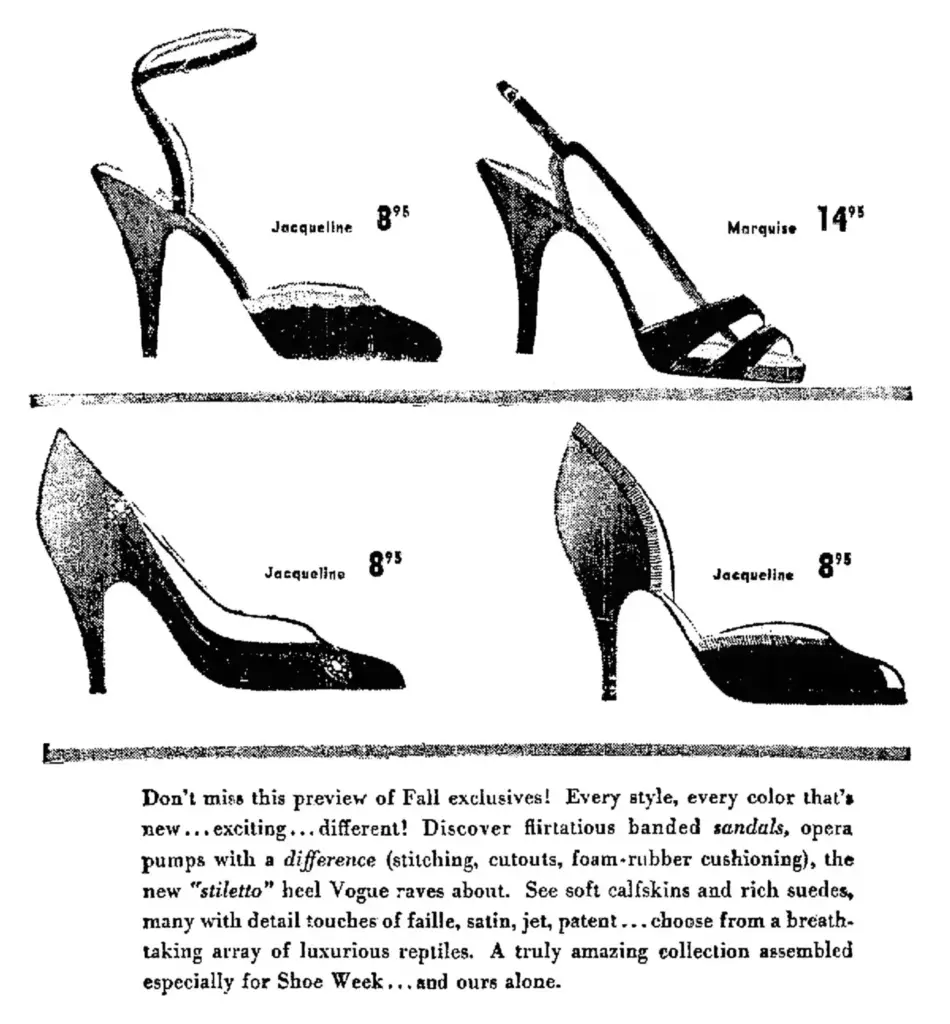
The stiletto is the extreme version of a thin base, and technically it’s a feat. Very thin molded plastic heels are reinforced inside with a steel dowel. SATRA has two tests designed for them. TM20 is a lateral impact test for women’s heels taller than 38 millimeters, about an inch and a half, and is especially useful for molded plastic heels with a steel dowel. TM21 measures how well a heel resists the repeated impacts of normal walking: it strikes the heel near the tip again and again with a fixed force until it fails. Who invented the stiletto is still argued over. The Victoria and Albert Museum in London notes that Roger Vivier is credited with creating it, and in 1954 he was designing shoes for Christian Dior. Yet a newspaper ad from 1952 was already selling “the new ‘stiletto’ heel Vogue raves about,” alongside opera pumps with foam-rubber cushioning.
Pressure that monuments can’t take
A small base concentrates a lot of weight on a little area, and floors feel it too. This is our own back-of-the-envelope math, just to give a sense of scale: if a 130-pound person puts their full weight for an instant on a heel tip of about a sixth of a square inch, the pressure comes to roughly 800 pounds per square inch. Spread that same weight across a wide heel of about 4.5 square inches and it drops to around 29 pounds per square inch.

Greece took notice. In May 2009, NPR reported that Greek officials were banning high heels, food and drinks at performances held in historic monuments, because of the damage they caused. One of the monuments involved was the Odeon of Herodes Atticus, a stone theater built in 161 at the foot of the Acropolis, where maintenance crews had pulled nearly 60 pounds of chewing gum from under the marble seats the year before. We couldn’t find the official legal text behind the rule, so we can’t confirm its exact scope or the fines that are sometimes quoted.
The platform and the height that really counts
A platform under the front of the shoe isn’t decoration. It takes away slope, and that’s simple geometry. What tilts your foot isn’t the total heel height but the difference between how high your heel sits and how high the ball of your foot sits. A four-inch heel with a one-inch platform leaves your foot at the same slope as a three-inch heel without one. It’s the same idea that running shoe companies call drop, as we explain in our story on heel-to-toe drop. Every heeled shoe has one, even if nobody prints it on the box.
A platform does bring other things with it: weight, a thicker and stiffer sole that bends less under the toes, and more distance between your foot and the ground. None of the studies we reviewed measured all of that together, so a platform isn’t a magic fix. It’s just one way to change the slope.
What goes inside the shoe
The surface your foot actually touches can be designed too. In the 2005 Taiwan study, a total contact insert, molded to follow the shape of the sole, lowered peak pressure on the inner side of the forefoot, and, interestingly, it made a bigger difference the higher the heel. In 2018, a team at Copenhagen University Hospital in Hvidovre, Denmark, compared ordinary stilettos with ones that came from the factory with a built-in pad under the ball of the foot, arch support and a heel cup, and published the results in Ergonomics. Among 22 women who wore them over several workdays, the second pair recorded lower pressure under the ball and heel and higher comfort scores for both areas.
Both findings point in the same direction as the Hong Kong simulator. The more of the foot that rests on the shoe, the less the weight piles up on a few spots. Something soft inside doesn’t stop a heel from tipping the foot forward, but it changes how the load is spread.
The heeled sneaker of 1925
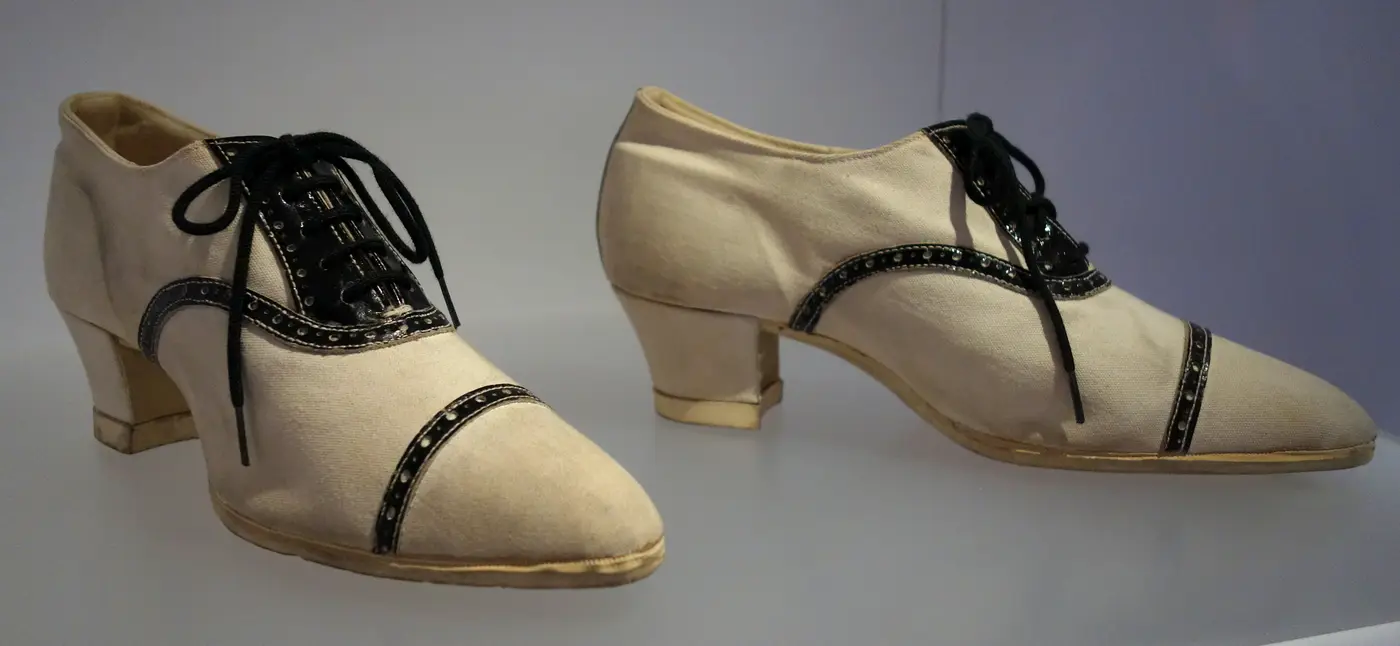
The photo at the top of this story shows a pair of canvas sneakers with heels from around 1925, maker unknown, held by the Bata Shoe Museum in Toronto. They’re proof that the idea of a heel you could wear without thinking about it isn’t new.
A century later, designing a comfortable high heel still runs on the same physics: a seat that fits the real heel and has the right angle for its height, a shank that’s stiff without being brittle, a base that doesn’t pile all the weight onto one point, a platform if you want to take away some slope, and an interior that supports the whole sole. And a last designed for that heel height from the start, because a heel isn’t something you bolt onto a shoe. The whole shoe is built around it, as we explain in how shoes are made. And for the era when heels belonged to men, there’s the history of men in high heels.
Sources
- R. E. Snow and K. R. Williams (1994), “High heeled shoes: their effect on center of mass position, posture, three-dimensional kinematics, rearfoot motion, and ground reaction forces,” Archives of Physical Medicine and Rehabilitation 75(5): 568–576.
- W. H. Hong et al. (2005), “Influence of heel height and shoe insert on comfort perception and biomechanical performance of young female adults during walking,” Foot & Ankle International 26(12): 1042–1048.
- C. P. Witana, R. S. Goonetilleke et al. (2009), “Footbed shapes for enhanced footwear comfort,” Ergonomics 52(5): 617–628.
- T. W. Weerasinghe and R. S. Goonetilleke (2011), “Center of pressure variations in high-heeled shoes,” Proceedings of the Human Factors and Ergonomics Society Annual Meeting 55: 1640–1644.
- Y. Cong, W. C. C. Lee and M. Zhang (2011), “Regional plantar foot pressure distributions on high-heeled shoes: shank curve effects,” Acta Mechanica Sinica 27(6): 1091–1097.
- J. Shang et al. (2020), “Influences of high-heeled shoe parameters on gait cycle, center of pressure trajectory, and plantar pressure in young females during treadmill walking,” Journal of Orthopaedic Surgery 28(2).
- J. Ø. Penny et al. (2018), “Can an off-the-rack orthotic stiletto alter pressure and comfort scores in the forefoot, arch and heel?” Ergonomics 61(8): 1130–1138.
- SATRA, “Testing of shanks for high-heeled footwear”; test methods TM20, TM21 and TM97.
- L. O. Cobler and J. E. Deandrea, U.S. Patent 1,265,056, “Shank stiffener and heel plate for shoes” (1918).
- FIDM Museum, “Embroidered evening wedge shoes, late 1930s”.
- Victoria and Albert Museum, evening pump by Roger Vivier for Christian Dior, 1954.
- NPR, “Heels, food banned from ancient Greek sites”, May 18, 2009.
Image credits
- Heeled sneakers from around 1925, Bata Shoe Museum (Toronto): Daderot. Public domain (CC0), via Wikimedia Commons.
- High heel design features diagram: feetkeepers.
- Heel-seat angle chart: feetkeepers.
- Drawing from U.S. Patent 1,265,056 by L. O. Cobler and J. E. Deandrea (1918): U.S. Patent Office. Public domain.
- 1952 stiletto heel ad: unknown author. Public domain, via Wikimedia Commons.
- Odeon of Herodes Atticus, Athens: Laurens R. Krol. CC BY 4.0, via Wikimedia Commons.