
Sneaker resale is a market built on selling something that, in theory, shouldn’t be scarce: mass-produced athletic shoes from factories that can turn out millions of pairs. And yet some models go on sale for under $200 and resell the next morning for ten times that. That isn’t the system breaking. It is the system. Scarcity gets manufactured just like a midsole: on purpose, with a release date, a limited run and a story to tell. Understanding that explains why people line up before dawn, why software buys sneakers in milliseconds and why at least one Nike executive had to resign.
A ban that mostly wasn’t
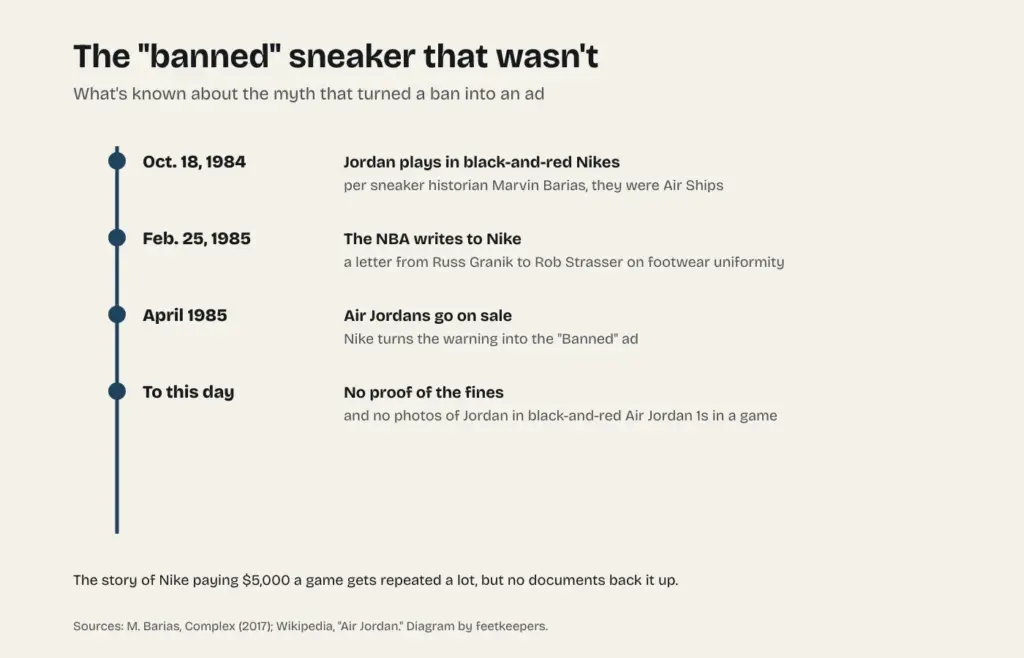
Resale’s founding myth is a ban. According to Wikipedia, Nike launched Air Jordans in April 1985 aiming to sell $3 million worth in three years, and it brought in $126 million in one. The deal was groundbreaking too: Jordan would earn royalties on products Nike sold with his name, considered a disruptive move at the time. Part of the success gets credited to an ad, “Banned,” which told viewers the NBA had thrown the shoes out of the game. The story repeated ever since says the league fined Michael Jordan $5,000 a game for wearing black-and-red sneakers, because the rules required shoes that were mostly white and matched the rest of the team’s, and that Nike happily paid every fine for the publicity.
The documented reality is more modest. In 2017, sneaker historian Marvin Barias went back through the case for Complex. There is an NBA letter, dated February 25, 1985, signed by executive vice president Russ Granik and addressed to Nike vice president Rob Strasser, about black-and-red sneakers Jordan had worn on October 18, 1984. But according to Barias, those were most likely Nike Air Ships, an earlier model, since the Air Jordan was still in development. No photos have surfaced of Jordan wearing the black-and-red Air Jordan 1 in an NBA game, and no evidence has surfaced of any fines. The most famous ban in athletic footwear was, above all, a brilliant piece of marketing, and it set the template every limited drop has followed since: tell people they can’t have it, then sell it to them.
How scarcity gets made
What the 1985 letter taught the industry is that a sneaker is worth more if it’s hard to get. Today brands do it with limited runs, collaborations with artists or designers and drops at a fixed date and time. Lining up isn’t enough anymore: many releases are handed out by raffle to people who sign up in the brand’s app or at a store.
That’s where bots come in, programs that fill out forms and check out faster than any human. The most notorious case came from inside Nike. In March 2021, Ann Hebert, Nike’s vice president and general manager for North America, left the company after 25 years, following a Bloomberg Businessweek report on her 19-year-old son’s resale business, a company called West Coast Streetwear. He told the magazine he had bought $132,000 worth of sneakers on a credit card and resold them for a $20,000 profit, using bots to get around per-customer purchase limits. Nike said Hebert had disclosed her son’s business in 2018 and hadn’t violated any policy, and her son said he never received inside information from her. But CEO John Donahoe reportedly acknowledged the episode had led some customers to question whether they could trust Nike, particularly around launch products.
A law that never came
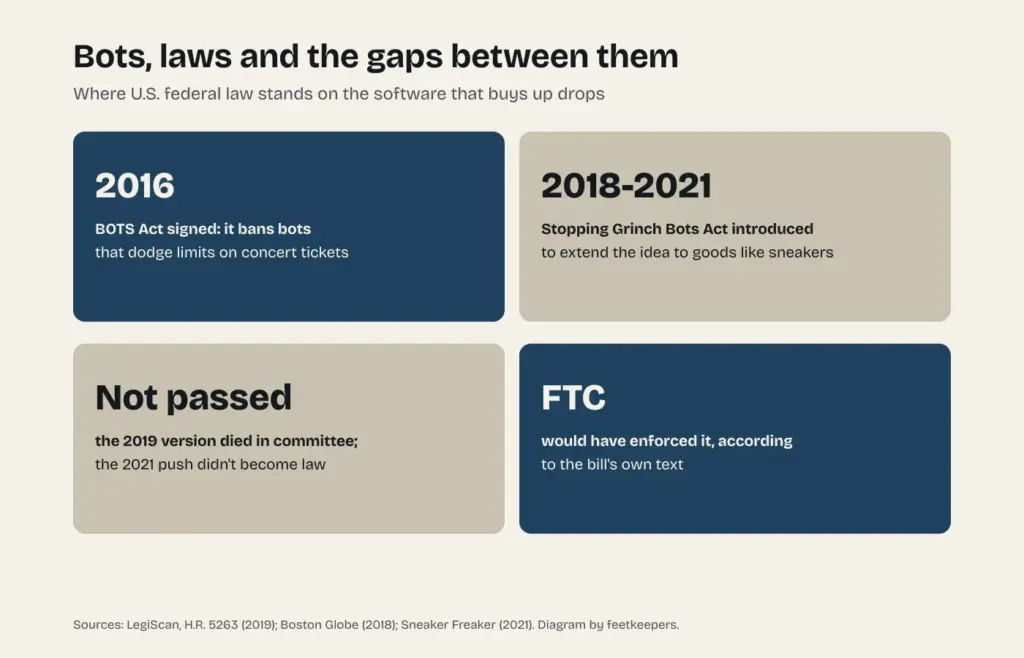
The law has lagged behind. In 2016, Congress passed the BOTS Act, signed by President Barack Obama, against software that dodges purchase limits on concert and event tickets. Sneakers were left out. Since 2018, a group of lawmakers including Sen. Chuck Schumer has tried to extend the idea to other goods with the Stopping Grinch Bots Act, named for the character who steals Christmas. According to the legislative tracker LegiScan, the 2019 version died in committee, and a renewed push in 2021 didn’t become law either. According to The Boston Globe, the bill wouldn’t have banned bots outright, only the kind that get around per-customer purchase limits, with the Federal Trade Commission enforcing it.
For a brand, in principle, bots don’t cost sales: the pairs sell either way, whoever buys them. What they cost is trust, as Donahoe’s reported comment made clear. The loser is the customer who strikes out in the raffle and then finds the same pair the next morning on a resale app at three times the price.
The numbers
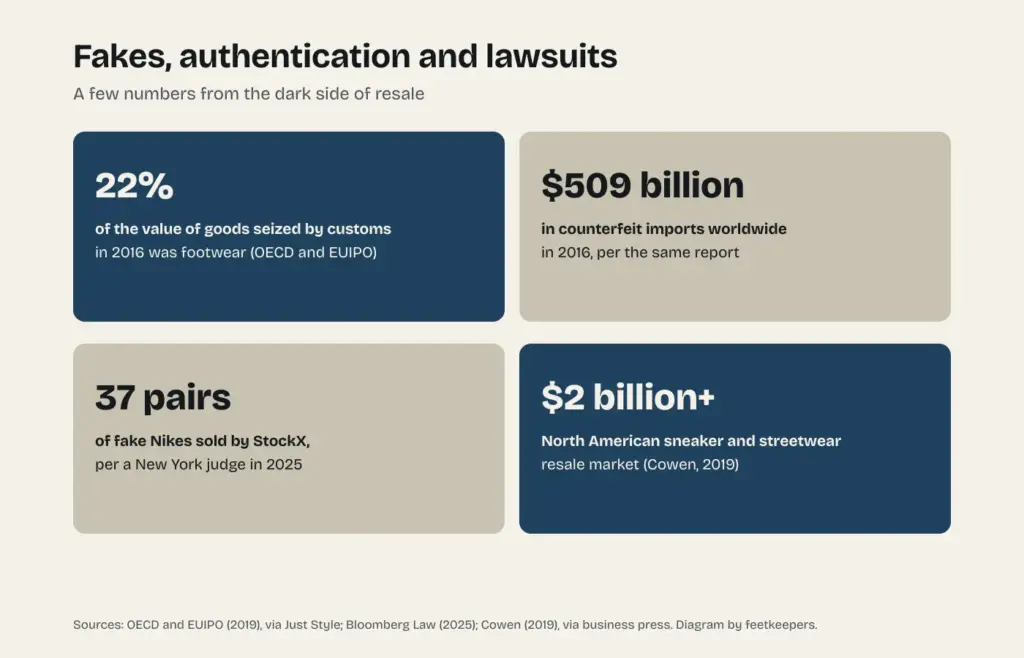
Putting a figure on a market that runs partly on platforms, partly on social media and partly hand to hand is hard. The number quoted most often comes from the investment bank Cowen, which estimated in 2019 that sneaker and streetwear resale topped $2 billion in North America and was growing more than 20 percent a year. We know it through business press coverage that doesn’t agree on the geographic scope of its projections, so treat it as a ballpark. Some of that coverage says Cowen expected the market to roughly triple by 2025; others put a $6 billion figure on the U.S., North America or the world, depending on the outlet. That spread alone says a lot about how little hard data this market produces about itself.
What’s documented are the extremes. According to VOA, in July 2019 Sotheby’s in New York auctioned a pair of Moon Shoes, sneakers Nike co-founder Bill Bowerman designed for runners at the 1972 Olympic trials, only twelve pairs of which were ever made. It was the only known unworn pair, and it sold for $437,500, then a record at public auction. The buyer, Canadian investor and car collector Miles Nadal, also paid $850,000 for 99 other rare pairs in the same sale. Sotheby’s had teamed up with the streetwear marketplace Stadium Goods to offer 100 pairs in all, which means a single collector walked out with the entire auction, Moon Shoes included. In 2021, samples of Kanye West’s Air Yeezys sold privately for $1.8 million. And in April 2023, according to Sports Illustrated and CNBC, Sotheby’s sold for $2,238,000 the Air Jordan XIIIs Jordan wore in Game 2 of the 1998 NBA Finals, in his last season with the Chicago Bulls, the one chronicled in the documentary The Last Dance. It was the record for sneakers at auction, though it came in under the house’s $2 million to $4 million estimate.
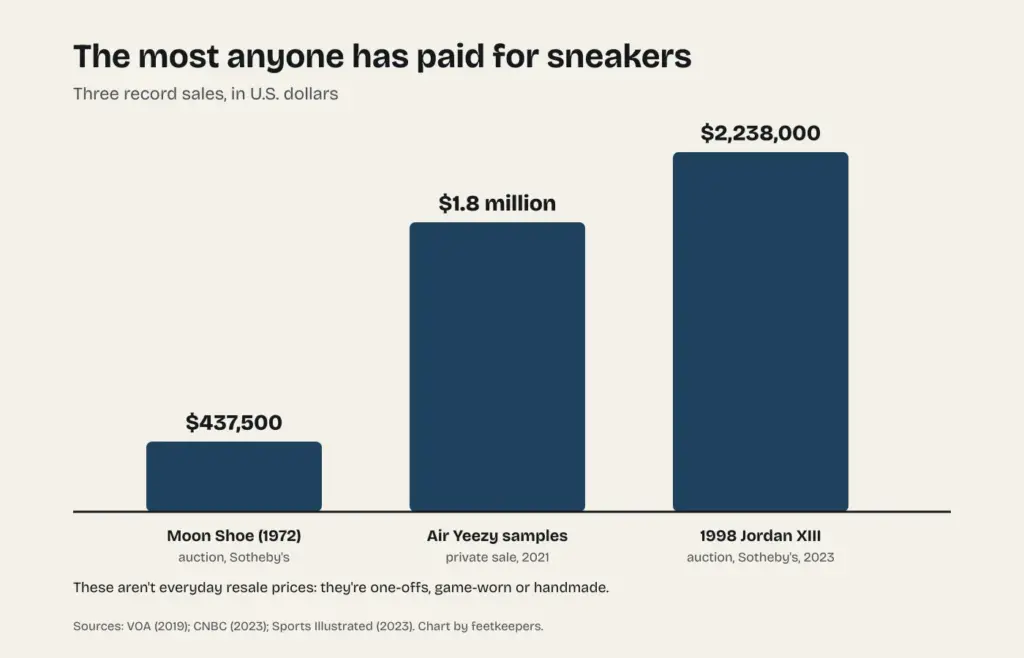
None of those prices has anything to do with everyday resale, which moves in tens or hundreds of dollars a pair. But they feed the idea that a sneaker can be an investment, like a painting or a watch. The difference is that a painting doesn’t decay on its own in the closet. Sneaker foams and polyurethanes do, even unworn, as we covered in how long sneakers last. A brand-new, never-worn pair can end up with a crumbling midsole inside its box.

Fakes and the authenticators
Where there’s a price, there’s a fake. According to a 2019 report by the OECD and the European Union Intellectual Property Office, using 2016 data, footwear was the biggest category by value among counterfeit goods seized by customs worldwide: 22 percent, ahead of clothing at 16 percent and leather goods at 13 percent. The same report put the value of counterfeit imports worldwide in 2016 at $509 billion.
To fight that, platforms emerged that check every pair before it reaches the buyer, like StockX, which billed itself as a marketplace with authentication. Nike sued it in February 2022, first over selling digital images of its sneakers as NFTs, which StockX called its “Vault” tokens and compared to digital receipts for authenticated goods, and then over selling fakes. In March 2025, according to Bloomberg Law, a New York judge found StockX liable for selling 37 pairs of counterfeit Nikes despite advertising everything as authentic, and sent the rest to trial. The two companies filed to dismiss the case on August 29, 2025, on confidential terms, weeks before a jury trial set for October 14 in Manhattan federal court. The dismissal was with prejudice, so the case can’t be refiled, and because it never went to trial, how much StockX would have owed for the fakes remains unknown. Authenticating sneakers, it seems, is harder than the box promises.
What the IRS sees
Resale has a tax side too, and in the U.S. its rules have bounced around for years. Payment apps and online marketplaces report sellers to the IRS on Form 1099-K. According to industry tax guides, the threshold that applied from the form’s start in 2011 through 2023 was more than $20,000 in payments and more than 200 transactions in a year. The American Rescue Plan Act of 2021 cut it to $600 with no transaction minimum, the IRS postponed that change several times, and in 2025 the law known as the One Big Beautiful Bill Act put the old threshold back. The IRS’s own page on the form today describes the reporting trigger as payments that exceed $20,000 in more than 200 transactions.
That’s only about when a platform files a form, not about what’s taxable. The IRS is explicit that you must report income on your return whether or not you get a 1099-K, and it lists personal items such as clothing sold at a gain among the things that count. What that means for any particular seller depends on their situation, and it’s not something we can sort out here. What’s clear is that the reseller moving dozens of pairs a year online isn’t invisible.
Europe went the other way at about the same time. Since January 1, 2024, under an EU directive known as DAC7, platforms where individuals buy and sell must report sellers to tax authorities once they reach 30 sales or go over €2,000 in a year, according to Spain’s Finance Ministry.
A sneaker that gets sold twice
The resale business says a lot about what people are actually buying when they buy a limited-edition sneaker. The materials, the last and the manufacturing are, in essence, the same as any other model from the brand; what it really costs to make a shoe we broke down in expensive vs. cheap shoes. What you pay extra for is something else: the story, the scarcity and the chance to show it off.
There’s something familiar about it. In 1990, when 80,000 Nikes fell into the Pacific and started washing up on Oregon beaches, locals organized swap meets to match up stray shoes into pairs, as we told in sneakers lost at sea. Three decades later, the swap meet lives in an app, the pair arrives with a certificate, and in many cases the sneaker never gets worn at all. It may be the only footwear people buy specifically so they won’t walk in it.
Sources
- M. Barias (2017), “The True Story Behind the Banned Air Jordan,” Complex, October 18, 2017.
- VOA Learning English (2019), “Old, Rare Nike Shoes Sold for Hundreds of Thousands of Dollars,” July 24, 2019.
- Sports Illustrated (2023), “Michael Jordan’s Shoes From 1998 NBA Finals Game 2 Shatter Auction Record,” April 11, 2023; CNBC (2023), on the record sales.
- CBS News (2021), on Ann Hebert’s resignation, March 2021.
- LegiScan, H.R. 5263, Stopping Grinch Bots Act of 2019; The Boston Globe (2018), “Don’t let a bot bust your holiday budget.”
- Decrypt (2025), “Nike, StockX End Trademark Clash Over NFTs and Fake Shoes.”
- Bloomberg Law (2025), “Nike, StockX Settle NFT, Counterfeiting Lawsuit Ahead of Trial.”
- OECD and EUIPO (2019), Trends in Trade in Counterfeit and Pirated Goods, reported by Just Style, March 19, 2019.
- IRS, “Understanding your Form 1099-K”; Avalara (2025), “One Big Beautiful Bill Act and the 1099 reporting threshold”.
- Spain’s Ministry of Finance (2024), Council of Ministers note on the DAC7 regulation, January 30, 2024.
- Wikipedia: Air Jordan.
Image credits
- Black sneaker with a white sole on a wood floor: chuttersnap, via Unsplash and Wikimedia Commons. Public domain (CC0); heel tab detail blurred.
- Auction gavel: Quince Media. CC BY-SA 4.0, via Wikimedia Commons.
- Diagrams and charts: feetkeepers.