

How long do sneakers last is a trick question, because almost everyone answers it by looking in the wrong place. We wait for the hole, the bald sole or the blown-out upper, and by then the shoe has been dead on the inside for a while. The hole is the last symptom, not the first. Before it, the foam has tired out, the sole has started to come unglued, the heel lining has worn through or, worst of all, the material has fallen apart on its own inside the box without ever touching pavement.
The most famous hole in history
One hole in a shoe won a Pulitzer Prize. In September 1952, during the presidential campaign, photographer William M. Gallagher of the Flint Journal caught Democratic candidate Adlai Stevenson in Flint, Michigan, sitting with one leg crossed. The sole of his right shoe had a hole in it. According to Wikipedia, the photo won Gallagher the 1953 Pulitzer, and the shoe became a symbol of the campaign: a candidate who had worn through his soles crisscrossing the country. When the Eisenhower campaign tried to use the shoe against him, Stevenson shot back that it was better to have a hole in your shoe than a hole in your head.
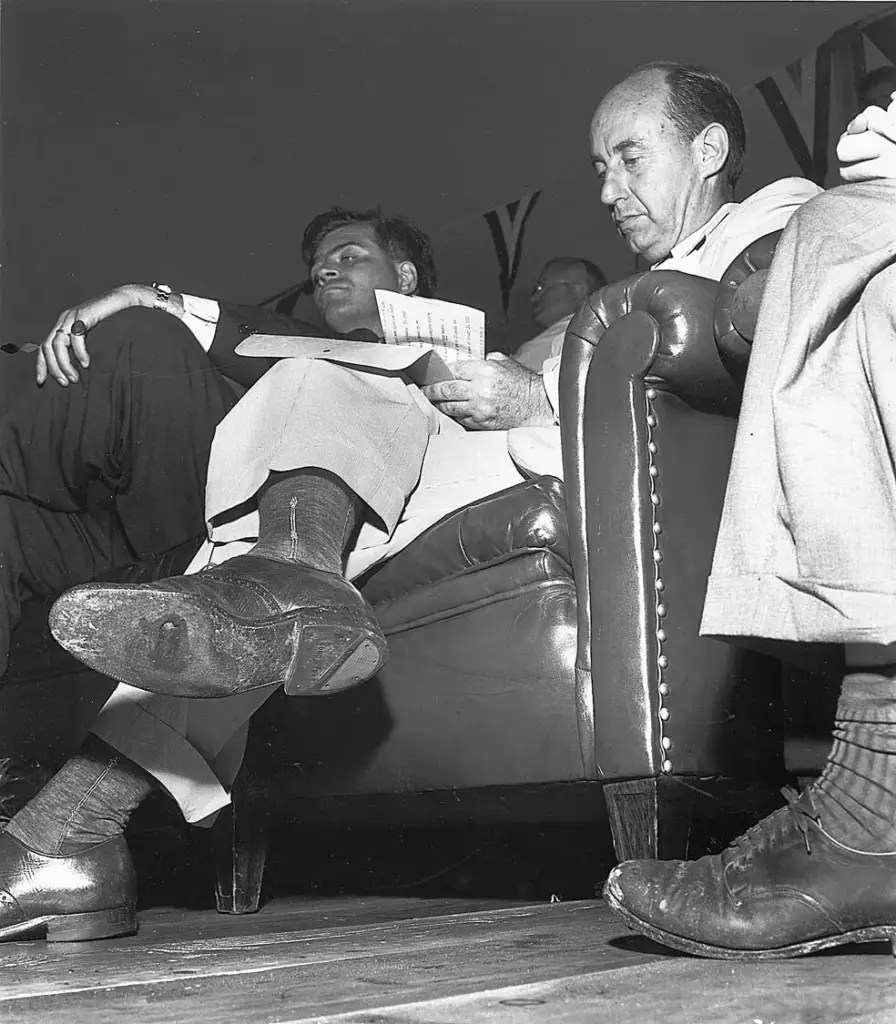
That hole was the end of a long story. In a modern sneaker, it almost always is.
There’s no magic number
The first thing to know is that there’s no reliable figure for how long everyday sneakers last. For running shoes, mileage rules get passed around that no study has actually proven, as we explain in how many miles running shoes last. For everyday shoes, there isn’t even that. It depends on how often you wear them, how much you weigh, the surfaces you walk on, the climate, how you store them and, above all, how they’re built. What we can explain is what fails and in what order.
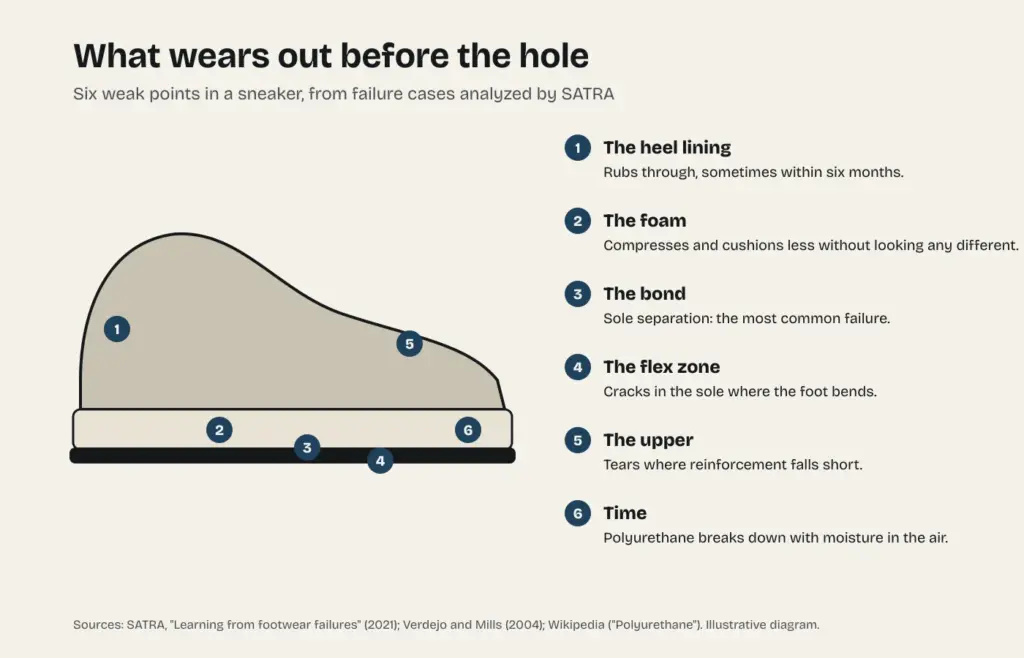
The foam gives out without warning
The part that loses performance soonest is the part you see least. The midsole, the foam between the outsole and your foot, is an enormous number of gas bubbles trapped in plastic, and every step squashes them. In 2004, Raquel Verdejo and Nigel Mills of the University of Birmingham found that in running shoes, peak pressure under the foot had risen by an average of 100 percent after 500 kilometers, about 310 miles, and under the microscope the bubble walls looked wrinkled, some with holes. From the outside, the shoe could look almost new. What that foam is made of, and why some tire faster than others, is in our story on EVA vs TPU vs PEBA.

The polyurethane that crumbles in your closet
One kind of wear doesn’t need any miles at all. Wikipedia sums it up in two sentences: polyurethanes can degrade through hydrolysis, a chemical reaction in which water breaks their bonds, and this is a common problem with shoes left in a closet, reacting with moisture in the air. It’s why some old sneakers disintegrate when you finally pull them out after years in storage.
SATRA, the British footwear research center, reported a textbook case in its magazine in 2021. A pair of hiking boots about ten years old and barely worn lost their midsoles in chunks at the heel, and then the outsoles came off. The diagnosis was clear: a classic case of hydrolysis breaking down a polyurethane component, caused by the passage of time and the moisture in normal air. SATRA added that the boots had been kept too long and that a label with storage advice might help.
Museums deal with this firsthand. In 2020, the Bata Shoe Museum in Toronto described on its blog how, while preparing its 2013 exhibition Out of the Box: The Rise of Sneaker Culture, staff found pieces actively deteriorating. One was a Puma RS Computer made in 1986: its polyurethane midsole was cracked, sticky, crumbling and covered in a white crystalline bloom. The shoes were so fragile they were left behind when the exhibition traveled to other institutions. Conservators call this inherent vice: deterioration built into the aging of the material itself, made worse by how an object was worn and where it was stored.
Saving foam like that is now a research field of its own. In 2024, a team from NOVA University Lisbon, working with Tate, the University of Glasgow and the National Museum of Denmark, explained in the journal Sustainability that degrading ester-based polyurethane foams suffer extensive fragmentation, stickiness and brittleness, both on the surface and inside. They tried consolidating them with supercritical carbon dioxide, which acts like a solvent that soaks deep into the foam and carries a strengthening agent along with it. The samples came out less sticky and noticeably more flexible. The same group had already tried the approach on an even trickier object: a pair of heavily degraded goalkeeper gloves made with synthetic latex foam, where traditional treatments had proved unsafe and inefficient, causing material loss with little gain in surface strength. Tested on lab mock-ups, the carbon dioxide treatment didn’t damage the fragile surfaces or cause further losses. The sneaker forgotten in your closet has the same problem museums have with their 1980s pieces.
To predict this kind of aging, the industry speeds it up. SATRA’s TM344 method, which also covers polyurethane-coated leathers, stores samples of polyurethane soling in a warm, humid environment for periods of seven days or multiples of seven, then compares their flex, tensile, tear and abrasion resistance with untreated samples. Archives study it too: in 2019, researchers from the University of Nottingham and the Alfred Gillett Trust, which holds the historic collection of the shoemaker Clarks, analyzed polyurethane soles stored for up to 50 years in Heritage Science to find out what substances might form as they break down.
Rubber has its own enemy
Rubber soles don’t hydrolyze the way polyurethane does, but they age another way. According to Wikipedia, tiny traces of ozone in the air attack the chemical double bonds in rubber chains, and natural rubber, polybutadiene and styrene-butadiene rubber, all common in soles, are among the most vulnerable. The attack starts on exposed surfaces and forms cracks, which open up mostly where the material is stretched or bent. The same article notes that ozone cracking used to be very common in car tires and is now rarely seen there thanks to preventive measures, yet it still shows up in seals, hoses and other rubber parts where nobody expects it. Polyurethane, by contrast, stands up well to ozone. Every material in a sneaker, in other words, has its own way of dying.
The bond: the most common failure
Most sneakers aren’t stitched: the sole is glued to the upper. SATRA puts it bluntly in the same 2021 article, writing about a pair of boots whose sole came off while someone was wearing them: this appears to be a case of poor sole adhesion, probably the most common type of footwear failure. Bonding a sole is a multi-step process, it explained, and a faulty shoe can come out of a perfectly good style.
Bonds age too. What punishes them most is heat, which softens adhesives and warps foam, as we explain in our story on cleaning white sneakers: no dryer, no radiator. And when the bond fails, the difference between a shoe you throw out and one you fix comes down to how it was built, which is what we cover in shoe repair.
The sole that cracks where it bends
A sneaker flexes thousands of times a day in the same spot, across the ball of the foot. In another SATRA case, a pair of everyday athletic trainers started cracking across the sole at two or three months old. The likely cause was a sole too weak to handle flexing, something testing during product development can catch. That’s what methods such as TM60 are for, cutting a nick into a sole sample and measuring how much it grows every thousand flexes, along with TM161, which bends the whole sole 90 degrees and is aimed mainly at treaded outsoles.
The heel lining and the upper
The heel takes the most rubbing of any part of the shoe. In the first case in SATRA’s article, the lining of a pair of safety shoes started breaking down at the heel within six months, and the explanation pointed to a loose fit: if the heel slips inside the shoe on every step, the friction wears through the lining. That’s why safety footwear standards require lining abrasion tests. Under that lining sits the heel counter, the stiff piece that holds the heel and that, as we explain in how to stretch shoes, is designed to spring back to shape. We haven’t found studies measuring how much shape it loses in everyday use.
The upper has its own ways of failing. In the case of a pair of leather shoes that tore at 18 months, SATRA blamed inadequate reinforcement, possibly helped along by poor leather structure and a bad fit that added strain. In other words, uppers tend to fail where the design skimped, not at random.
The sole, underneath
The outsole is what everyone checks, and it’s actually what holds up best. Sole rubbers are tested on abrasion machines such as the one in SATRA’s TM174 method: a rotating drum covered in standard abrasive cloth wears down a round sample that travels along it in a spiral, and the lost volume is calculated. The equivalent international standard for rubber, ISO 4649, includes a warning worth remembering: no close relationship between its results and real-world service performance can be inferred. The lab compares materials; it doesn’t predict how many months a sole will last.
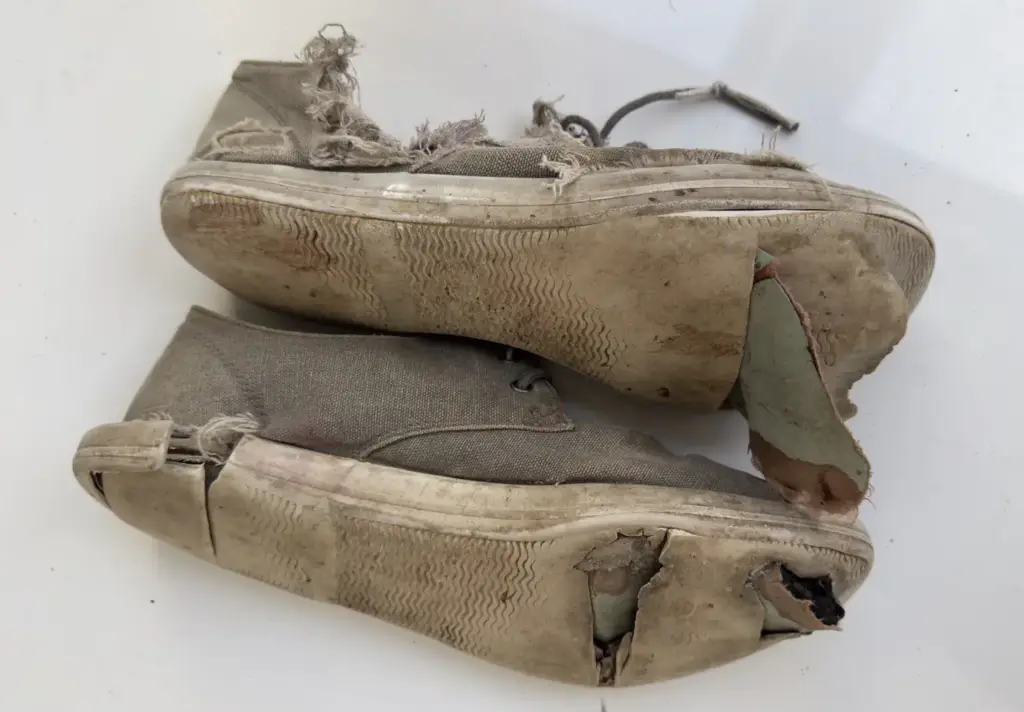
Once the tread is gone, a sole doesn’t just look worn: it grips less on wet floors, as we explain in shoe traction on wet floors. And inside there’s a part almost nobody sees: the insole board, the base the shoe is built on. In another SATRA case, a pair of boots broke down inside at the heel, and the cause was microbiological breakdown of a cellulose insole board, probably linked to sweat.
How to read a pair of sneakers
With all of that in mind, the question changes. It’s not how long they last but what’s already worn out. A sneaker with an intact sole can have spent foam; one with a flawless upper can have been losing strength in its box for years if its midsole is polyurethane. Rotating pairs so they dry between wears, as we explain in how many pairs of shoes you need, storing them somewhere dry and not too warm, and paying attention before the hole shows up stretches out what can be stretched. The rest was decided at the factory.
Sources
- Wikipedia, “Adlai Stevenson II,” “Polyurethane” and “Ozone cracking.”
- Bata Shoe Museum, “When good sneakers go bad,” August 2, 2020.
- R. Verdejo and N. J. Mills (2004), “Heel-shoe interactions and the durability of EVA foam running-shoe midsoles,” Journal of Biomechanics 37(9): 1379–1386.
- SATRA, “Learning from footwear failures – part 1,” SATRA Bulletin, July/August 2021.
- SATRA, TM344: Hydrolysis of polyurethane solings and polyurethane coated leathers; TM174, abrasion resistance of soling; TM60 and TM161, sole flex tests.
- R. Tillotson et al. (2019), “Analysing for 4,4′-diaminodiphenylmethane in heritage collections containing solid and medium density flexible linear polyester polyurethanes using liquid chromatography/mass spectrometry,” Heritage Science 7.
- I. Soares et al. (2024), “Assessing the use of supercritical carbon dioxide as a carrier for alkoxysilanes to consolidate degraded PUR ester foams,” Sustainability 16: 4375.
- J. Tomás Ferreira et al. (2024), “Proof-of-concept study on the feasibility of supercritical carbon dioxide-assisted consolidation treatment for a pair of goalkeeper gloves on synthetic latex-based foam mock-ups,” Sustainability 16: 1562.
- ISO 4649:2024, Rubber, vulcanized or thermoplastic — Determination of abrasion resistance using a rotating cylindrical drum device.
Image credits
- Worn-out canvas sneakers: Wolfmann. CC BY 4.0, via Wikimedia Commons.
- Adlai Stevenson with a hole in his shoe (1952): William M. Gallagher. Public domain, via Wikimedia Commons.
- Sneaker weak points diagram: feetkeepers.
- Visible vs. invisible wear diagram: feetkeepers.
- Worn-out canvas sneakers, sole view: Wolfmann. CC BY 4.0, via Wikimedia Commons.