
EVA vs TPU sounds like an acronym fight dreamed up in a marketing department, and on the box, it is. Every brand gives its foam a trademarked name that sounds like it belongs on a rocket. Strip away the branding, though, and almost every midsole on the market comes from one of three chemical families, each with a very different personality. One is cheap, dependable and wears down. One shrugs off the cold. The third bounces back harder than anything else and is also the first to lose its spark. Knowing which one is under your foot tells you more about a shoe than any slogan.
Foam is gas trapped in plastic
Before the acronyms, the basic idea. The midsole, the thick layer between the rubber outsole and your foot, is a foam: plastic filled with gas bubbles, which engineers call cells. When you step down, the cells squash and store energy. When you lift your foot, the plastic walls spring back and return some of that energy. Whatever doesn’t come back is lost as heat, and that loss is called hysteresis. The lower the hysteresis, the more a foam “bounces.”
We’ve covered how these layers work in our story on how shoe insoles are made, and how they wear down with mileage in how many miles running shoes last. This is the other half of the story: what they’re made of, how they’re manufactured and why they behave the way they do.
EVA: the old reliable
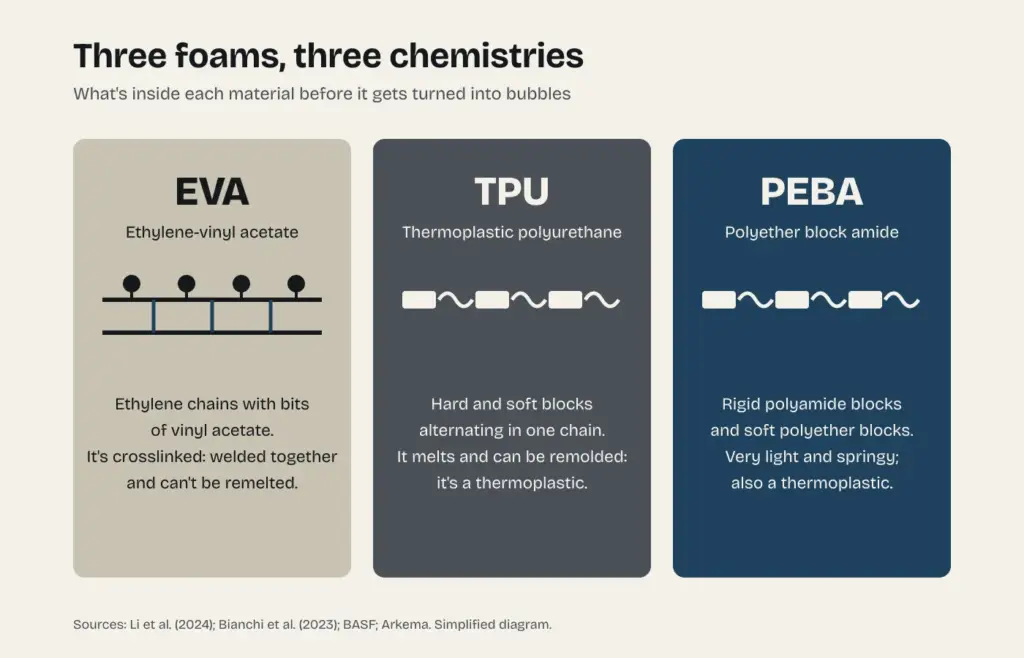
EVA, or ethylene-vinyl acetate, is a copolymer: a chain of ethylene, the same building block as the polyethylene in grocery bags, dotted with bits of vinyl acetate. Those bits get in the way when the chains try to line up neatly, and the result is a soft, flexible plastic that behaves a lot like rubber. Wikipedia lists it as the typical shock absorber in athletic shoe midsoles.
To turn it into foam, manufacturers mix it with two things: a blowing agent and a crosslinking agent. The crosslinker builds chemical bridges between chains, stitching the plastic into a three-dimensional network that holds its shape. The blowing agent breaks down in the hot mold and releases gas, which inflates the mix from the inside. In 2024, a team at Sun Yat-sen University in China noted in the journal Materials that conventional chemical blowing agents used for footwear EVA, such as azodicarbonamide, are considered environmentally problematic. They tested a physical alternative: nitrogen in a supercritical state, a high-pressure condition in which the gas behaves partly like a liquid and dissolves into the plastic. They produced foams of 0.15 to 0.25 grams per cubic centimeter, roughly four to nearly seven times lighter than water, with uniform cells 50 to 100 micrometers across and a wide foaming window, from 120 to 180 °C, about 250 to 355 °F.
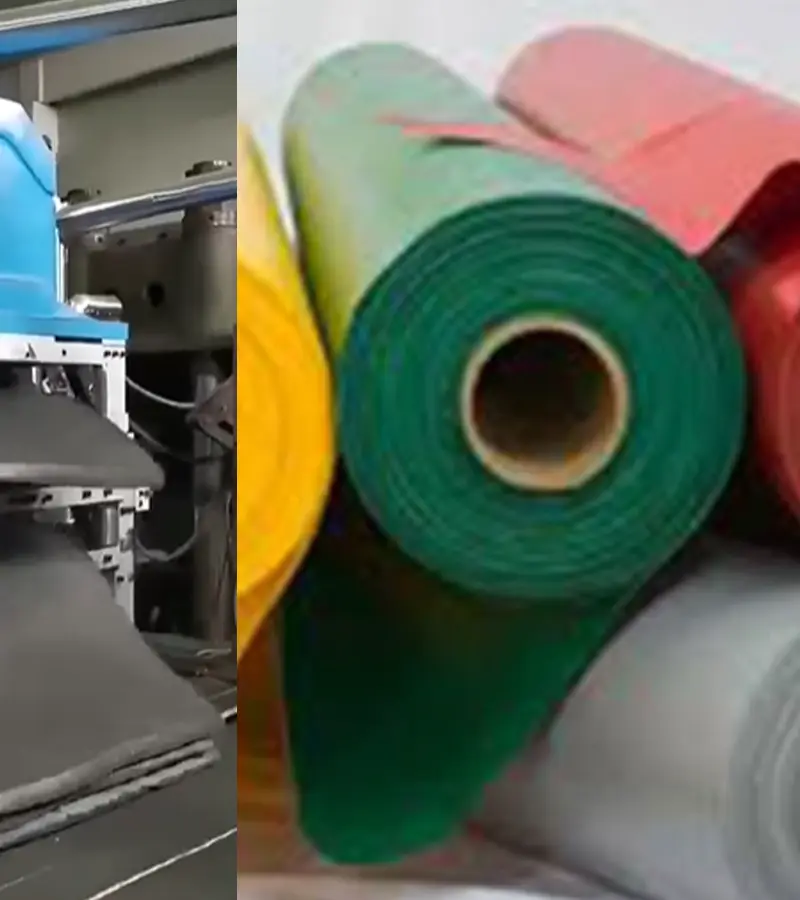
That chemical network matters at the end of a shoe’s life. Crosslinked EVA can’t be melted and remolded like an ordinary plastic. In 2023, researchers at Marche Polytechnic University in Italy looked, in The International Journal of Advanced Manufacturing Technology, at what to do with the scraps left over from injection-molding EVA soles, the channels that feed material into the mold, which had been going to landfill. They shredded the scrap and blended 10 percent of it into virgin EVA. The recycled material was noticeably weaker in tension, compression and abrasion than the original, but the life cycle assessment and cost analysis both came out clearly in its favor.
EVA and the thermometer
EVA has another quirk you notice in winter. In 1996, Hiroshi Kinoshita and Barry Bates published a study in the Journal of Applied Biomechanics on EVA-midsole running shoes at different temperatures. First they measured that during a 40-minute run, midsole temperature rose by an average of 8 °C, about 14 °F, over the first 15 to 20 minutes and then leveled off. Then they tested soft, medium and firm shoes on an impact machine across a range from winter cold to summer heat. As the temperature rose, peak impact deceleration and energy absorption dropped, and the foam took longer to reach full compression: it behaved like a softer foam. The authors concluded that an ordinary shoe of medium hardness probably cushioned poorly in cold weather and controlled the heel poorly in very hot weather. In other words, the same EVA isn’t the same foam in January as it is in August.
Expanded TPU: polyurethane popcorn
Thermoplastic polyurethane, or TPU, is a different animal. Its chain alternates short, highly polar hard segments with long, flexible soft segments. The hard segments cluster together like tiny knots that hold the structure in place, and the soft segments supply the stretch. Because those knots come apart with heat and re-form as it cools, TPU can be melted and molded again, which is what makes it a thermoplastic.
In shoes, it’s best known in bead form. According to the German chemical company BASF, which sells it as Infinergy, expanded TPU, or E-TPU, starts as TPU granules up to five millimeters across that are “blown up like popcorn”: their volume grows tenfold, producing oval foam beads with tiny closed gas bubbles inside. According to Wikipedia, adidas first built it into its running shoes in 2013 under the name Boost. The beads are then loaded into a mold and fused together, usually with steam, in a process the industry calls steam-chest molding. That’s why this kind of midsole, up close, looks like a pile of little balls stuck together.

In 2021, a team at Dankook University in South Korea tried another route in the journal Polymers: inflating the beads with supercritical CO₂ and then pressing them into sheets, carefully controlling pressure and temperature so only the bead surfaces fused. They found the processing window was much narrower than with steam, along with a useful rule: the more the beads expanded, the springier and softer the foam became.
TPU and the cold
BASF says its foam keeps its properties at minus 20 °C, about minus 4 °F. That’s a manufacturer’s claim, but an independent study points the same way. In 2024, researchers at the University of Bayreuth in Germany and University College London compressed E-TPU at temperatures from minus 50 to 120 °C and published the results in the Journal of Materials Science: Materials in Engineering. The foam recovered very well after compression, especially between minus 50 and 60 °C, and samples that had been taken down to minus 40 °C absorbed up to 10 percent more energy in later tests. Compared with Kinoshita’s EVA, which changed character with temperature, that’s far more stable behavior.
PEBA: the record-breaking foam
The third family is polyether block amide, or PEBA, sold by the French chemical company Arkema as Pebax and by Germany’s Evonik as Vestamid E. According to Arkema, its chain is made of rigid polyamide blocks, the nylon family, and soft polyether blocks. It’s another thermoplastic elastomer, like TPU, but lighter. In 2021, Arkema marked the brand’s 40th anniversary, and its announcement boasted that over those four decades Pebax had proven itself in athletic footwear, with foams lighter and more resilient than traditional ones. Standard grades use polyamide 12 blocks; the bio-based Rnew grades use polyamide 11, which Arkema derives from castor beans.
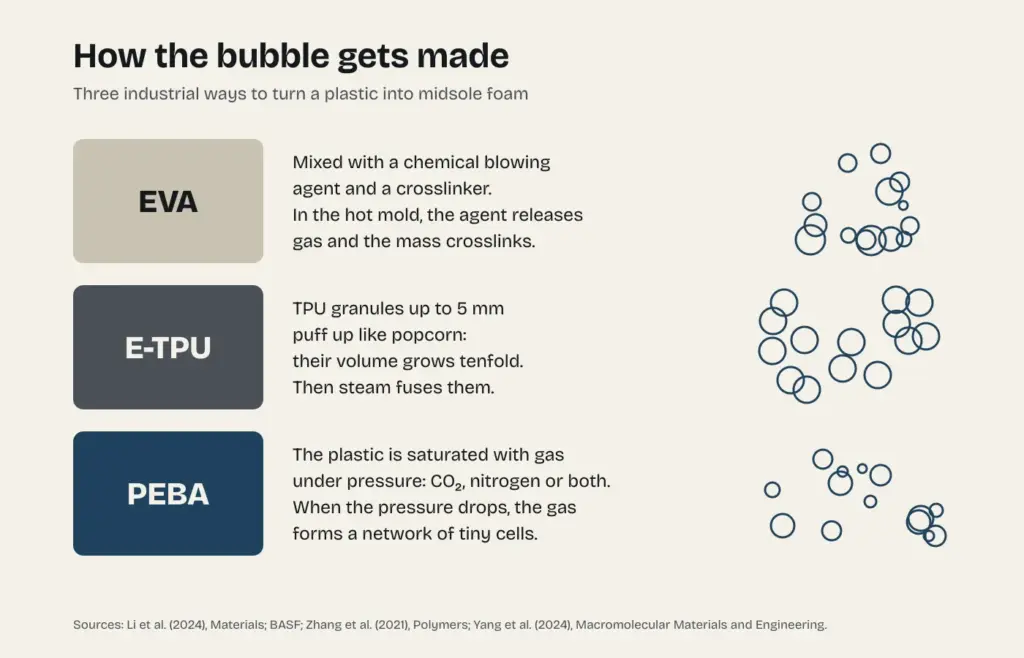
Turning PEBA into foam isn’t easy. In 2024, a team from Shandong University and Hainan University in China explained in Macromolecular Materials and Engineering that with standard microcellular foaming, which saturates the plastic with gas under pressure and lets it expand when the pressure drops, it’s still hard to make PEBA foams that don’t shrink afterward. Their fix was to blend CO₂ with nitrogen. The nitrogen escapes from the cells more slowly and props them up against the outside air pressure. That gave them a stable foam with an expansion ratio of 7.9.
What makes PEBA famous is the bounce. In the 2018 lab test that accompanied the first marathon super shoe, the PEBA prototype foam returned 87 percent of the energy in each compression, more than the marathon shoes of the day, as we cover in detail in how many miles running shoes last. That story also covers the flip side: in a 2024 Spanish study, PEBA’s advantage over EVA disappeared after 280 miles of use. How that foam works together with a stiff plate is in our story on stiff vs. flexible shoe soles.
Why every foam wears out
No foam lasts forever. Every step crushes the cells, and over thousands of steps some cell walls wrinkle, crack or stop springing all the way back. Engineers call that permanent squashing compression set, and the damage that builds up cycle after cycle fatigue. As we noted in our running shoe mileage story, a 2024 study of five commercial foams found an uncomfortable pattern: the lightest, most porous foam cushioned best but also broke down fastest, while the densest performed worse but held up much longer.
Here’s the summary, without the marketing:
| EVA | E-TPU | PEBA | |
|---|---|---|---|
| Chemistry | Crosslinked copolymer | Thermoplastic elastomer with hard and soft blocks | Thermoplastic elastomer of polyamide and polyether |
| How it’s foamed | Chemical blowing agent or physical gas, plus crosslinking | Expanded beads, fused together | Gas under pressure, microcellular foaming |
| Temperature | Changes hardness with heat and cold | Very stable from −50 to 60 °C in the lab | No independent data found |
| Rebound | The baseline | Higher than EVA, according to its maker | The highest measured in shoes |
| Recycling | Can’t be remelted; only shredded and blended | Thermoplastic: remeltable in principle | Thermoplastic: remeltable in principle |
What each one costs
Let’s be straight about this: we haven’t found public, verifiable per-kilogram prices for these foams, and we’re not going to make any up. What we can explain is where the differences come from. EVA starts from ethylene, one of the most abundant feedstocks in petrochemistry, and is made with mature processes used in shoes at every price point; ResourceWise, a chemical industry consultancy, notes that its cost tracks mainly with the ethylene market. E-TPU and PEBA are engineering plastics made by a handful of suppliers, and their foams need fussier processes such as steam-chest molding or pressurized gas foaming. That fits with PEBA foams showing up mostly in premium shoes, but how a shoe’s price actually splits between materials, labor and brand is a separate story, which we tell in expensive vs. cheap shoes.
Recycling a foam
The ending is the least glamorous part. EVA, because of its chemical network, recycles badly: the 2023 Italian study could only reuse it shredded and blended in small amounts. TPU and PEBA, as thermoplastics, can in theory be melted down again, and in 2021 Arkema announced a program called Virtucycle to recycle both post-industrial and post-consumer polymers. In practice, a sneaker is a sandwich of foams, rubbers, fabrics and adhesives, as we explain in how shoes are made, and separating them is still the real problem.
Next time a box tries to sell you a foam with a rocket-ship name, ask a simpler question: is it EVA, TPU or PEBA? That alone tells you how it will bounce, how it will handle the cold and what happens to it when you throw it out.
Sources
- Wikipedia, “Ethylene-vinyl acetate,” “Thermoplastic polyurethane,” “Polyether block amide” and “Boost (material).”)
- Y. Li et al. (2024), “Comparative study of the foaming behavior of ethylene–vinyl acetate copolymer foams fabricated using chemical and physical foaming processes,” Materials 17: 3719.
- I. Bianchi, A. Forcellese, M. Simoncini and A. Vita (2023), “Mechanical characterization and sustainability assessment of recycled EVA for footwears,” The International Journal of Advanced Manufacturing Technology 126: 3149–3160.
- H. Kinoshita and B. T. Bates (1996), “The effect of environmental temperature on the properties of running shoes,” Journal of Applied Biomechanics 12: 258–268.
- BASF, “Small beads for long distances.”
- T. Zhang et al. (2021), “Compression molding of thermoplastic polyurethane foam sheets with beads expanded by supercritical CO₂ foaming,” Polymers 13: 656.
- J. Meuchelböck et al. (2024), “Influence of temperature on the compression properties of expanded thermoplastic polyurethane (ETPU),” Journal of Materials Science: Materials in Engineering 19.
- Arkema, Pebax elastomer family, and the Pebax 40th anniversary announcement as reported by Textile World (March 2021).
- H. Yang et al. (2024), “Super-elastic and dimensionally stable polyether block amide foams fabricated by microcellular foaming with CO₂ & N₂ as co-blowing agents,” Macromolecular Materials and Engineering 309.
- W. Hoogkamer et al. (2018), “A comparison of the energetic cost of running in marathon racing shoes,” Sports Medicine 48: 1009–1019.
- ResourceWise, “Footwear feedstocks price forecast: a chemicals cost comparison.”
Image credits
- Expanded polystyrene beads before expansion: Swoolverton. CC BY-SA 3.0, via Wikimedia Commons.
- Three chemistries diagram: feetkeepers.
- EVA foaming press: Sultan Salahuddin. CC BY-SA 4.0, via Wikimedia Commons. Cropped.
- Plastic granules for injection molding: Teemeah. CC BY-SA 3.0, via Wikimedia Commons.
- How the bubbles get made diagram: feetkeepers.