
The oldest shoes in the world have never been found, and almost certainly never will be. They were made of hide, plant fiber or bark, and all of that rots. What survives is something else: a mark left in the bones of the people who wore them, a handful of sandals that made it through the millennia in dry caves or under volcanic ash, and a few shoes that ice or the floor of a cave happened to preserve. From those scraps you can piece together a story that starts about 40,000 years ago, and one of its best chapters takes place in Oregon, where a stubborn archaeologist had to wait thirteen years for science to catch up with him.
Bones that give the shoe away
The earliest clue to footwear isn’t a shoe. It’s a toe. Paleoanthropologist Erik Trinkaus of Washington University in St. Louis realized that shoes leave their mark on the skeleton. When you walk barefoot, he explained in 2008, your middle toes curl into the ground for traction as you push off. In shoes that hold the foot, more of the push goes through the big toe and less force runs through the others. Over a lifetime, those middle toe bones grow slimmer.
In 2005, Trinkaus published an analysis in the Journal of Archaeological Science comparing toe bones from Middle and Upper Paleolithic humans with those of recent populations who did and didn’t wear shoes. His conclusion: supportive footwear was rare in the Middle Paleolithic and had become common by the middle of the Upper Paleolithic. In 2008, with Hong Shang, he added two more skeletons in the same journal. Tianyuan 1, a modern human from a cave near Zhoukoudian, China, about 40,000 years old, had robust legs and strikingly slender middle toes. According to the authors, it pushed the habitual use of footwear further back than anyone had thought.
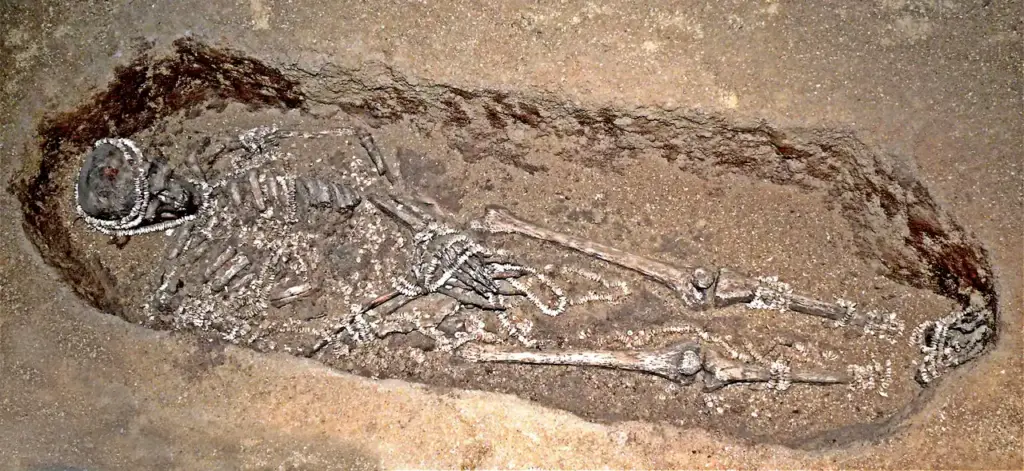
The other skeleton was Sunghir 1, from Russia, about 27,500 years old. Sunghir also comes with archaeological evidence: its burials held large numbers of ivory beads around the ankles and feet. If those beads were sewn onto clothing, as their placement on the rest of the body suggests, these people were buried wearing some kind of footwear.
Fort Rock: the sandals that waited for carbon-14
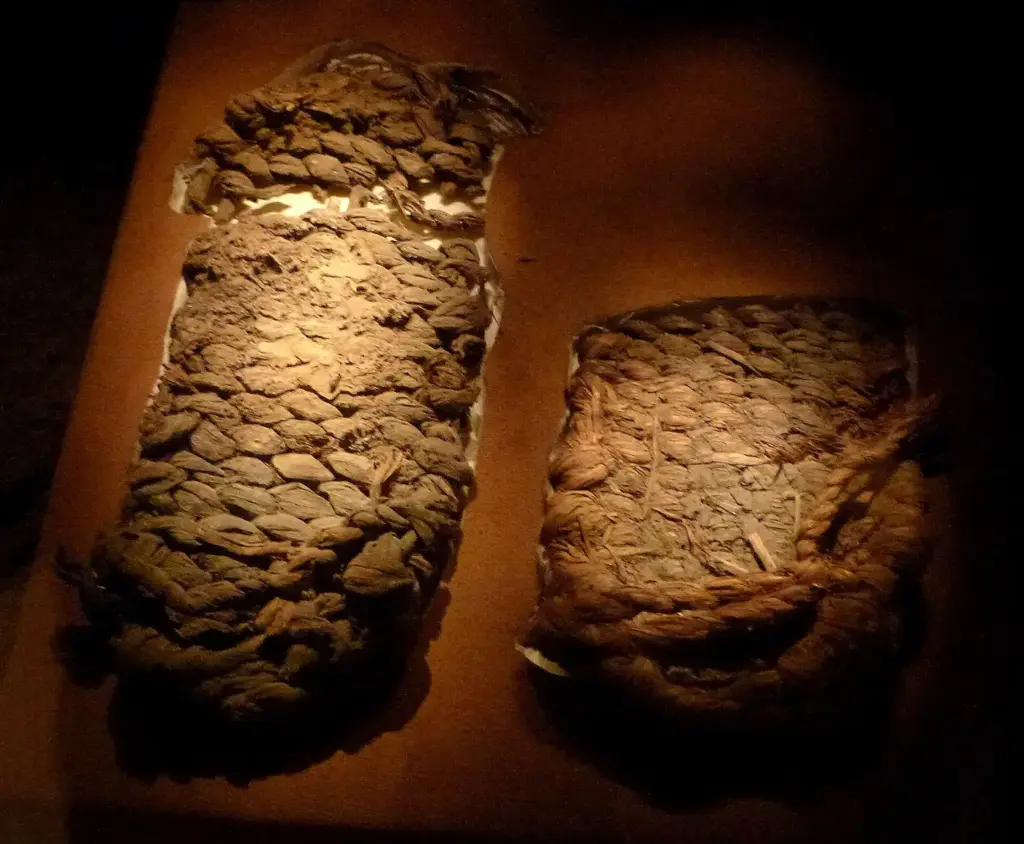
The oldest footwear that has survived and been directly dated turned up in Oregon. In 1938, University of Oregon archaeologist Luther Cressman excavated Fort Rock Cave, in the central part of the state, and found dozens of sandals beneath a layer of volcanic ash. That ash came from the eruption of Mount Mazama about 7,500 years ago, so the sandals had to be even older. His colleagues didn’t buy it, and the doubts lasted for more than a decade.
The answer came from a technique that had only just been invented. In 1951, J. R. Arnold and Willard Libby dated sagebrush bark from the cave with the brand-new radiocarbon method and got ages of 9,188 and 8,916 radiocarbon years, which today translate to a range of roughly 10,390 to 9,650 calendar years. According to the University of Oregon, the directly dated sandals span from at least 10,500 to 9,200 years ago.
They’re made of shredded sagebrush bark, twined rather than simply woven over and under: pairs of fibers twisted around rope warps, usually five of them, forming a flat, tight sole. Cressman’s theory was that they were held on with a tie rope attached to one edge of the sole, wrapped around the ankle and fastened to the opposite edge.
Albuñol: the sandals the miners burned
Spain’s entry in this story begins with a disaster. In 1857, a mining company found a vein of galena, a lead ore, in a rock shelter at Albuñol, in the province of Granada, that until then had been used to pen goats. Removing rock to get at the ore exposed a chamber holding several partially mummified bodies, along with baskets, wooden tools and other remains. According to the accounts gathered later, the miners burned some of the fiber objects to keep their boiler running, and others were handed out among the villagers.
Ten years after the discovery, archaeologist Manuel de Góngora y Martínez visited the cave, collected the miners’ accounts, gathered what was left and published it. After his death in 1884, the material went into the founding collections of Spain’s National Archaeological Museum in Madrid, where it still is.
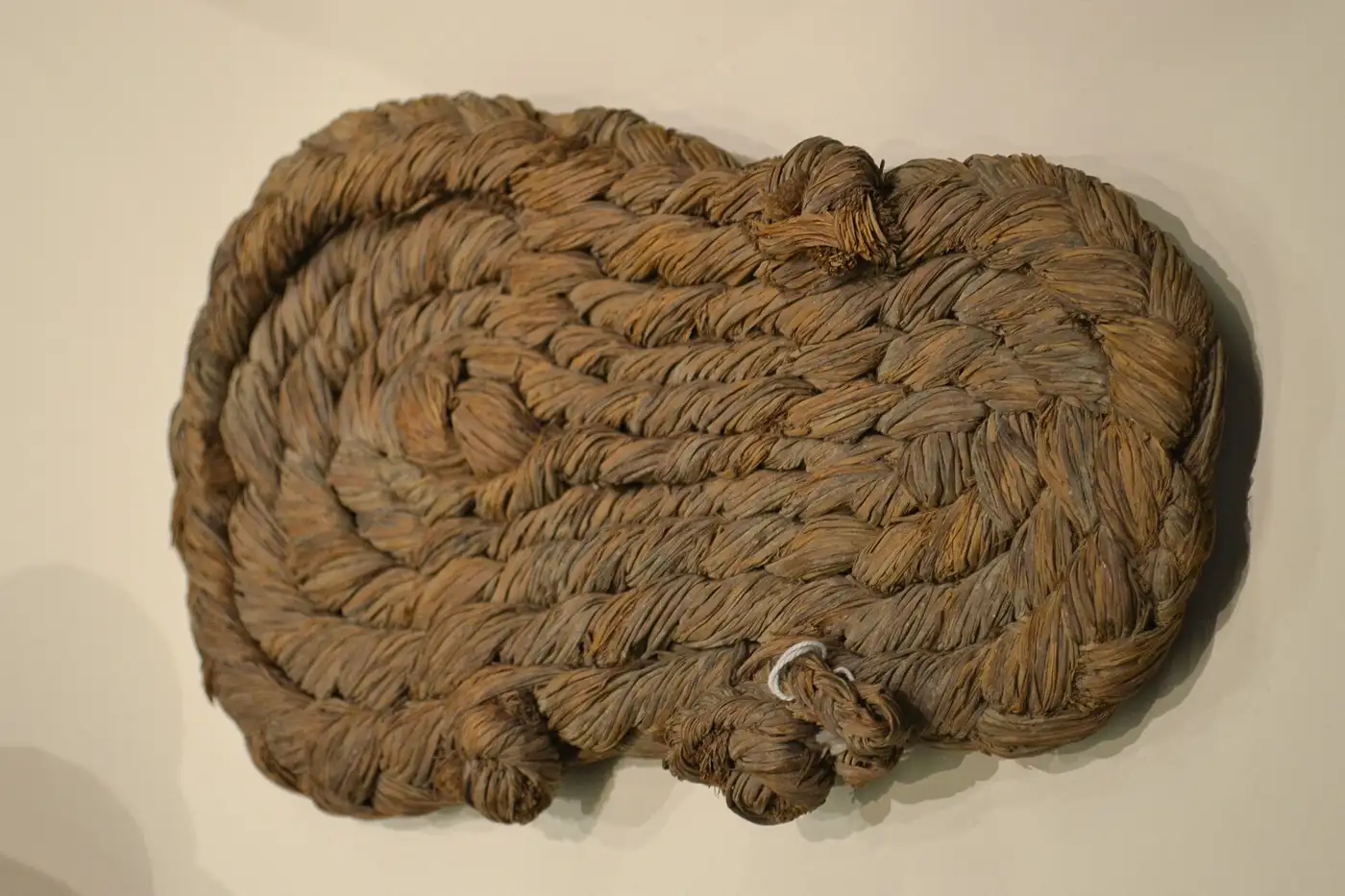
In 2023, a team led by F. Martínez-Sevilla of the University of Alcalá published the most complete study of the collection so far in Science Advances. They analyzed 76 objects and reported 14 new radiocarbon dates, placing the assemblage between roughly 9,500 and 6,200 years ago. The sandals date to the Neolithic: an earlier analysis of two of them, along with a basket fragment and other pieces, had already returned dates between 5200 and 4850 BCE. The authors call it the earliest and most diverse set of plant-based footwear documented in European prehistory. The cave also yielded what the study describes as the best-preserved hunter-gatherer basketry in southern Europe, along with a wooden hammer. And of everything in the museum collections, the sandals are the only objects that can be identified as clothing.
They’re made of esparto grass, Stipa tenacissima, almost always crushed first, a technique that, according to the study, is still used traditionally today. There are two types. Two are simple. The other twenty have a central core in the sole, and on some of them a small bundle of fibers comes up from the base and may have sat between the first and second toes, attached to a braid fixed midway along the sandal and tied around the ankle. In other words, about seven thousand years ago in southern Spain, someone was already making something a lot like a flip-flop strapped to the ankle.
Areni-1: the oldest leather shoe
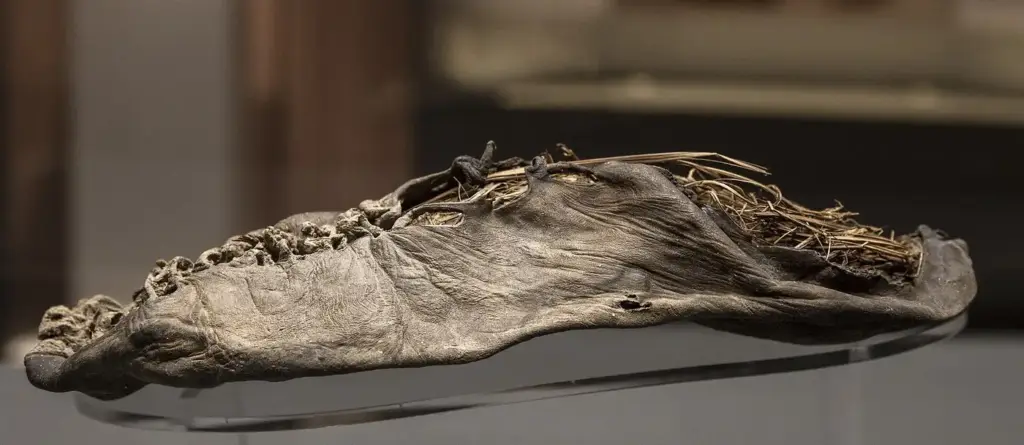
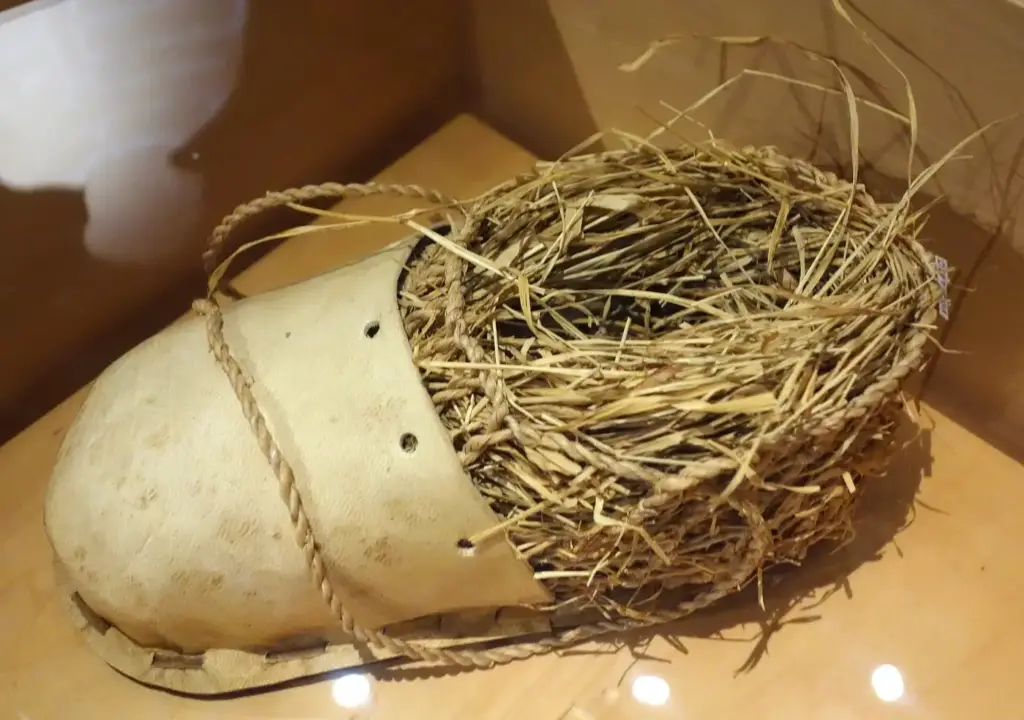
For a complete leather shoe, you have to go to Armenia. In 2008, an international team found a remarkably well-preserved leather shoe at the bottom of a pit in the Areni-1 cave. Ron Pinhasi and colleagues published it in 2010 in PLoS One: three leather samples, dated at Oxford and at UC Irvine, gave an age between 3627 and 3377 BCE, and the grass stuffed inside was the same age. It’s more than 5,400 years old.
The Areni shoe is 24.5 centimeters long, a European size 37, and 7.6 to 10 centimeters wide. It’s made from a single piece of leather that wrapped around the foot, and it was packed with loose grass, probably to hold its shape or for storage. It even preserves an imprint of its owner: it had molded itself to a right foot, especially at the heel and big toe, the areas that bear the most pressure in normal walking, as we explain in our story on the gait cycle.
It wasn’t a one-off, either. According to the authors, other finds from the fourth millennium BCE, shoes from the Italian and Swiss Alps and sandals from southern Israel, show that more than one type of footwear existed at the time, and that more regional variations should turn up wherever conditions preserve them. The Areni shoe isn’t a prototype. It’s a sample of a craft that already had styles.
Ötzi: the Iceman’s shoes
On September 19, 1991, a natural mummy was discovered in the Ötztal Alps, on the border between Austria and Italy: a man who had died some 5,300 years earlier. He is Europe’s oldest known natural human mummy, and an arrowhead lodged in his left shoulder has led researchers to conclude he was killed by another person. Ötzi, as he came to be called, was wearing shoes. According to Wikipedia’s summary of the research, they were wide and waterproof, apparently built for walking on snow, with bearskin soles, deerskin uppers and a netting of tree bark. Inside, soft grass wrapped the foot and worked like a sock. The Albuñol study describes them as a sock-like structure of linden bast covered in leather, and notes a resemblance to a shoe from the Swiss site of Sutz-Rütte, dated to around 2750 BCE. Both are very different from the Granada sandals: though they used grasses, they combined them with other materials such as leather and bark.
A Czech researcher who reproduced Ötzi’s shoes came away convinced that, because they were fairly complex, people 5,300 years ago already had the equivalent of a cobbler making shoes for others. The replicas reportedly turned out so well that a Czech company offered to buy the rights to sell them. British archaeologist Jacqui Wood has floated a different reading: that the shoes were actually the upper part of snowshoes, and that the object interpreted as part of a backpack was the wooden frame and netting of one of them.
Egypt: the man who carried the king’s sandals
Some footwear is known not because it survived but because someone carved it. The Narmer Palette, an Egyptian object dating to around the 31st century BCE, is one of the earliest known depictions of an Egyptian king. It carries some of the earliest hieroglyphic inscriptions ever found, and between its two faces it shows the king in both the white crown of Upper Egypt and the red crown of Lower Egypt, the earliest known example of a king wearing both. On one side, King Narmer, wearing the white crown of Upper Egypt, is about to strike a kneeling prisoner. Behind him, to his left, a smaller figure is holding the king’s sandals.
A royal sandal-bearer says a lot about what footwear was worth more than 5,000 years ago: it mattered enough to have a dedicated servant carrying it, and enough to appear in one of the oldest known images of an Egyptian king.

What they say together
Put side by side, these finds tell a consistent story. The bones suggest that some humans were habitually wearing something on their feet about 40,000 years ago. The Fort Rock sandals prove that people in North America were twining plant-fiber footwear more than 10,000 years ago. The Albuñol sandals show it being made from esparto in Iberia about seven thousand years ago. And the Areni shoe and Ötzi’s boots show that by about 5,000 years ago, there was leather footwear that was cut, stitched and fitted to the foot.
None of them is the first shoe. They’re the ones lucky enough to survive. And nearly all of them share something with today’s footwear: a sole that protects, something that holds it to the foot, and a shape that, with wear, ends up copying the foot of whoever wears it. Thousands of years later, at Vindolanda, a Roman soldier would get socks and sandals in the same care package, as we explain in our story on socks and sandals.
Sources
- E. Trinkaus (2005), “Anatomical evidence for the antiquity of human footwear use,” Journal of Archaeological Science 32: 1515–1526.
- E. Trinkaus and H. Shang (2008), “Anatomical evidence for the antiquity of human footwear: Tianyuan and Sunghir,” Journal of Archaeological Science 35: 1928–1933.
- T. Connolly, University of Oregon Museum of Natural and Cultural History, “Fort Rock Sandals,” citing J. R. Arnold and W. F. Libby (1951).
- F. Martínez-Sevilla, M. Herrero-Otal, M. Martín-Seijo et al. (2023), “The earliest basketry in southern Europe: hunter-gatherer and farmer plant-based technology in Cueva de los Murciélagos (Albuñol),” Science Advances 9(39): eadi3055.
- R. Pinhasi, B. Gasparian, G. Areshian et al. (2010), “First direct evidence of chalcolithic footwear from the near eastern highlands,” PLoS One 5(6): e10984.
- Wikipedia, “Ötzi” and “Narmer Palette,” and the references they cite.
Image credits
- Esparto sandal from the Cueva de los Murciélagos, Albuñol, National Archaeological Museum of Spain: Dorieo. CC BY-SA 4.0, via Wikimedia Commons.
- Sunghir burial (reconstruction): José-Manuel Benito Álvarez. Public domain, via Wikimedia Commons.
- Fort Rock sandals, Oregon Historical Society: Ian Poellet. CC BY-SA 4.0, via Wikimedia Commons.
- Areni-1 shoe: David Castor. Public domain (CC0), via Wikimedia Commons.
- Replica of an Ötzi shoe, Bata Shoe Museum: Daderot. Public domain (CC0), via Wikimedia Commons.
- Narmer Palette: unknown photographer. Public domain, via Wikimedia Commons.