
Shoe throwing is the perfect insult: you always have one on you, it won’t kill anyone, and everybody gets the point. No translation needed. A shoe flying at a politician says contempt in any language, and in some it says something worse: that this person is worth less than the ground you walk on. In December 2008, an Iraqi journalist proved it in front of cameras from half the world, and within weeks the gesture was being copied from Montreal to Cambridge to Cairo. But the idea is far older than television. A Roman emperor took a shoe at a public appearance in the fourth century, and the Bible was already using the shoe as a way to say “this is mine.”
Why a shoe, of all things
A shoe offends because it’s what touches the ground. According to Wikipedia’s account of the Baghdad incident, shoes are considered unclean in the Arab world, and effigies of American presidents had been appearing across the Middle East with shoes on them long before 2008. Showing someone the sole of your shoe, as we covered in why people are embarrassed by their feet, is already a sign of contempt; hitting them with it adds insult to injury. Anthropologist José Mansilla, of a Barcelona urban-conflict research group, put it this way to the fact-checking outlet Verificat in 2021: the shoe is in contact with the ground, so it stands for dirt, for what’s disposable and rejected, and that negative charge runs through both the Judeo-Christian tradition and the Arab world.
In the Bible, the shoe also carried a sense of ownership. In the Book of Ruth, pulling off your shoe and handing it over sealed a deal, and in Psalm 60, God declares, “over Edom will I cast out my shoe,” a way of saying the land belongs to him. Throwing your shoe over something, in that language, claims it and puts it beneath you. The same symbolic load explains, as we noted in shoes on power lines, why the thing people sling over a wire to mark a spot or mock someone is a shoe and not a ball cap.
The shoe of A.D. 359
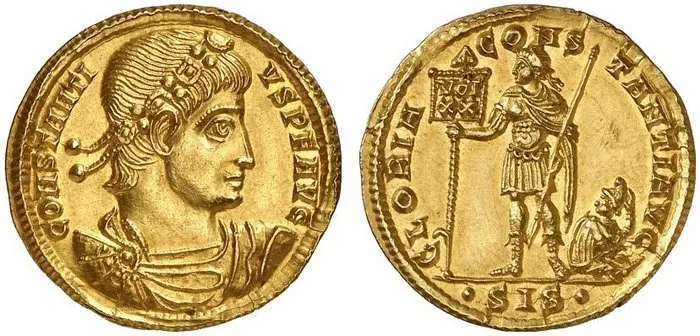
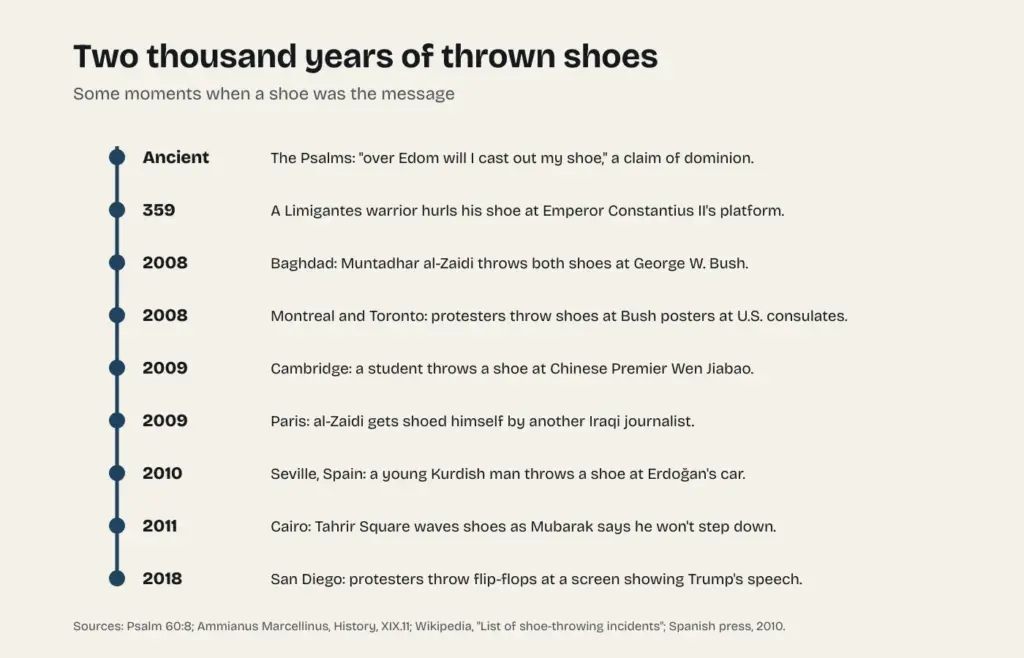
The oldest political shoe-throwing we found on record comes from the Roman historian Ammianus Marcellinus, who lived in the fourth century and wrote a history of the empire. In 359, Emperor Constantius II agreed to take in the Limigantes, a people from the Danube region who had asked him for land. He had a mound built next to a camp at a place called Acimincum, on the Danube, as a speaker’s platform, and from there he prepared to give them a gentle address as future loyal subjects.
According to Ammianus, as the emperor appeared on the platform, one of the Limigantes, “struck with savage madness,” hurled his shoe at it and shouted “Marha, marha!”, their war cry. The crowd raised a barbarian banner and rushed the emperor. That shoe wasn’t an insult; it was a signal to attack. Constantius, surrounded and with nothing to mark him out from a common soldier, jumped on a fast horse and galloped off. Some of his attendants were killed trying to hold back the rush, and the attackers seized the imperial seat with its golden cushion. Then the Roman soldiers, only half armed, struck back, and the retaliation was a massacre: the dead lay piled in heaps, Ammianus writes, and the rebels were wiped out. The emperor then returned to Sirmium, in present-day Serbia. The gesture, though, is the same one that would go around the world sixteen centuries later: a shoe flying at the most powerful man in the room.
Baghdad, December 14, 2008
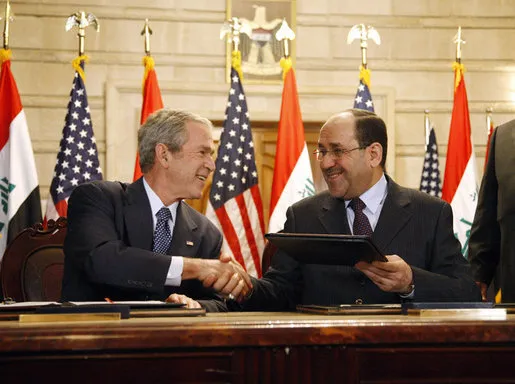
George W. Bush had about five weeks left in office when he made a surprise trip to Iraq. On December 14, 2008, at the prime minister’s palace in Baghdad, he held a joint news conference with Iraqi Prime Minister Nouri al-Maliki after signing a security agreement. According to Wikipedia, among the reporters was Muntadhar al-Zaidi, a 29-year-old correspondent for the Iraqi channel Al-Baghdadia TV who grew up in Baghdad’s Sadr City.
He was no stranger to the violence of that war. According to Wikipedia, in November 2007, after he reported on the death of a schoolgirl shot by U.S. troops, armed men kidnapped him in Baghdad, blindfolded him with his own necktie and tied his hands with shoelaces; they dumped him on a street three days later in the middle of the night. A year after that, at the news conference, al-Zaidi took off his shoes and threw them, one after the other. With the first, he shouted in Arabic that it was a farewell kiss from the Iraqi people, “dog”; with the second, that it was for the widows, the orphans and everyone killed in Iraq. Bush ducked twice and dodged both. Maliki tried to catch one. The second shoe hit a U.S. flag standing behind the president. Al-Zaidi was tackled to the floor by security and dragged out, and White House Press Secretary Dana Perino got a black eye when a presidential bodyguard knocked a microphone boom into her face.
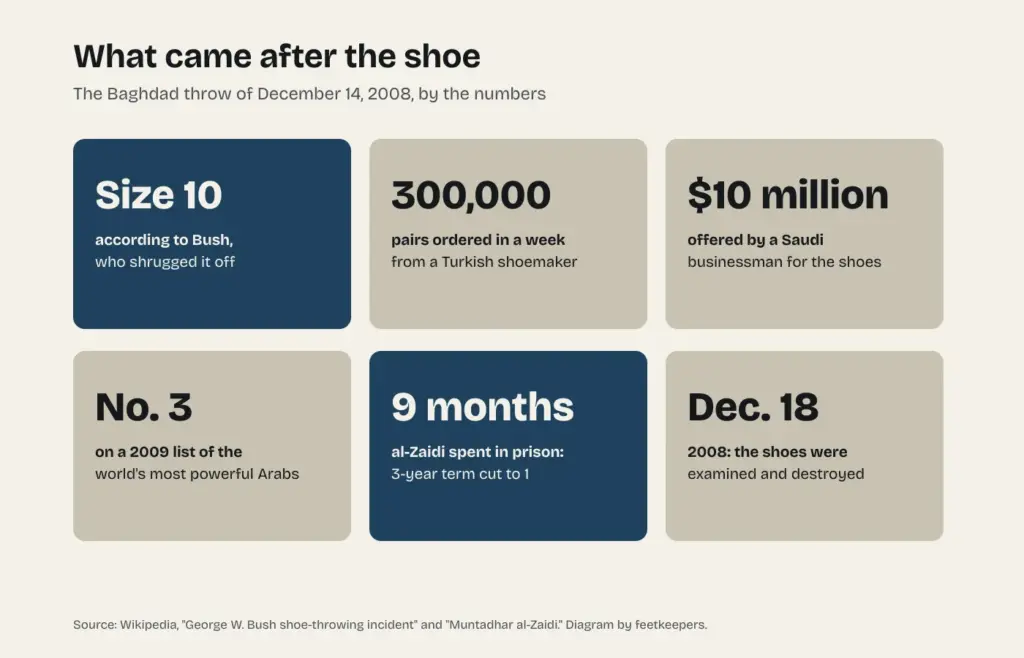
Bush brushed it off. According to the same source, he said some Iraqi reporters had apologized to him, that it didn’t bother him, and that if you wanted the facts, “it’s a size 10 shoe that he threw.” He also said he hadn’t felt the least bit threatened, and later, asked to reflect on it, that he hadn’t had much time to reflect on anything because he was ducking and dodging. Perino said one guy throwing his shoe couldn’t be taken as representative of the people of Iraq. Al-Zaidi’s lawyer, the head of the Iraqi Bar Association, saw it the other way: he argued that his client hadn’t committed a crime, only expressed himself freely to the occupier.
What came next
The shoe played out very differently for everyone involved. For al-Zaidi, according to Wikipedia, it meant a 90-minute trial, a three-year sentence for assaulting a foreign head of state on an official visit, later cut to one year, and nine months behind bars: he was released for good behavior on September 15, 2009, and said he’d been mistreated in custody. For the shoes, it meant destruction: on December 18, 2008, Iraqi and American security agents examined them for explosives and destroyed them, despite calls across the Middle East to put them in a museum and a Saudi businessman’s offer of $10 million.
For the shoe business, it was a small earthquake. According to the same source, the Turkish company believed to have made the shoes, Baydan of Istanbul, received orders for 300,000 pairs in a week and renamed its model “The Bush Shoe,” then “The Bye-Bye Bush Shoe.” No one ever confirmed who actually made them: a Lebanese producer said they might have been his, and al-Zaidi’s brother insisted they came from a respected Baghdad shoemaker.
For al-Zaidi, there was fame, too. Arabian Business ranked him the world’s third most powerful Arab in 2009; a monument shaped like a shoe went up in Tikrit before police ordered it taken down; there were job offers, a bravery award in Libya, a song, and a man in Egypt who offered him his daughter’s hand in marriage. In the U.S., the antiwar group Code Pink delivered a petition for his release, and one member made the obvious point: if he’d wanted to hurt Bush, he would have picked a different weapon. Pop culture took the hint. David Letterman’s Late Show ran a segment of famous presidential speeches with digitally added flying shoes, a London artist made a 21-kilogram bronze of the shoes covered in 24-karat gold, and in 2010 a Colombian detergent brand restaged the scene in an ad with bouquets of flowers flying instead. And there was one last irony: in December 2009, in Paris, an exiled Iraqi journalist threw a shoe at al-Zaidi, accusing him of working for dictatorship. In 2018 he ran unsuccessfully for Iraq’s parliament, and in 2023 he told Reuters, according to the same source, that he had never regretted throwing his shoes.
The copycats
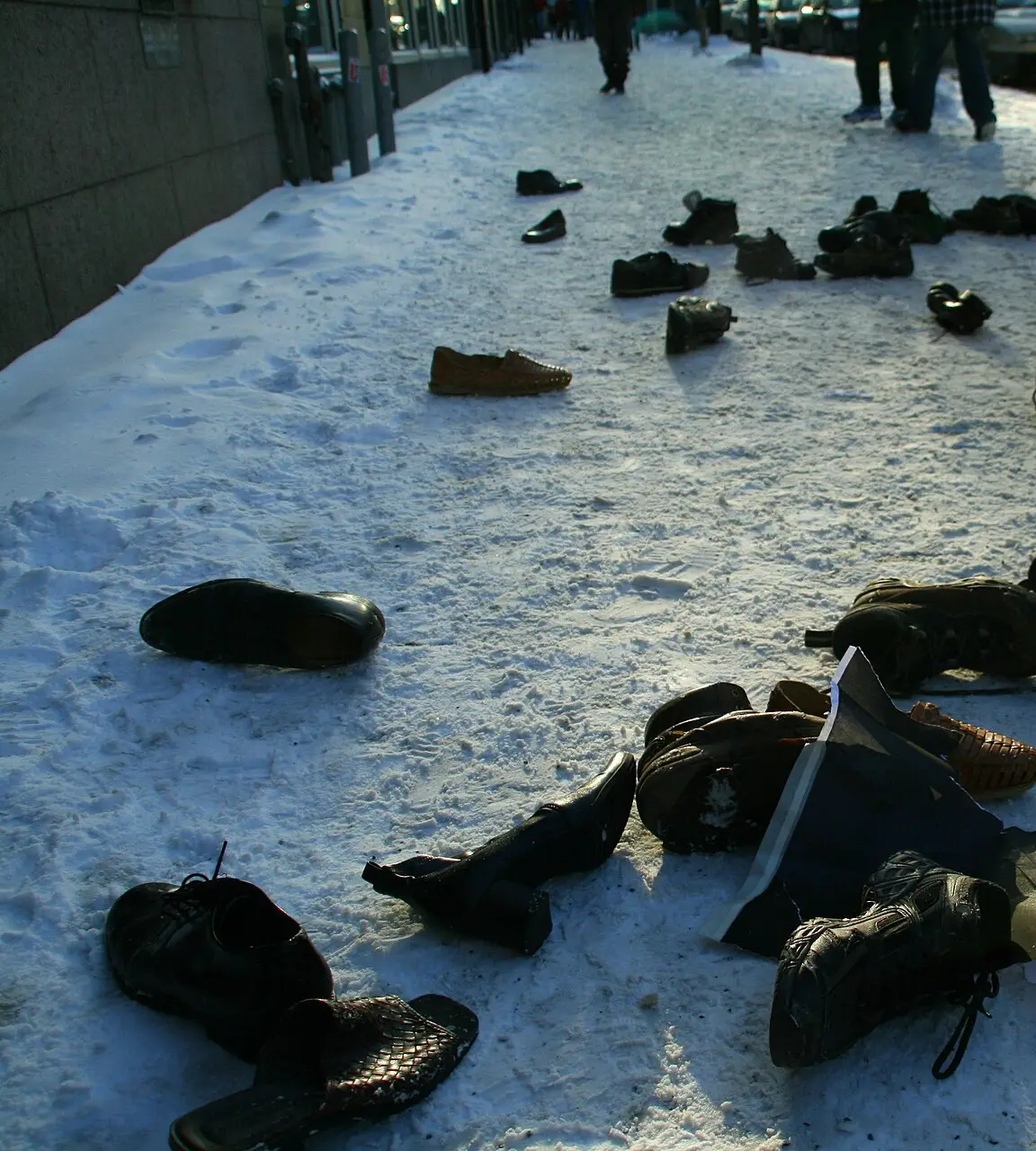
The Baghdad throw became a protest format. According to Wikipedia, on December 19, 2008, a Ukrainian reporter threw a shoe at a politician over sexist remarks and said the shoe would become ordinary people’s main way of influencing their leaders. The next day, protesters in Montreal and Toronto threw shoes at posters of Bush outside the U.S. consulates in temperatures of minus 24 Celsius, about minus 11 Fahrenheit. In February 2009, a 27-year-old German student threw a shoe at Chinese Premier Wen Jiabao at the end of a lecture at the University of Cambridge; he later said he didn’t want to hit him and thought just placing the shoe on the stage would be universally understood, and a judge ruled there wasn’t enough evidence to convict. In February 2011, during the Egyptian revolution, crowds in Cairo’s Tahrir Square waved their shoes when Hosni Mubarak announced he wouldn’t step down.
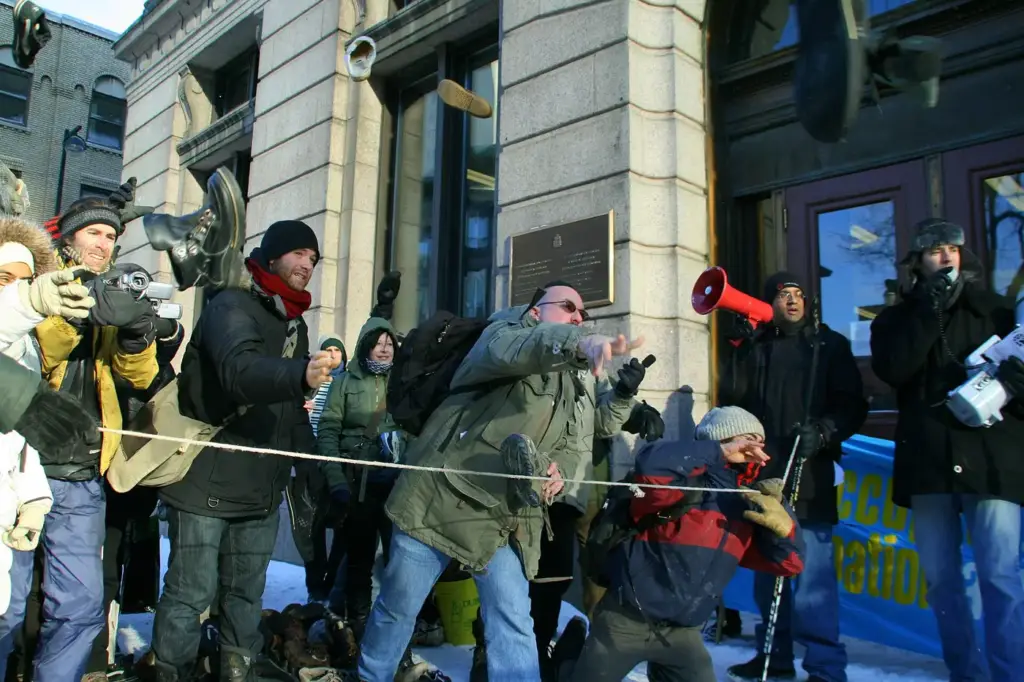
The list kept growing. In September 2010, former British Prime Minister Tony Blair had eggs and shoes thrown at him at a book signing in Dublin. In February 2010, a young Kurdish man was arrested in Seville, Spain, for throwing a shoe at Turkish Prime Minister Recep Tayyip Erdoğan; according to the Spanish press, it missed him and hit his car. In July 2012, during a visit to Alexandria, Egypt, Secretary of State Hillary Clinton’s motorcade was pelted with shoes and tomatoes. And in January 2018, a group in San Diego threw flip-flops at a screen showing President Donald Trump’s State of the Union address.
Why it works
The shoe has every virtue of a symbolic weapon. Everyone has one, it doesn’t set off a security check, and it rarely does real damage. And it comes with a built-in meaning that needs no explaining, because it’s the thing that separates the body from the ground. Throwing a shoe at someone is treating them like dirt, literally.
That’s why it survives. Throw a rock and you’ve committed an assault; throw a shoe and you’ve also said something. Sixteen centuries ago a warrior from the Danube did it to start a battle, and less than twenty years ago a journalist did it to see off a presidency. In between, the shoe has barely changed shape, and the message hasn’t changed at all. What changes is where it lands afterward: in the fourth century, on a battlefield; in the twenty-first, in television archives and on the floor of a press room, which is exactly where, as far as the thrower is concerned, the target belongs. For the other side of the same idea, the border between the ground and the home, see taking shoes off in the house.
Sources
- Ammianus Marcellinus, History, Book XIX, chapter 11, sections 8-17, trans. J. C. Rolfe, LacusCurtius.
- The Bible, King James Version, Ruth 4:7 and Psalms 60:8 and 108:9.
- Verificat (2021), “Los zapatos colgados en cables significan que se vende droga: ¿mito o realidad?” Time Out Barcelona.
- Periódico de Ibiza (2010), “Detenido un joven de origen kurdo por arrojar un zapato al primer ministro turco,” February 23, 2010.
- Wikipedia: George W. Bush shoe-throwing incident, Muntadhar al-Zaidi and List of shoe-throwing incidents.
Image credits
- Thrown shoes in the snow outside the U.S. consulate in Montreal, 2008: Anirudh Koul. CC BY 2.0, via Wikimedia Commons (cropped).
- Solidus of Constantius II: Otto Nickl. CC BY-SA 4.0, via Wikimedia Commons.
- Bush and Maliki in Baghdad, December 14, 2008: White House photo by Eric Draper. Public domain, via Wikimedia Commons.
- Shoe protest in Montreal: Anirudh Koul. CC BY 2.0, via Wikimedia Commons.
- Numbers diagram and timeline: feetkeepers.