
Being embarrassed by your feet isn’t a personal quirk. It’s one of the oldest and most widespread habits on the planet. We show our faces to anyone, our hands to everyone and our arms the moment the sun comes out, but our feet stay tucked inside our shoes, and when summer rolls around plenty of people think twice before letting them out. Some blame the smell, some blame looks, some blame marketing. All of those reasons are real, but they arrived late. Long before them, across much of the world, the feet were already the part of the body you don’t put on display.
How many of us hide them
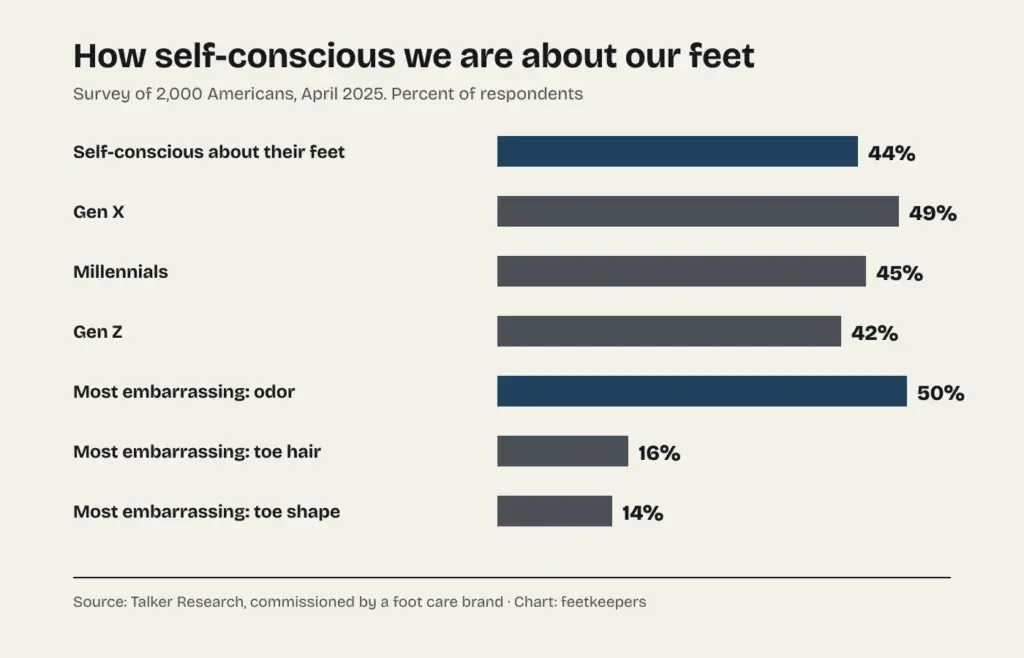
There are recent numbers. In April 2025, Talker Research surveyed 2,000 Americans on behalf of a foot care brand, so it’s worth reading the results knowing who paid for them. According to the survey, 44 percent of Americans feel self-conscious about their feet. Gen X is the most uncomfortable, at 49 percent, ahead of millennials at 45 percent and Gen Z at 42 percent.
What embarrasses people most? Odor, cited by half of respondents. Far behind come toe hair, at 16 percent, and toe shape, at 14 percent. Two in three said they had avoided open-toed shoes at some point because of how their toenails looked.
The lowest part of the body
To understand that discomfort, you have to look past the beach. In many cultures, the foot is the lowest part of the body and therefore the most unclean, because it’s the part that touches the ground. According to Wikipedia’s roundup of Asian etiquette, in Malaysia the feet are considered symbolically unclean: you don’t use them to point at a person or a thing, and when sitting on the floor you shouldn’t expose the soles of your feet to anyone. In Thailand, images of the king, which appear on banknotes and stamps, are never stepped on, because placing a foot above the king’s head is considered the ultimate sign of disrespect.
Hindu tradition even has a gesture for apologizing when a foot touches something it shouldn’t. According to the same source, when someone accidentally touches a book with their foot, a book being associated with Saraswati, goddess of knowledge, or money, associated with Lakshmi, goddess of wealth, or another person’s leg, they first touch the object with their fingertips and then bring their hand to their forehead or chest. That gesture belongs to pranama, the family of reverent salutations offered above all to elders, teachers or the divine, whose name means bowing forward. In that logic, the body has an order: the head at the top, the most dignified, and the feet at the bottom, which shouldn’t touch what deserves respect.
In many Arab cultures, showing the sole of your shoe is an insult, precisely because the shoe touches the ground, and hitting someone with a shoe adds insult to injury. The whole world learned that on December 14, 2008, when Iraqi journalist Muntadhar al-Zaidi threw both of his shoes at President George W. Bush during a press conference in Baghdad, shouting, “This is a farewell kiss from the Iraqi people, you dog.” Bush ducked. Al-Zaidi became a hero across much of the Arab world. He faced a possible charge of insulting a foreign leader, which could have carried up to two years in prison. There were calls across the Middle East to put the shoes in an Iraqi museum, but according to Wikipedia’s account, they were destroyed by U.S. and Iraqi security officials. And shoe-throwing as an insult hasn’t stayed in the Arab world: other incidents have targeted celebrities and world leaders elsewhere.
Feet of clay
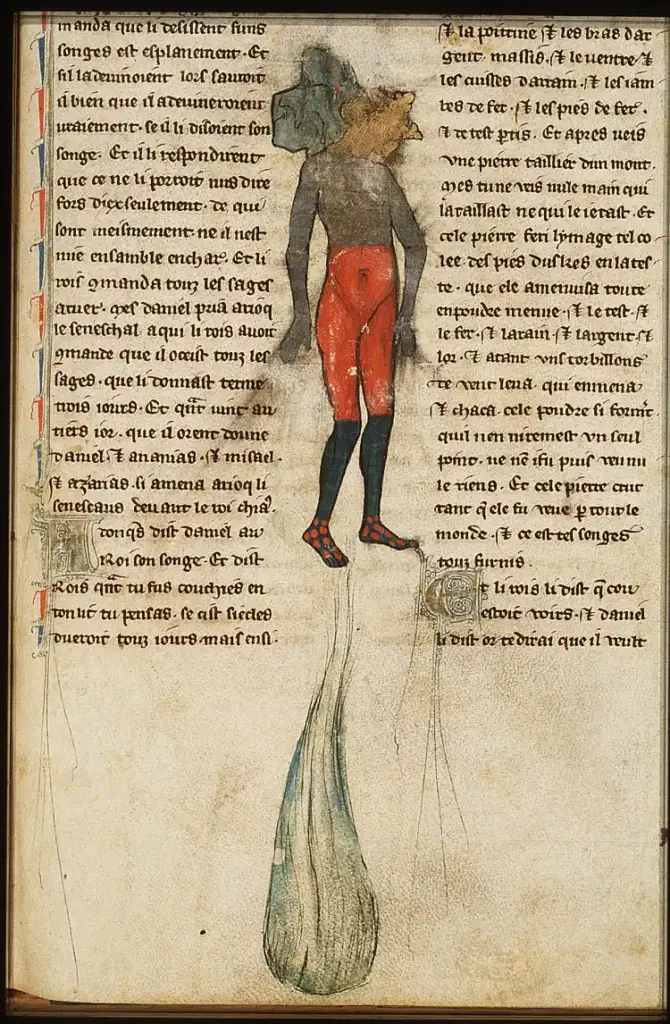
In the European tradition, too, the foot is the bottom, what holds everything up and what gives way. In the Book of Daniel, King Nebuchadnezzar dreams of an enormous statue: a head of gold, chest and arms of silver, belly and thighs of bronze, legs of iron and feet partly of iron and partly of clay. A stone strikes the statue on its feet, and the whole thing comes crashing down. That’s where “feet of clay” comes from: something that looks mighty with its weakness right where it stands.
Washing feet, the humblest act
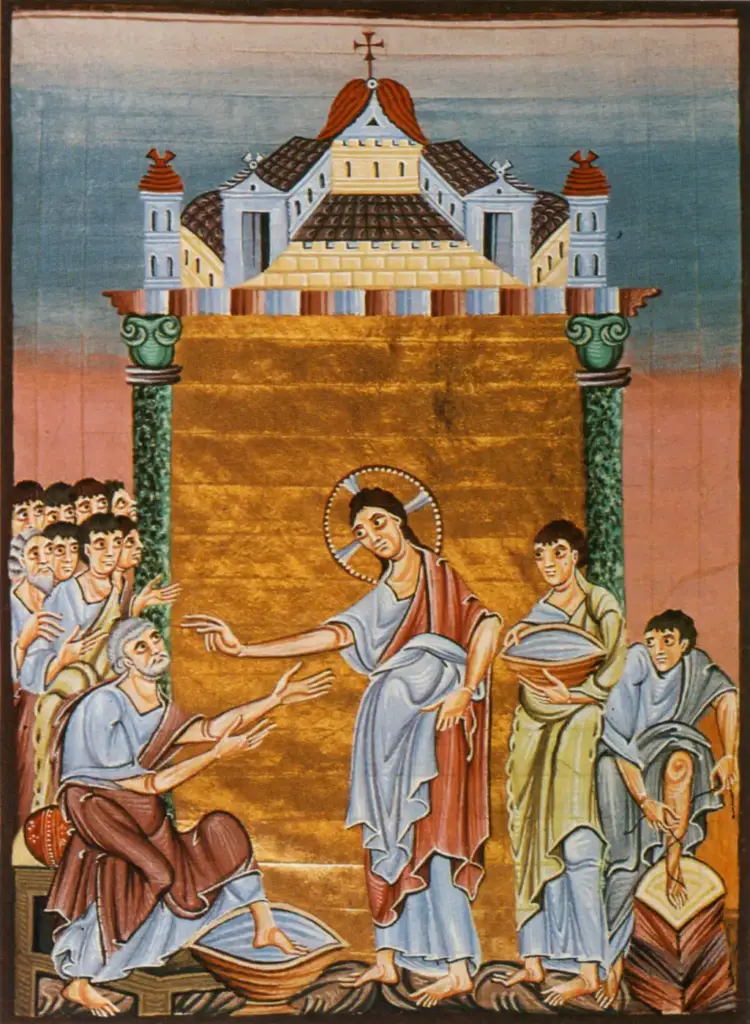
If feet are the lowest thing, touching them is lowering yourself. That’s why washing someone else’s feet carries so much weight in the Christian tradition. According to the Gospel of John, at the Last Supper Jesus got up from the table, took off his outer robe, tied a towel around his waist and began washing his disciples’ feet. Peter refused at first. Once Peter had been persuaded, Jesus told them to do the same for one another.
The gesture became a rite, known in English as Maundy, from the Latin mandatum, the first word of the antiphon sung during the ceremony: Mandatum novum do vobis, “a new commandment I give to you.” According to Wikipedia, by the second half of the 12th century the pope was washing the feet of twelve subdeacons after Mass on Holy Thursday and of thirteen poor men after dinner. In English, the day has been called Maundy Thursday since at least 1440. In 1955, Pope Pius XII brought the rite into the Mass itself. In 2013, Pope Francis washed the feet of two women and of Muslims at a juvenile detention center in Rome, and in 2016 the Roman Missal was revised to allow women’s feet to be washed on Holy Thursday.
Islam builds foot washing into daily purification. Wudu, the ablution usually performed before prayer, follows a fixed order: the hands, the mouth and nose, the face, the forearms, the head and ears and, last of all, the feet. According to the schools of Islamic law summarized on Wikipedia, simply passing a wet hand over them isn’t enough, though under certain conditions it can be done over traditional leather socks. The feet close the ritual because they come last, sit lowest and have the most contact with the street.
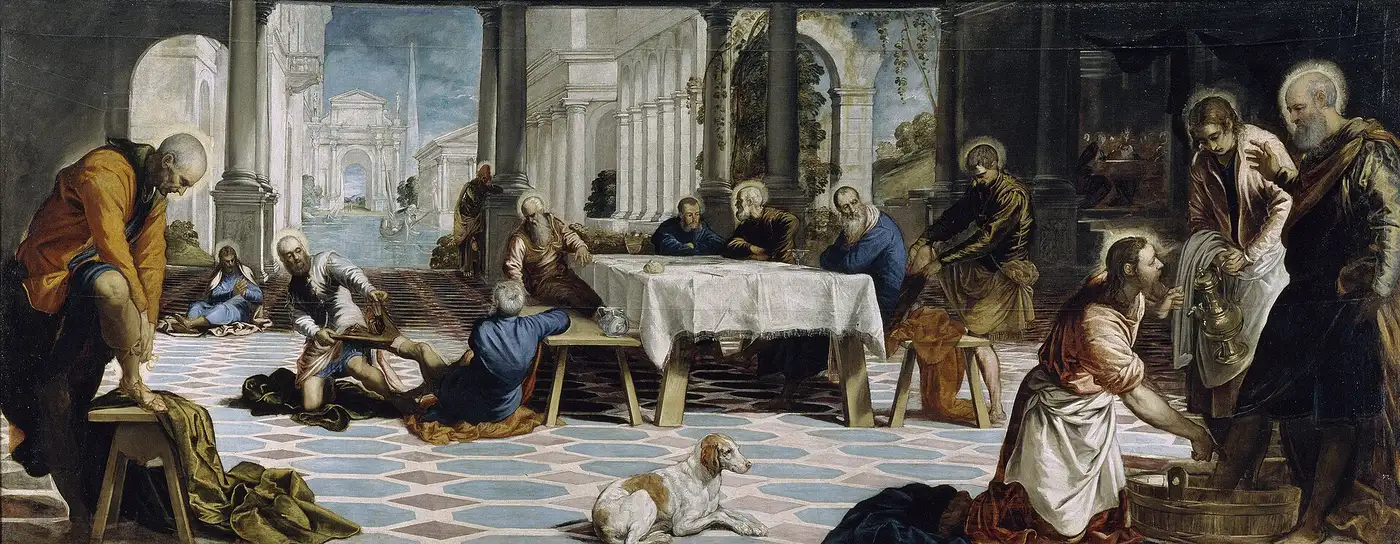
Madrid’s Prado Museum holds one of the most famous versions of the foot-washing scene, Tintoretto’s The Washing of the Feet, painted between 1548 and 1549 for the church of San Marcuola in Venice. Its trip to Madrid is a story in itself: about seventy years later it went to the Duke of Mantua, in 1627 Charles I of England bought it, and after his execution Parliament sold off his collection. Spain’s ambassador, Alonso de Cárdenas, acquired it, it passed to Luis de Haro, and he gave it to King Philip IV. It’s the painting at the top of this story. Tintoretto chose the moment Peter tries to refuse, before agreeing to have his feet washed, and he placed a dog lying down at the center of the scene.
Dirty feet on an altar
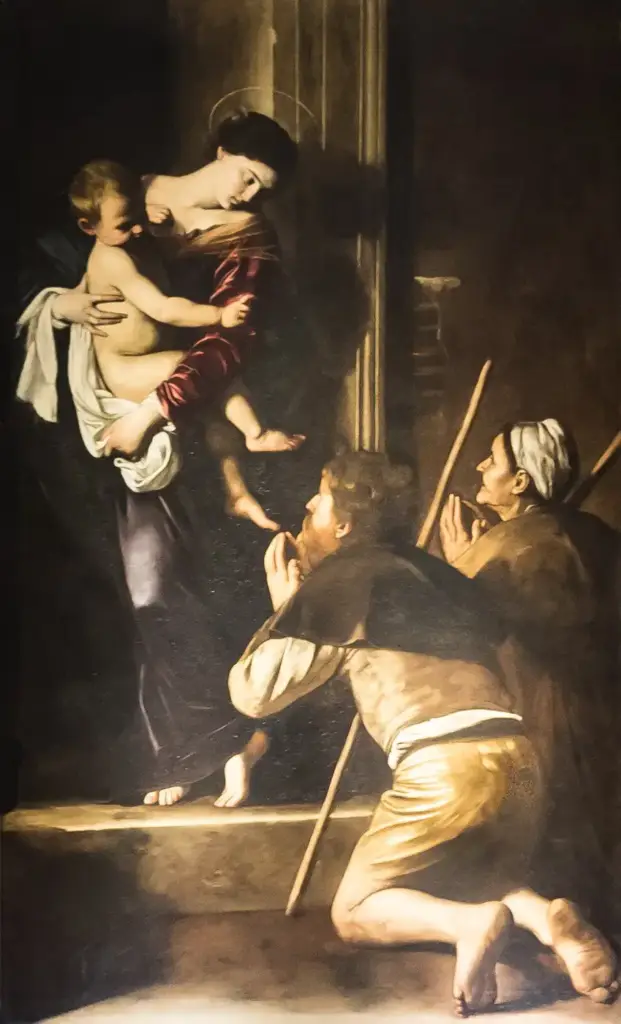
In art, showing dirty feet could cause a scandal. Around 1604, the heirs of the Marquis Ermete Cavalletti commissioned Caravaggio to paint the Madonna of Loreto for their family chapel in the church of Sant’Agostino in Rome. The result, finished around 1606, shows a barefoot Virgin in a doorway before two kneeling pilgrims, also barefoot. The bare feet of the pilgrim in front sit in the foreground, soles turned toward the viewer, nearly at eye level. The Virgin, leaning against a wall of flaking brick, could be any woman from the neighborhood but for a very thin halo. According to the painter Giovanni Baglione, Caravaggio’s rival, the unveiling made the common people raise a great racket.
It wasn’t the first time. For the Contarelli Chapel in the church of San Luigi dei Francesi, Caravaggio had painted a Saint Matthew and the Angel in which the evangelist looked like a scruffy peasant with dirty feet. According to the history summarized on Wikipedia, the church found it too crude for an altarpiece, and the painter had to replace it with a more dignified version, The Inspiration of Saint Matthew, which is still there. The first one was lost; only black-and-white photographs taken before World War II survive.
Taking off your shoes as a sign of respect
The flip side of the same idea is taking your shoes off. In the Book of Exodus, when Moses approaches the burning bush, the voice coming from it tells him to remove his sandals, because the place where he stands is holy ground. Going barefoot acknowledges that the ground beneath you deserves respect. Many religions keep the practice: people enter mosques and temples of various traditions barefoot.
Home life works the same way. In Malaysia, according to the same etiquette roundup, wearing shoes inside a house is considered rude. In Japan, the entryway of a home, the genkan, marks the border: shoes stay there, and you go in barefoot or in slippers. The zoologist Edward S. Morse sketched one in Tokyo in 1885, as we explain in our story on how many pairs of shoes you need. What’s being kept out isn’t the foot, it’s the dirt of the street that shoes carry in.


Odor, the chemical argument
The most down-to-earth explanation is also the one most cited in the survey: odor. And it has chemistry behind it. According to a 2006 study in the Canadian Journal of Microbiology, the main culprit in foot odor is isovaleric acid, which forms when a bacterium that normally lives on skin, Staphylococcus epidermidis, breaks down leucine in sweat. A 2015 study found that the compound is concentrated on the sole, where nearly all the bacteria that make it live, and not on the top of the foot. We cover it in detail in our story on how many pairs of shoes you need.
In other words, the part of the foot we show least is also the part that makes the smell people worry about most. And, in the cultures we just looked at, it’s also the part it’s rudest to show: the sole.
Other people’s eyes
That leaves the last ingredient, the one that weighs heaviest in summer: other people looking. Feet are full of details the rest of the body doesn’t have, like toes of different lengths, nails, hair and shapes that vary enormously from person to person, and hardly anyone sees feet up close every day other than their own. That unfamiliarity makes them easy to judge. It’s the same gaze that turned socks with sandals into a fashion crime, as we explain in our story on socks and sandals.
More than 5,000 years ago, on the Narmer Palette, the king of Egypt appeared barefoot while a servant carried his sandals, as we explain in our story on the oldest shoes in the world. A king showed his feet in one of the oldest images of royal power we have, and nobody seems to have thought it was a problem.
Sources
- Talker Research, survey of 2,000 Americans conducted April 16–24, 2025, commissioned by a foot care brand.
- Wikipedia, “Etiquette in Asia,” “Shoe-throwing,” “Muntadhar al-Zaidi,” “Maundy (foot washing),” “The Washing of the Feet,” “Pranāma,” “Wudu,” “Madonna di Loreto (Caravaggio)” and “Saint Matthew and the Angel,” and the references they cite.
- The Bible: Daniel 2:31–35; Exodus 3:5; John 13:1–17.
- K. Ara, M. Hama, S. Akiba et al. (2006), “Foot odor due to microbial metabolism and its control,” Canadian Journal of Microbiology 52(4): 357–364.
- D. Stevens, R. Cornmell, D. Taylor et al. (2015), “Spatial variations in the microbial community structure and diversity of the human foot is associated with the production of odorous volatiles,” FEMS Microbiology Ecology 91(1): 1–11.
Image credits
- The Washing of the Feet (1548–1549), Jacopo Tintoretto, Prado Museum. Public domain, via Wikimedia Commons.
- Survey chart: feetkeepers.
- Statue from Nebuchadnezzar’s dream, Royal Library of the Netherlands (KB 131 A 3): unknown artist. Public domain, via Wikimedia Commons.
- Foot washing in the Gospels of Otto III, Bavarian State Library: unknown artist. Public domain, via Wikimedia Commons.
- Madonna of the Pilgrims (around 1604–1606), Caravaggio, Sant’Agostino, Rome: Peter1936F. CC BY-SA 4.0, via Wikimedia Commons.
- Shoes at a ryokan entrance, Minamisoma: Hajime Nakano. CC BY 2.0, via Wikimedia Commons.
- Japanese home entryway: Bernat Agulló. CC BY-SA 2.0, via Wikimedia Commons.