
Taking shoes off in the house looks like a quirk of individual households, but it’s really a cultural border as sharp as language. In some countries, walking into a living room in your shoes is as rude as not saying hello. In others, asking a guest to take theirs off feels almost as odd as asking them to take off their shirt. The United States sits awkwardly in the middle, with most people kicking off their own shoes at the door and very few willing to ask anyone else to. The interesting part isn’t who’s right. It’s why the front door became, in so many places, the line where the street stops, and what exactly the street leaves stuck to your soles.
We covered the religious meaning of going barefoot and the basics of the Japanese genkan in our piece on why people are embarrassed by their feet. This one covers the rest: the global map of customs, the science of what soles carry, and a colonial standoff that started with a pair of shoes.
Japan: one step between two worlds
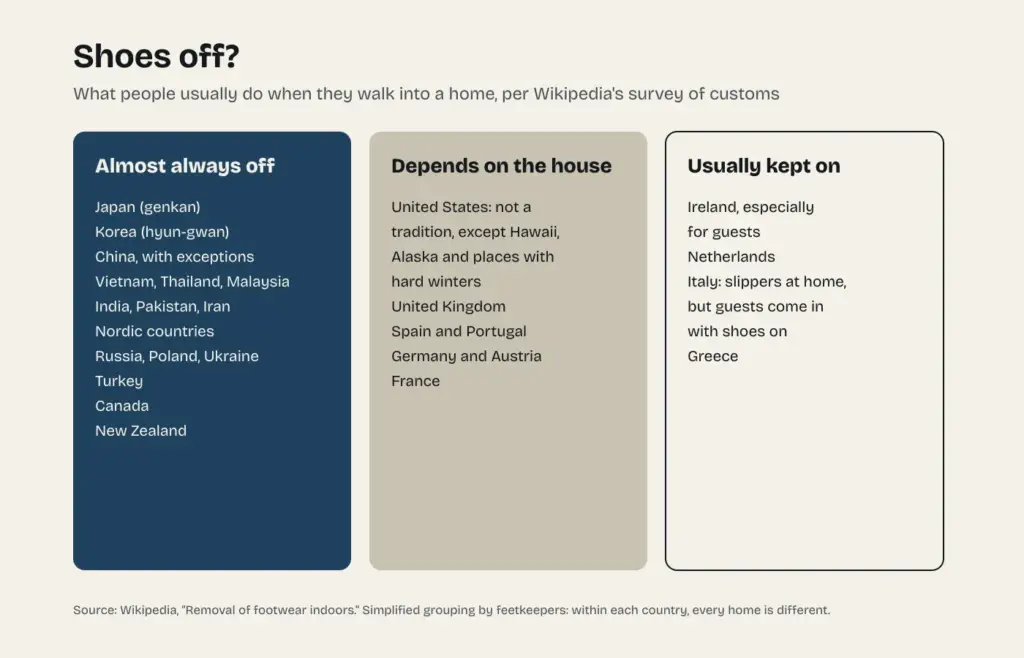
In Japan, according to Wikipedia, the genkan is the entry area of a house, apartment or some buildings, a cross between a porch and a doormat whose main job is shoe removal before you enter the rest of the home. It’s usually recessed below the main floor to contain tracked-in dirt, like a mudroom, with a step that can range from 2 to 4 inches up to shin or knee height. Once your shoes are off, you don’t step back onto the tile or concrete floor of the genkan, the tataki, so you don’t carry dirt inside. The custom is believed to go back more than a thousand years, to buildings with raised floors, and it survived the Westernization of Japanese homes that began in the Meiji era, from 1868 on. American zoologist Edward S. Morse sketched one in Tokyo in 1885, as we noted in how many pairs of shoes you need.
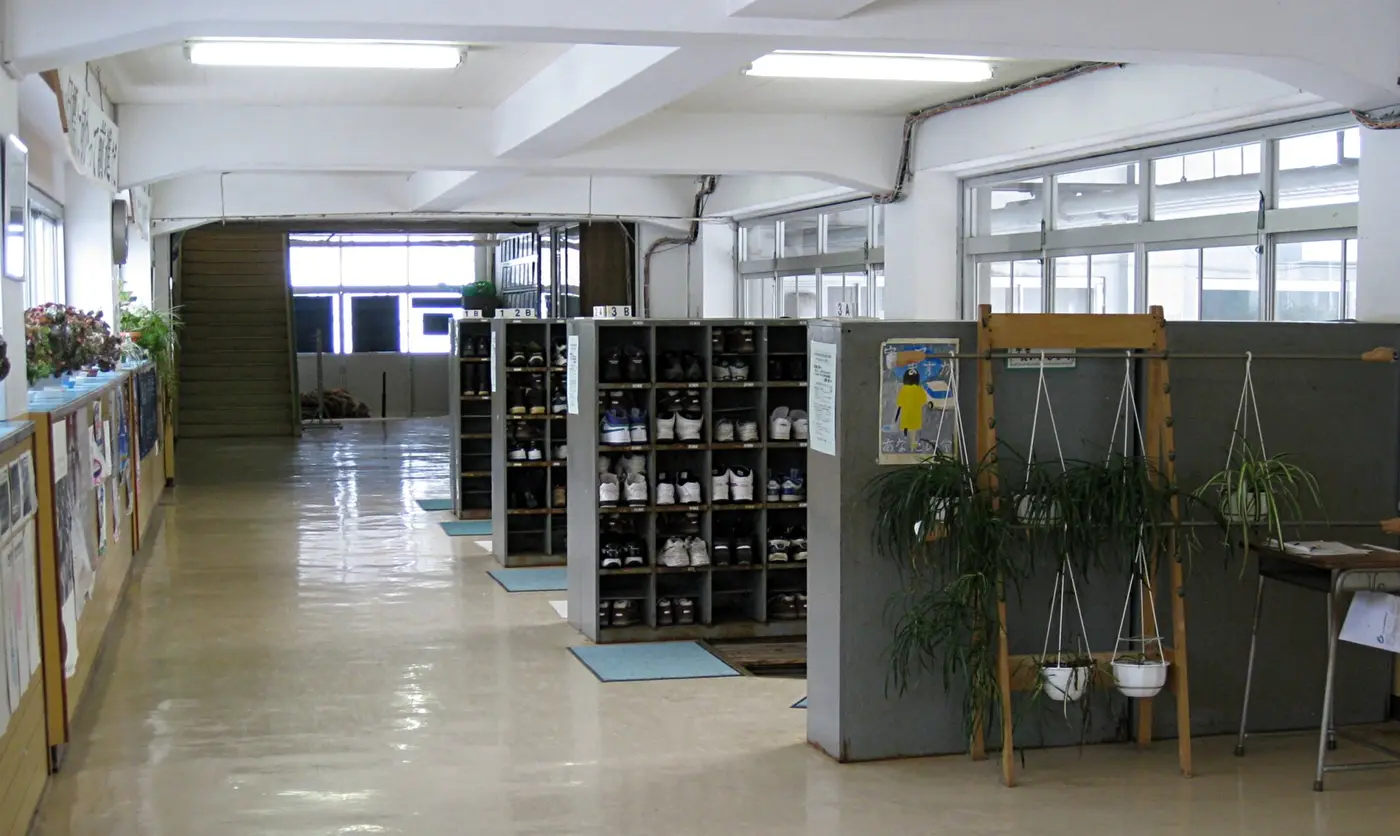
The genkan is a social boundary too. According to the same source, it’s where brief visits happen: a delivery that in an English-speaking country would happen on the porch, in Japan traditionally takes place across the genkan step. Schools and public baths have big shoe cupboards, getabako, with a cubby for each person, and at school students change into indoor slippers called uwabaki, white with a colored stripe that often marks the grade.
Inside the home there’s a second border. According to Wikipedia, many Japanese homes keep separate toilet slippers that you step into on the way into the bathroom and out of on the way back. The outdoors and the toilet are considered dirty zones; the rest of the house is a clean space to be protected. On tatami mats, even indoor slippers are often considered inappropriate.

Korea, India, Russia, Canada: half the world goes shoeless
Japan isn’t an outlier. According to Wikipedia’s survey of customs, in Korea it’s standard to take your shoes off at the entryway, the hyun-gwan, and walking in with shoes on is considered disrespectful; many Koreans go barefoot or in socks at home, with rubber slippers in the bathroom so they don’t slip. It’s also a country that has heated its homes from below for centuries: ondol, the traditional underfloor system, runs heat from the kitchen fire through channels beneath a thick masonry floor. In Vietnam, Thailand and Malaysia, and in India, Pakistan, Afghanistan and Iran, taking your shoes off at someone’s door is also the norm.
Europe is split. In the Nordic countries, according to the same source, most people consider it unhygienic and rude to keep shoes on indoors, partly because of the winters, and the same goes for Russia, Poland, Ukraine, the Balkans and Turkey, where hosts hand guests slippers. In Ireland, on the other hand, it’s very unusual for guests to take their shoes off, in the Netherlands it’s a little uncommon, and in Italy and Greece slippers are common at home but guests usually keep their shoes on.
In North America, climate draws the line. In Canada, according to Wikipedia, it’s generally seen as unhygienic and rude for a guest not to take their shoes off, and many schools ask students to keep a pair of indoor shoes for winter, because boots come in wet with snow and the salt and sand spread on the roads. In the continental U.S., it isn’t a tradition, but it’s expected in Hawaii and Alaska and common in the Northeast and Pacific Northwest, where many New England elementary schools ask kids to bring indoor shoes along with their winter boots.
The American compromise
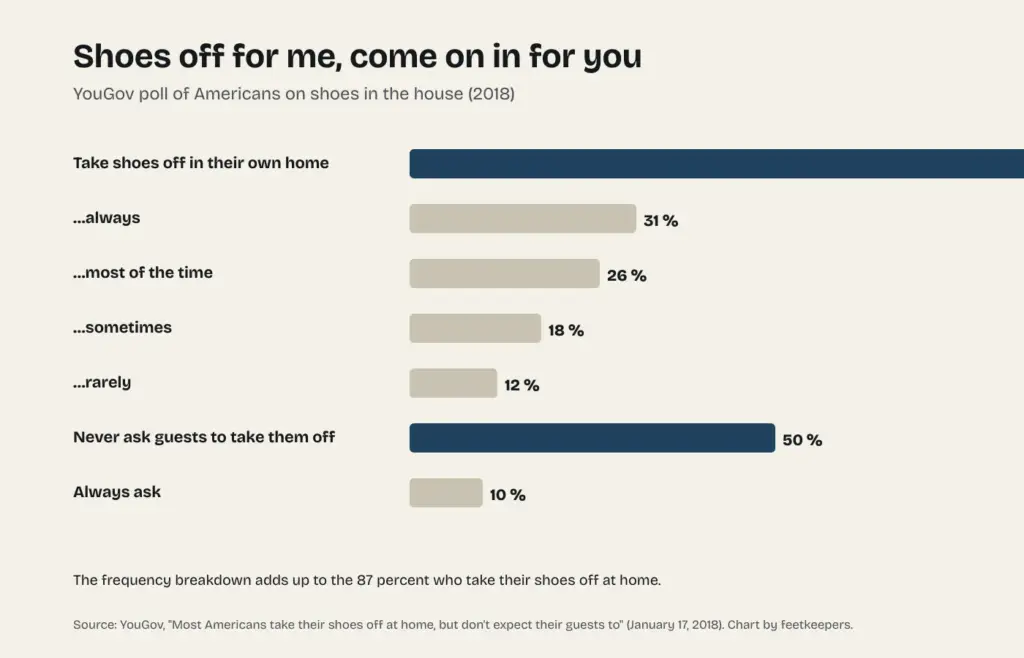
The U.S. has numbers. In January 2018, the polling firm YouGov found that 87 percent of Americans take their shoes off in their own homes: 31 percent always, 26 percent most of the time, 18 percent sometimes and 12 percent rarely. But half never ask visitors to take theirs off, and only one in ten always does. Shoes off for me, come on in for you: that’s more or less the American doctrine.
It’s a compromise that makes some sense in a country where the custom varies by region, by family and by the weather on a given day. A host in Minnesota in January and a host in Phoenix in May are dealing with very different floors, very different boots and very different amounts of what’s coming in on them.
The shoe war in Burma
In one place, the question turned political. In Burma, now Myanmar, removing your shoes to enter a pagoda or a Buddhist monastery is a sign of respect, and before colonial rule, according to Wikipedia, anyone who wasn’t royalty took off their footwear to enter the palace grounds. In 1879, the British Resident refused to remove his shoes on the Mandalay Palace platform, which kept him from meeting King Thibaw, and that October the British withdrew their delegation. According to the same source, it foreshadowed the Third Anglo-Burmese War, after which the rest of the kingdom was annexed into British India.
Under British rule, according to the newspaper The Irrawaddy, pagoda trustees put up signs reading, “No shoes except for Europeans and Americans.” The “shoe question” became a nationalist cause. U Thein Maung, a Cambridge-educated barrister on the board of trustees of the Shwesandaw Pagoda in Prome, took down one of those signs and was known from then on as “Shoe Thein Maung.” In 1917, a senior British official, Sir Archibald Douglas Cochrane, kept his shoes on while visiting the earthquake-damaged Shwemawdaw Pagoda in Pegu, and residents complained to the Young Men’s Buddhist Association. Thein Maung, a member, took up the fight and two years later persuaded the colonial government to ban shoes on the grounds of religious sites. The monk Ledi Sayadaw wrote an entire essay on the impropriety of wearing shoes on pagoda platforms, according to Wikipedia.
The custom is still taken seriously. According to the same source, in August 2017 a Russian tourist was arrested and sentenced in Bagan for repeatedly refusing to remove her shoes on pagoda grounds.

What soles bring in, according to science
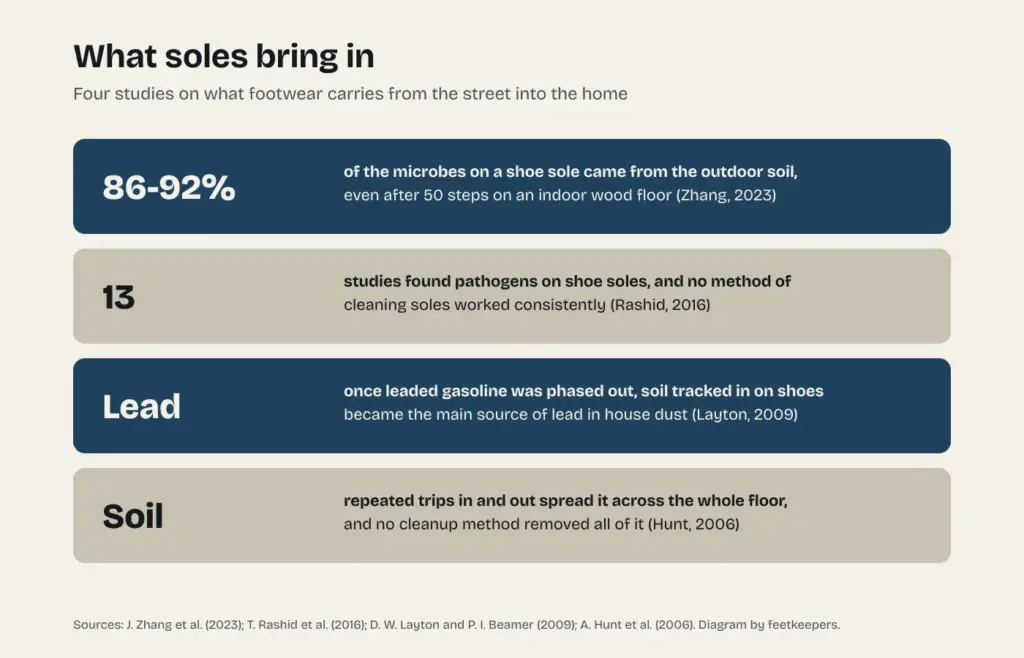
Behind almost all these customs is one shared idea: shoes bring the street inside. That part, at least, has been measured. In 2023, a team at Shanxi Medical University in China published an experiment in Forensic Science International: Genetics in which people walked on outdoor soil and then on an indoor wood floor. The researchers sampled microbes from their soles and footprints at 5, 20 and 50 steps. Even after 50 steps indoors, 86 to 92 percent of the microbes on the soles still came from the outdoor soil, and only a small share from house dust. They were studying it to trace where someone had been, for forensic purposes, but the finding works just as well for understanding what comes through the front door.
In 2016, a team led by the University of Houston reviewed every study it could find on microbes on shoe soles in the Journal of Applied Microbiology. Thirteen studies supported the idea that soles can carry disease-causing microbes, in hospitals, in everyday community settings and among food workers. Another fifteen had tested ways of cleaning soles, and none worked consistently. The authors concluded that more research was needed to know how much dirty shoes actually contribute to spreading those microbes. In other words: that microbes ride on soles is established; how much that ride matters, not yet.
Soil works much the same way. In 2006, A. Hunt, D. L. Johnson and D. A. Griffith measured in Science of the Total Environment how much soil footwear left on a hard floor. A single trip in dirtied a small area, but repeated trips spread it over the whole floor, and neither brushing, vacuuming nor wet wiping got all of it up. And in 2009, D. W. Layton and P. I. Beamer of the University of Arizona published a model in Environmental Science and Technology of how house dust forms: a mix of skin and fibers, particles from outdoor air and soil tracked in on shoes. Using historical data from Sacramento, California, they found that in the early 1980s most of the lead in house dust came in through the air, from leaded gasoline, and that once leaded gasoline was phased out, soil tracked in on shoes and stirred back up became the main source.
There’s one widely shared study worth handling with care: a 2008 University of Arizona project on bacteria on shoes whose eye-catching numbers circulate all over the internet. It was co-sponsored by a footwear company that sold machine-washable shoes, and we could only find press summaries, not the full study, so we’re not repeating its figures.
What the studies don’t say
None of these studies says that taking your shoes off at home has a specific effect on the health of the people who live there, and it isn’t our place to say so either. What they do say is more modest: a shoe sole is a very efficient courier for whatever is on the street, it spreads that across the floor at home, and cleaning it up afterward is harder than not bringing it in. Odor, the other perennial argument, we covered in why shoes smell.
Whether to go shoeless is still mostly a matter of custom, climate and flooring. In a Japanese home with tatami, a Korean home with a warm floor or a Canadian home with two feet of snow outside, the answer is obvious. In a carpeted apartment in a city with mild winters and guests who drop by unannounced, less so. In the end, every front door decides how far the street gets to come in. And the sole, meanwhile, keeps carrying it along, with the same symbolic load of dirt that explains why it’s shoes hanging from power lines and not T-shirts.
Sources
- J. Zhang et al. (2023), “Tracing recent outdoor geolocation by analyzing microbiota from shoe soles and shoeprints even after indoor walking,” Forensic Science International: Genetics 65: 102869.
- T. Rashid, H. M. VonVille, I. Hasan and K. W. Garey (2016), “Shoe soles as a potential vector for pathogen transmission: a systematic review,” Journal of Applied Microbiology 121(5): 1223-1231.
- A. Hunt, D. L. Johnson and D. A. Griffith (2006), “Mass transfer of soil indoors by track-in on footwear,” Science of the Total Environment 370(2-3): 360-371.
- D. W. Layton and P. I. Beamer (2009), “Migration of contaminated soil and airborne particulates to indoor dust,” Environmental Science and Technology 43(21): 8199-8205.
- YouGov (2018), “Most Americans take their shoes off at home, but don’t expect their guests to,” January 17, 2018.
- The Irrawaddy (2019), “‘Shoe Thein Maung’ Fought to Stop Colonists Trampling on Buddhist Customs,” March 11, 2019.
- Wikipedia: Removal of footwear indoors, Genkan, Uwabaki and Ondol.
Image credits
- Shoe cupboards at the entrance to Yashima Junior High School, Japan: Douglas P. Perkins. CC BY 3.0, via Wikimedia Commons.
- Toilet slippers in Japan: RachelH_. CC BY 2.0, via Wikimedia Commons.
- Portrait of Ledi Sayadaw: unknown author. Public domain, via Wikimedia Commons.
- Customs and soles diagrams, and poll chart: feetkeepers.