
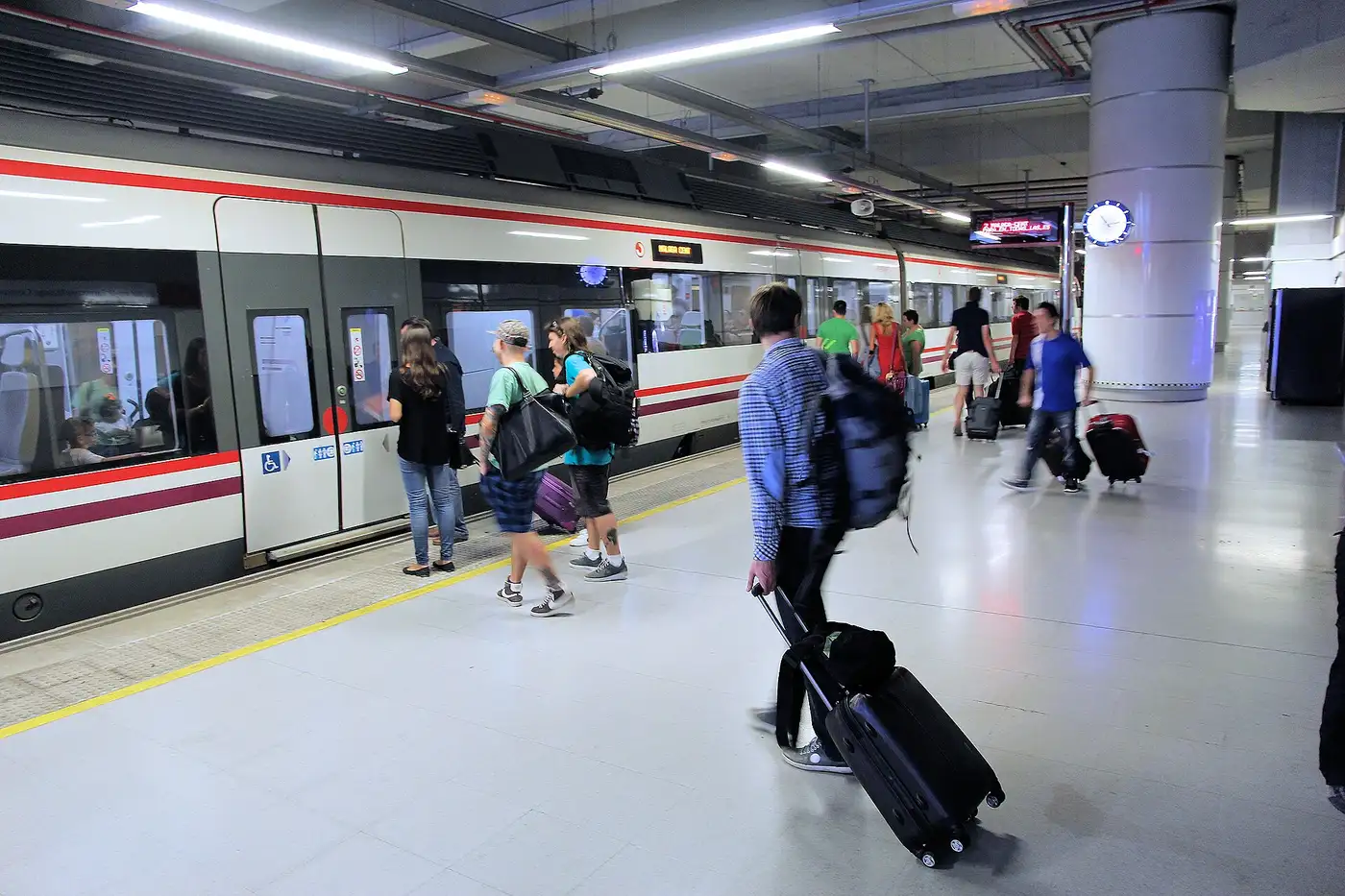
When it comes to shoes for carry-on travel, every pair is the most expensive tenant in the bag. Shoes are stiff, they don’t fold or roll, they weigh more than almost any piece of clothing, and they come back from the street carrying whatever was on the street. In a big checked suitcase, an extra pair sneaks in by accident. In a carry-on, each pair earns its spot or stays home. The good news is that the decision doesn’t come down to taste. It comes down to a few rules of physics: what it costs to carry weight on your feet, how long a shoe takes to dry and what city streets do to a sole.
The suitcase that took forever to get wheels
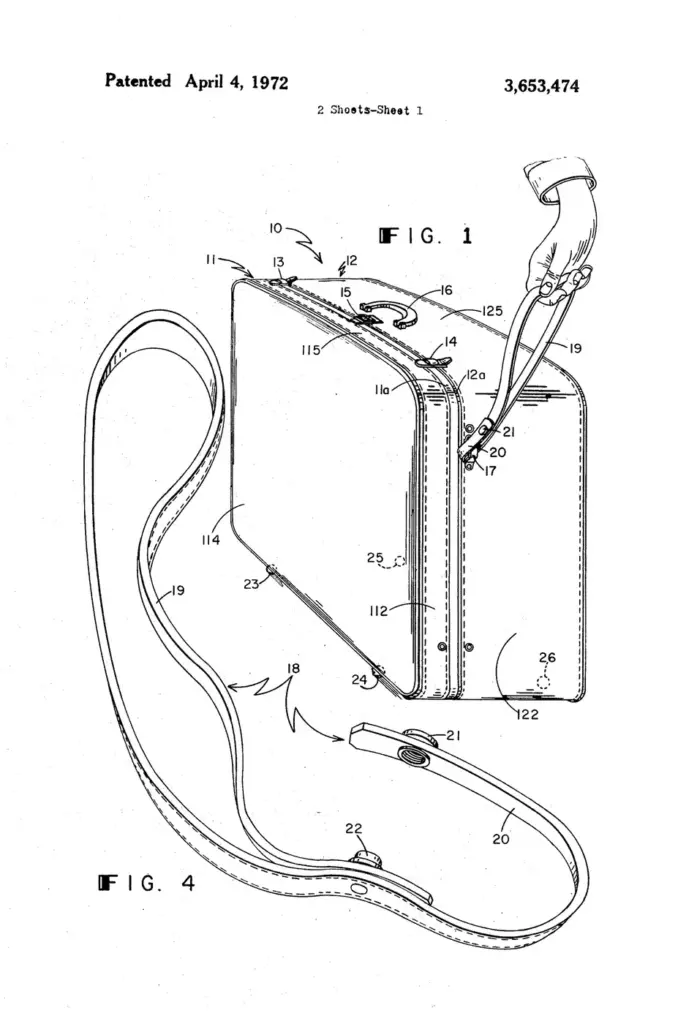
The modern carry-on is younger than you’d think. U.S. Patent 3,653,474, “Rolling luggage,” was filed by Bernard D. Sadow on February 16, 1970, on behalf of United States Luggage, and granted on April 4, 1972. As the story usually goes, Sadow got the idea coming home from a vacation in Aruba, lugging two big suitcases, when he saw a man pushing luggage on a wheeled skid. His design had four little casters and a strap to pull it along, like walking a dog on a leash. According to the same story, the idea was laughed at until a Macy’s executive agreed to sell it.
Half a century later, the question isn’t how to drag your bag but how much fits in it. In 2015, the International Air Transport Association, IATA, proposed a guideline size for carry-on bags of 55 by 35 by 20 centimeters, about 21.5 by 13.5 by 7.5 inches, designed so every passenger could bring a bag into the cabin on aircraft with 120 seats or more. It isn’t a maximum: each airline sets its own limits, and they’re worth checking before every flight. Bags meeting the guideline could carry a joint IATA label with a unique code, and participating airlines would give them priority to stay in the cabin when not everything fit. Still, it gives a sense of the space: 55 by 35 by 20 centimeters works out to about 38.5 liters, roughly 2,350 cubic inches, for everything, shoes included.
The shoe that went through the X-ray
Shoes also have a complicated history with airports. On December 22, 2001, Richard Reid boarded American Airlines Flight 63 from Paris to Miami with explosives hidden in his shoes and tried, and failed, to set them off. Passengers subdued him, and the plane landed in Boston. Forensic analysis identified two compounds, PETN and TATP, and in 2002 Reid pleaded guilty to eight counts of terrorism; he was sentenced to three life terms plus 110 years. According to Wikipedia, X-ray scanners can’t detect PETN hidden in a shoe, which takes a chemical test, but they can reveal whether a shoe has been altered to hide something.
From 2006, the TSA required every passenger to take their shoes off at security. In 2011, the rule was relaxed for children 12 and under and adults 75 and over. It lasted almost twenty years. On July 8, 2025, the Department of Homeland Security announced that passengers at domestic airports could keep their shoes on through TSA screening, with the rest of the layered security process still in place. Outside the U.S., each country and airport has its own procedures, so a shoe that’s quick to take off and put on is still an advantage at plenty of checkpoints.

Rule one: wear the heaviest pair
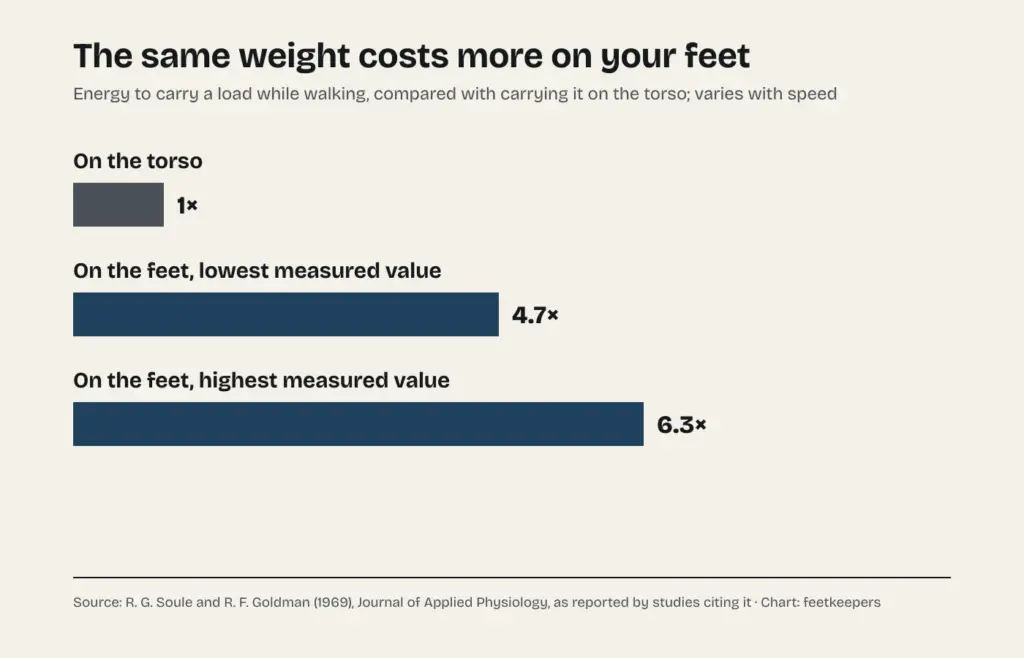
The first decision is which pair travels on your feet. The usual advice is to wear the bulkiest, heaviest pair so it doesn’t eat up space in the bag. That makes sense for packing, but it’s worth knowing what it costs. In 1969, Richard Soule and Ralph Goldman published a classic study in the Journal of Applied Physiology on the energy cost of carrying weight on different parts of the body. According to the studies that cite it, the same weight carried on the feet cost between 4.7 and 6.3 times as much energy as carried on the torso, depending on speed. A pound in your boots isn’t a pound in your backpack, as we explain in our story on work shoes.
On an airport day with only a few hours of walking, the price is small. In a city you explore on foot from morning to night, that same heavy pair costs you on every step. The shoes for your big walking days should be the lightest ones that can handle the terrain.
Rule two: two pairs, so one can dry
Traveling with a single pair has a problem you can’t see in the suitcase: the shoe never gets a break. Back in 1927, the U.S. Department of Agriculture was already recommending two pairs for alternate daily wear so each could dry out in between, because perspiration is very hard on leather. Materials science backs that up: a 2019 study showed that as moisture rises, the collagen in leather becomes more flexible, because water lubricates its fibers. A wet shoe gives and loses its shape. We cover this in detail in our story on how many pairs of shoes you need.
On a trip, that advice matters even more. A day of rain or heat leaves your shoes damp, and in a hotel room the temptation is to set them by the radiator. The same bulletin warned firmly against it: wet leather is damaged by heat far more readily than dry leather, and dried too fast it shrinks, hardens and loses its shape. The fix was to stuff the shoe with crumpled paper and let it dry slowly somewhere not too warm. With two pairs, one can dry that way while the other does the work.
In a cold destination, dampness has another price. In 1999, researchers at Sweden’s National Institute for Working Life used a heated artificial foot to show that accumulated sweat cut footwear insulation by 9 to 36 percent, depending on the sweat rate and the boot. A boot that hasn’t dried out from the day before heads into the snow keeping you less warm.
Rule three: the ground picks the sole
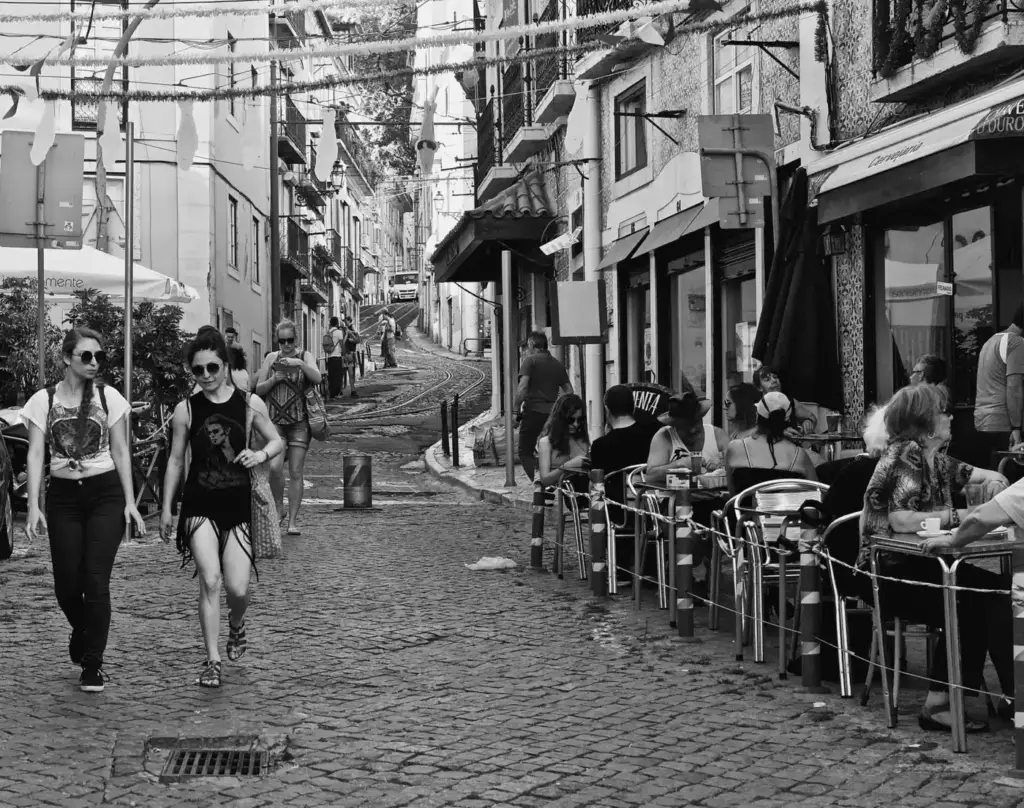
Your second pair isn’t chosen by style. It’s chosen by the ground at your destination. A city built of stone changes things a lot. In 2013, a University of Michigan team measured that walking on uneven ground, with bumps of up to about an inch, raised the energy needed to walk at the same speed by 28 percent. In flip-flops, according to a 2014 University of Salford study, the heel comes down twice as fast as barefoot. And in Lisbon, the polished, wet stone of the famous Portuguese pavement has earned its slippery reputation. We go through all the data in our story on flat sandals on cobblestones.
Heat counts too. According to the U.S. Environmental Protection Agency, conventional asphalt can reach surface temperatures of up to 152°F at midday, while so-called cool pavements, designed to reflect more sunlight, stayed 10 to 16 degrees cooler in the measurements the agency cites. With a very thin sole, a few millimeters are all that separate your foot from that surface.
If the forecast calls for rain, flip-flops have one more problem. In 2021, a University of Waterloo team in Canada triggered controlled slips in people wearing flip-flops on dry and wet tile. On wet tile, the more weight on the slipping foot, the faster it slid. Their conclusion: in flip-flops, a slip can happen in two places at once, between your foot and the sandal and between the sandal and the floor.
So the useful question before you pack isn’t which shoes go with which outfit. It’s how many miles you’ll walk, on what kind of ground and in what weather.
Rule four: no breaking in on the road
One last rule has to do with time, not space. Your foot changes over the course of the day: according to the studies we review in our story on why shoes feel tighter in the afternoon, it gains around 3 percent in volume, and simply standing up makes it longer. In a 2003 Hong Kong Polytechnic University study that took 3D casts of 16 healthy feet, going from no weight to full body weight made the foot 3.4 percent longer and 6 percent wider on average, while the arch dropped 20 percent in height. On a foot about 10 inches long, that’s roughly a third of an inch, just from standing. A shoe you tried on one morning in the store can behave differently at 8 p.m. after twelve hours in a city. A trip isn’t the place to find out. Shoes you plan to put through their paces should have a few long days on your feet behind them first.
Packing them
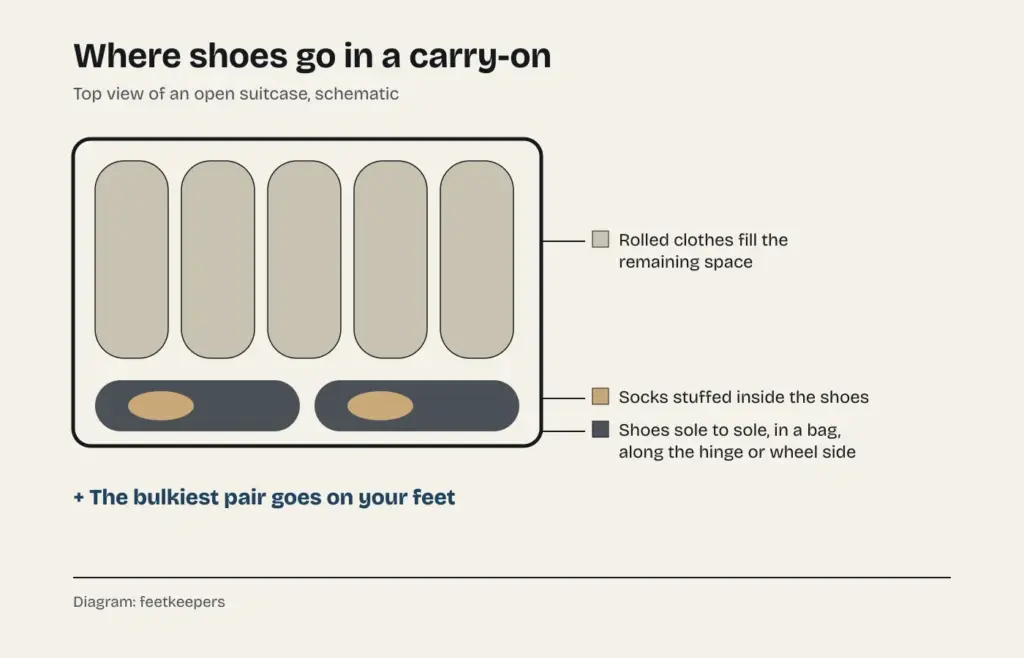
Once you’ve picked them, the shoes going in the bag get packed with three things in mind. First, dirt: sole to sole, inside a bag. Second, space: shoes have a hollow interior, and socks fit in it. And just like the 1927 bulletin’s crumpled paper, a stuffed shoe holds its shape better. Third, weight: the stiffest, heaviest bundle goes at the base of the suitcase, along the hinge or wheel side, so the bag doesn’t tip over and your clothes don’t get crushed underneath.
Socks have the same issue as shoes: they need to dry too. According to a 2023 review in the journal Textiles, cotton absorbs a lot of moisture and is slow to release it, wool absorbs water vapor but dries slowly, and polyester barely absorbs water at all. A fiber that hardly absorbs anything has less water to give up after a rinse in a hotel sink. We explain it in our story on merino, cotton and synthetic socks.
The math for a carry-on
Put the rules together and the math is short. One pair on your feet, the bulkiest of the ones that work for walking. A second pair in the bag, different in the ways that matter: if the first is closed and heavy, the second is lighter; if it’s a hot destination, one of the two can be a sandal that actually holds onto your foot. And only if the trip calls for it, a third, very light flat pair for the shower, the beach or the hotel room. Beyond that, every pair you add takes up the space of two or three pieces of clothing. At home, the same logic of drying time and repeated uses came out to about five pairs for a life with a job, workouts and a real winter. On a short trip, the uses shrink to walking, dinner and maybe getting rained on, and two well-chosen pairs cover almost all of them.
Sources
- B. D. Sadow, U.S. Patent 3,653,474, “Rolling luggage” (filed February 16, 1970; granted April 4, 1972).
- IATA, “Cabin OK” carry-on size guideline (2015).
- U.S. Department of Homeland Security and TSA, “DHS to end ‘shoes-off’ travel policy” (July 8, 2025); Wikipedia, “Richard Reid.”
- K. Kuklane, I. Holmér and G. Giesbrecht (1999), “Change of footwear insulation at various sweating rates,” Applied Human Science 18(5): 161–168.
- L. M. Tennant et al. (2021), “Analysis of invoked slips while wearing flip-flops in wet and dry conditions,” Applied Ergonomics 92: 103318.
- R. G. Soule and R. F. Goldman (1969), “Energy cost of loads carried on the head, hands, or feet,” Journal of Applied Physiology 27(5): 687–690.
- F. P. Veitch, R. W. Frey and H. P. Holman, Leather Shoes: Selection and Care, Farmers’ Bulletin No. 1523, U.S. Department of Agriculture (1927, revised 1952).
- S. J. R. Kelly et al. (2019), “Effect of collagen packing and moisture content on leather stiffness,” Journal of the Mechanical Behavior of Biomedical Materials 90: 1–10.
- A. S. Voloshina et al. (2013), “Biomechanics and energetics of walking on uneven terrain,” Journal of Experimental Biology 216: 3963–3970; C. Price et al. (2014), Journal of Foot and Ankle Research 7: 40.
- U.S. Environmental Protection Agency, “Using cool pavements to reduce heat islands.”
- M. R. Islam, K. B. Golovin and P. I. Dolez (2023), “Clothing thermophysiological comfort: a textile science perspective,” Textiles 3(4).
Image credits
- Passengers with luggage at Málaga Airport: Marek Ślusarczyk (Tupungato). CC BY 3.0, via Wikimedia Commons.
- Rolling luggage patent drawing: Bernard D. Sadow. Public domain, via Wikimedia Commons.
- Packing diagram and weight chart: feetkeepers.
- Security checkpoint in Austin: FASTILY. CC BY-SA 4.0, via Wikimedia Commons.
- Alfama, Lisbon: Pedro Ribeiro Simões. CC BY 2.0, via Wikimedia Commons.