
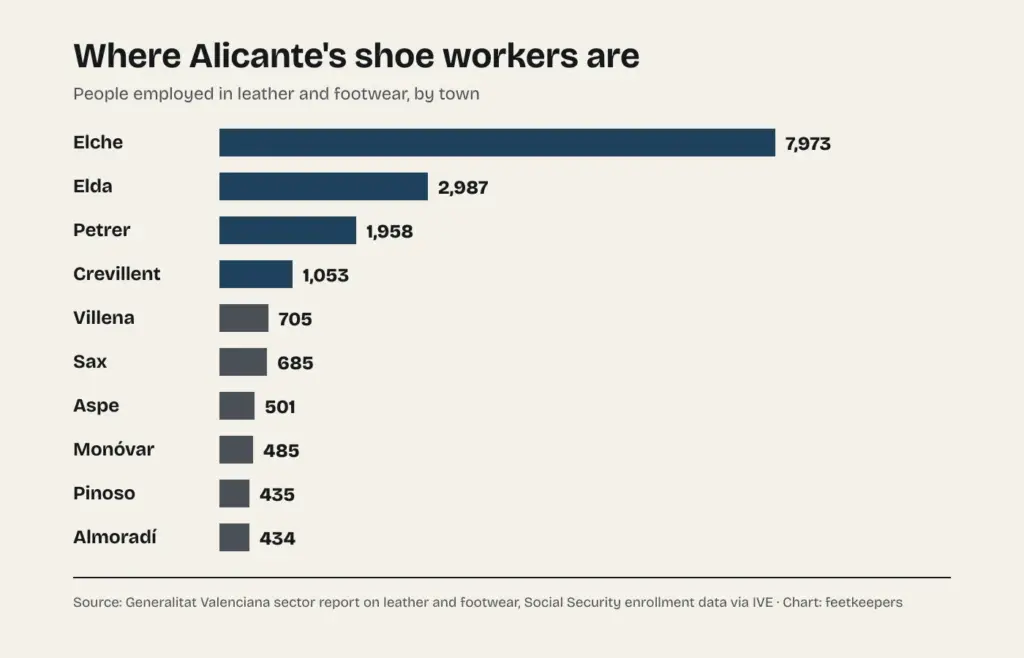
The Spanish shoe industry has a strange map: nearly all of it fits into one valley in the province of Alicante, on Spain’s Mediterranean coast, plus one town in the plains of La Mancha and one island. It isn’t where the most cattle are, or where the most tanneries were, or next to the big ports. It’s where, in the 1800s, some farmers lost their land to bad water, others got a railroad, and others had leftover tires and leather. What remains is still substantial: more than half the country’s leather and footwear manufacturers are in a single region, and one city, Elche, employs close to eight thousand people in the trade. If a shoe in your closet says “Made in Spain,” the odds are good it came from somewhere on this map.
How big it still is
According to a November 2025 sector overview from Spain’s Ministry of Industry, using 2023 data from the national statistics office, Spain’s leather and footwear sector, which also includes leather goods and tanning, counted 3,776 companies and 39,924 workers. It exported €5.61 billion worth of goods and imported €7.15 billion, for a trade deficit of €1.54 billion. These are small companies: the average firm had 10.6 workers, with average pay of about €27,300 per employee and value added of about €34,000 per worker, both well below the average for Spanish industry as a whole.
The concentration is extreme. According to a sector report from the regional government of the Valencian Community, based on 2022 business registry data, the region had 2,170 leather and footwear manufacturers, 52.4 percent of the national total. Of those, 1,948, or 89.8 percent, made footwear, while the other 222 worked in tanning, leather goods and similar products. On top of that, it had 984 supplier companies making components, lasts and soles, which the industry association says account for 82 percent of all such suppliers in Spain. Altogether, 3,154 companies, or 9.1 percent of all the region’s industry.
Within the region, footwear is almost entirely an Alicante affair: the province accounts for 92.9 percent of the sector’s workers. And within Alicante, two counties along the Vinalopó River account for most of it: Baix Vinalopó, home to Elche, with 47.5 percent of the province’s footwear jobs, and Vinalopó Mitjà, home to Elda, with 26.6 percent. Each area has its specialty, according to the same report: Villena, up the valley, makes children’s shoes; Elda makes women’s shoes; and Elche turns out a wider mix. Outside Alicante, the town of La Vall d’Uixó, in Castellón province, is the region’s other footwear hub.
A valley that lost its good water
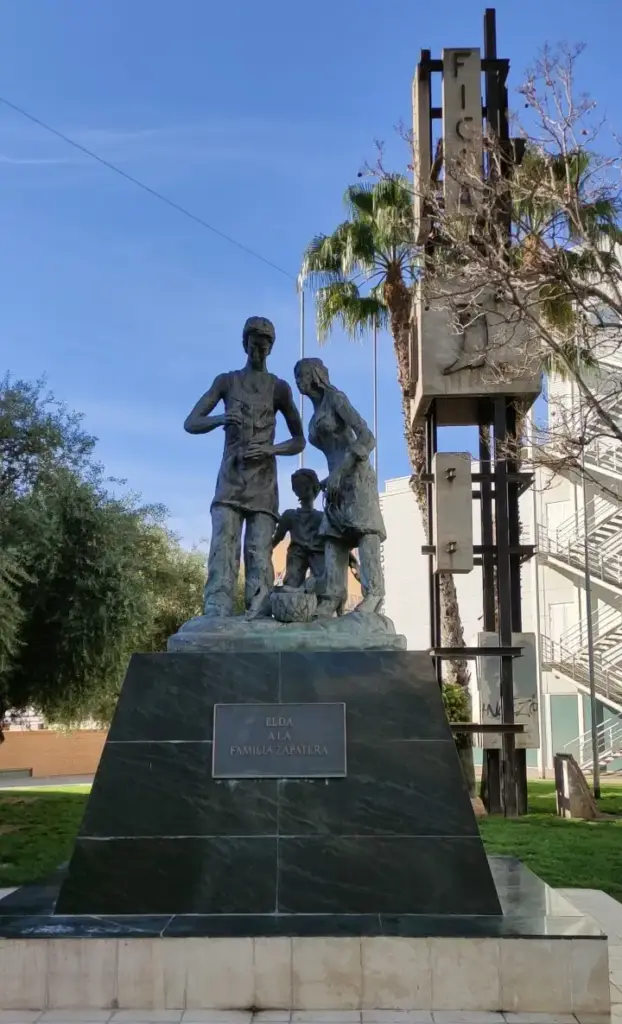
The story starts with a farming disaster. According to the Footwear Museum in Elda, in the early 1800s the uncontrolled draining of a salt marsh near Villena ruined farming along the Vinalopó, along with many Elda families who lived off the land. A few people, whom the town took for eccentrics, started making shoes to sell at local markets, at first children’s shoes made on their doorsteps with help from the family. They sold in nearby towns like Salinas, Sax and Monóvar, and demand encouraged them to start making adult shoes too.
Oddly, Elda’s shoemakers didn’t come out of the espadrille tradition. According to the museum, the town had plenty of esparto grass in its hills and sold it to other cities, but that wasn’t what launched its shoe industry. Necessity was.
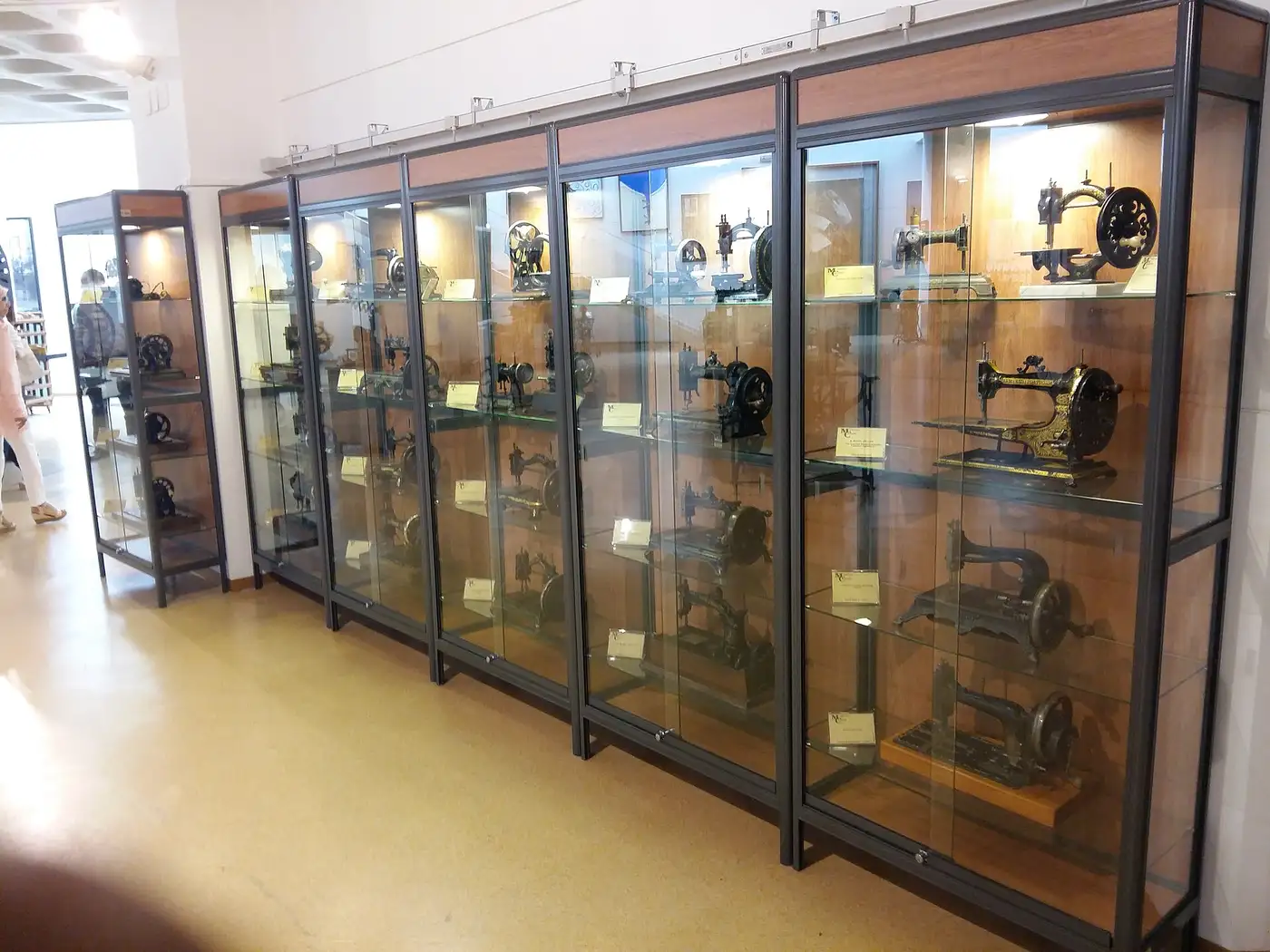
Two inventions gave it a push. The first was the sewing machine, commercialized around 1840 and used for both clothing and footwear. The second was the railroad: in 1858 the line between Alicante and Almansa opened, part of the route to Madrid, and local shoemakers could suddenly reach far more distant markets.
Big factories came later. Geographer Antonio Martínez Puche, in a study of the industry’s origins along the Vinalopó corridor between 1823 and 1936, describes how for a long time the basic unit of production was the artisan doing everything by hand, within a putting-out system that funneled sales through a few workshops. In Villena in 1903, eleven workshops together produced 242,400 pairs a year, the biggest of them run by families named Morant, Guillén, Bañón, Milán and Domene, and shoemaking already employed 54.9 percent of the town’s male industrial workers and 58.9 percent of its female ones, and it was common for lasting and skiving to be done at home after factory hours. World War I changed everything. Citing historian José Antonio Miranda Encarnación, Martínez Puche notes that Spanish footwear output rose from 8 million pairs on the eve of the war to more than 20 million in the 1930s. In Villena, some abandoned wineries, relics of the town’s winemaking past, were converted into shoe factories.
We cover the water-powered last workshops of Elda in our story on the shoe last, and the home-based upper stitching that later spread across the province in our story on how shoes are made.
Elche: from espadrilles to leather
Elche, unlike Elda, really did grow out of espadrilles. The town itself had only been granted the title of city in 1871, by the short-lived King Amadeo. According to the city’s history as summarized in encyclopedias from local studies, the farm crisis of the 1800s gave way to a modern espadrille industry in which hemp was partly replaced by jute. Historian Pedro Ibarra credited the first factory to Josep María Buch, who brought together a scattering of looms that had been working in exchange for raw materials. Just before World War I, Elche had around a hundred factories making espadrilles, jute and braid, employing about 80 percent of the town’s working population. It became Spain’s leading producer of fabric footwear, and by the end of the 1800s local businessmen had started investing in leather shoe factories.
The big leap came in the 1960s and 1970s, when Elche’s population surged with industrialization and the city became one of Europe’s major shoe producers. Brands that now sell around the world got their start there.
Globalization had its moment in Elche too. On September 16, 2004, a protest by around 500 people against competition from Chinese-owned footwear warehouses in the city’s Carrús industrial park ended with one warehouse set on fire. It came at the height of a crisis in the sector, and an academic study at the time analyzed it under a title that sums it up: conflicting interests and racism.
Almansa: the railroad and mass production
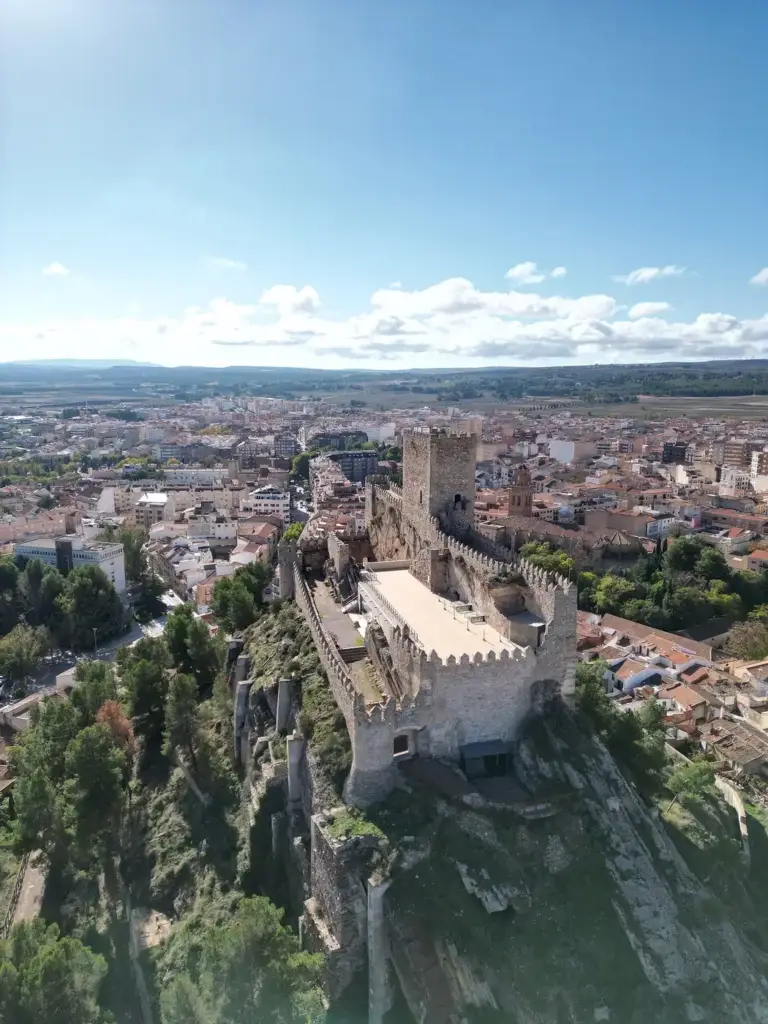
Almansa, in the province of Albacete, sits in the neighboring region of Castilla-La Mancha but shares the Vinalopó’s railroad. According to the history compiled by the Elda Footwear Museum, until the mid-1800s its shoemaking was craft work in tanneries and small workshops, each with a master and one or two apprentices. The arrival in 1858 of the Madrid–Alicante railway, running through Albacete and Almansa, multiplied the workshops: by 1887 the census listed 150 shoemakers, and 96 muleteers carried their goods to other towns.
The name that matters in Almansa is Coloma. Starting in 1907, according to the same source, the Coloma family’s company gradually mechanized with equipment from the United Shoe Machinery Company, the American machinery giant we discuss in our shoe last story, and by 1912 it was Spain’s largest producer, turning out 1,800 pairs a day. The Albacete Institute of Studies devoted a book to it with a telling title: Calzados Coloma, a pioneer of Spanish Fordism (Almansa, 1900–1936). In 1928, Almansa had fourteen shoe factories employing 1,537 people.
The Spanish Civil War stalled all of that, and Calzados Coloma, the hardest hit, closed in 1954 with around 600 workers. Many moved to Elda. By the late 1970s, the flow reversed: according to the museum, buses brought shoemakers in every day from surrounding towns to work in Almansa’s factories.
Menorca: tires and leather
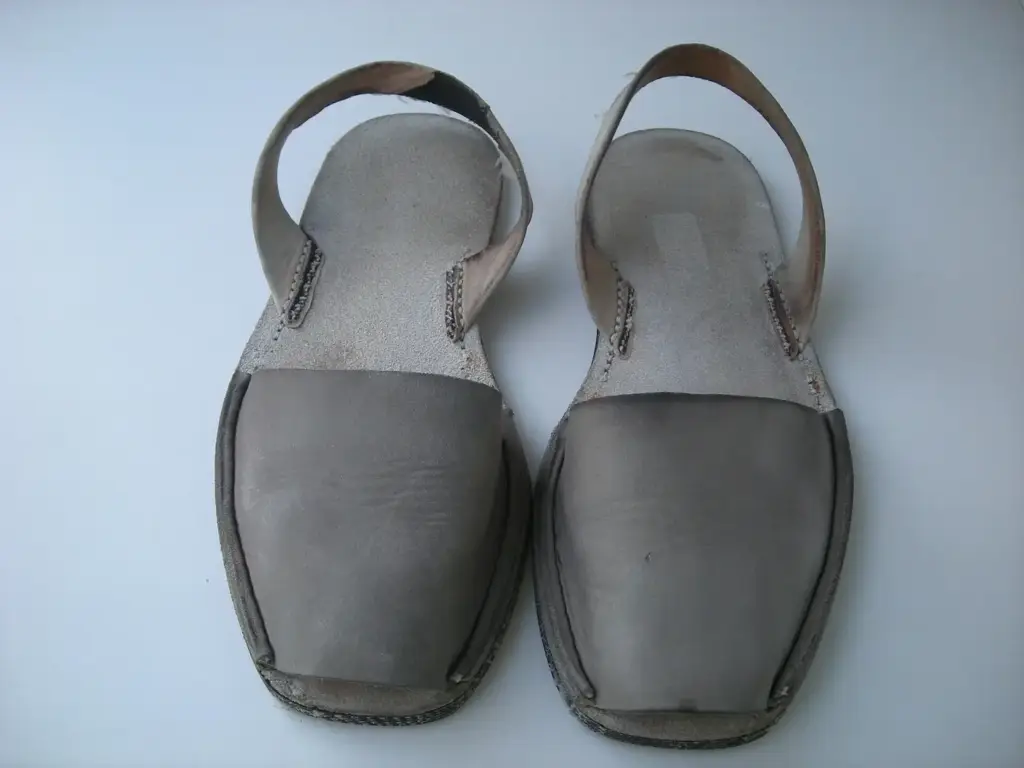
The fourth piece of the map is in the Mediterranean, on the Balearic island of Menorca. There, shoemaking is a 19th-century tradition with a product all its own: the avarca. According to Wikipedia’s summary of its sources, it’s a traditional sandal made of leather straps on a sole that was originally cut from recycled tires, designed for the island’s farmers and shepherds, who needed something tough, comfortable and suited to the local climate and terrain. It dates to the mid-1800s, and in the 20th century the tire soles gave way to recycled rubber. A leather strap wraps behind the heel.
The word is far older than the sandal. Abarca is a pre-Roman term, possibly from a language related to Basque, that shows up in Old Spanish as auarca, auarcha or avarca, and it shares a root with alpargata, the Spanish word for espadrille, which changed under the influence of Andalusian Arabic.
Today, to protect the island’s makers, there’s an official “Avarca de Menorca” label, backed by the Menorca Footwear Manufacturers’ Association and granted by the local government, which certifies quality and that the sandals were made on the island. Towns like Alaior are known as much for their cheese as for their shoe factories. And the sandals are sometimes sold as “ibicencas,” as if they came from Ibiza, although they’re Menorcan in origin.
Why there
Put the four stories side by side and a pattern emerges. First, a farm economy in crisis, leaving labor available and used to combining fieldwork with work at home, something the botanist Cavanilles already noted in the late 1700s for the mat-making industry of nearby Crevillent, as Martínez Puche points out. Second, a nearby raw material or know-how: esparto, hemp, leather. Third, a way to sell far away: the 1858 railroad for the Vinalopó and Almansa, the sea for Menorca. And fourth, once the industry took off, the effect that keeps it in place: suppliers of soles, lasts, heels and components set up where the manufacturers are, and manufacturers stay where the suppliers are. Eighty-two percent of the country’s suppliers in a single region is no accident.
What’s been lost along the way
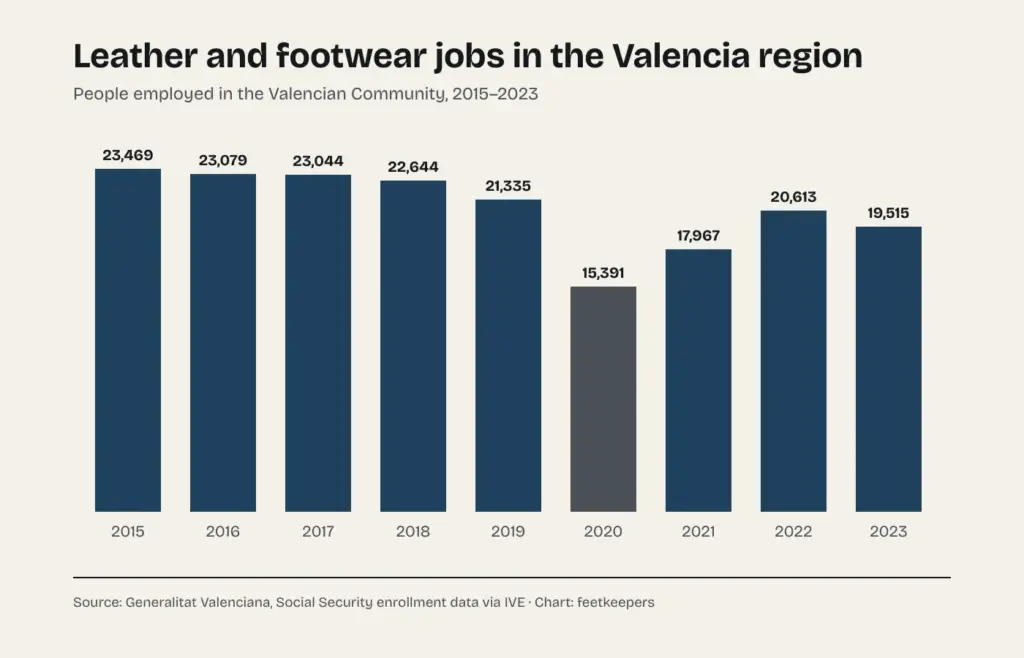
The flip side is the recent numbers. According to the same regional report, between 2014 and 2022 the number of leather and footwear manufacturers in the Valencian Community fell 17.3 percent, 453 fewer. Employment went from 23,469 in 2015 to 19,515 in 2023, with a collapse to 15,391 in 2020, the pandemic year.
And the business has changed. Spanish shoes no longer compete with Asia on volume: in 2024, according to Spanish customs data, the average pair Spain exported was valued at €19.90, while the average pair Italy imported from China came in at €7.53, as we explain in our story on expensive vs. cheap shoes. What’s left along the Vinalopó, in Almansa and on Menorca plays in a different price league, and rests on a trade that in those towns has been handed down for two centuries, often within the same household.
Sources
- Spanish Ministry of Industry and Tourism, Sector presentations: leather and footwear (November 2025), using 2023 data from INE and the Secretary of State for Trade.
- Generalitat Valenciana, Report on the leather and footwear sector, using 2022 INE business registry data and 2015–2023 Social Security enrollment data from the Valencian Statistics Institute.
- A. Martínez Puche, “El desarrollo de la industria del calzado en Villena (Alicante): un complemento a la evolución y origen del calzado en el corredor del Vinalopó (1823–1936),” citing J. A. Miranda Encarnación (1998), La industria del calzado en España (1860–1959).
- Museo del Calzado de Elda, histories of the Elda and Almansa footwear industries.
- Instituto de Estudios Albacetenses, Calzados Coloma: empresa pionera del fordismo español (Almansa, 1900–1936).
- Academic study “Intereses contrapuestos y racismo: el incendio de los almacenes chinos en Elche (septiembre de 2004).”
- Wikipedia, “Elche” and “Abarca de Menorca,” and the references they cite.
Image credits
- Antique sewing machines at the Elda Footwear Museum: Touzrimounir. CC BY-SA 4.0, via Wikimedia Commons.
- Employment charts: feetkeepers.
- Monument to the shoemaking family, Elda: Francesc Fort. CC BY-SA 4.0, via Wikimedia Commons.
- Almansa Castle: K8t.slezavina. Public domain (CC0), via Wikimedia Commons.
- Menorca avarcas: Paucabot. CC BY-SA 3.0, via Wikimedia Commons.