
The steel toe is the easy part of a steel toe boot. Making a metal shell that survives a brutal hit is a problem industry solved about a century ago. The hard part is everything around it: fitting that rigid piece into a boot that has to flex thousands of times a day, keeping the whole thing from weighing like a cinder block, stopping it from turning your toes into an ice tray in January, and making it work for feet that don’t look anything alike. That’s where a safety boot wins or loses on comfort, and plenty of them lose.
Our story on work shoes covers what the standards demand from each class of footwear. This one goes inside the toe cap itself: where it came from, what it’s made of, and why it’s constantly at odds with the foot it protects.
An idea with armor behind it
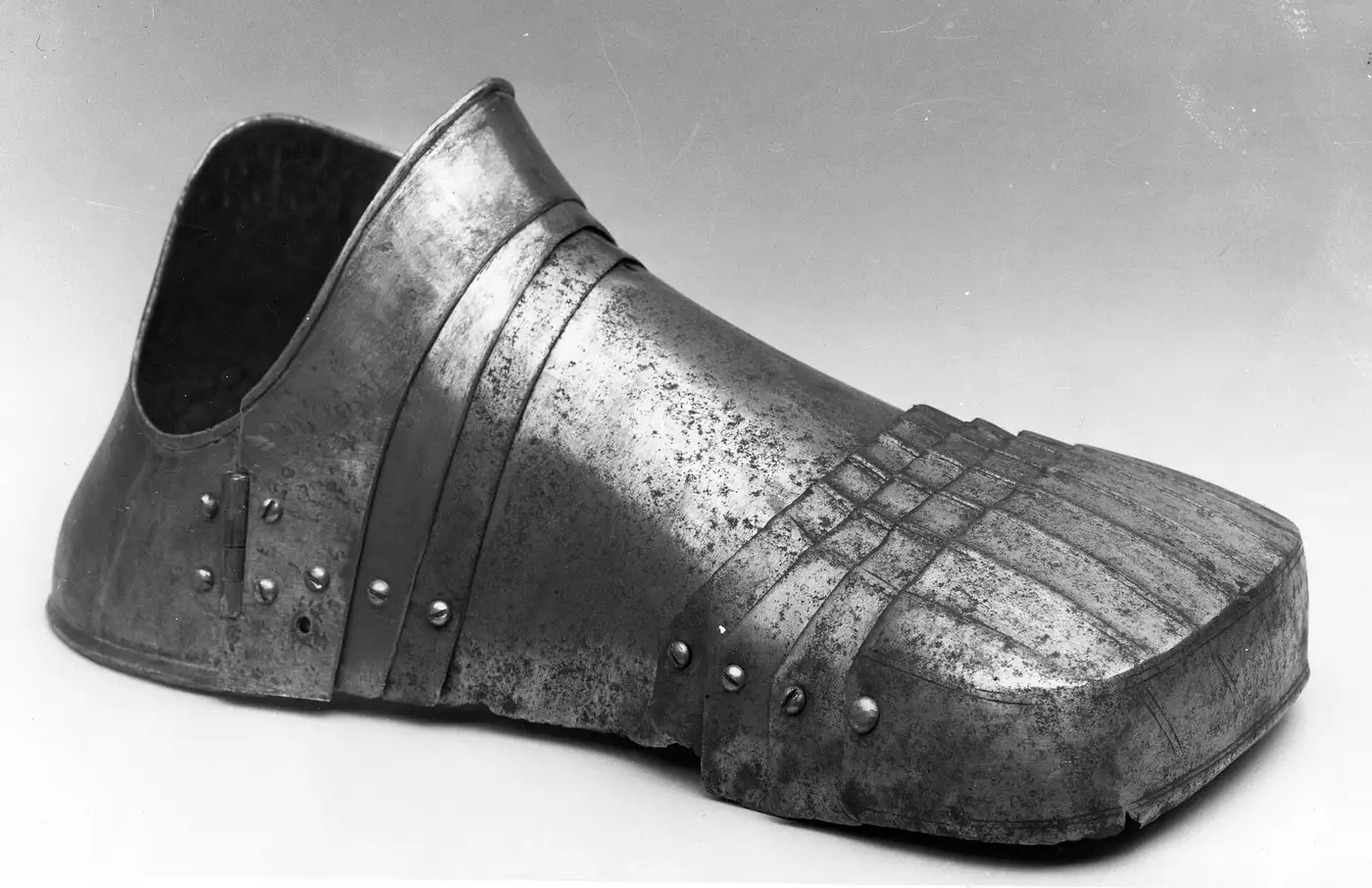
Wrapping the foot in metal isn’t an industrial invention. Sixteenth-century plate armor covered the foot with sabatons, articulated steel shoes built from overlapping plates so the wearer could still walk. The Metropolitan Museum of Art in New York holds a German one from around 1550, pictured at the top of this story: a blunt steel toe with plates stepping up toward the ankle. Even earlier, according to Wikipedia, late medieval military writers such as Konrad Kyeser were suggesting iron soles to protect against foot traps and caltrops.
The steel toe as part of a work shoe is far more recent. According to a 2021 review from the University of Minho in Portugal, published in the journal Polymers, steel toe caps went into production in the early 1920s and are still the most common thanks to their mechanical properties.
In the Netherlands, safety footwear has an origin story few people know. According to the company itself, the Dutch State Mines set up a foundation in 1918 to find work for miners in South Limburg who had been injured or disabled underground. In 1927, that foundation opened a workshop for disabled miners that repaired, and later also made, heavy-duty shoes for the mines. In 1931 it officially became the Emma shoe factory, named after the Emma state mine, which in turn was named after Queen Emma. The miners’ safety shoes were made by other miners the mine had already used up.
In the United States, the protective footwear standard ANSI Z41 was first published in 1967. In 1970, Congress passed the Occupational Safety and Health Act, which created OSHA, and in 2005 ANSI Z41 was replaced by ASTM F2412 and F2413, the standards still in use today.

What a safety toe actually is
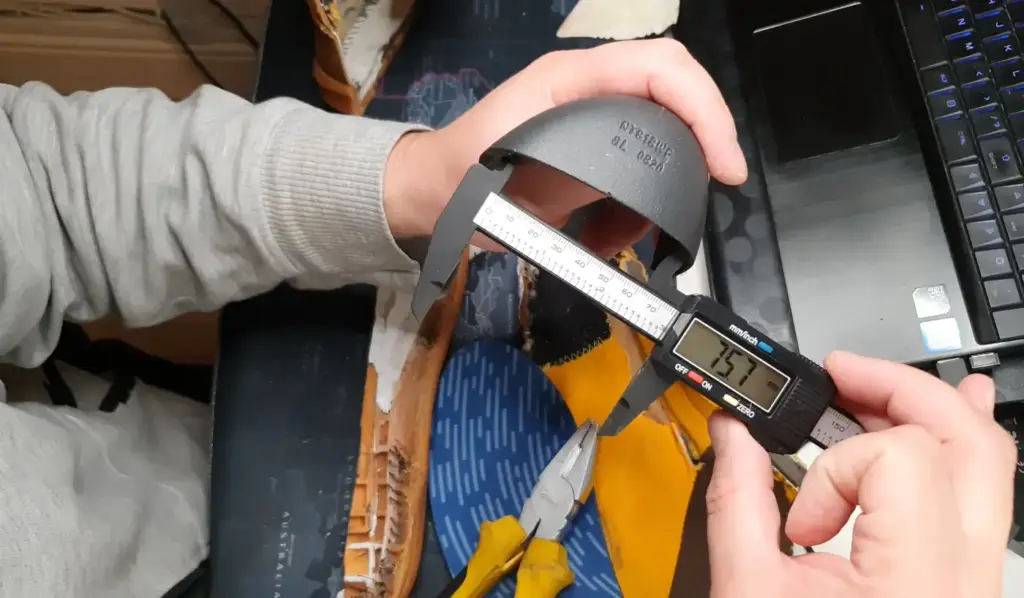
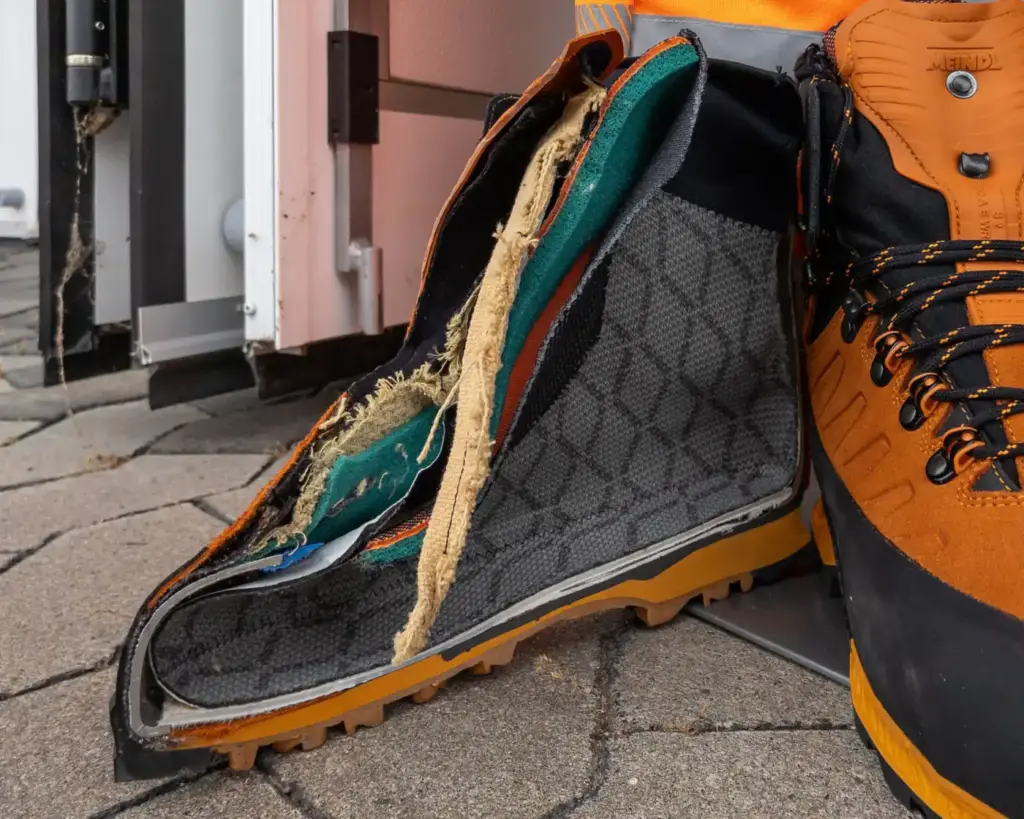
A safety toe is a rigid, dome-shaped shell that sits between the lining and the upper over the toes. It’s shaped to match the last the boot is built on, because it has to fit inside without gaps or pressure points. Its job is to hold its shape under load. ASTM F2413 requires a safety toe rated I/75 and C/75 to withstand a 75 foot-pound impact and 2,500 pounds of compression. In Europe, EN ISO 20345 calls for 200 joules of impact and 15 kilonewtons of compression, and after each test there has to be a minimum clearance left for the toes, which the Polymers review puts at around 22 millimeters, a little under an inch, varying by size.
Those numbers explain the design. What gets measured after the hit is how much room is left for the toes underneath. A cap can dent and still pass, as long as it doesn’t intrude on that space.
Steel, aluminum or plastic
There are three families of materials, and each one comes with its own trade-off.
Steel is the classic answer. It’s strong in thin sections, so the cap can stay slim and the boot keeps a shape close to a regular shoe’s. The price is weight. The Polymers review estimates a steel toe cap can account for up to 35 percent of a shoe’s total mass, and weight on the feet is expensive, as we explain in our work shoes story.
Aluminum is lighter than steel and gets used to cut weight while keeping a metal cap.
Plastic and composite caps, made from fiberglass or carbon fiber set in resin, are the third route. According to the same review, the studies it cites achieved weight reductions of 40 to 56 percent compared with steel. Composites are also non-magnetic, don’t conduct electricity and insulate better against heat and cold, which matters, for example, at jobs with metal detectors. The catch is volume. To be as strong as steel, they need to be thicker, and that makes for a bulkier toe. The authors put it plainly: today’s non-metallic options are bulky and have an obvious aesthetic problem. That’s why so many lightweight safety shoes have that round, puffy toe.
More and more of that trade-off gets worked out on a computer before anything is molded. The Minho team characterized a commercial plastic toe cap in the lab and then modeled it in OpenFOAM, a free, open-source engineering software package, simulating both the 15-kilonewton compression test and the 200-joule impact. Their predictions of how far the cap deflected landed within roughly 5.4 and 6.8 percent of the measured values. Their point was practical: a reliable simulation lets a manufacturer try out cap shapes and materials without making and crushing a physical prototype for every idea.
Aluminum conducts more cold than steel
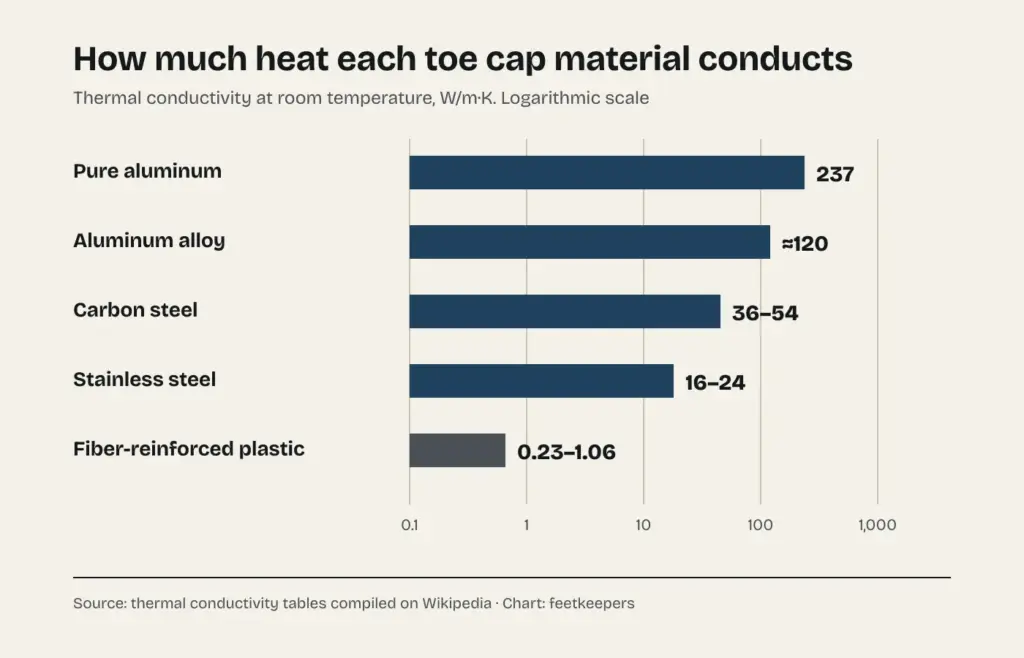
Here’s a fact that runs against a lot of what you’ll read on retail sites. Plenty of them say aluminum transfers less cold than steel. Thermal conductivity tables say the opposite. At room temperature, pure aluminum conducts about 237 watts per meter-kelvin, and its alloys around 120. Carbon steel runs between 36 and 54, and stainless steel between 16 and 24. In other words, aluminum conducts heat two to five times better than steel. Fiber-reinforced plastics, by contrast, come in at 0.23 to 1.06, tens to hundreds of times lower than any metal.
That doesn’t mean an aluminum-toe boot is automatically colder. Between the cap and your foot there’s lining, sock and air, and what reaches your toes depends on the whole stack. But the material on its own conducts more.
Lab work confirms it’s complicated. In 1998, Kalev Kuklane and Ingvar Holmér of Sweden’s National Institute for Working Life tested four steel toe boot models on a heated artificial foot, along with identical versions made without the steel toe. A pump fed water to three artificial sweat glands. Sweating cut the boots’ insulation by 19 to 25 percent overall, and by 30 to 37 percent in the toe area. And the steel toe? Its effect varied depending on how well insulated each boot was. There’s no simple rule. It depends on how everything around the cap is built.
The toe-amputation myth
There’s a legend that’s dogged steel toes for decades: that if something heavy enough lands on one, the steel folds inward and slices off your toes, so you’re better off without it. In November 2005, MythBusters put that to the test using setups similar to safety footwear certification tests. According to the episode summary, the myth was busted. Toes were far safer with a steel toe than without one, the cap didn’t curl in a way that cut, and even a blade attached to the falling weight failed, glancing off the steel and cutting just behind where the cap ended.
That last detail is the telling one. A safety toe protects what it covers and nothing else. That’s why the standards add other protection, like metatarsal guards over the top of the foot, for jobs where heavy objects can land farther back.
A rigid part on a foot that bends
This is where the design conflict starts. The cap doesn’t bend, and your foot does: every step, it flexes right behind the toes. So the boot has to fold along a line very close to the back edge of a rigid metal or plastic shell. If the cap is too long or the boot creases in the wrong spot, the upper folds into a ridge against that edge.
Workers notice. Between 1990 and 1991, S. J. Marr and S. Quine interviewed 321 people in Australia required to wear safety footwear across a wide range of jobs, for a study published in Occupational Medicine. Their main complaints about the footwear were excessive heat, mentioned by 65 percent, inflexible soles (52 percent), weight (48 percent) and pressure from the steel toe cap (47 percent). Nearly half of them pointed straight at the part that was there to protect them.
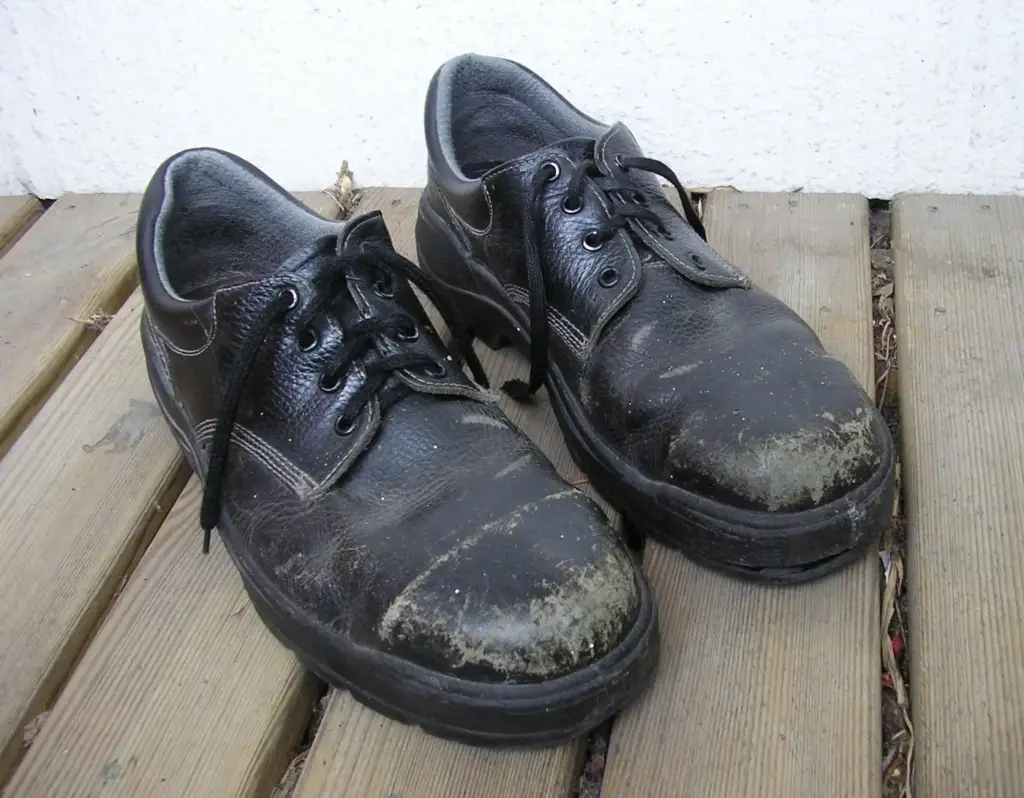
And there’s a deeper problem: the cap never gives. A leather upper molds to the foot with wear, especially when it’s damp, as we explain in our story on how many pairs of shoes you need. A steel shell never molds to anything. The width of the toe box is what it is, on day one and on the last day.
The foot that doesn’t fit the boot
A team at the University of Wollongong in Australia measured this with coal miners. In 2018, J. A. Dobson and colleagues published 3D scans of 208 underground coal miners’ feet in the journal Ergonomics and compared them with the inside of the boots the miners wore. The miners were in boots substantially longer than their feet, possibly because boots in their correct length were too narrow. The authors urged manufacturers to rethink the algorithms they use to create boot lasts, adjusting girth at the instep and heel as foot length goes up.
In a second study that year with 197 miners, the team concluded that length alone isn’t enough to fit a mining boot: fit at the heel, instep and forefoot has to be considered too. And in a survey of 358 miners published the same year, most rated their boots uncomfortable even though they considered the fit reasonable to good.
A safety toe makes that mismatch worse. In a regular shoe, a slightly wide foot stretches the leather until it finds room. In a safety boot, the toe area is locked in by a rigid shell. That’s what the miner study suggests: someone with a wide forefoot who can’t find their width ends up in a longer size so their toes fit under the dome, and then there’s extra boot behind the heel.
Why comfort costs more
Put it all together and it’s clear why a comfortable safety boot is hard to make. Every last needs its own toe cap, matched to the exact shape of its toe, and every new width multiplies the lasts. A lighter cap means composites that take up more room to be as strong, and that room has to come from somewhere without the boot looking like a mushroom. A cap that doesn’t drain heat needs insulation around it, which adds bulk. And all of it still has to pass the same 75 foot-pound and 2,500-pound tests.
A cheap boot solves the equation the short way: one last, one width, one standard steel cap. It meets the standard and it protects you. What it can’t promise is that the foot inside will be comfortable for an eight-hour shift.
Sources
- P. V. Rodrigues, B. Ramoa, A. V. Machado, P. Cardiff and J. M. Nóbrega (2021), “Assessing the compressive and impact behavior of plastic safety toe caps through computational modelling,” Polymers 13(24): 4332.
- K. Kuklane and I. Holmér (1998), “Effect of sweating on insulation of footwear,” International Journal of Occupational Safety and Ergonomics 4(2): 123–136.
- S. J. Marr and S. Quine (1993), “Shoe concerns and foot problems of wearers of safety footwear,” Occupational Medicine 43(2): 73–77.
- J. A. Dobson, D. L. Riddiford-Harland, A. F. Bell and J. R. Steele (2018), “The three-dimensional shapes of underground coal miners’ feet do not match the internal dimensions of their work boots,” Ergonomics 61(4): 588–602; “How do we fit underground coal mining work boots?,” Ergonomics 61(11): 1496–1506; “Are underground coal miners satisfied with their work boots?,” Applied Ergonomics 66: 98–104.
- Emma Safety Footwear, company history.
- ASTM International, announcement of ASTM F2412 and F2413 superseding ANSI Z41 (2005).
- Wikipedia, “List of thermal conductivities,” “Steel-toe boot” and “MythBusters (2005 season),” and the references they cite.
- Metropolitan Museum of Art, German sabaton, around 1550.
Image credits
- German armor sabaton, around 1550: Metropolitan Museum of Art. Public domain (CC0), via Wikimedia Commons.
- Emma state mine (1955): unknown photographer, DSM Information Service. CC BY-SA 4.0, via Wikimedia Commons.
- Toe cap measured with a caliper: Best For My Feet. CC BY 3.0, via Wikimedia Commons.
- Thermal conductivity chart: feetkeepers.
- Worn safety shoes: Liftarn. CC BY-SA 3.0, via Wikimedia Commons.
- Safety boot cut in half: Q116983635. CC BY-SA 4.0, via Wikimedia Commons.