
Why chefs and nurses wear clogs has a simple answer and a strange one. The simple answer: a clog washes clean, slips on without your hands and stands up to wet floors, which is exactly what a kitchen line or a hospital needs. The strange answer is that operating-room footwear once had to pass a test no street shoe ever faced: proving every morning that it wouldn’t throw a spark in a room full of explosive anesthetic. And here’s the twist. The same rules that made the clog a fixture now ask for something the classic clog doesn’t have, a closed back.
A word from the comedy stage
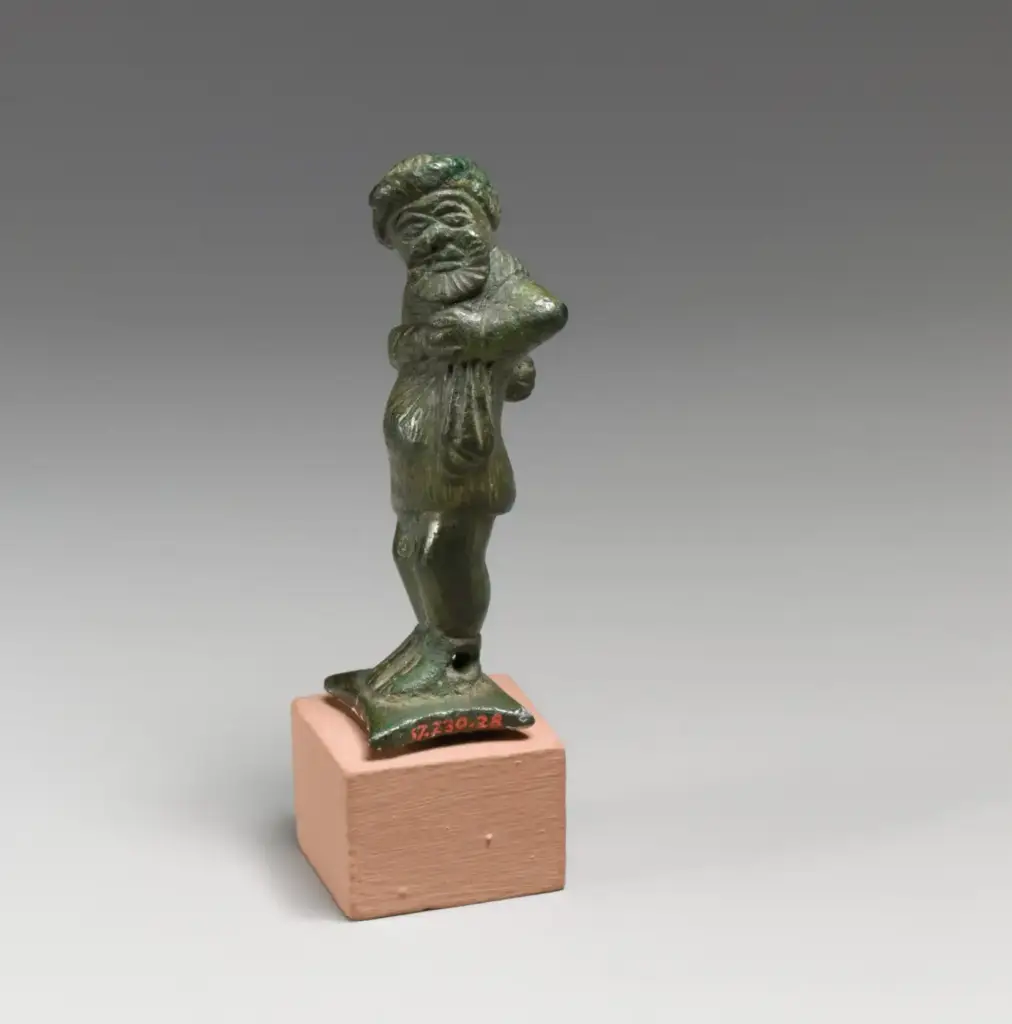
The word for this shoe has a theatrical past. According to Wikipedia, the soccus was a loose-fitting slip-on shoe worn in ancient Greece and Rome, with a leather sole and no hobnails, and it was the shoe of comic actors, as opposed to the platform-soled cothurnus worn by tragedians. The word was borrowed into the West Germanic languages for light footwear and eventually became the English word sock. In Spanish, according to Wiktionary, the same Latin soccus gave zueco, the word for a clog. Your socks and a chef’s clogs are distant cousins.
The French word for a wooden shoe, sabot, comes with its own legend: that “sabotage” started with workers hurling their clogs into factory machinery. According to Wikipedia’s account of the word’s history, that’s a popular but incorrect story. What’s documented is tamer. In 1808, D’Hautel’s French dictionary listed saboteur with senses like making noise with clogs and bungling a job, and in 1873–1874 Littré’s dictionary defined sabotage as making clogs. The modern sense of deliberate damage arrived in the late 1800s: in 1897, the syndicalist Émile Pouget used it in his paper Le Père Peinard, and in 1911 he published a book called Le Sabotage.
Klompen, madreñas and a painter’s still life
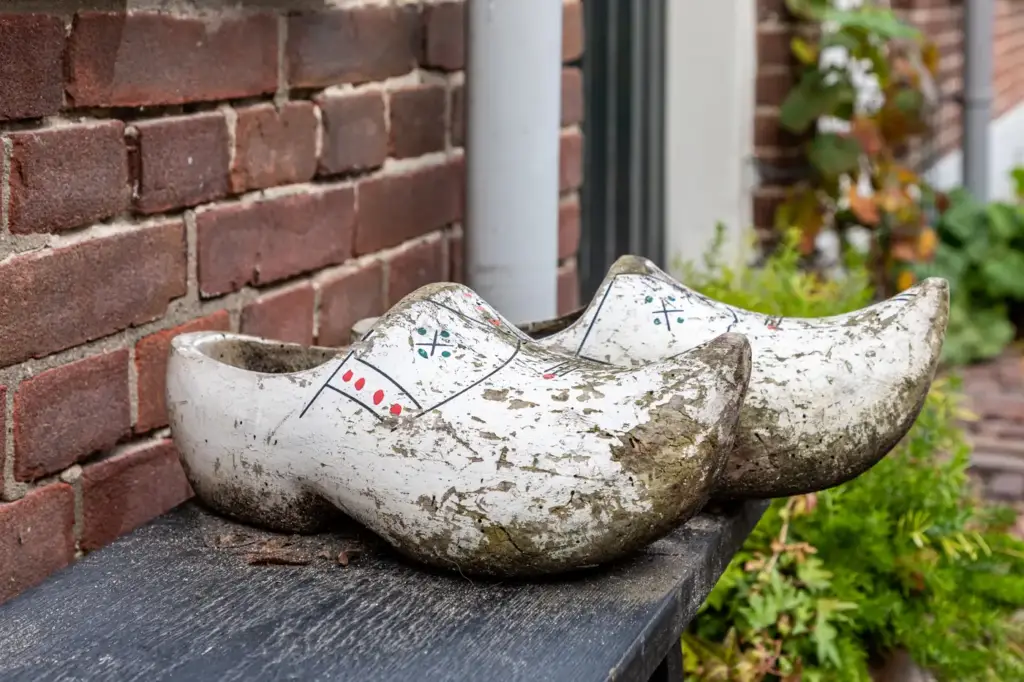
Long before it reached restaurant kitchens, the clog was the shoe of farms and workshops. The Dutch klomp is the version everyone pictures. According to Wikipedia, about three million pairs are made each year, usually from willow or poplar, and while much of the market is tourist souvenirs, some Dutch farmers and market gardeners still wear them every day. The same source says traditional all-wooden klompen have been accredited as CE-marked safety footwear and can withstand sharp objects and concentrated acids. We couldn’t confirm that certification with an official source, so treat it as unverified.
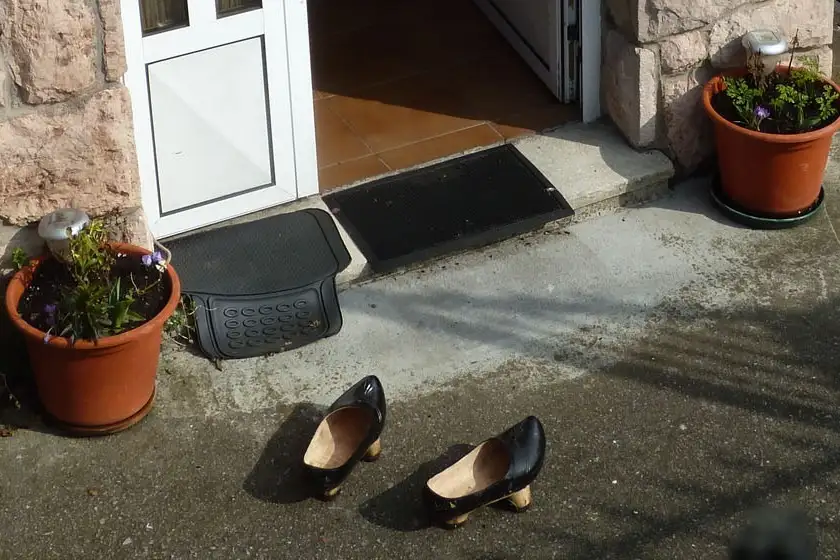
Northern Spain has its own carved version, the madreña. According to Wikipedia, it’s a single piece of wood, usually carved by hand from green alder, beech or walnut, and it stands on three small pegs, two in front and one in back, that lift it out of the mud. It’s still worn in rural parts of Asturias, Cantabria, Galicia, León and the Basque Country.
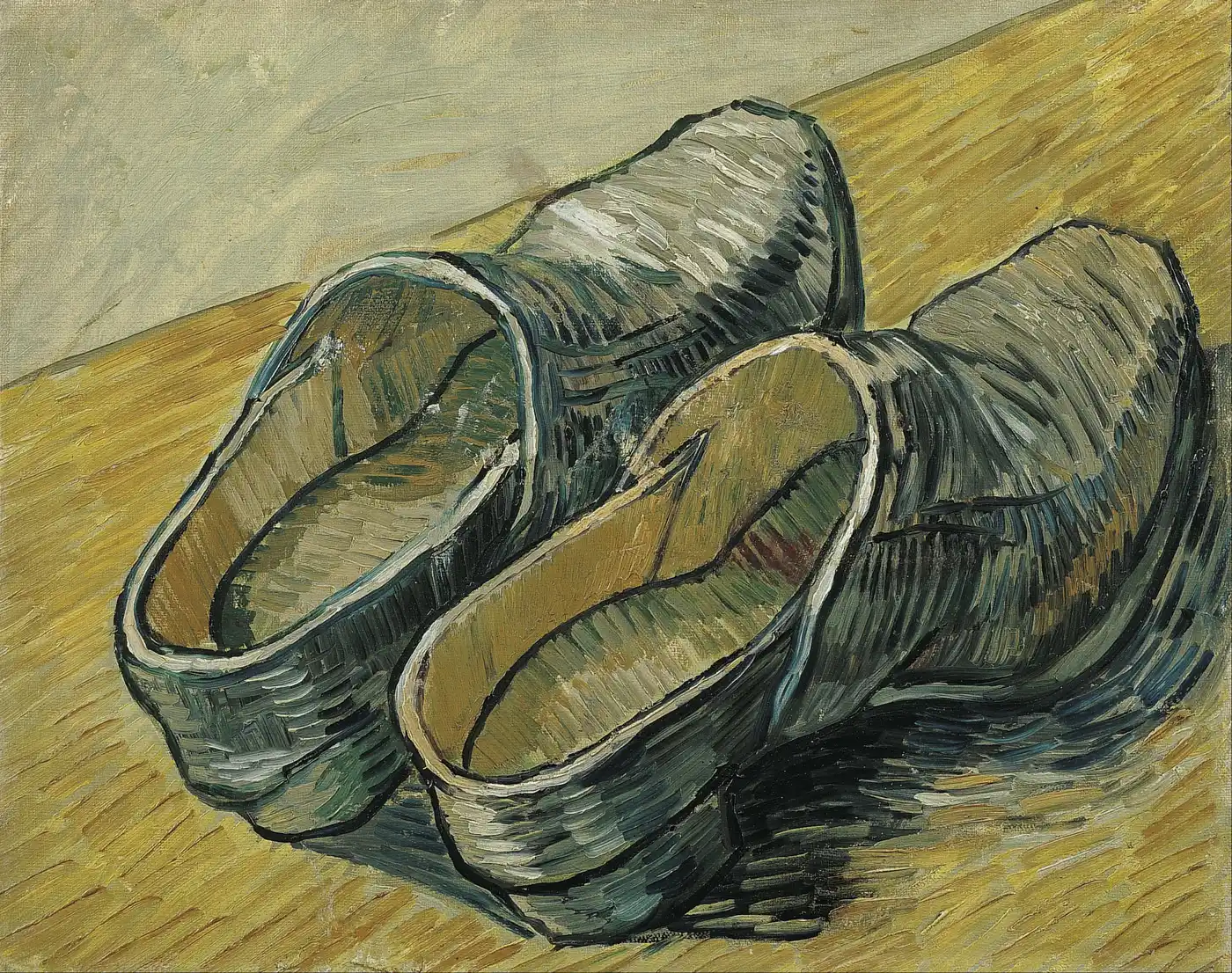
Vincent van Gogh painted the pair of leather clogs at the top of this page in 1888, worn and empty on wooden boards, the way you’d paint a tool.
The operating room that could explode
The oddest chapter in the history of hospital clogs is about static electricity. For much of the 20th century, operating rooms used flammable anesthetics. According to a 1994 historical review in the British Journal of Anaesthesia by A. G. MacDonald, the first recorded fire caused by an anesthetic happened in 1850, when ether caught fire during an operation on a patient’s face. Many more followed, involving ether, acetylene, ethylene and cyclopropane, and the worst came after giving patients oxygen instead of air became standard practice.
A single static spark could set it off. So footwear became part of the protocol. A training course on the operating room developed by the U.S. Army Medical Department laid out the rules: wear conductive shoes; test them for conductivity on a meter every day; avoid shoes with iron nails because of the danger of sparks from striking; check the conductive floors, usually ceramic or vinyl tile, at least once a month; and keep the room’s humidity at 55 to 60 percent to reduce the buildup of static charge.
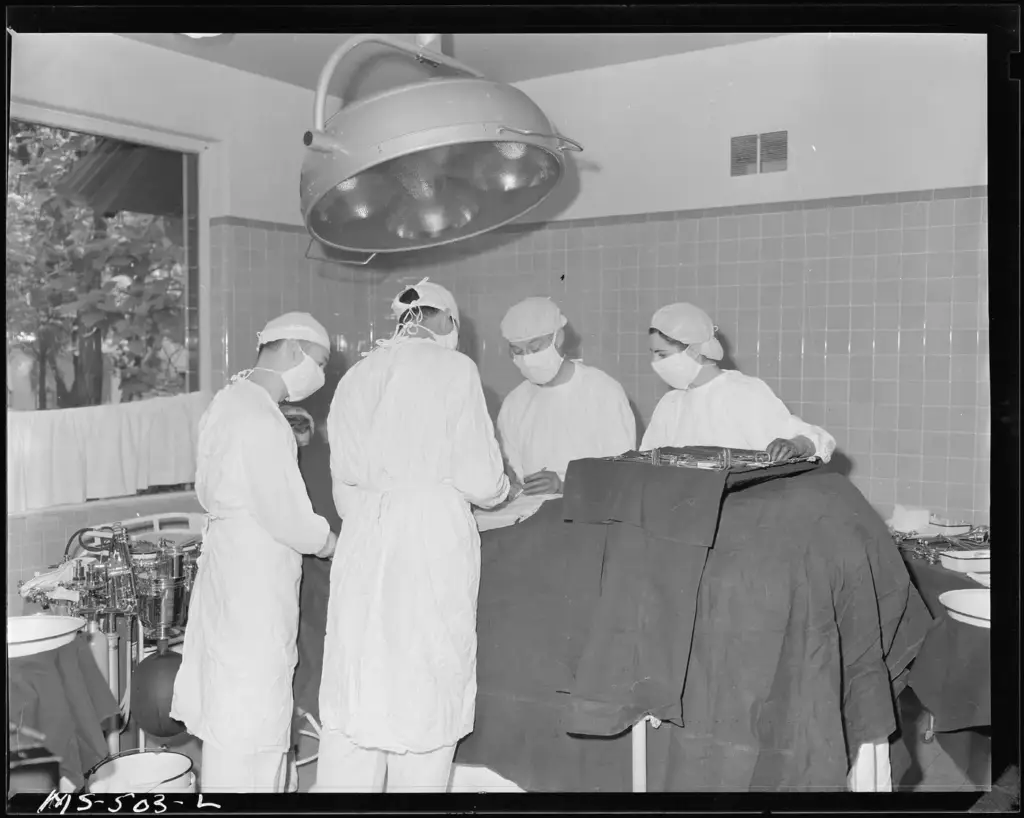
Shoe testers became a small technical genre of their own. In November 1950, the journal Hospitals published plans for a “build-it-yourself” conductive shoe tester, and in July 1951, Anesthesiology described another apparatus for testing the electrical conductivity of shoes worn in hazardous locations, both co-authored by C. B. Hickcox. Then, in 1978, E. Kulis and J. C. Newell reported in the Journal of Clinical Engineering on a problem that hit clogs directly. Everyday dirt made operating-room footwear lose conductivity, and shoes and clogs with a relatively small conductive contact area lost it sooner, and more often, than any other type tested. Booties, sneakers and shoes with a larger conductive area stayed within specification for the whole testing period.
Flammable anesthetics faded out. Writing in 1994, MacDonald said their use had decreased significantly and that fires from anesthetic gases might now be of historical interest only.
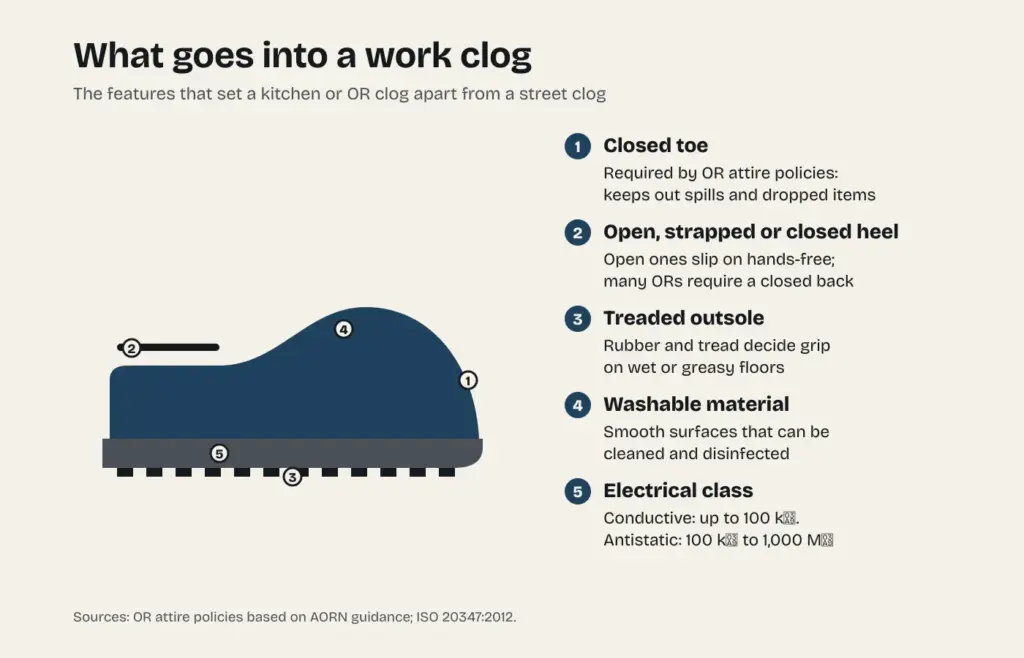
The electrical categories, though, live on in the standards. The international occupational footwear standard, ISO 20347, in its 2012 edition, defined conductive footwear as having a resistance of 0 to 100 kilohms, and antistatic footwear as having a resistance above 100 kilohms and up to 1,000 megohms. The 2021 edition renamed the first category partially conductive footwear, defined as having low electrical resistance between the wearer and the ground and able to dissipate static electricity.
Closed toe, closed back
In U.S. hospitals, operating-room dress codes rest on guidance from AORN, the Association of periOperative Registered Nurses. Its guideline, published in January 2025, says to wear protective footwear that meets your facility’s safety requirements and dress code, to wear fluid-resistant shoe covers or boots when gross contamination can reasonably be anticipated, and points out that OSHA regulations require protective footwear meeting ASTM F2414 wherever there’s a danger of foot injuries from falling or rolling objects or from objects piercing the sole.
Each hospital turns that guidance into its own policy, and that’s where the classic clog runs into trouble. The operating-room attire policy at Loyola University Medical Center, near Chicago, first implemented in March 1982 and revised in January 2018, says shoes in the surgical area must be clean and used only there, be built to prevent exposure to blood and body fluids, and have closed toes and backs, low heels and non-skid soles. Closed backs: exactly what an open-back clog doesn’t have. That’s why nursing clogs with a closed heel exist.
The closed toe has a very specific reason behind it: things fall off instrument tables. In 2004, J. Barr and D. Siegel noted in Dermatologic Surgery that scalpels were reported to cause around 7 percent of the 385,000 sharps-related injuries sustained by health care personnel each year, and that a dropped scalpel can pierce unprotected skin on the lower leg and foot.
What a kitchen floor will do to you
In a kitchen, the enemy is the floor. In 2010 and 2011, a team led by S. K. Verma at the Liberty Mutual Research Institute for Safety, the research arm of the insurer, published two studies of 475 workers at 36 limited-service restaurants from three major chains in six states. For 12 weeks, every participant reported their slips each week, on survey materials offered in English, Spanish and Portuguese. The overall rate was 0.44 slips per 40 hours worked, but the average ranged from 0.02 to 2.49 between restaurants, a more-than-hundredfold difference. Most slips happened near the sinks and fryers, and liquid or grease was on the floor in more than 70 percent of them.
Shoes made a big difference. After adjusting for age, gender, body mass index, education, primary language, job tenure and restaurant chain, wearing shoes marked slip-resistant was associated with a 54 percent lower slip rate. For every 0.1 increase in the average coefficient of friction of the kitchen floor, the rate dropped 21 percent. The same data had a practical lesson: where the employer supplied slip-resistant shoes, 91 percent of workers wore them; where the employer neither supplied nor encouraged them, only 53.5 percent did.
In 2021 came the first big randomized trial. The University of York and the Health and Safety Executive, Britain’s workplace safety regulator, randomly assigned 4,553 employees of England’s National Health Service between March 2017 and January 2019. Half got shoes with the top rating, five stars, on the agency’s own GRIP scale, under which manufacturers pay to have their footwear tested and get one to five stars. The other half wore their usual work shoes. Participants included doctors, nurses, ward clerks, and catering and cleaning staff. Over 14 weeks, the first group reported 1.16 slips per person and the second 1.80: 37 percent fewer. The extremes tell the story too: the most slips anyone in the five-star group reported was 36, while one person in the usual-shoes group reported 83. Falls from a slip dropped 49 percent. The shoes came from a single manufacturer that, according to the authors, had no input into the study’s design, conduct or analysis. We explain the European slip-resistance markings in our story on work shoes, and toe caps in our story on steel-toe boots.
Why a clog and not some other shoe
No rule says you have to wear clogs. What the rules ask for is a toe that protects, a sole that grips, a material that cleans up and, where it matters, a specific electrical resistance. A clog checks most of those boxes with a very simple shape: one piece that washes clean, a thick sole that doesn’t flex, no laces to soak up spills, and nothing to bend down and tie. That rigid sole also changes how you walk, as we explain in our story on stiff vs. flexible soles.
You’ll often hear that chefs wear open clogs so they can kick them off fast if hot oil spills on their feet. It’s a story that gets passed around kitchens a lot, but we haven’t found a source that documents it, so consider it unverified. What is documented points the other way: in operating rooms that follow AORN-based policies, an open back doesn’t pass.
Habit matters too. In December 2021, three doctors at Aarhus University Hospital in Denmark published a study of their colleagues’ footwear in the Danish medical journal Ugeskrift for Læger, billed by the journal as a Christmas article. They observed 153 doctors at morning conferences across seven specialties: 48 percent wore clogs, 42 percent sneakers and 9 percent sandals. Senior doctors favored clogs more than junior ones, and seniority went along with worn-out shoes. Their conclusion was that the traditional clog is losing ground with the younger generation.
From the mud of a Spanish mountain village to the grease by a fryer, the clog has survived because you can step into it without bending down and wash the whole thing. What it never came with, a closed back and a sole that grips on grease, the rules have been adding ever since.
Sources
- A. G. MacDonald (1994), “A short history of fires and explosions caused by anaesthetic agents,” British Journal of Anaesthesia 72(6): 710–722.
- U.S. Army Medical Department, Introduction to the Operating Room, Lesson 3, Section 2, “Explosion and fire hazards” (republished by Brookside Associates).
- C. B. Hickcox and B. B. Lovell (1950), “A new ‘build-it-yourself’ conductive shoe tester,” Hospitals 24(11): 57–59.
- C. B. Hickcox and R. M. Tovell (1951), “Apparatus for testing electrical conductivity of shoes used in hazardous locations,” Anesthesiology 12(4): 506–511.
- E. Kulis and J. C. Newell (1978), “Loss of conductivity in operating room shoes,” Journal of Clinical Engineering 3(2): 193–195.
- ISO 20347:2012 and ISO 20347:2021, Personal protective equipment — Occupational footwear.
- AORN, “Surgical attire in the operating room: an AORN guideline” (2025).
- Loyola University Medical Center, Operating Room Attire, Policy 13.6090.51 (revised 2018).
- J. Barr and D. Siegel (2004), “Dangers of dermatologic surgery: protect your feet,” Dermatologic Surgery 30(12): 1495–1497.
- S. K. Verma et al. (2010), “Workers’ experience of slipping in U.S. limited-service restaurants,” Journal of Occupational and Environmental Hygiene 7(9): 491–500.
- S. K. Verma et al. (2011), “A prospective study of floor surface, shoes, floor cleaning and slipping in US limited-service restaurant workers,” Occupational and Environmental Medicine 68(4): 279–285.
- S. Cockayne et al. (2021), “Slip-resistant footwear reduces slips among National Health Service workers in England: a randomised controlled trial,” Occupational and Environmental Medicine 78(7): 472–478.
- R. H. Gantzel, M. B. Kjær and K. Kjærgaard (2021), “Footwear fashion amongst medical doctors: are clogs fashion or history?,” Ugeskrift for Læger 183(50): V20214.
- Wiktionary (Spanish), “zueco”; Wikipedia, “Soccus,” “Sabotage,” “Madreña” and “Klomp,” and the references they cite.
Image credits
- A Pair of Leather Clogs (1888), Vincent van Gogh, Van Gogh Museum. Public domain, via Wikimedia Commons.
- Roman bronze statuette of a comic actor, Metropolitan Museum of Art. Public domain (CC0), via Wikimedia Commons.
- Wooden clogs in Veere (2022): Dietmar Rabich. CC BY-SA 4.0, via Wikimedia Commons.
- Madreñas: Nacho. Public domain (CC0), via Wikimedia Commons.
- Operation at the Colorado Fuel & Iron hospital (1946): Russell Lee, U.S. National Archives. Public domain, via Wikimedia Commons.
- Work clog diagram: feetkeepers.