
How leather is made is the story of what separates a shoe from a piece of dead animal. A freshly removed hide rots within days. Tanned, it can last for centuries: there are leather shoes more than 5,000 years old. In between lies a bit of chemistry that permanently changes the structure of the skin’s main protein, collagen, plus a string of decisions that end up on your foot: what it’s tanned with, which layer of the hide gets used, how the surface is finished. Those decisions explain why a leather shoe behaves differently from a synthetic one, why some soles lasted nearly twice as long as others, and what the little label inside your shoe is actually telling you.
A word with a Spanish accent
The old English word for a shoemaker has a Spanish city hidden inside it. According to Wikipedia, drawing on the Oxford English Dictionary, cordwainer, a shoemaker who makes new shoes from new leather, came into English through Anglo-Norman from the Old French cordoanier, and originally meant someone who worked cordwain, or cordovan: the leather produced in Moorish Córdoba, Spain, in the Middle Ages. The earliest recorded use in English refers to one “Randolf se cordewanere,” around the year 1100. The trade’s name comes from the name of a Spanish city.
The word tanning has its own history. It comes from the medieval Latin tannare, from tannum, oak bark, because bark supplied the substances that turn skin into leather.
An ancient and smelly trade
Tanning is very old. According to Wikipedia’s account of its sources, people at Mehrgarh, in what’s now Pakistan, were tanning hides between 7000 and 3300 BCE. The shoe from the Areni-1 cave in Armenia and Ötzi’s shoes, both around five thousand years old, are made of tanned leather, as we explain in our story on the oldest shoes in the world.
The old methods explain the trade’s bad reputation. Hides arrived dried stiff and caked with dirt and gore. They were soaked, pounded and scraped to remove flesh and fat. To loosen the hair, they were left in urine, painted with an alkaline lime paste or simply allowed to rot for months. Then they were softened by pounding dung into them, often from dogs or pigeons, or by soaking them in a solution of animal brains, with bacteria in the dung supplying the enzymes. No wonder tanning was considered a noxious trade and pushed to the edge of town, and why in some places tanneries are still kept apart from settlements.
Vegetable tanning: weeks of bark
The traditional method is vegetable tanning. It uses tannins, compounds found in the bark and leaves of many plants, such as chestnut and oak. Tannins bind to the collagen fibers in the hide and coat them, making them less soluble in water and more resistant to bacteria. In some places, as the same source notes, hides stretched on frames are soaked for several weeks in vats of increasing tannin concentration.
The result is a firm, fairly stiff leather, prized for parts that need to hold up. According to the 1952 USDA bulletin we discuss in our story on how many pairs of shoes you need, most sole leather at the time was vegetable-tanned, and the best soles came from the bend, the firm section along the animal’s back.
Chrome tanning: under a day
In the 1800s came the alternative that dominates the market today: chrome tanning, using chromium salts instead of tannins. According to Wikipedia, it accounts for 85 to 90 percent of modern leather production, and chromium(III) sulfate has long been considered the most effective tanning agent. It’s fast: this stage takes less than a day. Afterward, the bath’s acidity is adjusted with sodium bicarbonate to a pH of 3.8 to 4.0 while the temperature is raised gradually to about 104°F, and the chromium forms stable bridges with the collagen. In its raw state the hide comes out a grayish blue, which is why the trade calls it “wet blue.”
Chrome-tanned leather can contain 4 to 5 percent chromium, and one of its strengths is stability in hot water: it resists shrinking. That’s exactly the flaw the 1952 bulletin warned about with wet leather dried next to a radiator: it “burned,” shrank and hardened.
Chrome also has a troublesome side. The chromium(III) compounds used for tanning are far less toxic than hexavalent chromium, but the latter can form when waste isn’t treated properly. According to the same source, a ton of hide can generate 20 to 80 cubic meters of wastewater, with 100 to 400 milligrams of chromium per liter, and solid waste can reach 70 percent of the hide’s original wet weight. In the European Union, since Regulation 301/2014, leather articles that come into contact with skin can’t be sold if they contain 3 milligrams or more of hexavalent chromium per kilogram of the leather’s dry weight.

The test of 996 soles
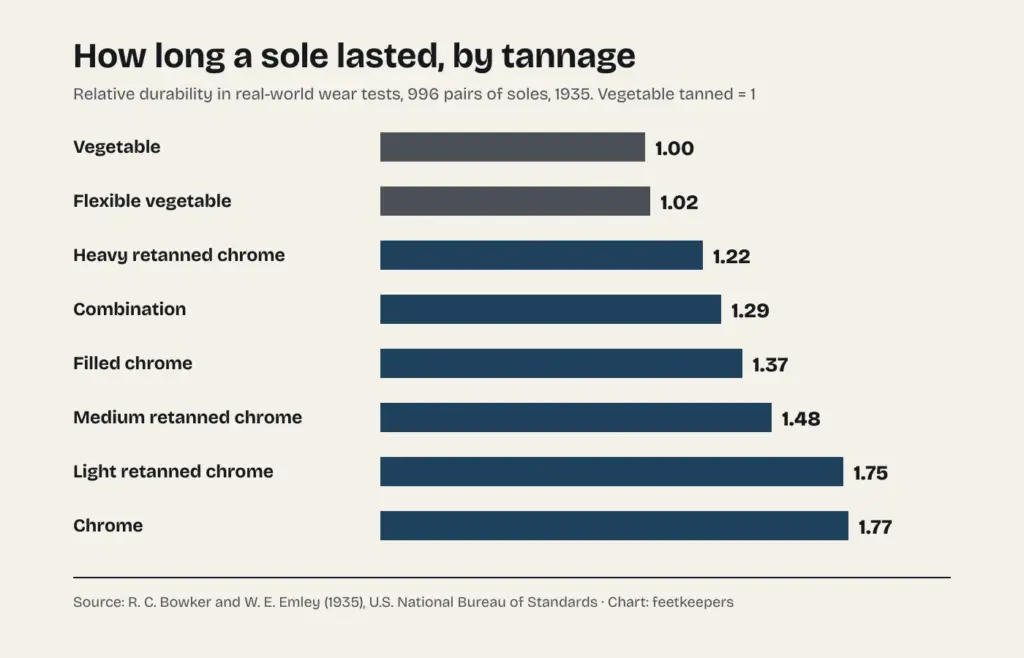
So which tannage holds up better on a shoe? In the U.S., the government measured it by walking. In 1924 and 1925, the National Bureau of Standards found that chrome-tanned sole leather lasted roughly twice as long as vegetable-tanned. But it had a drawback: its structure was loose, lacking firmness and water resistance. Tanners started combining the two methods, and the Bureau went back to work.
In October 1935, Roy C. Bowker and Warren E. Emley published the results in the Bureau’s research journal. Since there was no accepted lab method for measuring sole durability, they used real-world wear tests. They cut soles from two different leathers, paired them so both soles in each pair came from the same spot on the hide, and split the leather so half the left soles were one type and half the other. The soles went onto shoes worn by Bureau staff, who logged their hours of wear. When a sole wore through, the pair was pulled from service. All told: 22 series and 996 pairs of soles.
In the first series, for example, the filled-chrome sole lasted an average of 80.8 days and the vegetable sole 66.4. Adjusted for starting thickness, the chrome leather came out 23 percent more durable. Pooling all the series and setting vegetable-tanned durability at 1, straight chrome leather reached 1.77, and the combination leathers landed in between, closer to chrome the more chrome they contained. The authors added a caveat: all the vegetable leathers they compared contained more than 20 percent water-soluble material, and in general, the higher the proportion of actual hide substance, the longer the sole lasted.
Which layer of the hide you’re wearing
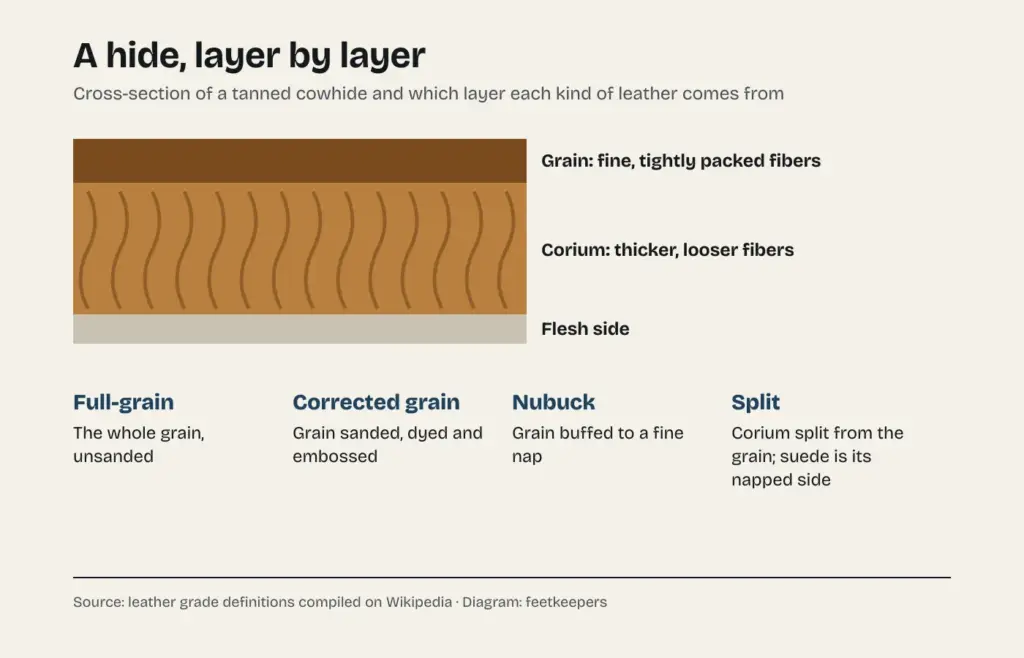
A cowhide isn’t uniform. On top is the grain, a layer of fine, tightly packed fibers that provides strength and the attractive surface. Below it is the corium, with thicker, looser fibers. According to the definitions compiled on Wikipedia, that’s where the leather grades on labels and in catalogs come from.
Full-grain leather keeps the entire grain layer, unsanded. Instead of wearing out, it develops a patina over the years, and it’s usually considered the highest quality; plenty of footwear is made from it. Corrected-grain leather is sanded or buffed to remove flaws, then dyed and embossed for a uniform look. Nubuck is grain leather buffed on the outer side to raise a short nap of fibers, with a velvety feel. Split leather is the corium left over once the grain has been separated, and suede is made from the underside of a split, often from young or small animals, since adult hides give a coarser nap. Then there’s patent leather, a leather with a high-gloss coating that took off after inventor Seth Boyden developed the first mass-production process, using a linseed-oil-based lacquer, in 1818.
There’s also a material that isn’t leather even if it looks like it: bonded leather, made from shredded leather scraps bound with polyurethane or latex onto a fiber mesh, with anywhere from 10 to 90 percent leather fiber.
Why leather doesn’t behave like a synthetic
The difference between a leather shoe and a synthetic one isn’t just about image. In 2021, a team at the FILK institute in Freiberg, Germany, led by Michael Meyer, published a technical comparison in the journal Coatings of a shoe upper leather, an artificial leather and nine alternative materials marketed as vegan leathers. They measured structure, tensile and tear strength, resistance to repeated flexing, water vapor permeability and how much moisture each absorbed.
Leather had the highest tensile and tear strength in the whole study, above the more than 15 newtons per square millimeter that the ISO 20942 standard sets for chrome-tanned shoe upper leather. For water vapor permeability, leather beat that standard’s minimum by a wide margin; the polyurethane-coated fabric usually sold as synthetic leather met it, but came nowhere close to leather. And for water vapor absorption, leather was among the highest, which the authors put down to the polar nature of its proteins, while materials containing a lot of synthetic polymer absorbed far less.
The explanation, the authors suggest, is structure. A typical artificial leather is a layered sandwich: a topcoat, a compact layer, a foamed middle layer and a textile backing. Leather is a structure that grew that way: a very tight surface and a density that changes gradually across its thickness. None of the alternatives they tested, synthetic or plant-based, managed to combine leather’s strength, flex resistance and breathability. That doesn’t make leather better at everything: as we explain in our story on how many pairs of shoes you need, leather also soaks up sweat and gets softer and easier to deform when it’s damp.
What the label says
In the U.S., the Federal Trade Commission’s guides for leather and imitation leather products cover footwear among many other goods, and they define a shoe by the same three parts the European Union uses: the upper, the lining and sock, and the outersole. For footwear, it’s enough to disclose non-leather materials in each of those parts according to which material predominates. The guides also say that material containing ground, pulverized, shredded, reconstituted or bonded leather shouldn’t be represented as leather, and that if those terms are used, the percentages of leather fiber and non-leather substances should be disclosed.
In the European Union, every shoe sold carries a label with three pictograms under Directive 94/11/EC, one for each of those same three parts. It identifies the material making up at least 80 percent of the surface of the upper and of the lining, or of the volume of the sole, and if no single material reaches 80 percent, the two main ones. The directive defines leather as a hide or skin tanned to be rot-proof with its original fibrous structure more or less intact, even if it’s been split into layers. If the hide is broken down into fibers or powder and pressed into sheets, it’s no longer leather. Any surface coating can be no thicker than 0.15 millimeters. And if a maker uses the term “full grain leather,” it has to be leather with its original grain surface, with none of it removed by buffing or splitting.
Sources
- R. C. Bowker and W. E. Emley (1935), “Comparative wear of chrome-tanned, vegetable-tanned, and retanned sole leather,” Journal of Research of the National Bureau of Standards 15: 363–367.
- M. Meyer, S. Dietrich, H. Schulz and A. Mondschein (2021), “Comparison of the technical performance of leather, artificial leather, and trendy alternatives,” Coatings 11(2): 226.
- Federal Trade Commission, Guides for Select Leather and Imitation Leather Products, 16 CFR Part 24.
- Directive 94/11/EC of the European Parliament and of the Council, on the labeling of the materials used in the main components of footwear.
- Commission Regulation (EU) No 301/2014, on chromium VI in leather articles.
- F. P. Veitch, R. W. Frey and H. P. Holman, Leather Shoes: Selection and Care, Farmers’ Bulletin No. 1523, U.S. Department of Agriculture (1927, revised 1952).
- Wikipedia, “Tanning (leather),” “Leather” and “Cordwainer,” and the references they cite.
Image credits
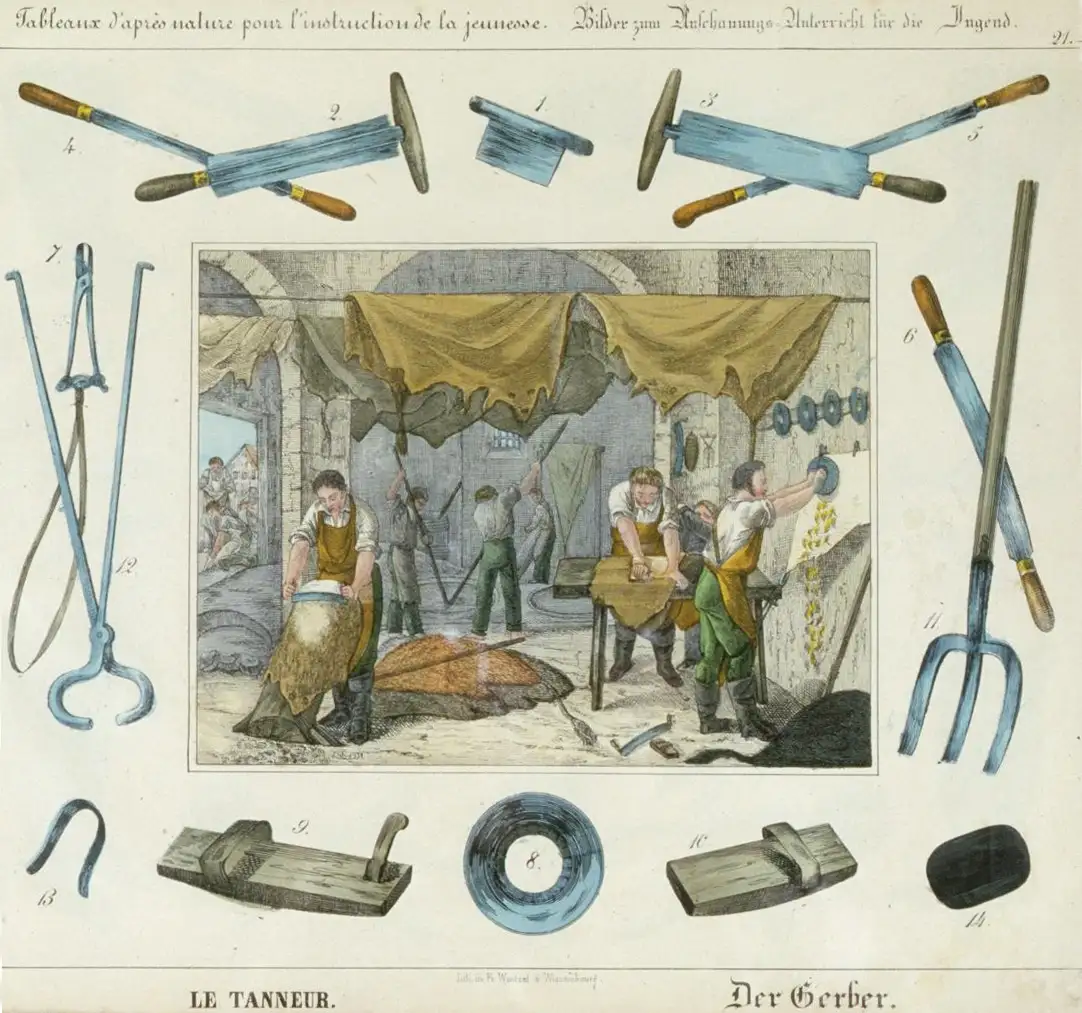
- Le tanneur / Der Gerber (1847), Jean Frédéric Wentzel. Public domain, via Wikimedia Commons.
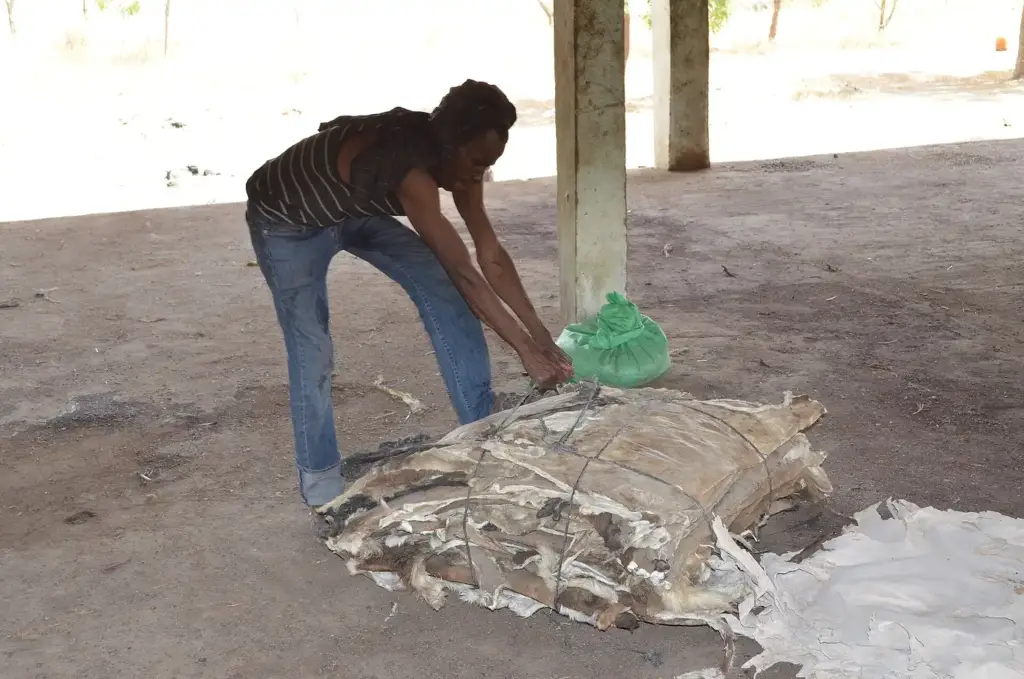
- Tanners in Maroua (two photographs): Oumarou OB. Public domain (CC0), via Wikimedia Commons.
- Durability chart and hide layer diagram: feetkeepers.
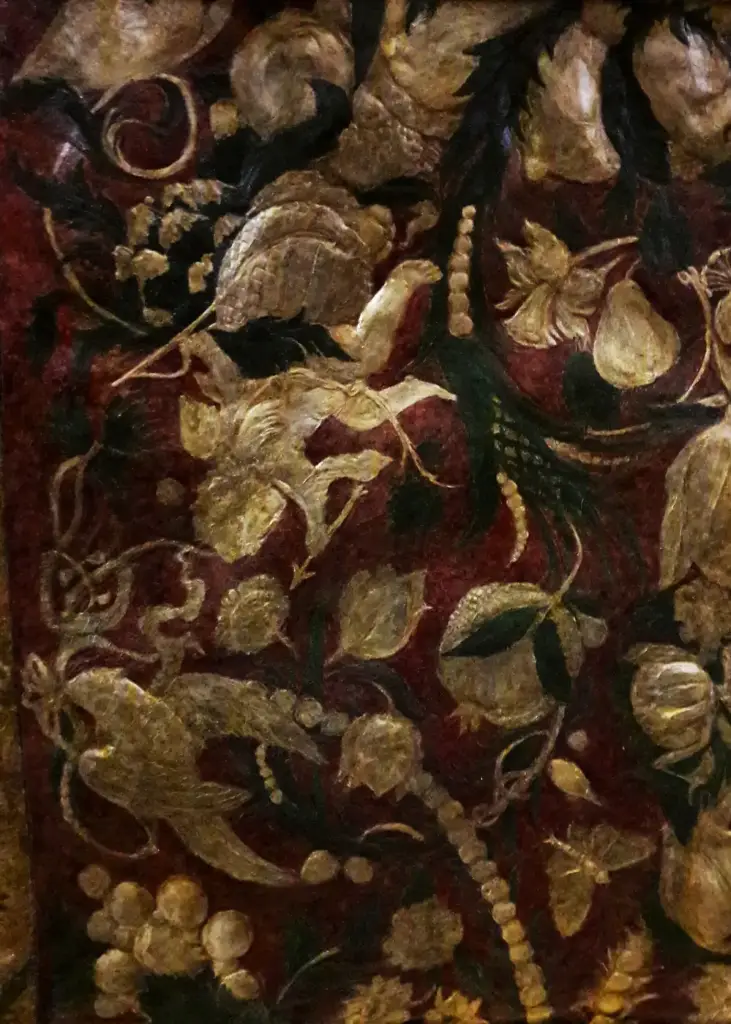
- Dutch gilt leather panel (1650–1670): unknown artist. Public domain (CC0), via Wikimedia Commons.