
Sneakers lost at sea make better oceanographers than a lot of buoys. They float, they last for years in salt water, they carry serial numbers, and when one lands on a beach, someone always picks it up and wants to tell somebody. In 1990, tens of thousands of sneakers tumbled off a container ship into the North Pacific, and instead of ending up as a curiosity in the local paper, they ended up in a scientific journal, inside a federal computer model and at the start of a beachcombing network that’s still running. The ocean keeps giving back sneakers because a midsole is built to be light, and light is exactly what it takes to cross an ocean.
May 27, 1990
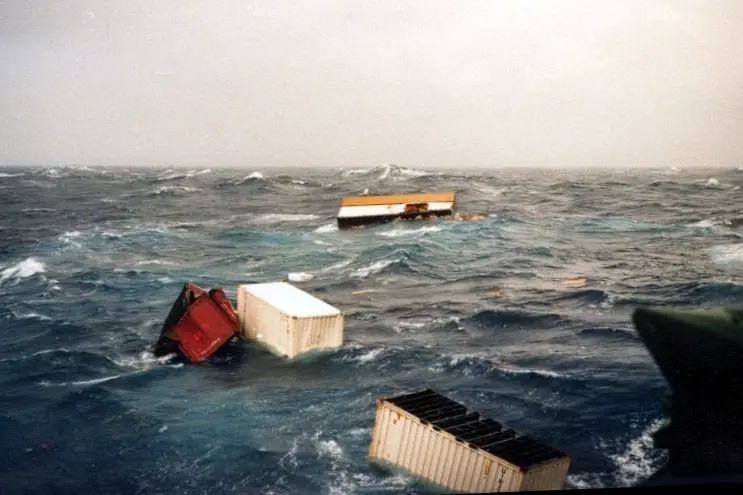
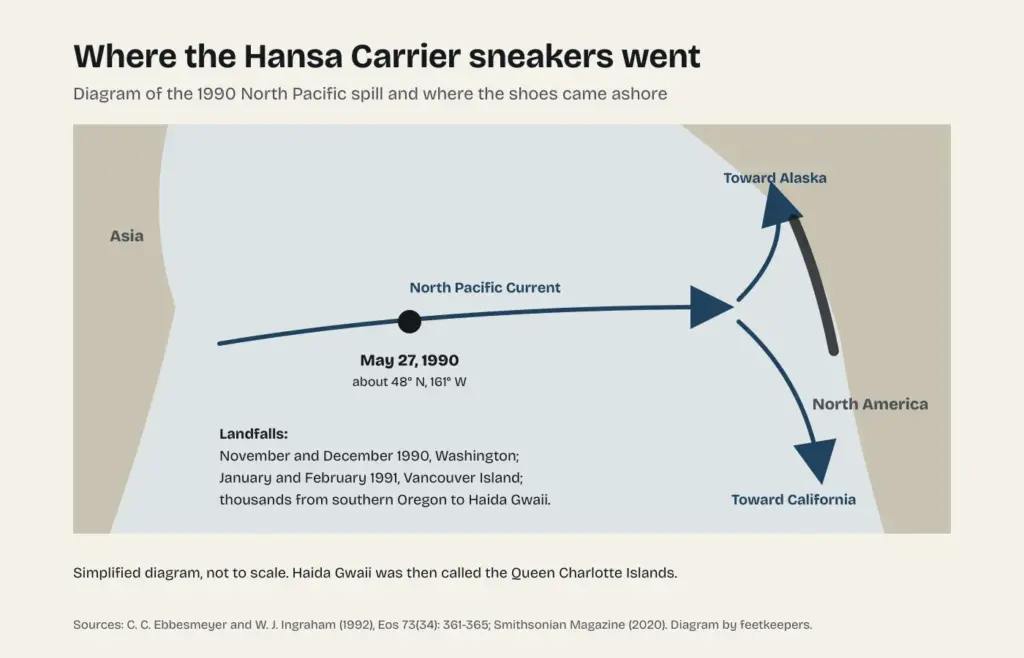
According to the paper oceanographers Curtis Ebbesmeyer and James Ingraham published in August 1992 in Eos, the newsletter journal of the American Geophysical Union, roughly 80,000 Nike shoes went overboard on May 27, 1990, in the North Pacific at about 48 degrees north, 161 degrees west, south of Alaska. The ship was the Hansa Carrier, bound from South Korea to Seattle, and it ran into a storm. Later accounts, including Smithsonian magazine’s, put the count at 61,820; the figure the scientists who studied the spill reported comes first here.
Six months to a year later, according to the same paper, thousands of shoes washed ashore in North America, from southern Oregon to the Queen Charlotte Islands in British Columbia, now called Haida Gwaii. Beachcombers started finding them by the armful, and what would otherwise have been an insurance headache turned into a gift to science.
An oceanographer, his mother and a newspaper clipping
Ebbesmeyer, who earned his doctorate at the University of Washington and made his living forecasting where oil spills and sewage would drift, has told the origin story more than once. According to Smithsonian, about a year after the spill his mother handed him a Seattle Times clipping about the sneakers washing up, figuring he’d find it funny, and asked whether that wasn’t exactly what he did for a living. He said he’d look into it.
He called Jim Ingraham, a former University of Washington classmate who had built a computer program for the National Oceanic and Atmospheric Administration called OSCURS, the Ocean Surface Current Simulator, originally to study salmon migration. Ebbesmeyer’s idea was simple: if they knew where each shoe started and where it ended up, they could check whether the model was right. And these shoes had something almost no drifting object has: a serial number. With the numbers Nike provided, Ebbesmeyer could tell for certain whether a shoe found on a beach had come off the Hansa Carrier.
He still needed the landing points, and help came from an unexpected place. According to Smithsonian, Steve McLeod, an Oregon painter and beachcomber, had kept meticulous records of where and when 1,600 of the shoes were found. Fed that data, the model nailed it: the first landfalls on the Washington coast in November and December 1990, and on Vancouver Island in January and February 1991, matched the simulation. In their 1992 paper, the two scientists wrote that the spill had given them a calibration point for the model, and that runs covering 1946 to 1991 suggested that drift across the northeast Pacific that year had been farther south than average.
Swap meets to find the other shoe
The most human part of the story is what coastal residents did next. According to Smithsonian, collectors and beachcombers in the Pacific Northwest started holding swap meets to trade shoes and complete pairs. It made sense: the ocean doesn’t return sneakers two by two, because in the water each one goes its own way. And as The Seattle Times reported in 1992, quoted by the magazine, the shoes were still wearable after many months of battering by storms and water.
Three decades later, the spill got its own art show. In 2020, sculptor Andy Yoder opened “Overboard” at the Brattleboro Museum and Art Center in Vermont, with 240 replicas of the Nike Air Jordan 5, the model that went into the sea just as it was hitting stores, according to Smithsonian, each one built from trash he’d scavenged around his suburban Washington, D.C., neighborhood. Yoder told the magazine he wanted to look at how consumer culture affects the environment, since so much of what we buy is made overseas and crosses an ocean in a shipping container.
Why a sneaker floats
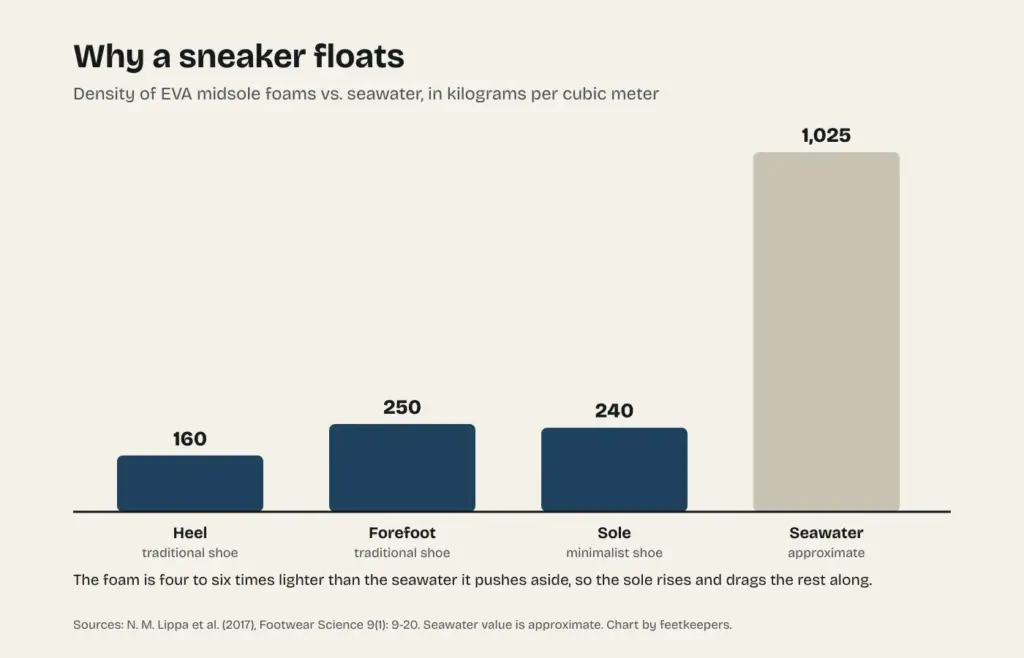
A floating sneaker isn’t luck, it’s design. The midsole of most sneakers is a foam, usually EVA or one of the relatives we explained in EVA vs. TPU vs. PEBA: a plastic packed with tiny gas bubbles that make it light and soft. In 2017, a team that included researchers from the University of Southern Mississippi measured the density of EVA foams from several shoes in the journal Footwear Science: 160 kilograms per cubic meter in the heel of a traditional running shoe, 250 in the forefoot and 240 in a minimalist shoe. Seawater weighs a little over 1,000 kilograms per cubic meter. In other words, the foam is four to six times lighter than the water it pushes aside.
The rest of the shoe is heavier than water: the rubber outsole, the glue, a waterlogged upper. But as long as there’s plenty of foam compared with everything else, the whole thing floats. Over time, water and sunlight break the materials down, as we covered in how long sneakers last, but that breakdown is slow. Slow enough to cross an ocean.
Rubber ducks, hockey gloves and the great whirlpool
The sneakers weren’t the only ones. On January 10, 1992, according to Wikipedia, the container ship Ever Laurel lost twelve containers in a storm in the North Pacific near the International Date Line. One held 28,800 plastic bath toys called Friendly Floatees: yellow ducks, red beavers, blue turtles and green frogs. Ebbesmeyer and Ingraham, already tracking the sneakers, took them on too, and for good reason. According to Wikipedia, the classic way to study currents was to release 500 to 1,000 drift bottles, and since roughly 2 percent of what’s released in the Pacific tends to be recovered, that yielded 10 to 20 finds. With 28,800 toys, the same rate promised about 600. Ingraham’s model, meanwhile, worked out wind and surface currents from air pressure readings going back to 1967.
The first find came on November 16, 1992, near Sitka, Alaska, about 2,000 miles from where the container went over, and by August 1993 about 400 toys had turned up along 530 miles of coastline, a 1.4 percent recovery rate. Sun and salt water bleached the ducks and beavers white; the turtles and frogs kept their colors.
In 2007, the two scientists and two colleagues published a review in Eos of fifteen years of toys found around the Pacific Subarctic Gyre, an ocean whirlpool the size of the United States formed by currents linking Asia and America. They wanted to work out how long it takes a floating object to make one full lap. According to Wikipedia, other toys spent years frozen in Arctic ice before reaching the U.S. East Coast and the shores of Britain and Ireland, although the duck a retired teacher found in Devon in July 2007, which British papers celebrated, turned out not to be one of them after an expert from the National Oceanography Centre in Southampton examined it. Ebbesmeyer’s list also includes 34,000 hockey gloves that fell off the Hyundai Seattle in 1994. In 1996 he founded a nonprofit for beachcombers and oceanographers that publishes the newsletter Beachcombers’ Alert. After studying hundreds of spills, he has said, they concluded that ocean currents run in great circles, which he calls gyres, and that the planet has about a dozen of them.

What the ocean still gives back
Thirty years on, sneakers are still washing up, and they’re no longer a scientific curiosity. In 2018, the container ship Maersk Shanghai lost several containers off North Carolina. According to the Irish news site TheJournal.ie, by spring 2019 sneakers and flip-flops had been landing for months on beaches in western Ireland, from Donegal to Clare, and had also turned up in Jersey, Spain, Brittany, Cornwall and the Azores. Liam MacNamara, a beachcomber in County Clare, said many were Nikes and that two companies had confirmed they had cargo on the ship; Nike said it wasn’t aware of any missing containers. Unlike the 1990 shoes, these weren’t wearable: MacNamara said they had bite marks.

Footwear is also part of the trash that drifts on its own to the most remote places on Earth. In 2020, a University of Oxford-led team reported in Scientific Reports what it cost to clean up Aldabra Atoll in the Seychelles, a UNESCO World Heritage Site that’s almost uninhabited. In March 2019 they removed 25 tons of plastic and estimated another 513 tons remained. The cleanup cost $224,537, and by the team’s estimate, finishing the job would take about $4.68 million and 18,000 hours of labor. By weight, 83 percent was debris from the regional fishing industry and 7 percent was flip-flops that had traveled from much farther away. What floats doesn’t go away; it circles until a current drops it on some shore. As we explained in our piece on vegan shoe materials, the plastics in shoes don’t biodegrade.

The sadder side of buoyancy
The same physics that carried the Hansa Carrier sneakers to Oregon explains a much more serious story. Since August 2007, at least 20 human feet inside sneakers have washed up on the shores of the Salish Sea, between British Columbia and Washington State. According to Wikipedia, the British Columbia Coroners Service said in December 2017 that foul play had been ruled out in all previous cases, and most of the feet found in that province have been identified. The coroner said the sneakers were responsible both for keeping the remains buoyant enough to reach shore and for preserving them. There was no mystery, just a light sole doing what it always does. Vancouver even has a plaza called Leg-In-Boot Square, named for a similar find in 1887.
What a sneaker on the shoreline tells you
Every sneaker the ocean leaves on a beach is, in its way, a data point, the same way the ones hanging from power lines say something about a neighborhood. Ebbesmeyer saw that: an object with a known origin, a known launch date and a serial number is worth more for mapping currents than a pile of bottles with messages. Oceanographers have satellites and GPS buoys now, but beachcombers still log what they find, and sneakers nobody lost on that beach still keep showing up in the sand.
What’s unsettling isn’t that they float, since that’s what they’re built to do. It’s how well they float and how little they break down: a sneaker that goes overboard today can still be circling the Pacific after the person who designed it has retired. You don’t need a computer model to see that. You just need to look at the tide line.
Sources
- C. C. Ebbesmeyer and W. J. Ingraham (1992), “Shoe spill in the North Pacific,” Eos, Transactions American Geophysical Union 73(34): 361-365.
- C. C. Ebbesmeyer, W. J. Ingraham, T. C. Royer and C. E. Grosch (2007), “Tub toys orbit the Pacific subarctic gyre,” Eos 88(1): 1-4.
- J. Nalewicki (2020), “Artist Fashions Nike Air Jordan 5s From Trash,” Smithsonian Magazine, October 28, 2020.
- N. M. Lippa, P. K. Collins, J. Bonacci, S. G. Piland, J. W. Rawlins and T. E. Gould (2017), “Mechanical ageing performance of minimalist and traditional footwear foams,” Footwear Science 9(1): 9-20.
- A. Burt et al. (2020), “The costs of removing the unsanctioned import of marine plastic litter to small island states,” Scientific Reports 10: 14458.
- P. McMahon (2019), “Runners and flip flops keep washing up on the west coast of Ireland,” TheJournal.ie, May 2, 2019.
- Wikipedia: Friendly Floatees spill, Curtis Ebbesmeyer and Salish Sea human foot discoveries.
Image credits
- Containers in the sea during a storm, North Atlantic, 1980: Buonasera. CC BY-SA 4.0, via Wikimedia Commons.
- Beachcombers at Sunset Bay, Oregon: RickObst. CC BY-SA 4.0, via Wikimedia Commons.
- Boot on a beach: Alan Fryer. CC BY-SA 2.0, via Wikimedia Commons.
- Flip-flop on a beach on Bantayan Island, Philippines: Øyvind Holmstad. CC BY-SA 4.0, via Wikimedia Commons (cropped).
- Spill diagram and density chart: feetkeepers.