
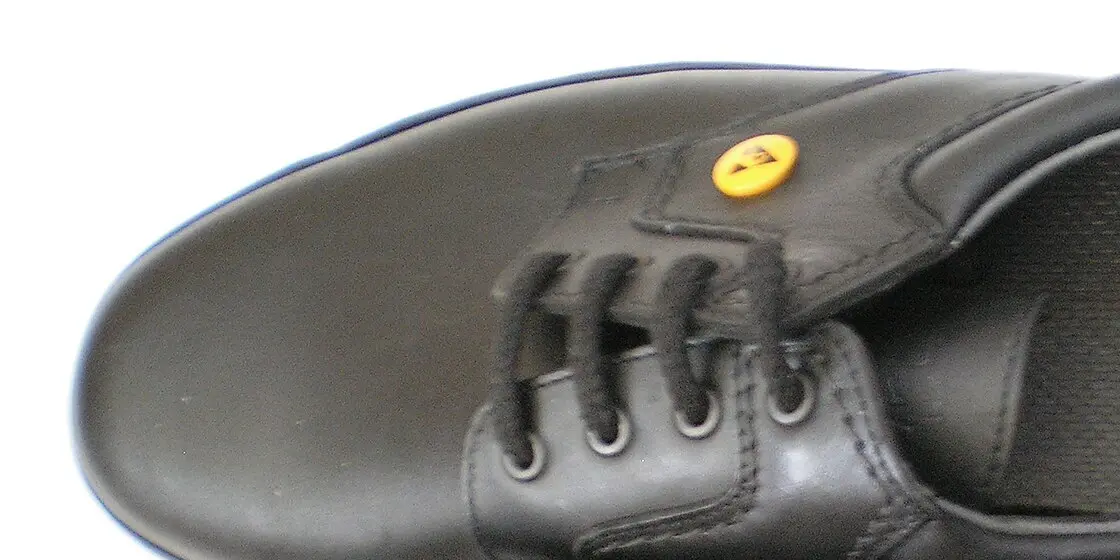
ESD shoes are the one kind of work footwear that isn’t really there to protect you. It’s there to protect things from you. On an electronics line, the hazard doesn’t fall off a shelf or slice like a blade. You’re wearing it. Every step you take charges you with static electricity, and someone walking across carpet in dry air can build up tens of thousands of volts. An electronic component can be damaged by a discharge of less than a hundred. The sole is the drain that keeps that charge from riding along with you until you touch something expensive.
ESD stands for electrostatic discharge: the snap that jumps when a charged body gets close to another one at a different potential. ESD footwear is designed to bleed that charge into the floor slowly and under control, instead of letting it leap into a circuit all at once.
Why walking charges you up
It starts with contact. According to the EOS/ESD Association, the Rome, New York-based group that writes many of the industry’s standards, static electricity is most commonly created when two materials touch and then separate. In that contact, one gives up electrons and the other picks them up: the one that loses them ends up positively charged, the one that gains them negatively charged. It’s called triboelectric charging, from the Greek tribo, to rub, and elektron, amber, because the ancient Greeks noticed that rubbed amber attracted dust and bits of leaves.
Walking is a machine built to do exactly that. The association uses the example word for word: a person walking across a floor generates static electricity as shoe soles contact and then separate from the floor surface. How much charge builds up depends on the contact area, the speed of separation, the chemistry of the materials and, above all, the humidity.
The association’s table gives a sense of scale. Walking across carpet at 10 to 25 percent relative humidity can generate about 35,000 volts; at 65 to 90 percent, about 1,500. On vinyl tile, the spread runs from 12,000 to 250 volts. A worker at a bench, 6,000 down to 100. Picking up a plastic bag from the bench, 20,000 to 1,200. And getting up from a chair with urethane foam, 18,000 to 1,500. Moisture in the air leaves a very thin film on surfaces that helps charge leak away, which is why dry winters and heated buildings are the worst. The association is careful to add that charge still builds up even at high humidity.

Those thousands of volts sound alarming, but the amount of charge is tiny and rarely amounts to more than a nasty zap from a doorknob. Industry guides often say people start to feel a discharge at around 3,000 volts, but we couldn’t find an official study that backs up that number, so treat it as a rule of thumb. What is clear is that there are discharges you’ll never feel that a chip can’t survive.
What a component can take
The electronics industry rates how fragile a part is with standardized test models, and the one tied to people is the human body model, which simulates a charged fingertip discharging into a part. According to the EOS/ESD Association, the current classifications split the most sensitive category into three levels: under 50 volts, 50 to under 125, and 125 to under 250. The two major ESD control program standards, the American ANSI/ESD S20.20 and the international IEC 61340-5-1, set their requirements to protect items sensitive to 100 volts under that model.
The damage isn’t always visible. The association distinguishes between catastrophic failure, when a part stops working because the discharge melted metal or punched through an insulating layer, and a latent defect, when the part is weakened but keeps working for a while. That second category, the association acknowledges, is controversial and not fully accepted by everyone in the technical community, because it’s so hard to prove once the part is inside a finished product.
The problem isn’t new, either. According to the association, as early as the 1400s, European and Caribbean military forts used static control procedures to keep a spark from setting off their gunpowder, and by the 1860s, U.S. paper mills were grounding equipment and running steam drums to pull static off the paper. Electronics only changed the scale: what used to be a spark that could blow up a powder magazine is now an invisible spark that can quietly kill a chip.
What the sole does
An ordinary shoe with a rubber or foam sole tends to be a poor conductor of electricity. The charge you generate by walking stays on your body because it has nowhere to go. ESD footwear changes that with a sole, an insole and sometimes a lining made from materials that let electricity through, but slowly. That’s the whole trick: not too fast and not too slow.
To make sense of it, you need resistance, the property that opposes electric current, measured in ohms. The higher it is, the harder it is for electricity to get through. The EOS/ESD Association sorts materials into three groups: conductive, below 10,000 ohms; dissipative, from 10,000 ohms up to 100 billion; and insulative, 100 billion and up. A conductor dumps charge all at once, an insulator never lets it go, and a dissipative material lets it drain at a controlled rate. ESD footwear lives in the dissipative zone.
Why not make the sole as conductive as possible? Because a sole that lets static out would also let in current from the power grid if the wearer touched a live wire. That’s why ESD footwear has a floor on its resistance as well as a ceiling. According to a technical guide from safety-gear maker uvex, written around the European standards, that floor is 100,000 ohms. The ceiling depends on how you measure it: under 35 million ohms when tested on a person standing on an electrode and touching a metal plate, under EN 61340-5-1, and under 100 million ohms for the shoe alone, set on a stainless steel plate and loaded with about 27 pounds, under EN 61340-4-3.

ESD, antistatic, SD and EH: the alphabet on the box
This is where most of the confusion lives. In Europe, plenty of safety shoes are marked antistatic, and that doesn’t make them ESD. According to uvex, the European safety footwear standard, EN ISO 20345, calls a shoe antistatic if its resistance falls between 100,000 ohms and 1 billion. The test fills the shoe with about 9 pounds of steel balls, sets it on a copper plate and applies 100 volts for one minute. ESD footwear is a narrower band inside that range, with a much lower ceiling. Every ESD shoe is antistatic; not every antistatic shoe is ESD. Between the two ceilings there’s a factor of 10 to nearly 30, depending on how it’s measured, and the higher the resistance, the longer charge lingers on the body. For a part that fails at 100 volts, that delay is the margin between a good chip and a damaged one.
U.S. work boots speak a different dialect. The American standard for protective footwear, ASTM F2413, covers, among other things, conductive properties that reduce hazards from static buildup, electric shock resistance and static dissipative properties, according to ASTM’s own summary. On the label they show up as codes. SD marks static dissipative footwear, which the standard describes as reducing hazards from footwear resistance that’s too low in places where SD footwear is required. Cd marks conductive footwear, meant to drain static almost instantly in places like explosives handling. EH marks electrical hazard footwear, with non-conductive soles and heels that act as a secondary source of shock protection, according to the University of Nebraska-Lincoln’s environmental health and safety guide. EH and Cd pull in opposite directions: one blocks current, the other invites it. And none of those codes, on its own, says a boot meets the system limits an electronics plant runs under ANSI/ESD S20.20.
Conductive shoes have a hospital history too, from the days of flammable anesthetics, which we covered in why chefs and nurses wear clogs, along with how ISO 20347 sorts those categories. At the far end of the scale sits insulating footwear for live electrical work, the opposite of everything above. In Europe it has its own standard, EN 50321-1, published in 2018, which sorts boots into classes by the voltage of the installation, from Class 00, for up to 500 volts AC, to Class 4, for up to 36,000. That standard, according to its listing, doesn’t cover antistatic or conductive footwear. A lineworker and a cleanroom technician can both wear something that looks like a work boot, and their soles do opposite jobs.
The floor has to do its part
ESD footwear comes with a catch that isn’t printed on the box: it only works if the floor cooperates. A dissipative sole on an insulating carpet is a drain that empties into a wall. That’s why the standards don’t treat the shoe alone. They treat the system: person, footwear and floor.
The EOS/ESD Association lays it out. The floor in a protected area has to be conductive or dissipative and grounded. When footwear and flooring are the way people get grounded, total resistance from the body through the shoe and floor to ground must be under 1 billion ohms under the ANSI/ESD STM97.1 test, and in a standard walking test, body voltage must stay under 100 volts under ANSI/ESD STM97.2. The association stresses that both limits must be met. The walking test means recording a person’s voltage as they walk across the floor in their footwear and logging the peaks.
Even that test is up for debate. In 2011, Jeremy Smallwood and David Swenson argued in the Journal of Physics: Conference Series that the usual method, which picks out the five highest peaks and five lowest valleys of the voltage trace, isn’t well suited to estimating the risk that voltage will cross a hazardous threshold. They proposed analyzing the probability of each voltage level and recommended that future standards adopt it. Measuring how a person charges up while walking is harder than it sounds.
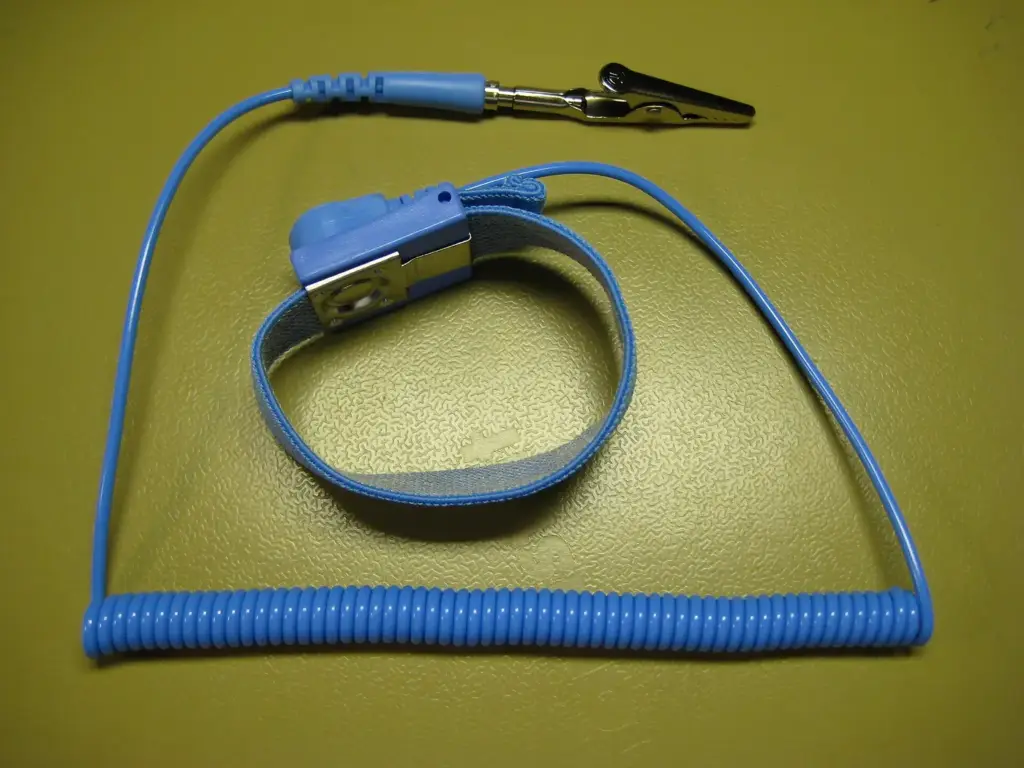
For people who work seated, the main tool isn’t the shoe at all. It’s the wrist strap. According to the association, wrist straps are the primary means of grounding personnel: a conductive band against the skin connected to ground through a cord with a one-megohm resistor. That resistor is there for safety, and the association warns that wrist straps must not be used if the operator will be exposed to circuits of 250 volts or more. Footwear is for people on the move, the ones who can’t be tethered to a bench.
The morning check
ESD footwear doesn’t last forever. The idea that shoes lose their ability to pass charge with use isn’t new: back in 1978, E. Kulis and J. C. Newell published a paper in the Journal of Clinical Engineering on the loss of conductivity in operating room shoes. What’s between your foot and the sole counts too. The EOS/ESD Association warns that insulative footwear keeps charge from flowing from the body to ground, and by the same physics, a very insulating sock or insole can break the path. The association recommends testing wrist straps regularly, daily at test stations or with continuous monitors at the bench, and for shoes there are testers like the one pictured: you step onto a metal plate, touch an electrode and lights tell you whether resistance is within limits, too high or too low.

Socks have joined the system too. In 2022, a team at Lithuania’s Center for Physical Sciences and Technology published a study in Materials on socks knitted with fibers containing carbon and silver additives, which have static dissipative properties; the best fabric cut its charge in half in under a hundredth of a second. We covered cotton, wool and synthetics in everyday socks in sock fibers.
How to spot an ESD shoe
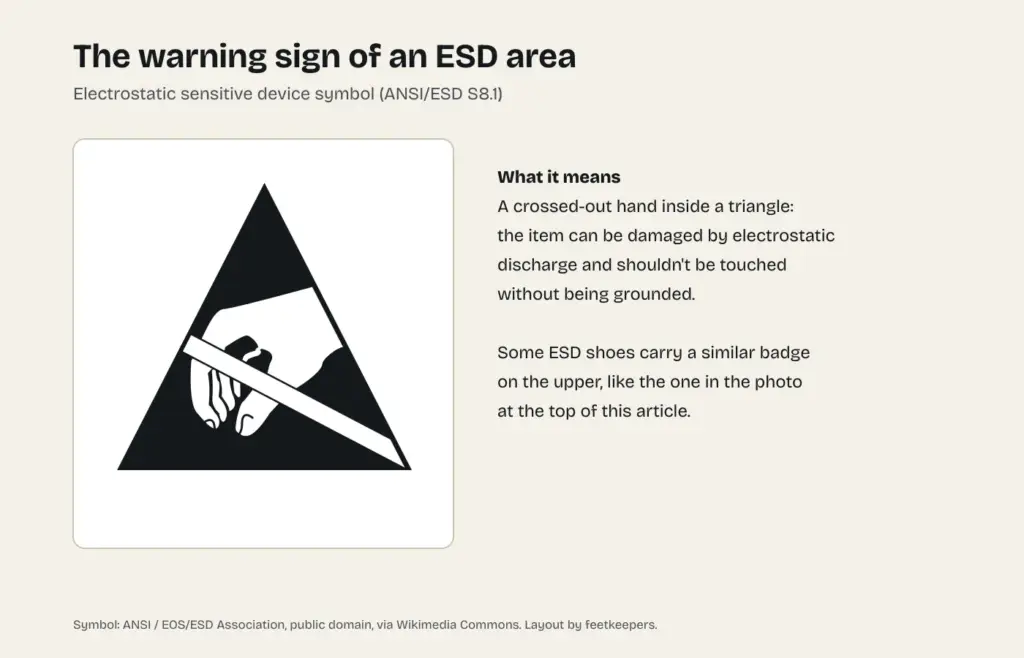
In a protected area, the warning sign is a triangle with a crossed-out hand, the ANSI/ESD S8.1 symbol for items sensitive to electrostatic discharge. Some ESD shoes carry a similar badge on the upper. But the badge isn’t proof. What counts is the marking and the manufacturer’s certification, and the reading on the tester at the door, with that shoe, that sock and that floor.
From the outside, an ESD shoe can look a lot like any other work shoe, and it can even have a steel toe if the job calls for one, because the protections stack. Inside, it’s built around an idea no other shoe shares: the wearer’s own body is a hazard to whatever it touches. It’s the only safety footwear where the danger runs from the foot outward. And it’s the only one that needs the floor to hold up its end.
Sources
- EOS/ESD Association (2020), Fundamentals of Electrostatic Discharge, Part 1: “An Introduction to ESD”; Part 3: “Basic ESD Control Procedures and Materials”; Part 5: “Device Sensitivity and Testing”.
- ASTM International, ASTM F2413, Standard Specification for Performance Requirements for Protective (Safety) Toe Cap Footwear, abstract and scope.
- University of Nebraska-Lincoln Environmental Health and Safety, Foot Protection Evaluation and Checklist.
- uvex safety, “The difference between antistatic and ESD: a safety footwear example”, technical guide to EN ISO 20345, EN 61340-5-1 and EN 61340-4-3.
- J. Smallwood and D. E. Swenson (2011), “Evaluation of performance of footwear and flooring systems in combination with personnel using voltage probability analysis,” Journal of Physics: Conference Series 301: 012064.
- E. Kulis and J. C. Newell (1978), “Loss of conductivity in operating room shoes,” Journal of Clinical Engineering 3(2): 193-195.
- L. Stygienė et al. (2022), “Thermal Comfort and Electrostatic Properties of Socks Containing Fibers with Bio-Ceramic, Silver and Carbon Additives,” Materials 15: 2908.
- EN 50321-1:2018, Live working – Footwear for electrical protection – Part 1: Insulating footwear and overboots, BSI listing.
Image credits
- ESD shoe with a badge on the upper: Antoine. CC BY-SA 3.0, via Wikimedia Commons (cropped).
- Antistatic wrist strap: Kms. CC BY 3.0, via Wikimedia Commons.
- Wrist strap and footwear tester: ArnoldReinhold. CC BY-SA 3.0, via Wikimedia Commons (brand blurred).
- ANSI/ESD S8.1 symbol: ANSI and EOS/ESD Association, public domain, via Wikimedia Commons; layout by feetkeepers.
- Voltage chart and resistance scale: feetkeepers.