

How to clean white sneakers is a question with a thousand answers online and almost no explanations. Bleach, the washing machine, toothpaste, baking soda with vinegar, magic erasers, a day in the sun: every hack promises good-as-new, and some of them are the fastest route to shoes that are yellow, warped or peeling at the sole. A white sneaker isn’t one object. It’s a bundle of materials glued together, each with its own chemistry, and what cleans one can ruin the one right next to it. Before you start scrubbing, it helps to know what’s under the stain and what each method actually does to it.
What the people who make them say
The manufacturers themselves are a lot more cautious than the hack videos. Nike’s cleaning guide, first published in 2021 and updated in 2022, calls for a shoe brush or toothbrush, a soft cloth and warm water mixed with a small amount of mild laundry detergent or dish soap. It warns you to dilute the soap with plenty of water, because a high concentration can cause discoloration or strip the natural oils from the material. For white or light shoes, it also suggests a paste of baking soda and water. Laces and insoles come out and get cleaned separately. Drying happens in the air, at room temperature, and according to the brand, many shoes take at least eight hours to dry completely.
In a separate 2022 article, the same company is blunt about the washer: Nike doesn’t recommend washing shoes in the washing machine, and says the heat from a dryer can damage or deform them. Converse goes further in the instructions on its site for its classic canvas sneakers: test the mild-soap-and-lukewarm-water mix on a spot nobody will see, such as the edge of the tongue, clean with a damp cloth or soft brush and, in capital letters, do not machine wash or dry.
Nike’s guide adds two smaller warnings that say a lot about materials. On leather, avoid scrubbing too hard, or you could damage it. And when blotting fabric uppers dry, don’t rub, because rubbing can wear down the fabric. That caution has a technical reason behind it. A sneaker combines fabrics, foams, rubbers and adhesives, and each tolerates different things.
Heat, the enemy of foam and glue
Many sneaker midsoles are foams, materials with millions of gas bubbles trapped in a polymer such as EVA. Heat can make them shrink, and the industry knows it well enough to have a test for it. SATRA, the British footwear technology center, describes its TM70 method as a way to determine how much cellular and microcellular soles shrink: mark two points on a test piece, measure the distance between them before and after heating under set conditions, and calculate the percentage of shrinkage. SATRA notes that the test also serves as an accelerated way to estimate shrinkage that could develop over a long period at normal temperatures. A clothes dryer or a radiator runs that test on your shoes without anyone asking it to.

Leather doesn’t forgive heat when it’s wet, either. The 1952 USDA bulletin we cite in our story on how many pairs of shoes you need warned that wet leather “burns” much more readily than dry leather, that leather heated beyond what the hand can bear is almost sure to be ruined, and that shoes dried against radiators or stoves shrink and come out hard, tight and misshapen. Its method: wash off mud with tepid water, stuff the shoes with crumpled paper to hold their shape, and let them dry slowly somewhere that isn’t too warm. It also said not to wear them until they were thoroughly dry, and to polish street shoes once or twice as soon as they were. We explain how leather behaves around water in our story on how leather is made.
Bleach: whiter today, yellower tomorrow
Bleach looks like the obvious answer for white, and it’s exactly what gets warned against most. According to a technical bulletin from Cotton Incorporated, the research and marketing organization of America’s cotton producers and importers, sodium hypochlorite is one of the oldest and most widely used textile bleaches, and chlorine is such a common cause of yellowing that the industry has called it “the unseen assailant.” The same bulletin explains that chlorine attacks and yellows protein-based fibers such as wool, and that it yellows nylon, too.
Stretch fibers are another weak spot. In a 1976 DuPont patent on spandex, the elastic polyurethane fiber found in many knit fabrics, the company describes how certain chemical structures make the filament more susceptible to yellowing from light, acid fumes, smog and chlorine-containing bleaches. Nike sums it up in its advice for knit and mesh sneakers: it’s best not to use bleach or other harsh cleaning products, because they can damage the material.
Baking soda and vinegar cancel each other out
One of the most repeated hacks is to mix baking soda with vinegar and scrub with the foam. Chemistry says that mix cancels itself out. Baking soda is a mild base, and vinegar is a solution of acetic acid. Put them together and they react: the acid and the base neutralize each other, forming sodium acetate, water and carbon dioxide, which is the gas in the bubbles. It’s the same reaction behind every science-fair volcano. When the fizzing stops, what’s left is essentially salt water. The foam looks impressive, but it uses up exactly what each ingredient had going for it on its own.

Separately, they make more sense. Baking soda mixed with water into a paste is a barely soluble powder that scrubs gently, which is what Nike suggests for light-colored shoes. Vinegar is a weak acid. But every material reacts its own way, which is why the brands keep telling you to test on a hidden spot first.
The sponge that wears itself away
A melamine sponge, the kind sold as a magic eraser, cleans very differently from an ordinary sponge: it sands. In 2024, a team led by Yu Su and Baoshan Xing published a study in Environmental Science & Technology on how these sponges wear when rubbed against metal surfaces of varying roughness. Inside, the sponge is a network of open cells held up by thin struts of melamine-formaldehyde polymer. As you rub, those struts bend and snap, breaking off as microscopic fibers 10 to 405 microns long. The authors calculated that sponge wear releases about 6.5 million fibers per gram, and estimated global emissions of 4.9 trillion microfibers from the use of these sponges.
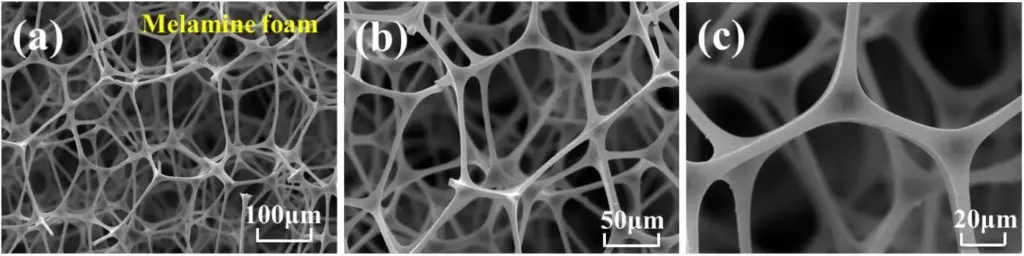
A separate 2019 study whose electron microscope images appear above described the same foam as an interconnected network of fibers with pores typically 100 to 200 microns across. In other words, a melamine sponge works like very fine sandpaper that crumbles as it goes. On the smooth rubber of a sole it can take surface grime off, but it does so by taking material off, and the same goes for the finish on leather or a synthetic.
Why white turns yellow
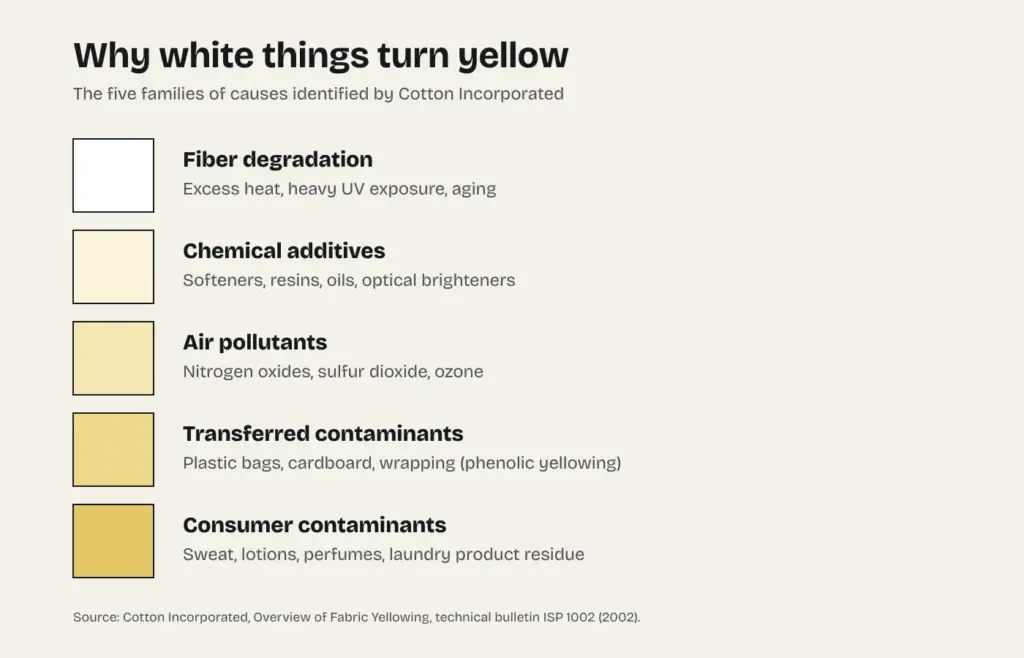
Yellowing is the great enemy of a white sneaker, and it has more causes than you’d think. Cotton Incorporated’s bulletin groups them into five families: degradation of the fiber itself from excess heat, heavy UV exposure or aging; finishing chemicals such as softeners, resins, oils and optical brighteners; air pollutants such as nitrogen oxides, sulfur dioxide and ozone; contaminants transferred from cardboard, plastic films and bags; and contaminants from the user, such as sweat, lotions, perfumes and laundry product residue.
One of those causes has its own name: phenolic yellowing. As James Heal, a British maker of textile testing equipment, explains it, it happens when nitrogen oxides in the air react with phenolic compounds such as BHT, an antioxidant added to polyethylene packaging bags and films that migrates easily to whatever is nearby. The result is an intensely yellow compound, and under the right conditions less than 2 parts per million of nitrogen oxides and less than 5 of BHT are enough to produce a noticeable stain. The stains tend to show up, the company adds, around openings, perforations or holes in the bag. The industry even has a standard to screen for the risk, ISO 105-X18. The twist, according to Cotton Incorporated, is that this kind of yellowing is normally reversible and can often be removed by an acidic scour or by direct sunlight.
Storage matters in other ways too. The same bulletin notes that nylon and polyester tend to yellow when stored for long periods or in hot warehouses, and that unfinished spandex blend fabrics are notorious for poor storage stability. The sun isn’t a friend to every material, though. Many of the synthetics and coatings on sneakers are polyurethanes, and polymer chemists have spent decades studying how UV light yellows them, as in the 2009 paper by D. Rosu, L. Rosu and C. Cascaval in Polymer Degradation and Stability on the infrared changes and yellowing of polyurethane exposed to UV irradiation. What fades a stain on canvas can yellow the plastic right next to it.
And there’s an optical trick behind many detergents that promise brighter whites. Long before them, people added a blue tint to the rinse water, laundry bluing, which washed out over time; according to Cotton Incorporated, in practice that method generally dulled fabrics. Its modern replacement is optical brighteners, compounds that absorb invisible ultraviolet light and re-emit it in the blue part of the spectrum. That blue cancels out yellowness and adds light, so the fabric looks whiter. But the same bulletin warns that in certain cases these compounds can actually contribute to yellowing.
Suede is its own case
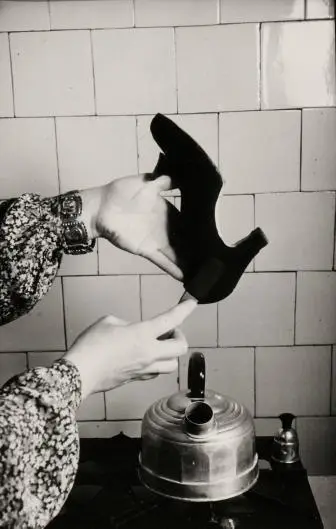
Suede and nubuck are leathers with the surface sanded or with the inner side of the hide facing out, as we explain in our story on how leather is made, and they don’t take the same treatment as canvas. In the Netherlands in the 1950s, a photo from the Spaarnestad archive shows suede shoes being brushed and cleaned over the steam from a teakettle. It’s a reminder that every material has always had its own ritual.
What to take away
Put together what the brands, the technical centers and the chemistry say, and a pattern emerges. The gentler the method, the lower the risk: warm water, very diluted soap, a soft brush and patience. Heat shrinks foam and scorches wet leather. Bleach is linked to yellowing in several fibers. Baking soda and vinegar neutralize each other when mixed. A melamine sponge sands. And yellow has many causes, some sitting in the very plastic bag you store your sneakers in, and one of them fades in the sun while another arrives with it.
Shoes that last also get repaired, and we cover what can be fixed in our story on shoe repair.
Sources
- Nike, “How to Clean Your Shoes in 6 Easy Steps” (2021, updated 2022) and “Can You Put Sneakers in the Washer?” (2022).
- Converse, “How to Clean Your Converse Shoes”.
- SATRA Technology, “SATRA TM70: Heat shrinkage of cellular solings”.
- F. P. Veitch, R. W. Frey and H. P. Holman, Leather Shoes: Selection and Care, Farmers’ Bulletin No. 1523, U.S. Department of Agriculture (1927, revised 1952).
- Cotton Incorporated, Overview of Fabric Yellowing, technical bulletin ISP 1002 (2002).
- James Heal, “Phenolic yellowing: the scientific reason that white clothes can go yellow”.
- ISO 105-X18:2007, Textiles — Tests for colour fastness — Assessment of the potential to phenolic yellowing of materials.
- Y. Su et al. (2024), “Mechanochemical formation of poly(melamine-formaldehyde) microplastic fibers during abrasion of cleaning sponges,” Environmental Science & Technology.
- D. Rosu, L. Rosu and C. N. Cascaval (2009), “IR-change and yellowing of polyurethane as a result of UV irradiation,” Polymer Degradation and Stability 94: 591–596.
- E. I. du Pont de Nemours and Company, U.S. Patent No. 3,994,881, “Spandex process and product based on tetra-halogenated diisocyanates and diamines” (1976), and U.S. Patent No. 4,340,527, “Chlorine-resistant spandex fibers.”
Image credits
- White sneakers on asphalt: Nadine Shaabana. Public domain (CC0), via Wikimedia Commons.
- White canvas ankle boots, around 1920: Museum Rotterdam. CC BY-SA 3.0, via Wikimedia Commons.
- Sodium bicarbonate: Thavox. Public domain, via Wikimedia Commons.
- Melamine foam under the electron microscope: S. Kang, M. Chen, Y. Wang, F. Tang, L. Cui and M. Dong (2019). CC BY 4.0, via Wikimedia Commons.
- Yellowing causes diagram: feetkeepers.
- Cleaning suede with steam (1950–1960): Nationaal Archief / Spaarnestad. No known restrictions, via Wikimedia Commons.