
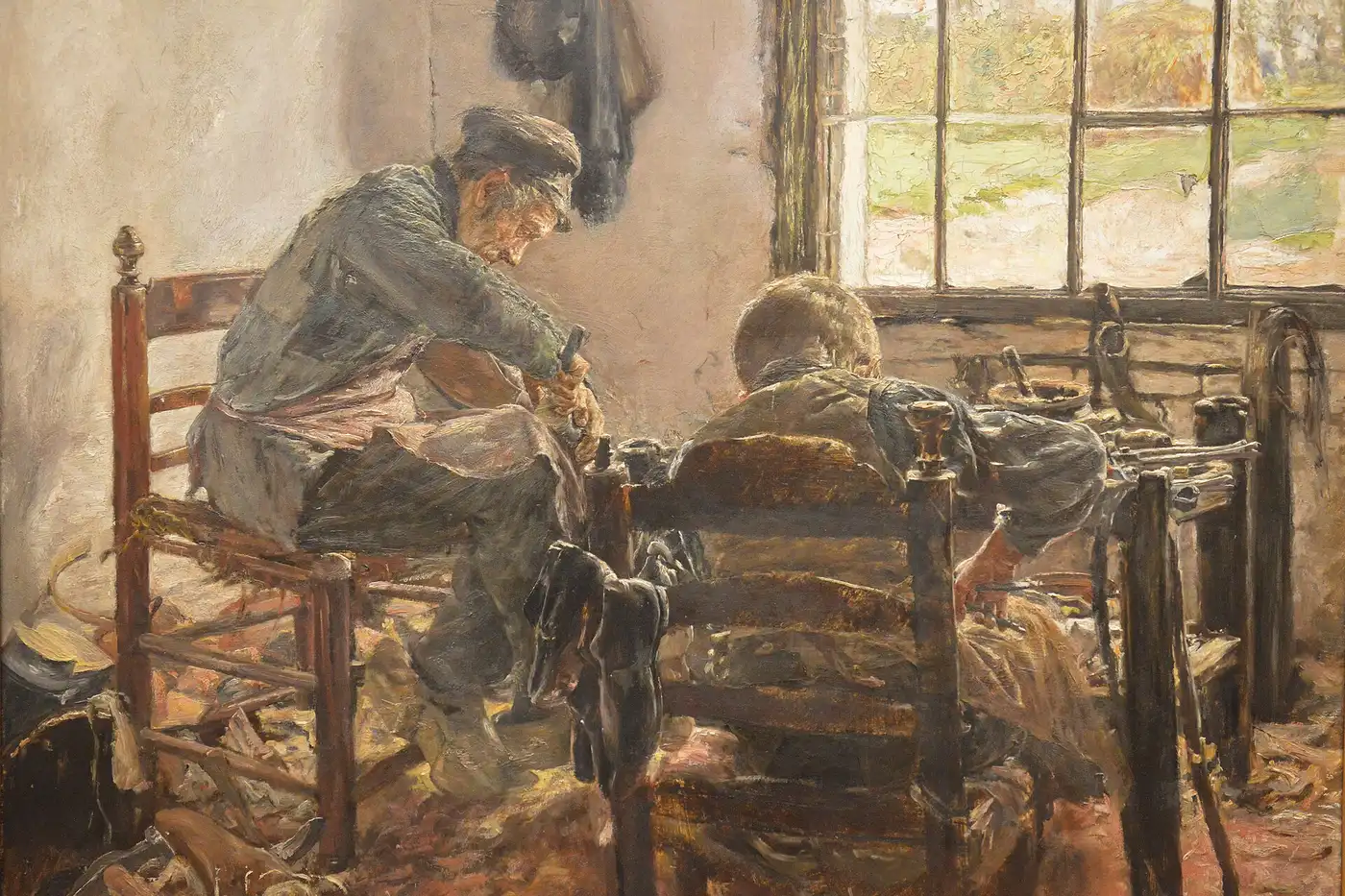
Shoe repair has become an almost quaint idea, and it shouldn’t be. A shoe doesn’t die all at once: a heel lift wears down, a seam splits, a sole starts to peel. Every one of those failures can be fixed, if you catch it in time and if the shoe was built to be fixed. Seventy years ago, a U.S. government pamphlet explained it as matter-of-factly as we’d explain charging a phone today, complete with a shopping list of tools for doing it at home. Today the trade that lives on that work is shrinking, and in France the government has started covering part of the bill to keep it alive. The useful question isn’t whether a shoe can be repaired. It’s which part of it, and whether what’s left around that part is worth the money.
Cordwainer or cobbler
For centuries, making shoes and fixing them were separate trades. According to Wikipedia, in the British tradition a cordwainer made new shoes from new leather, and a cobbler repaired them. The word cobbler started out as an insult for someone who didn’t know their craft, and by the 1700s it had come to mean someone who could mend shoes but didn’t know enough to make them. We trace the Spanish roots of the word cordwainer in our story on how leather is made.
That line has long since blurred: today the person who fixes your shoes practices a specialized, increasingly rare craft. But their work depends on a decision made at the factory, long before the shoe ever reaches their bench: how the sole was attached.
What the 1952 bulletin said
In 1927, the U.S. Department of Agriculture published Farmers’ Bulletin No. 1523, Leather Shoes: Selection and Care, revised in 1952, which we also quote in our story on how many pairs of shoes you need. Its section on repairs opens with a simple point: there’s no need to throw shoes away as soon as they show wear. When a seam rips or the outsole wears through, shoes can often be repaired and worn for a long time.
The bulletin stressed speed. The minute a seam starts to rip, the upper cracks, a heel twists or runs down, or a hole wears through the sole, the shoe needs mending. Put it off, and the shoe may get so worn it’s no longer worth fixing, especially if the welt has worn away or the insole has worn through. It offered a specific example: on a covered wood heel, if the leather or rubber lift isn’t replaced promptly when it wears away, the covering over the wood gets cut through and may have to be replaced, sometimes an expensive job because it’s hard to match the material on the rest of the shoe.
And it went a step further: ripped seams in the upper could often be stitched at home, and a handy person with a repair kit could put on new heel lifts, rubber heels, half soles and metal heel or toe plates without much trouble. The kit included a last holder, iron lasts, a shoemaker’s hammer, pincers, leather knives, a rasp or file, awls, sole and heel nails, flax thread, bristles and wax, all sold by hardware stores, shoe-findings dealers and mail-order houses.
The maintenance that keeps you out of the shop
Before repair comes care, and the same bulletin gave it pages of attention. Its summary fits in one line: mud, water and excessive dryness ruin leather, and oil and grease preserve it. So, it said, the life of boots and shoes can be extended by keeping them clean, pliable and water resistant. Farm and heavy outdoor boots needed greasing; street shoes needed polish only, though their soles could be oiled or greased. It recommended frequent polishing, especially with flexible wax polishes, because they keep leather soft and pliable and leave a finish that helps shed water and keep off dust and dirt. For patent leather, a light, even coat of castor oil on a cheesecloth pad once or twice a month helped keep the uppers from cracking. Plenty of the damage that ends up at the repair shop starts much earlier, with a shoe left to dry next to a radiator or one that never saw a tin of polish.
The bulletin was blunt about water. Wet leather is soft, it wrote, so it stretches out of shape easily, stitches cut through it and it wears away fast. And wet leather “burns” much more readily than dry leather: if it gets hotter than the hand can bear, it’s almost sure to be ruined. Shoes dried against hot radiators in streetcars, steam pipes, stoves or even ovens shrink and come out hard, tight and misshapen, and the sole often cracks and sometimes falls out in pieces. Its method takes a minute: wash off the mud and grit with tepid water, oil the leather, straighten the counter, heel, vamp and toe, stuff the shoes with crumpled paper to hold the shape and speed drying, and leave them somewhere not too warm to dry slowly. Don’t wear them until they’re completely dry. It also suggested owning two pairs and alternating them daily, so each one gets time to dry out, and it called shoe trees the way to keep a shoe’s original shape, with paper pads a fair substitute.
What can be fixed
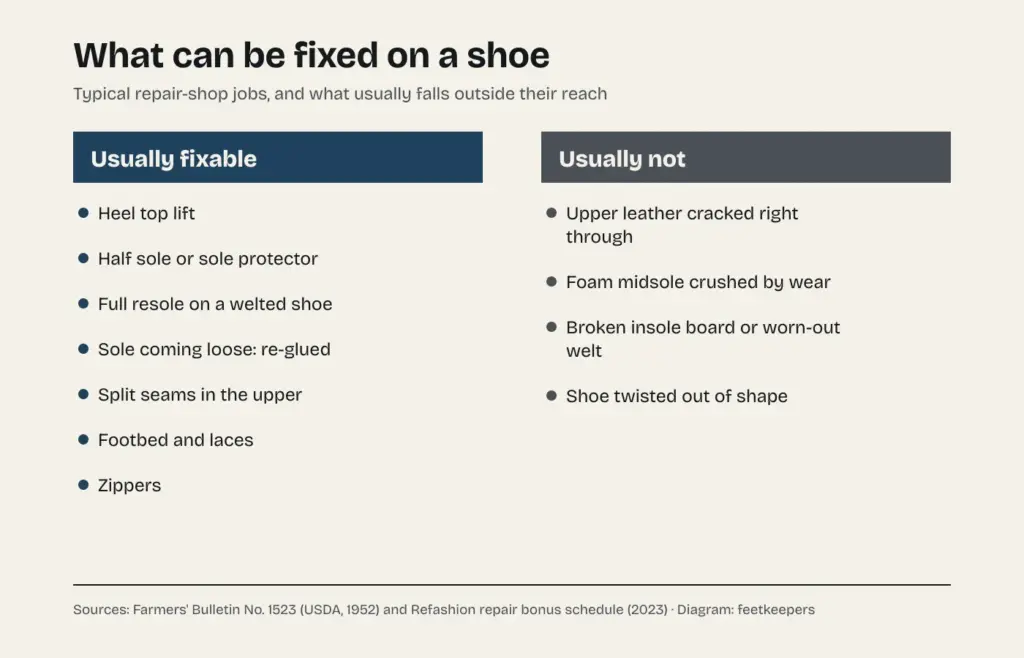
The most common repair-shop jobs run from simple to complex.
The heel lift is the rubber or leather piece under the heel that touches the ground, and it’s the first thing to wear out. Replacing it in time keeps the wear from reaching the heel itself, exactly as the 1952 bulletin warned.
A half sole replaces just the front of the sole. A sole protector is a thin sheet of rubber glued over a leather sole so that the leather itself doesn’t meet the ground.
A full resole is the big job, and here construction rules. On a Goodyear-welted shoe, the outsole isn’t stitched directly to the upper but to a strip running around the edge, so it can be replaced several times as long as the upper holds up, as we explain in our story on how shoes are made.
A sole coming loose on a cemented shoe can be glued back. Split seams in the upper, footbeds, laces and zippers are everyday work at any shop. They’re the same jobs listed, with their discounts, in the French repair bonus we describe below, which makes that list a good summary of what the trade considers fixable.
What usually can’t
Some failures are beyond almost any cobbler. The first is upper leather cracked right through. The 1952 bulletin already warned that uppers constantly wet with perspiration could crack and rip, and a crack that goes all the way through the leather can be patched but not undone.
The second is a crushed foam midsole. In sneakers and many city shoes, cushioning comes from a foam, often EVA, that fatigues with mileage: a 2004 University of Birmingham study found that after 500 kilometers, about 310 miles, of running, peak pressure under the foot had doubled, as we explain in our story on how many pairs of shoes you need. That foam is bonded to the upper and the outsole, and in practice it doesn’t get replaced.
The third is a broken insole board or a worn-out welt, the limit the 1952 bulletin already drew. And the fourth is a shoe that’s lost its shape, twisted or warped: the last it was built on is no longer inside to give it back.
Construction decides
All of this boils down to an idea worth keeping in mind when you buy: how repairable a shoe is gets decided at the factory. In 1972, a USDA study compared a casual oxford with a cemented sole and a dress oxford with a welted sole, and the second left the factory 64 percent more expensive, largely because of the labor that construction takes, as we explain in our story on expensive vs. cheap shoes. Part of that difference is exactly what you’re paying for the ability to replace the sole later.
So when is it worth it? The math has three parts. First, the condition of the upper: if the leather is sound, the shoe has life left in it. Second, the construction: a welted shoe can take a whole new sole; a cemented one is mostly a candidate for smaller fixes. Third, the fit: a shoe that’s already molded to your foot and fits well is worth more than a new one whose behavior at 8 p.m. you haven’t tested yet, as we explain in our story on why shoes feel tighter in the afternoon.
When soles were rationed
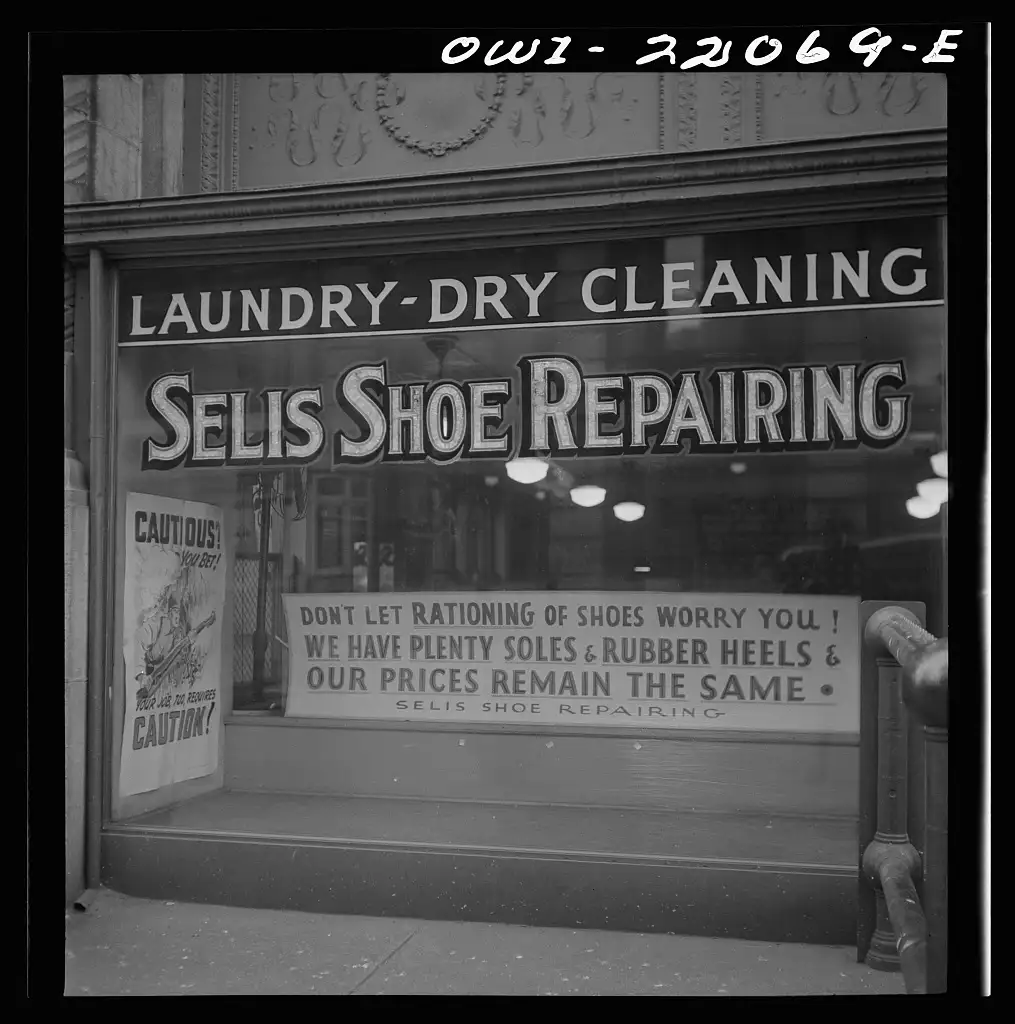
There was a time when repair wasn’t an option but the rule. During World War II, the U.S. rationed footwear for civilians. According to Wikipedia, by the end of 1942 shoes were among the goods that required ration coupons, and at one point it took a specific stamp from your ration book, on top of the cash, to buy a pair. Repair shops made the most of it. In April 1943, Office of War Information photographer Marjory Collins captured a shop window with a sign that said it all: don’t let rationing of shoes worry you, we have plenty of soles and rubber heels, and our prices remain the same. The message was clear: if you couldn’t buy new shoes, you could make the old ones last.
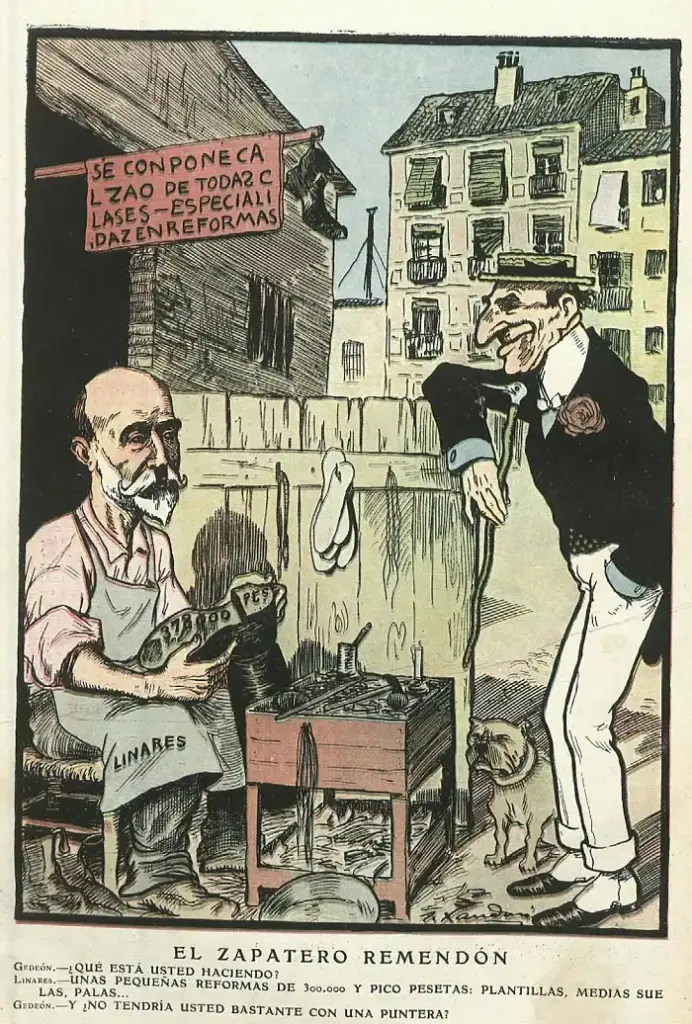
In Spain, shoe repair even became political shorthand. In 1904, cartoonist Joaquín Xaudaró published a cartoon called “The Cobbler” in the satirical magazine Gedeón, in which a gentleman asks a cobbler what he’s working on, and the cobbler answers: a few small reforms, insoles, half soles.
A shrinking trade
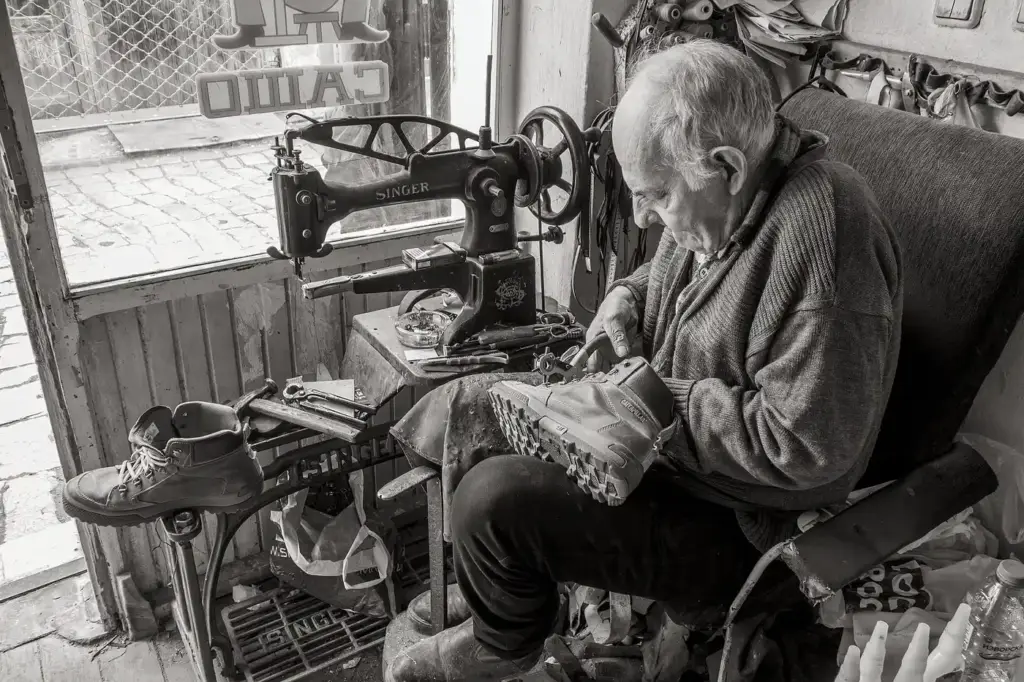
The trade is small today. According to the Bureau of Labor Statistics, in May 2023 there were 7,230 people in the U.S. working as shoe and leather workers and repairers, with an average annual wage of $37,030. Half earned less than $36,020 a year, and the top 10 percent more than $48,440. According to O*NET, the occupational database sponsored by the Department of Labor, employment in the occupation is expected to keep declining.
France has decided to step in. On November 7, 2023, Refashion, the organization that manages French clothing and footwear makers’ legal responsibility for their products’ end of life, launched a repair bonus set up under the country’s anti-waste law and funded by the brands. According to its press kit, customers get an instant discount at participating repairers: €7 off a heel lift, €8 off a sole protector, €8 off a seam or a re-glue, and €18 off a new rubber sole or €25 if it’s leather. The fund has €154 million for 2023 to 2028. At launch, the network had 600 repairers, including 254 cobblers. The goal is to go from 16 million items of clothing and footwear repaired in 2019, according to France’s environment agency, to 21.6 million in 2028.
Sources
- F. P. Veitch, R. W. Frey and H. P. Holman, revised by J. S. Rogers and I. D. Clarke, Leather Shoes: Selection and Care, Farmers’ Bulletin No. 1523, U.S. Department of Agriculture (1927, revised 1952).
- R. Verdejo and N. J. Mills (2004), “Heel-shoe interactions and the durability of EVA foam running-shoe midsoles,” Journal of Biomechanics 37(9): 1379–1386.
- F. Poats (1972), “Cattle hides and shoe prices,” Economic Research Service, U.S. Department of Agriculture.
- U.S. Bureau of Labor Statistics, Occupational Employment and Wage Statistics, “Shoe and leather workers and repairers,” May 2023.
- O*NET OnLine, “51-6041.00 Shoe and leather workers and repairers.”
- Refashion, Le Bonus Réparation, press kit (November 7, 2023).
- Wikipedia, “Shoemaking,” “Cordwainer,” “Goodyear welt” and “Rationing in the United States,” and the references they cite.
Image credits
- Schusterwerkstatt (1881), Max Liebermann, Alte Nationalgalerie, Berlin. Public domain, via Wikimedia Commons.
- Repair diagram: feetkeepers.
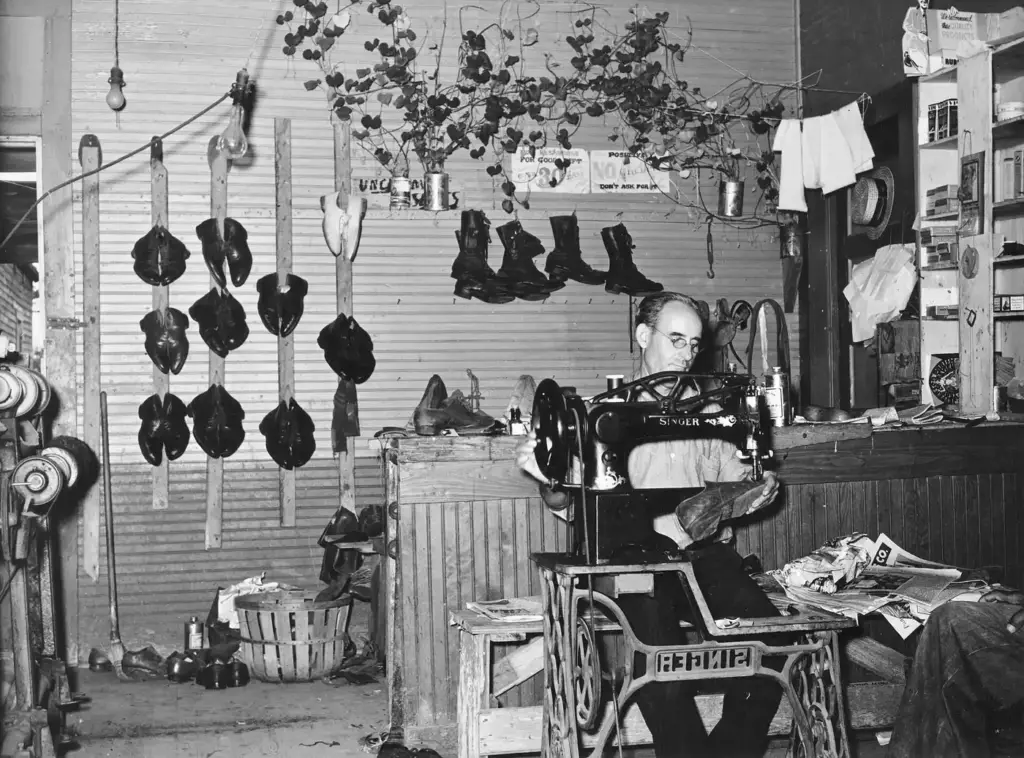
- Shoemaker in Kenner (1938): Russell Lee, Library of Congress. Public domain, via Wikimedia Commons.
- Shoe repair shop (1943): Marjory Collins, Library of Congress. Public domain, via Wikimedia Commons.
- “El zapatero remendón” (1904): Joaquín Xaudaró. Public domain, via Wikimedia Commons.
- Cobbler in Bitola (2025): Petar Milošević. CC BY-SA 4.0, via Wikimedia Commons.