
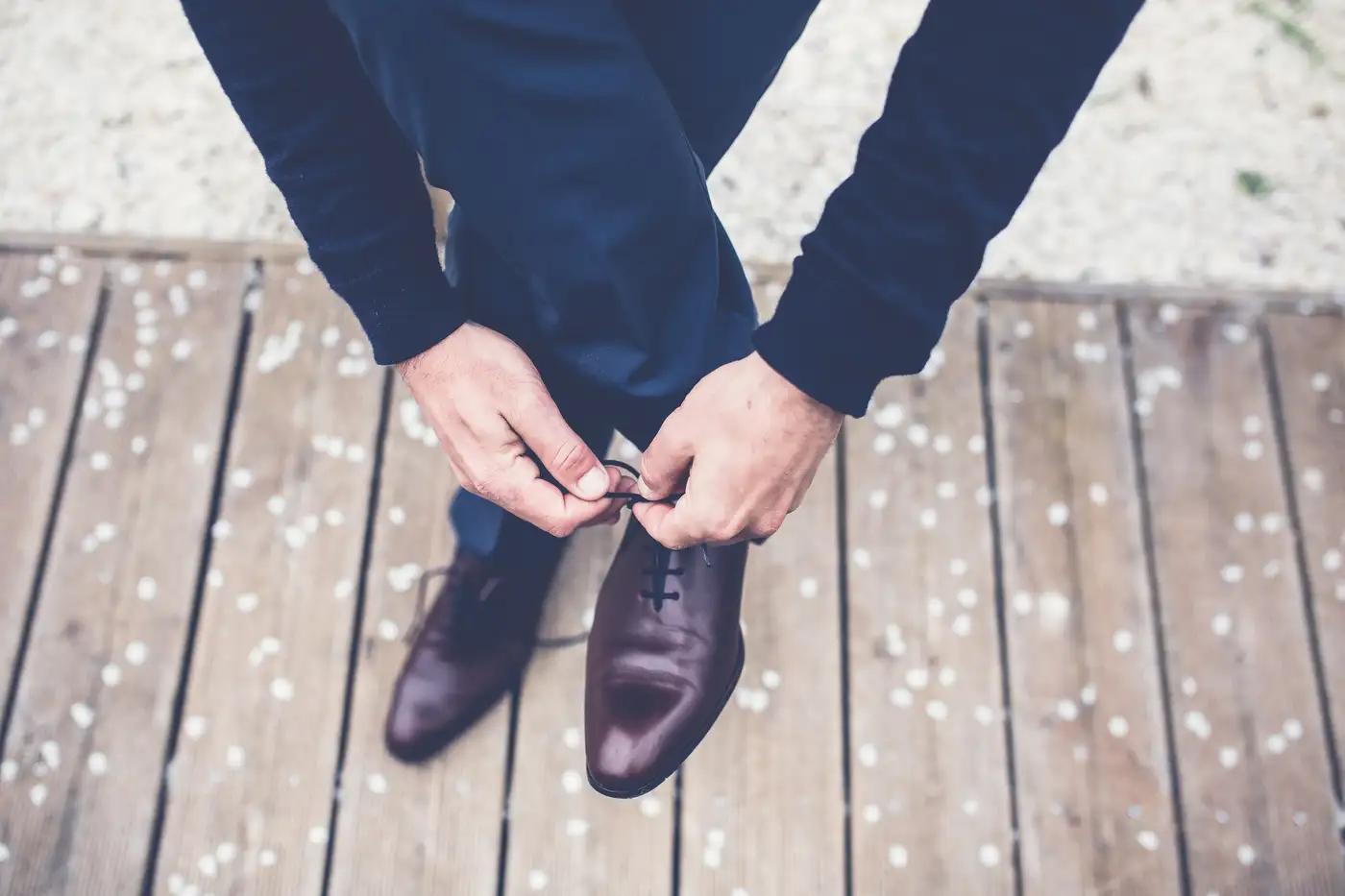
How to lace shoes sounds like a question for kindergarten, and it turns out mathematicians, mechanical engineers and biomechanists have all taken a crack at it. There are hundreds of millions of ways to thread a lace through the eyelets of an ordinary shoe, nearly everyone uses the same one, and a lot of people finish with the knot that holds worst. What has been measured is that the way you lace changes how much your foot moves inside the shoe, where it presses on top, and how fast the bow comes loose. None of it fixes any foot problem. It only changes how the shoe holds on.
A math problem in disguise
In 2002, the mathematician Burkard Polster of Monash University in Australia published a short paper in Nature with a title that sounds like a joke: what is the best way to lace your shoes? To answer it, he turned the shoe into a model, two facing columns of eyelets and a lace forming a closed path through all of them, with one sensible condition: every eyelet has to genuinely help pull the two sides of the shoe together.
Under those rules, just counting the options is dizzying. By Polster’s calculation, a shoe with seven pairs of eyelets can be laced 382,838,400 different ways. Almost everyone uses one of two: criss-cross, which zigzags from side to side, or straight lacing, where only horizontal bars show on top and the vertical runs stay hidden underneath.
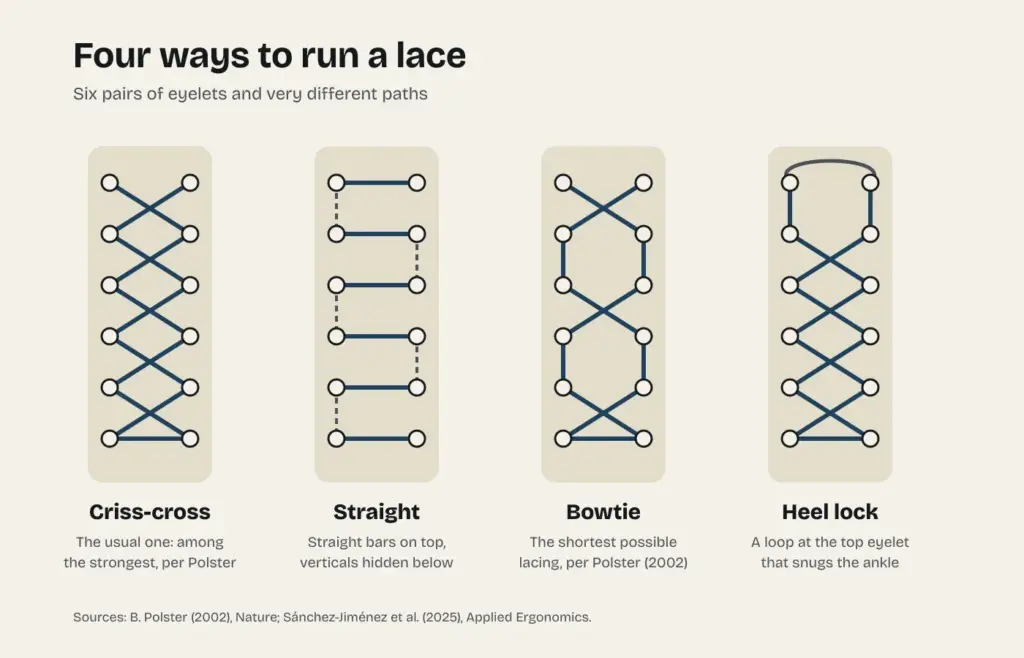
Polster looked for two things: the shortest lacing, which saves lace, and the strongest, meaning the one that best turns a pull on the ends into force drawing the two sides together, like a pulley. The answer has a twist. The shortest isn’t one of the common ones; it’s the so-called bowtie, which alternates crossings with vertical runs along the sides. The strongest, though, are the familiar ones, criss-cross and straight, and which one wins depends on the spacing between rows of eyelets. Polster added a neat detail: on many real shoes, the ratio between row spacing and column spacing sits very close to the point where the two tie, so whichever you prefer, your pull ends up close to the maximum. Among his examples of unusual lacings was one he noted had once been standard practice in the Canadian armed forces.
The question had a back story. As the paper recounts, in 1995 the mathematician J. H. Halton proved in The Mathematical Intelligencer that criss-cross is the shortest of the lacings that always go side to side and finish with a horizontal bar across the top, where you tie the bow. A year later, M. Misiurewicz published a very short proof that held even when the eyelets weren’t perfectly lined up. Polster generalized those results, also identified the longest lacings that still zigzag side to side, and noted that many lacings used for show don’t zigzag at all. He threw in another curiosity, too: with an even number of eyelet pairs there’s exactly one bowtie lacing, and with an odd number there are as many as half that number plus one.
What changes for your foot
So what do feet notice? In 2009, M. Hagen and E. M. Hennig of the University of Duisburg-Essen in Germany reported an experiment in the Journal of Sports Sciences with 20 experienced heel-striking runners. They ran across a force plate at 3.3 meters per second, about 7.4 miles per hour, in the same shoe laced six ways: using 1, 2, 3, 6 or 7 pairs of eyelets, and tied loose, regular or tight.
The differences were clear. With the highest, tightest lacing, impact loading built up more slowly and the foot rolled inward more slowly as it landed. Using the seventh eyelet, the one at the very top, produced the lowest peak pressures under the heel and the outer midfoot compared with regular six-eyelet criss-cross lacing, and the runners reported no difference in comfort. With the lowest lacing, by contrast, impacts and some pressures under the forefoot dropped, which the authors attributed most likely to the foot sliding inside the shoe.
A year later, the same group used a pressure insole to measure the other side of the equation: the top of the foot, under the tongue. In 14 runners, the highest pressures sat above the talus, the navicular bone and the first ray, in other words over the instep and the arch. Lacings that used the seventh eyelet were rated more stable, with no loss of comfort compared with six-eyelet criss-cross. The authors also found that lower pressure over the talus, the navicular and the extensor tendons that run along the top of the foot went along with better comfort ratings, which is useful information for anyone designing tongues and lacing systems.
How hard a lace pulls
Lace tension has been measured directly, too. In 2023, a team of Chinese researchers published a study in Acta of Bioengineering and Biomechanics with 16 male college basketball players who did side shuffles with their laces loose, comfortable and tight, with tension sensors at three points along the top of the foot. Average tension was 13.56 newtons when loose, 16.14 when comfortable and 21.25 when tight, and it varied by location: about 20 newtons at the front, 14 in the middle and 17 at the back. Loose laces increased the ankle’s inversion angle, the degree to which the sole of the foot tips inward, during the shuffle. Tight laces made players feel more pressure on the foot and less movement inside the shoe. The authors suggested that basketball shoes might use multiple laces or zonal lacing so each section could be adjusted on its own.
The effect of loosening has been measured in walking as well. In 2011, a team in Amsterdam reported in Gait & Posture on 20 healthy adults who walked with laces tied comfortably, loosened, and completely untied. Peak pressures barely moved, by less than 3 percent, but cumulative pressure over time under the big toe rose 16.3 percent and under the other toes 14.5 percent, and participants reported that their heels slipped and their feet slid back and forth inside the shoe.
The heel lock
The extra top eyelet on many running shoes isn’t there for looks. It’s for a technique known as the heel lock, or runner’s loop: the lace makes a small loop at the top eyelet on each side and passes through the opposite loop before you tie it, so that pulling tightens the top of the instep and the ankle.
In 2025, a team at the University of Valencia in Spain published one of the few studies comparing it with ordinary criss-cross, in Applied Ergonomics. Twenty-four recreational runners ran 20 minutes on a treadmill at 10 kilometers per hour, a little over 6 miles per hour, with each lacing. With criss-cross, foot skin temperature was higher at the end. The heel lock was rated more comfortable. The authors concluded that lacing patterns can affect foot temperature and how running feels.
Why the knot comes undone
The bow at the end has its own lab. In 2017, C. A. Daily-Diamond, C. E. Gregg and O. M. O’Reilly of the University of California, Berkeley, published the first study of how a shoelace knot fails, in the Proceedings of the Royal Society A. They filmed a volunteer running on a treadmill in slow motion and saw two phases: for many strides the knot barely changed, and then it came apart in the blink of an eye, often in less than two strides.
The mechanism combines two forces. The impact of the shoe hitting the ground, which their accelerometer under the knot clocked at around 7 g, gradually loosens it. And as the leg swings, the loose ends of the lace whip back and forth and tug, until the knot slips and unravels on its own. Using a pendulum rig that reproduced those impacts, they found that the more mass at the swinging ends, the faster the knot untied, and that the knot’s structure mattered enormously. To exaggerate the effect, they added weights of 1, 2 and 3 grams to the free ends, multiplying their original mass by 7.4, 14.8 and 22, and the knot went from rarely failing to failing often. They also measured impacts in running shoes, hiking boots, casual sneakers and barefoot-style shoes. Their conclusion was that failure needs both at once, the impact of each step and the swing of the leg, and that runaway loosening is linked to a mismatch between the inertial forces on the loops and those on the free ends. When the same volunteer tied her laces with the strong version of the knot, at about the same tightness, it never came fully undone during testing.
The granny knot
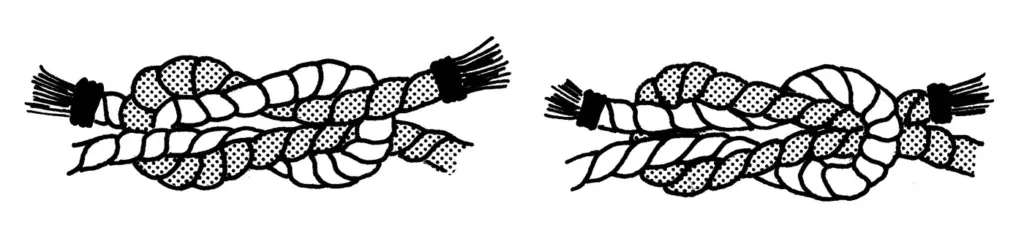
That structure is the whole story. A shoelace bow is two half knots stacked on top of each other. If the two go in opposite directions, you get a square knot, also called a reef knot. If they go in the same direction, you get a granny knot. The Berkeley team compared the two versions and called the granny-based one weak and the square-based one strong. You can see the difference: the strong knot lies flat when you pull it tight, and the weak one twists.
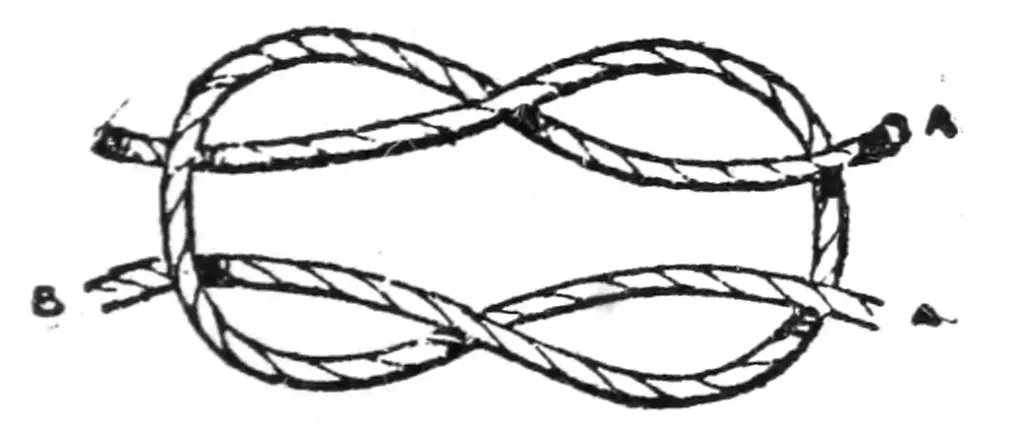
Polster had already said as much in 2002: the granny knot is notoriously unstable, the reef knot is very stable, and many people, if not most, tie their shoes with a granny knot. Thousands of years of trial and error, he wrote, have given us the strongest ways to lace our shoes, but not the best way to tie them.
The aglet, sixteen centuries on
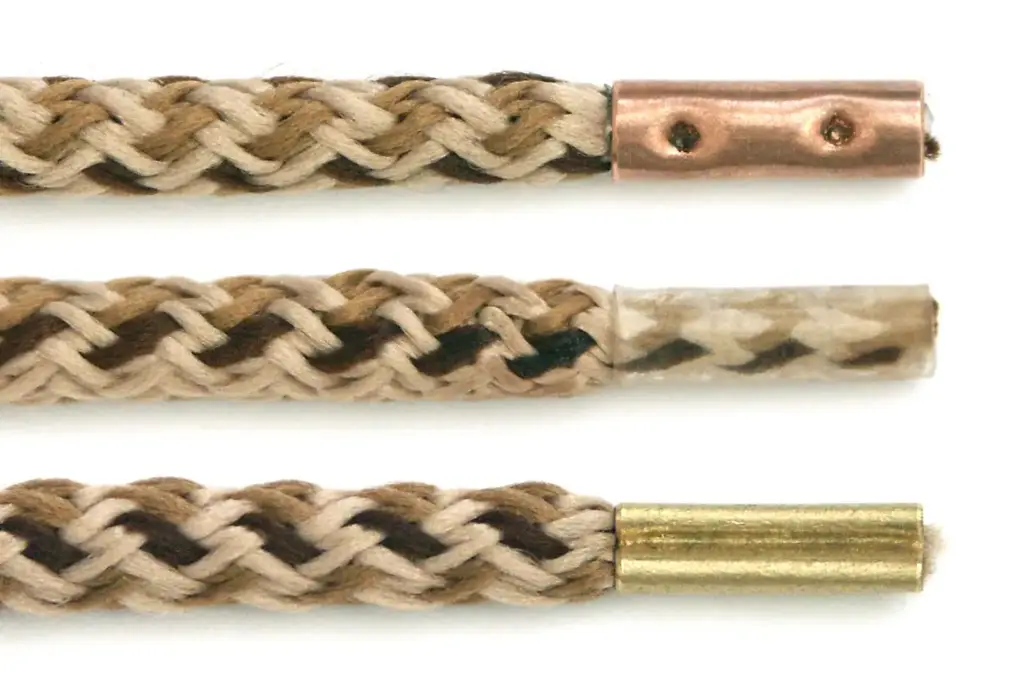
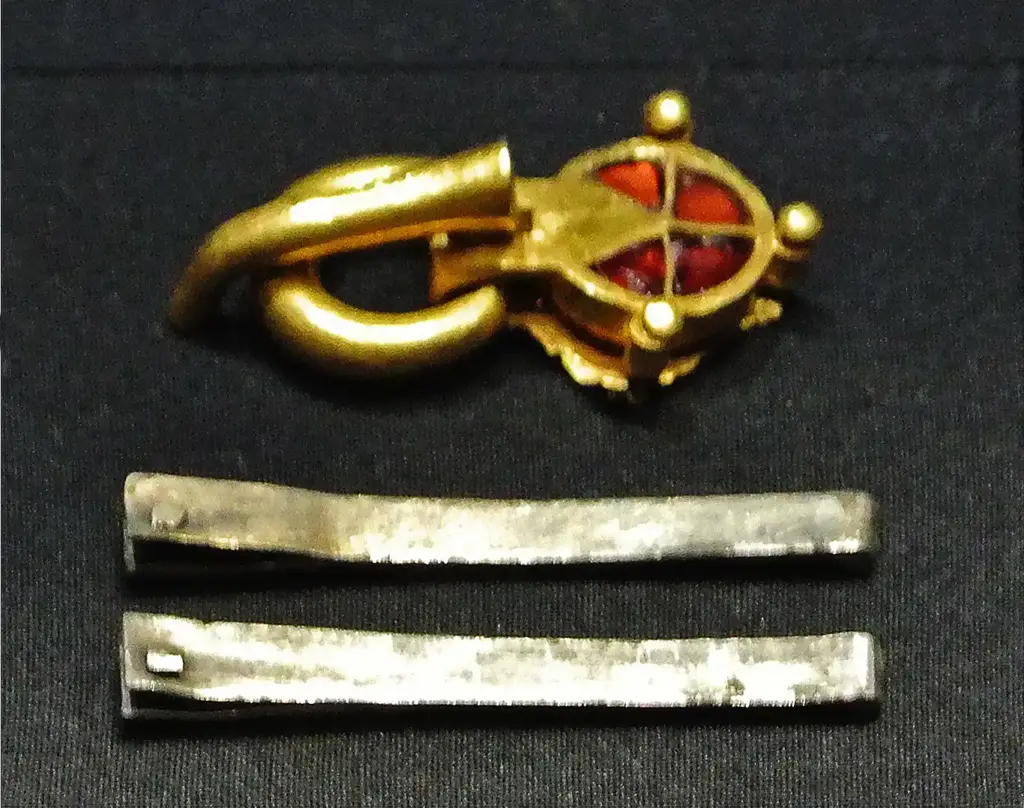
The humblest part of a lace has a very long history. The aglet is the stiff tip that keeps the end from fraying and helps it through the eyelet. Vienna’s Kunsthistorisches Museum holds a gold-and-garnet buckle and two silver strap ends from the footwear in the Treasure of Untersiebenbrunn, an East Germanic grave from around the year 430, discovered in 1910. Today aglets are usually plastic or metal, like the copper, plastic and brass tips pictured earlier, but they do the same job.
For your foot to move as little as possible inside a shoe, the right size and last matter too, as we explain in our stories on shoe size and the shoe last. And how the foot moves through each phase of a step is in our story on how the foot walks.
The single most useful takeaway fits in one glance: look at the knot after you pull it tight. If it lies flat, it’s a square knot. If it twists, it’s a granny, and next time all you have to do is wrap that first half knot the other way.
Sources
- B. Polster (2002), “What is the best way to lace your shoes?” Nature 420: 476.
- J. H. Halton (1995), “The shoelace problem,” The Mathematical Intelligencer 17: 37–41; and M. Misiurewicz (1996), “Lacing irregular shoes,” The Mathematical Intelligencer 18: 32–34.
- M. Hagen and E. M. Hennig (2009), “Effects of different shoe-lacing patterns on the biomechanics of running shoes,” Journal of Sports Sciences 27(3): 267–275.
- M. Hagen, A. K. Hömme, T. Umlauf and E. M. Hennig (2010), “Effects of different shoe-lacing patterns on dorsal pressure distribution during running and perceived comfort,” Research in Sports Medicine 18(3): 176–187.
- Y. Tang et al. (2023), “Effects of shoelace tightness on lower limb biomechanics and subjective perception during lateral shuffle in basketball,” Acta of Bioengineering and Biomechanics 25(4): 145–154.
- K. E. Fiedler et al. (2011), “The effect of shoe lacing on plantar pressure distribution and in-shoe displacement of the foot in healthy participants,” Gait & Posture 33(3): 396–400.
- J. L. Sánchez-Jiménez et al. (2025), “Sex differences in young adults on comfort and foot skin temperature using different running shoes lacing,” Applied Ergonomics 130: 104660.
- C. A. Daily-Diamond, C. E. Gregg and O. M. O’Reilly (2017), “The roles of impact and inertia in the failure of a shoelace knot,” Proceedings of the Royal Society A 473: 20160770.
- Kunsthistorisches Museum, Vienna, Collection of Greek and Roman Antiquities, Treasure of Untersiebenbrunn (U 14, U 56–57).
Image credits
- Man tying his shoes: Sweet Ice Cream Photography. Public domain (CC0), via Wikimedia Commons.
- Lacing patterns diagram: feetkeepers.
- Three different aglets: Ian W. Fieggen. CC BY-SA 3.0, via Wikimedia Commons.
- Granny knot: Pearson Scott Foresman. Public domain, via Wikimedia Commons.
- Reef knot, Scouting for Girls (1918). Public domain, via Wikimedia Commons.
- Buckle and strap ends from the Treasure of Untersiebenbrunn: James Steakley. CC BY-SA 3.0, via Wikimedia Commons.