
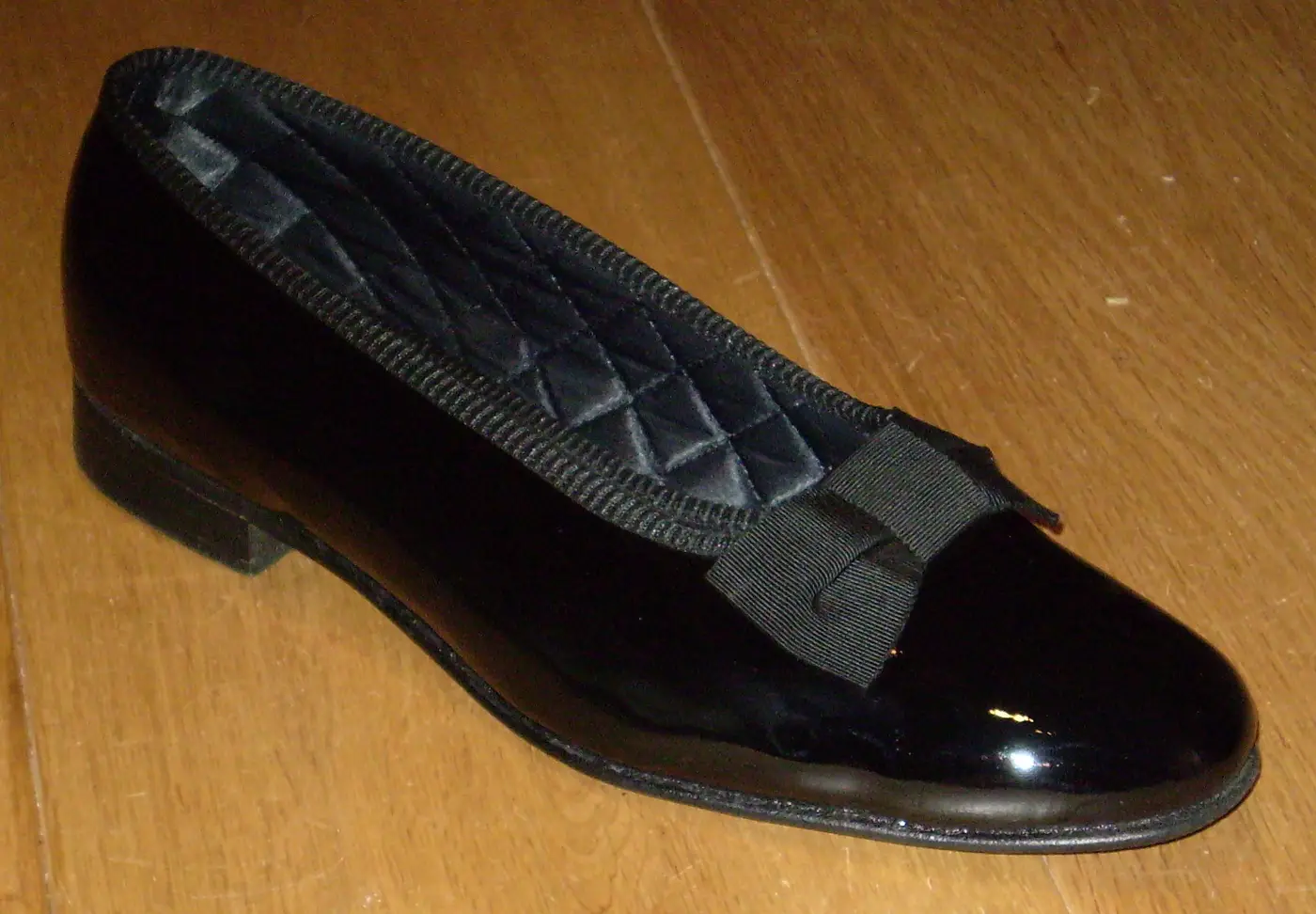
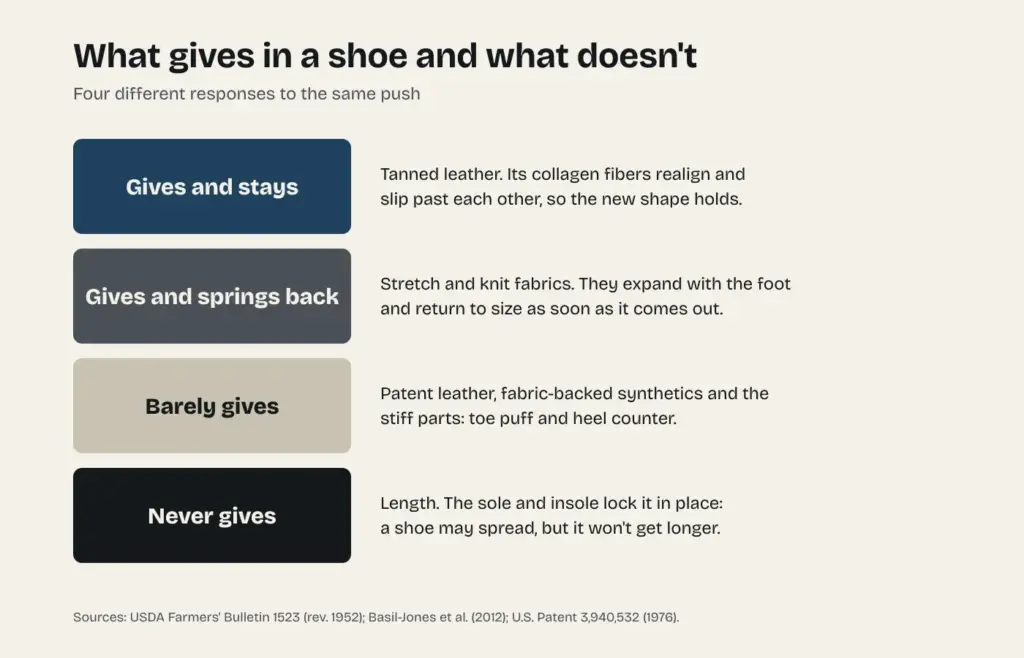
How to stretch shoes is the wrong first question. The right one is what they’re made of. A leather shoe that pinches across the toes can usually be coaxed wider. Patent leather, not so much. A synthetic upper with a fabric backing fights back and tends to return to its original shape. And a shoe that’s too short won’t get any longer, no matter how many bags of ice, potatoes or hair dryers you throw at it. The U.S. Department of Agriculture said as much in a pamphlet more than seventy years ago, and materials science backs it up: a shoe can spread, but it won’t grow toward your toes.
The USDA rule: wider, never longer
In 1927, the USDA published Farmers’ Bulletin 1523, Leather Shoes: Selection and Care, and revised it in 1952. We’ve leaned on it before, in our stories on how many pairs of shoes you need and shoe repair. Its section on fit contains a line that belongs on every shoe store wall: during wear, a shoe may spread, but it will not lengthen. That’s why it called for a good half-inch of empty space beyond the toes in a broad or well-rounded shoe.
The reason is how a shoe is built. The same bulletin explains it in a sentence: the finished upper is pulled tight over a form, the last, which gives the shoe its final shape, size and style, and then it’s fastened to the insole and the outsole. Length is pinned down by parts that don’t stretch, the insole and the sole. The vamp, the part of the upper that covers the instep and toes, is a sheet that can bulge outward. Everything you can and can’t do to stretch a shoe follows from that: you work on the vamp, never on the length.
The bulletin made another point that runs against what plenty of shoppers believe. New shoes that fit correctly, it said, are comfortable from the start and don’t need “breaking in.” Seventy years later, the Canadian Centre for Occupational Health and Safety, in a safety footwear fact sheet last revised in 2025, says nearly the same thing: don’t expect footwear to stretch with wear. Neither source says you can’t stretch a shoe. Both warn that buying a pair too small and counting on it to give is a gamble.
Why leather gives and stays
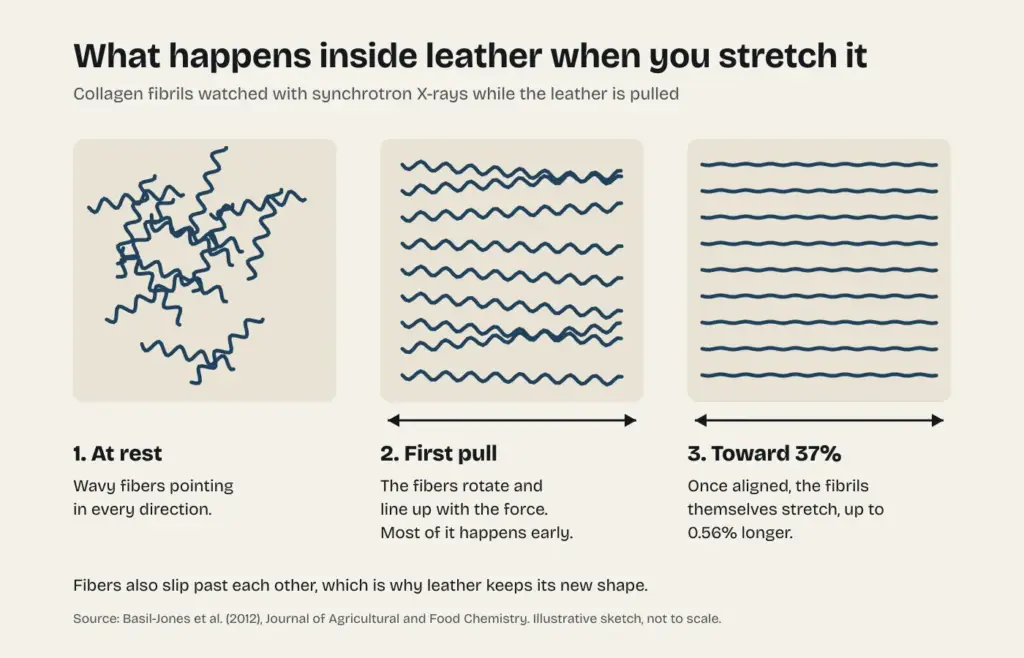
Leather is collagen, a dense three-dimensional tangle of protein fibers that tanning locks in place, as we explain in our story on how leather is made. What those fibers do when you pull on them has actually been watched from the inside. In 2012, a team at Massey University in New Zealand, including M. M. Basil-Jones and R. G. Haverkamp, stretched strips of sheep and cow leather until they tore, while shining X-rays from a synchrotron through them. A synchrotron is a particle accelerator that produces light intense enough to reveal which way collagen fibrils are pointing.
What they saw, reported in the Journal of Agricultural and Food Chemistry, happens in two stages. First, the fibers rotate and line up with the pull, so the leather lengthens mainly because its network rearranges, not because individual fibers stretch. That realignment tapers off at around 5 to 10 percent strain. After that, the load starts reaching the fibrils themselves, and at 37 percent strain the repeating spacing along the collagen had grown by up to 0.56 percent. Not every leather behaved the same way, either. In stronger leathers the stress spread evenly through the thickness, while in weaker ones it concentrated in certain zones.
The same group then pushed the idea further. In 2018, they stretched sheepskins 10 percent in two directions while they were being chrome tanned, and the fibrils stayed more aligned for good. Their orientation index rose from 0.48 to 0.79, and tear strength, adjusted for thickness, climbed from 27 to 43 newtons per millimeter. It’s a lab-grade demonstration of something cobblers always suspected: leather remembers the shape you force it into.
Engineers have a name for that. Leather is viscoelastic, meaning it acts partly like an elastic solid and partly like an extremely thick fluid. Hold it stretched, and the force it uses to pull back gradually fades, a process called stress relaxation. An introductory polymer course from Britain’s Open University uses exactly this example: leather shoes and boots, where stress relaxes under the constant strain of the foot. Let go, and leather only recovers part of the stretch. There’s even a European technical specification, CEN/TS 14689 from 2006, for measuring that leftover deformation in leather, which the trade calls bagginess, along with creep and relaxation.
A 1976 U.S. patent assigned to Fiberwoven Corporation put it in shop-floor terms: the fibrous nature of leather lets the fibers slip past one another under continued stress, so the shoe ends up, in effect, custom molded to the wearer’s foot.
Water, oil and heat
Water changes the rules. The 1952 bulletin was blunt about it: wet leather is soft, so it stretches out of shape easily and stitches cut through it. In 2019, the Massey team, working with researchers at the Max Planck Institute of Colloids and Interfaces in Potsdam, Germany, measured why. With more moisture, water gets inside the fibrils, pushes the collagen molecules apart and makes the leather more flexible. The authors described it as a lubricating effect of water inside the fibril. That’s the physics behind almost every home trick that starts with dampening a shoe.
Oil matters too. Tanneries work oils into leather, a step called fatliquoring, so it comes out soft and strong. A 2015 study from the same group, published in the Journal of the American Leather Chemists Association, found that adding as little as 2 percent fatliquor made leather 11.3 percent more extensible. Oddly, the X-rays didn’t show the oil lubricating the fibrils, which is what the trade had always assumed. Whatever it was doing, it was doing it somewhere else.
Heat is a different story, and it’s the one that ruins the most shoes. When wet leather is heated, it reaches a point where the collagen shrinks, known as the shrinkage temperature. In 1948, Charles E. Weir of the National Bureau of Standards measured how leather changes volume as it’s heated in water. Using the official federal method of the day, vegetable-tanned leather shrank at 68 °C, about 154 °F, and alum-tanned leather at 73 °C, about 163 °F. But in his slower tests, the change started earlier: around 60 °C, or 140 °F, for the vegetable-tanned leather, and around 35 °C, or 95 °F, for the alum-tanned. Shrinkage didn’t happen at one fixed temperature but across a band that depended on conditions, and it was irreversible. Leather that went past that point never returned to its original size, and left hot long enough, it almost completely dissolved into gelatin. Chrome-tanned leather is far more heat-stable. ASTM D6076, the U.S. standard for this test, singles out chrome tannage as an especially stable one.
The 1952 bulletin offered a kitchen-table version of that limit: if wet leather gets hotter than your hand can stand, it’s almost certain to be damaged. It shrinks, hardens, tightens and loses its shape. Exactly the opposite of what you were going for.
Patent leather, and leather that gives too much
Not all leather gives equally. Patent leather is leather with a film of varnish or lacquer on top, and the 1952 bulletin explained the factory trick behind it: the leather is thoroughly stretched before varnishing, so it has practically no give left, and the finish is nearly airtight and watertight. That’s why, it said, patent leather sometimes proves uncomfortable. Stretching patent leather means asking more of a hide that was already pulled to its limit, under a film that, the bulletin added, loses flexibility with age and develops fine checks.
That cracking risk has its own lab test. SATRA, the British footwear research center, uses method TM24, the lastometer test, to measure how far an upper material can be stretched in two directions at once before it’s damaged. A small metal ball pushes into the center of a clamped disk of material, mimicking what happens when an upper is pulled over the last, and the technician records the point where the first cracks appear on the grain surface, even if the material hasn’t burst yet. The surface usually fails first, and it’s the part you see.
At the other extreme is leather that gives too much. The 1952 bulletin ruled out sheepskin for shoe uppers because, although very soft, it’s loose and stretchy and not durable, and uppers made from it soon get out of shape. In 2018, the Massey group noted that sheep leather has roughly half the tear strength of cowhide, which is exactly why it isn’t considered suitable for shoes. A shoe that stretches easily isn’t necessarily a better shoe.
Why synthetics bounce back
Synthetic uppers behave differently, and the patents written by the people trying to imitate leather say so. A typical artificial leather is a sandwich: a woven or nonwoven fabric backing with a layer of polymer on top, usually polyurethane or PVC. The fabric backing provides strength, and it’s also what holds the material back when you try to stretch it.
The 1976 Fiberwoven patent laid it out plainly. Conventional artificial leathers, with a lot of polymer film and a woven backing, have some elasticity, but that elasticity doesn’t turn into a permanent set the way leather’s does. All the materials in common use at the time, the inventor wrote, suffered from the effects of “memory”: they kept trying to return to their original shape. That, the patent claimed, is why people wearing conventional artificial leather felt discomfort that leather wearers didn’t. It’s the argument of someone selling an alternative material, so read it accordingly, but it describes the effect well.
Another patent, granted in 1976 to the British company Porvair, puts numbers on it. Conventional upper leather substitutes of the day had ultimate elongations of roughly 20 to 60 percent, while its elastomeric microporous polyurethane sheet could stretch more than 200 percent. Even so, the patent said, uppers made from it kept their lasted shape very well, and when deformed, returned to it almost completely overnight. In other words, the material stretched far more but refused to stay stretched. Conventional substitutes, it added, didn’t hold their lasted shape to any significant degree either.
Stretch and knit fabrics, now everywhere in sneakers, take that to the extreme. They’re designed to expand with your foot and spring back to size as soon as you take the shoe off. They give while you’re wearing them and recover afterward. A cotton canvas shoe without spandex sits somewhere in between: the weave can usually open up a bit, but it has none of the collagen network that lets leather remember a new shape.
The parts that won’t budge
Some parts of a shoe are built specifically not to move. The toe puff keeps the toe box in shape, and the heel counter holds the heel. A European patent from 2020 on materials for these parts describes them as polymers that are both stiff and resilient, able to return the shoe to its shape even after it has been deformed. They’re heat-formed at the factory. The material in that patent is shaped at around 70 to 80 °C, roughly 160 to 175 °F, and the authors stress that it shouldn’t need more than 100 °C, or 212 °F, because the parts are heated in place, right next to other components that don’t tolerate heat.
That explains two things. First, trying to widen the toe of a shoe with a stiff toe puff means fighting a part designed to spring back. Second, heat really can reshape it, because that’s how it got its shape in the first place. But heating a shoe enough to reshape the toe puff also means heating the leather, the lining and the adhesives around it. What’s carefully controlled on a production line isn’t controlled in your kitchen.
The shoe stretcher, patented in 1872
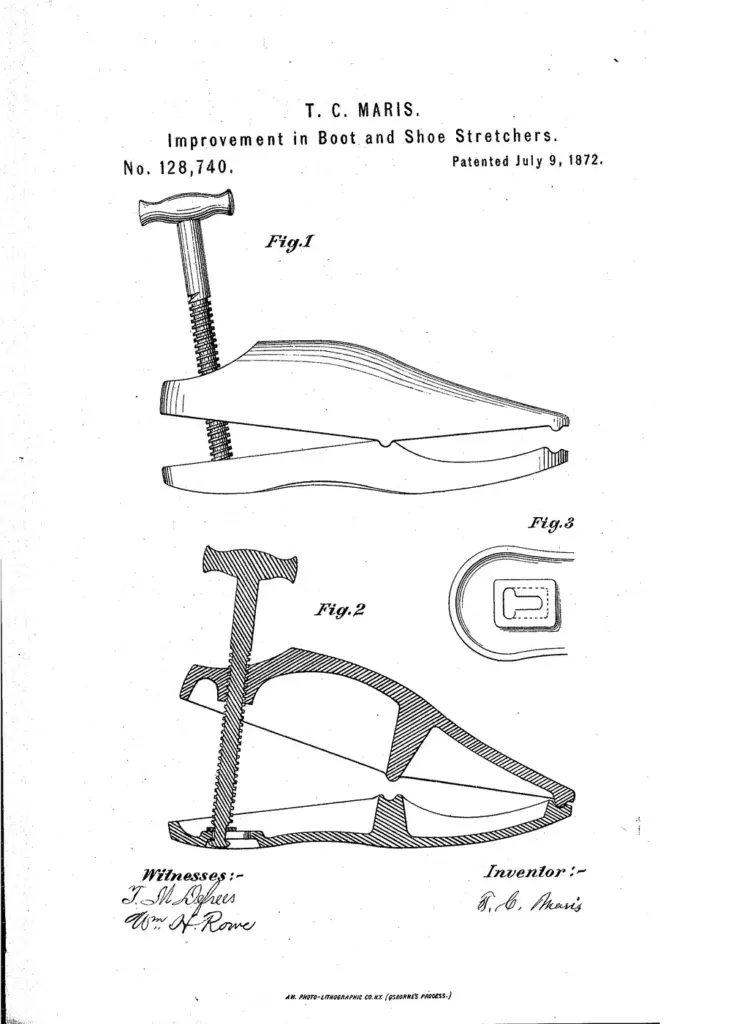
The classic tool for stretching shoes is more than 150 years old. On July 9, 1872, the U.S. Patent Office granted Thomas C. Maris of Marietta, Ohio, Patent No. 128,740 for an “Improvement in Boot and Shoe Stretchers”: a last split into two sections, joined by an adjusting screw at the heel and pivoting on a fulcrum below the instep, so that turning the screw spread the halves apart and opened the shoe at the toe or the instep, depending on the version.
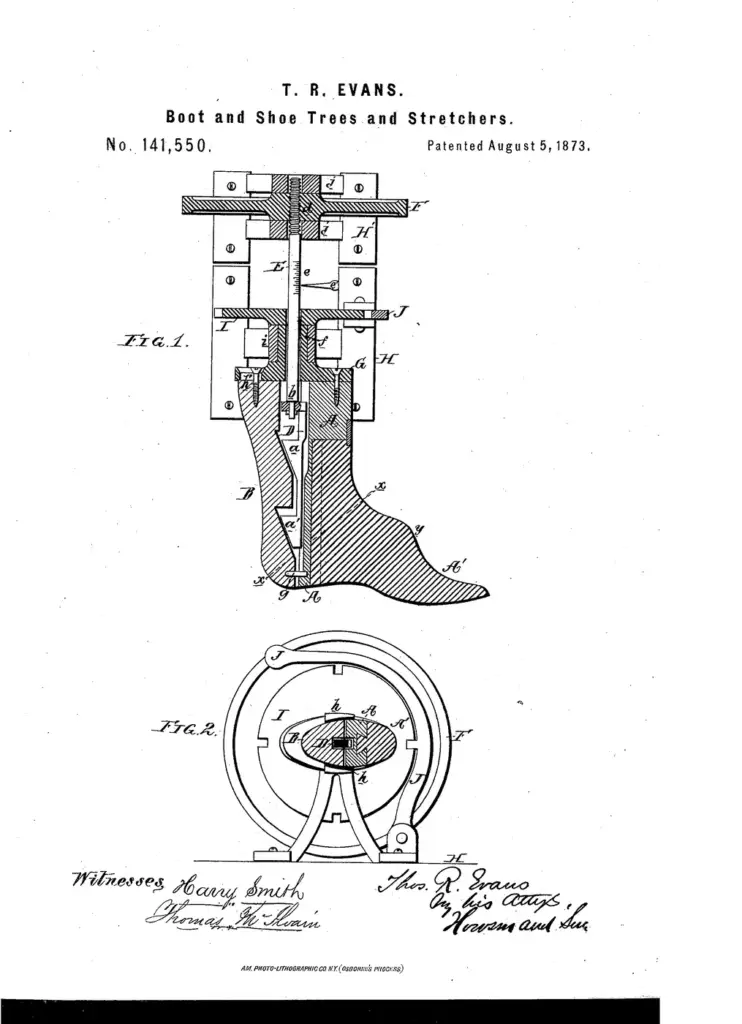
A year later, on August 5, 1873, Thomas R. Evans of Philadelphia patented his own take as No. 141,550: two sections pushed apart by wedges driven by a screw rod and a hand wheel, with a scale and pointer so the operator could tell exactly how much stretch had been applied. It also came with a detachable toe piece sized to the shoe, with projections at the spots that needed the most stretch, such as the instep.
In 1923, Charles Leslie Bower published Practical Shoe Repairing in Seattle, and his list of basic shop equipment included “small and large stretchers,” right alongside the pinchers, the nail set and the sanding wheels.
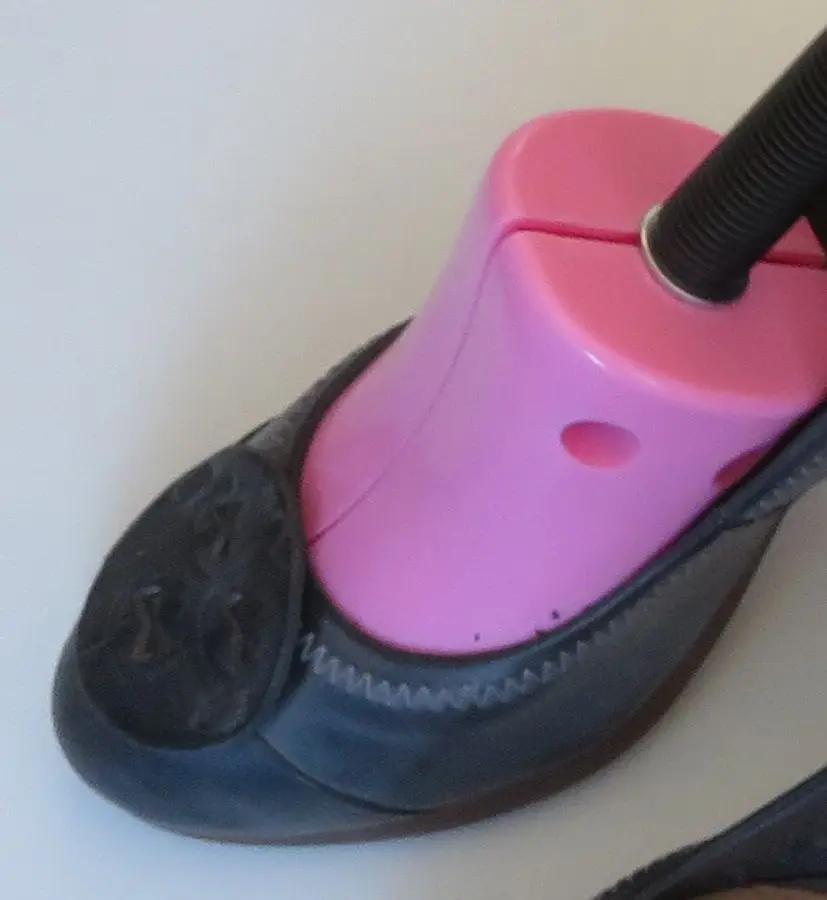
The stretchers sold for home use today work on the same principle as Maris’s: a screw that spreads two halves apart inside the shoe. What they apply is sustained strain, and leather does the rest. It relaxes under that tension and keeps part of its new shape.
What each home trick actually does
With all that in mind, the popular tricks make more sense, although we haven’t found any of them measured in an independent study.
The freezer. You put a tightly sealed bag of water in the shoe and leave it in the freezer overnight. The physics is real: according to the U.S. Geological Survey, water’s density drops by about 9 percent when it freezes, so ice takes up more room than the water it came from and pushes outward. That 9 percent applies to the water in the bag, not to the shoe, and the ice pushes wherever it meets the least resistance, which isn’t necessarily where the shoe pinches. On a synthetic with memory, the push lasts about as long as the ice does. And if the bag leaks, the leather gets soaked, which is exactly when the 1952 bulletin said it’s easiest to stretch out of shape.
The hair dryer. Heat softens thermoplastics, including many synthetic uppers and the toe puff and heel counter, which is why this trick sometimes seems to work. But warm, damp leather is creeping toward its shrinkage temperature, which in Weir’s vegetable-tanned samples started around 140 °F. The 1952 bulletin’s rule of thumb, your hand, is still the best home thermometer anyone has offered.
Rubbing alcohol. You rub it into the inside of the leather and walk around in the shoes. We couldn’t find any study that explains or measures what it does to the collagen in footwear, so any explanation would be made up. What we do know is that water, which is usually part of the mix, makes leather more flexible, and that what sets the new shape is sustained strain, not the liquid.
The potato and the wet newspaper. Both work as improvised stretchers pushing from the inside, with some moisture thrown in. The difference from a real stretcher is that you can’t adjust or measure them, which is precisely what Evans patented in 1873.
The cobbler, and the limit
A cobbler works with the same physics, but with tools that control how much pressure goes where, and with the judgment to tell which leather can take it and which is about to crack. What a cobbler can’t do, and nobody can, is the thing the 1952 bulletin already ruled out: make a shoe longer. If the problem is length, stretching won’t fix it.
That’s why the best time to stretch shoes is before you buy them. Getting your shoe size from an actual measurement, trying shoes on in the afternoon, when they feel tighter, and paying attention to the last, which is what sets the width, makes nearly every trick in this story unnecessary. And if a leather shoe is a little snug across the toes, you now know what’s happening inside: collagen fibers that will eventually rotate and slide until they’ve made room. A synthetic that pinches will most likely keep pinching.
Sources
- F. P. Veitch, R. W. Frey and H. P. Holman, revised by J. S. Rogers, I. D. Clarke and H. P. Holman, Leather Shoes: Selection and Care, Farmers’ Bulletin 1523, U.S. Department of Agriculture (1927, revised 1952).
- Canadian Centre for Occupational Health and Safety (CCOHS), Safety Footwear, fact sheet revised 2025.
- M. M. Basil-Jones, R. L. Edmonds, G. E. Norris and R. G. Haverkamp (2012), “Collagen fibril alignment and deformation during tensile strain of leather: a small-angle X-ray scattering study,” Journal of Agricultural and Food Chemistry 60(5): 1201–1208.
- S. J. Kelly et al. (2018), “Artificially modified collagen fibril orientation affects leather tear strength,” Journal of the Science of Food and Agriculture 98(9): 3524–3531.
- S. J. R. Kelly et al. (2019), “Effect of collagen packing and moisture content on leather stiffness,” Journal of the Mechanical Behavior of Biomedical Materials 90: 1–10.
- K. Sizeland et al. (2015), “Fatliquor effects on collagen fibril orientation and d-spacing in leather during tensile strain,” Journal of the American Leather Chemists Association 110(11).
- C. E. Weir (1948), “Effect of temperature on the volume of leather and collagen in water,” Journal of Research of the National Bureau of Standards 41: 279–285.
- ASTM International, D6076, Standard Test Method for Shrinkage Temperature of Leather.
- The Open University, Introduction to polymers, OpenLearn, section on creep and stress relaxation.
- CEN/TS 14689:2006, Leather. Physical and mechanical tests. Determination of bagginess, creep and relaxation.
- SATRA, TM24: Lastometer ball burst test.
- A. M. Smith II (Fiberwoven Corp.), U.S. Patent 3,940,532, “Needled textile fabric with a thin polymeric coating thereon” (1976).
- V. R. Cunningham and D. L. Boutle (Porvair), U.S. Patent 3,982,335, “Shoe uppers” (1976).
- European Patent EP 3120722 B1, “Thermoformable polyamide ionomer material for heel counter and toe puff” (2020).
- T. C. Maris, U.S. Patent 128,740, “Improvement in boot and shoe stretchers” (1872).
- T. R. Evans, U.S. Patent 141,550, “Improvement in boot and shoe trees and stretchers” (1873).
- C. L. Bower (1923), Practical Shoe Repairing, Seattle.
- U.S. Geological Survey, Water Density.
Image credits
- Patent leather court shoe: Kan8eDie. CC BY-SA 3.0, via Wikimedia Commons.
- What gives in a shoe chart: feetkeepers.
- Collagen fibers under strain diagram: feetkeepers.
- Drawing from U.S. Patent 128,740 by T. C. Maris (1872): U.S. Patent Office. Public domain.
- Drawing from U.S. Patent 141,550 by T. R. Evans (1873): U.S. Patent Office. Public domain.
- Shoe with a stretcher inside: Sciencia58. Public domain (CC0), via Wikimedia Commons. Cropped.