
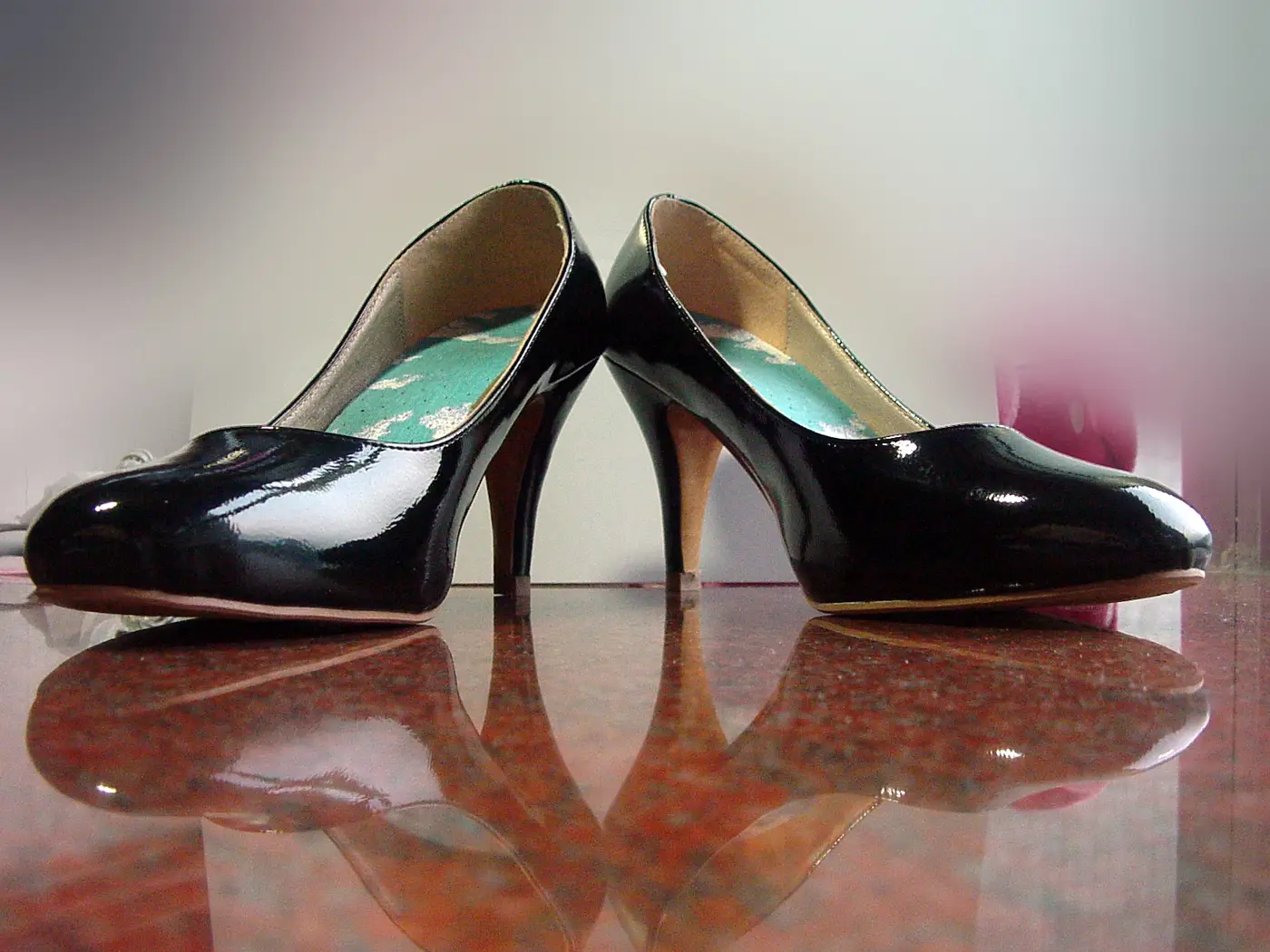
Mandatory high heels at work sound like a relic from a 1960s airline ad, and yet in 2016 a London firm sent a receptionist home for showing up in flats. In 2019, Japan’s labor minister told lawmakers heels could be required if they were necessary for the job. In 2023, Australia’s national airline finally stopped requiring them. This isn’t old history. It’s a live fight between a company’s right to set a dress code and a worker’s right not to carry a burden just because she’s a woman. And the legal question underneath is deceptively simple: can your boss decide how high your shoes are?
There’s irony baked in. As we told in men in high heels, the heel started out as men’s footwear, for riders and aristocrats. Centuries later, the dress codes that demand it are written almost entirely for women.
The word that changed everything: stereotype
In the U.S., there’s no federal law about heels. There is, however, a body of case law about what heel rules are really about, and it starts with a coincidence worth savoring. In 1989 the Supreme Court decided Price Waterhouse v. Hopkins. The defendant was the accounting firm that would later become PricewaterhouseCoopers, the same PwC whose London reception desk would start the most famous heels case of all, more than a quarter century later.
According to Wikipedia, Ann Hopkins was a project manager at the firm who was passed over for partner two years running. One partner’s written evaluation said what she needed was “a course in charm school.” Her department head told her that to improve her chances she should “walk more femininely, talk more femininely, dress more femininely, wear make-up, have her hair styled, and wear jewelry.” She sued under Title VII of the Civil Rights Act of 1964, and the Court held that penalizing someone for not matching a stereotype of how a woman should act or look is sex discrimination. That single idea, sex stereotyping, is the legal lens through which American lawyers still look at dress codes.
The bartender who wouldn’t wear makeup
The lens turned out to be blurrier for appearance rules than many expected. In 2000, according to Wikipedia, Harrah’s Casino in Reno, Nevada, rolled out a “Personal Best” policy with strict grooming standards, including a requirement that women wear face powder, blush, mascara and lipstick. Darlene Jespersen, a bartender with 20 years at the casino, refused and was fired. She sued in 2001 and lost in district court, which found the policy put “equal burdens” on both sexes.
In 2006, in Jespersen v. Harrah’s Operating Co., the full Ninth Circuit Court of Appeals agreed that grooming rules like this could in some cases be challenged as sex stereotyping, but ruled for the casino because, in its view, Jespersen hadn’t shown evidence that the policy was motivated by stereotypes. Two dissents are still quoted. Judge Harry Pregerson wrote that the policy carried the message that women’s faces are incomplete or unprofessional without full makeup. Judge Alex Kozinski pointed out that nobody needs an expert witness to know makeup costs money and takes time, and invited his colleagues to imagine a rule requiring every judge to wear face powder, blush, mascara and lipstick on the bench.
Swap “makeup” for “heels” and you have the shape of most of the arguments that follow: is it the same burden for everyone, or a burden placed on one sex only, justified by nothing more than an idea of how women should look?
Cocktail servers and flight attendants
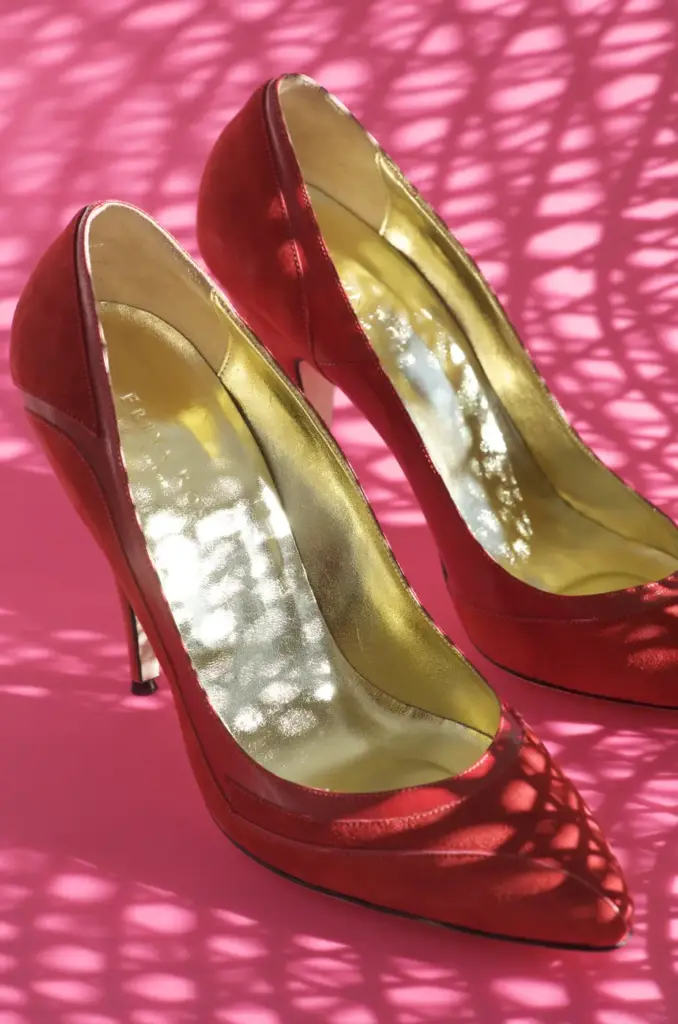
The workplaces where heel rules have shown up most often are the ones built around being looked at. According to Wikipedia, in the mid-1990s several U.S. airlines required female flight attendants to wear heels, with minimum heights ranging from half an inch up to the two inches USAir demanded. Some attendants quietly dodged the rule by changing into more comfortable shoes once the plane was in the air, where supervisors were less likely to see them.
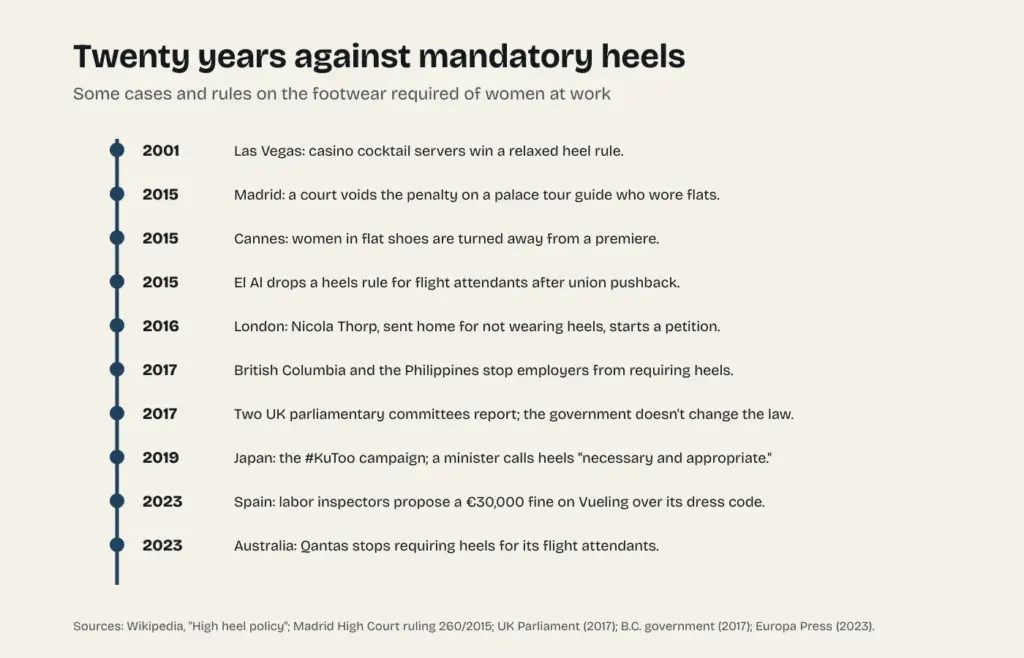
In 2001, cocktail waitresses in Las Vegas organized a campaign with a name that left nothing to interpretation, “Kiss My Foot,” and, according to the same source, got casinos to relax their heel requirements. It’s worth noticing what kind of work this was: hours on hard floors, carrying trays, in the same building where, as we explain in shoe traction on wet floors, the grip of a sole depends on its rubber and pattern far more than on how elegant it looks.

Other airlines took longer. In 2015, according to Wikipedia, Israel’s El Al introduced a rule that female flight attendants wear heels until passengers were seated; the union told its members to ignore it, citing their health and safety, and the rule was dropped that same year. In 2023, Qantas announced its female flight attendants no longer had to wear heels.
The receptionist sent home without pay
The case that turned all this into a global news story began on Nicola Thorp’s first day as a temp receptionist, placed by the outsourcing firm Portico at PwC’s London office. According to Wikipedia, she said she was sent home unpaid for refusing to follow a dress code that, by her account, required shoes with a 2- to 4-inch heel. Portico said Thorp had signed the appearance guidelines. But after she launched an online petition titled “Make it illegal for a company to require women to wear high heels at work,” the firm changed its policy: female staff could wear plain flat shoes or plain court shoes, whichever they preferred.
The petition drew more than 130,000 signatures, enough to force a debate in Parliament, with backing from Scotland’s First Minister Nicola Sturgeon and several members of Parliament. In January 2017, two parliamentary committees, Petitions and Women and Equalities, published a joint report, High heels and workplace dress codes, concluding that Portico had broken the law, though by then it had already changed its terms. On March 6, 2017, the House of Commons held the debate, and the MPs who spoke called on the government to change the law.
There was an earlier warning few people remembered. In 2009, the U.K.’s Society of Chiropodists and Podiatrists published a report on wearing heels for long periods and approached unions and employers about including women’s footwear in workplace risk assessments, with alternatives where needed. Seven years later, nothing much had moved.
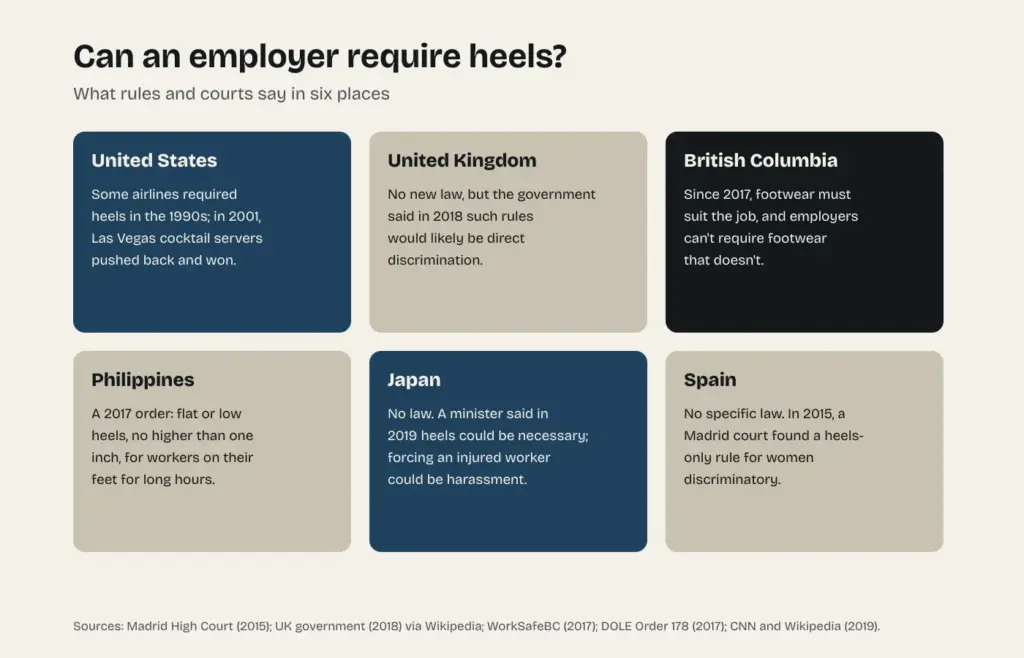
The government answered in April 2017 that it would not change the law because existing legislation was “adequate.” What it did do, in May 2018, was publish guidance on dress codes. According to Wikipedia, that guidance said requiring women to wear heels would likely be direct discrimination, even if men were also required to wear shoes that “look smart,” and could also be indirect discrimination against people with mobility or vision problems. So the law didn’t change, but the government admitted in writing that the existing law very probably already banned what had happened to Thorp. It took a petition, a report and a debate for someone to say so.
Japan’s #KuToo: shoes and pain
In Japan, the protest came with a pun. In 2019, Yumi Ishikawa, an actress, freelance writer and part-time funeral parlor worker, complained on Twitter about the heels her job required. According to Wikipedia, many Japanese companies expect women to wear heels of 5 to 7 centimeters, roughly 2 to 2.75 inches. Her post was retweeted nearly 30,000 times, other women answered with their own stories and photos of blistered feet, and #KuToo was born, blending #MeToo with kutsu, shoes, and kutsū, pain. Ishikawa gathered 18,856 signatures and delivered them to the Ministry of Health, Labour and Welfare.
What Minister Takumi Nemoto said at a parliamentary committee session on June 5, 2019, made headlines around the world, though not always the same headline. According to the transcript summarized on Wikipedia, he said that requiring women to wear heels should stay within what is reasonably necessary, judged by common sense for each workplace, and that forcing a worker with a foot injury to wear them without need could be considered power harassment. Some outlets reported that he wouldn’t condone mandatory heels; others, CNN among them, that he called them “necessary and appropriate.” Asked to clarify, the ministry put it this way: forcing heels where they lead to accidents or injury is unacceptable, but the government can’t bar companies from requiring them unless the requirement goes beyond what’s necessary and reasonable for the work.
Ishikawa’s next move was more vivid than a petition. That same month, she organized an event in Tokyo where men put on heels and tried to walk in them. And the debate spread to another unwritten rule: some employers had told women not to wear glasses at work because they gave a “cold impression,” and women answered online under a hashtag meaning “glasses are forbidden.”
The places that changed the rules
Some governments went further. On April 7, 2017, the Canadian province of British Columbia amended section 8.22 of its Occupational Health and Safety Regulation by order in council. The interesting part is that the amended rule never says “high heels.” According to the provincial government’s release and WorkSafeBC, the province’s workplace safety agency, it requires footwear of a design, construction and material that lets workers do their job safely, and says employers can’t require footwear that falls short of that. To decide what’s appropriate, the rule lists hazards to weigh: slipping, tripping, uneven terrain, abrasion, ankle protection and foot support, crushing, musculoskeletal injury, temperature extremes, corrosive substances, punctures and electrical shock, among others. It’s the same logic as the safety standards we covered in steel toe boots, run in reverse: instead of adding protection, it stops employers from taking it away.
Premier Christy Clark said the province was changing the regulation to stop an “unsafe and discriminatory practice,” and according to Wikipedia other Canadian provinces followed. There was a trigger close to home: in 2014, waitresses at three restaurant chains in Calgary, in neighboring Alberta, said they were required to wear heels; management answered that there was no written policy on heels.
That same year, the Philippines’ Department of Labor and Employment issued Department Order No. 178, on safety and health measures for workers who have to stand at work. It covers private-sector employees who are required to wear heels, who stand for long hours or whose jobs involve frequent walking. According to a summary in the HR trade magazine HCAMag, it calls for practical footwear that doesn’t pinch the toes, fits well, doesn’t slip and supports the arch, with flat or low heels no higher than one inch, wide-based or wedge type. It also requires rest breaks to cut time spent standing and accessible seats where the work can be done sitting down. The labor federation ALU-TUCP praised it as an answer to a request from saleswomen.
Spain: a palace guide and an airline
Spain has no law on heels either, but its courts have ruled on them. On March 17, 2015, the labor chamber of the Madrid High Court of Justice decided the case of a tour guide at Patrimonio Nacional, the agency that runs the royal palaces. Women guides were required to wear heels; men in the same job wore flat shoes. The agency had disciplined the guide, and a lower court had sided with the employer. The High Court didn’t. According to published summaries of the ruling, it found that requiring heels of women and flats of men was a sex-based difference in treatment without objective justification, unnecessary and disproportionate because the employer could allow either flats or heels without breaking the uniform look, and it voided the sanction.

In March 2023, according to Europa Press, the labor inspectorate of Catalonia proposed a €30,000 fine against the airline Vueling over its dress and makeup codes, after a complaint filed in April 2022 by the cabin crew union Stavla. The airline had required female cabin crew to wear heels of 5 to 8 centimeters, about 2 to 3 inches, plus foundation matching their skin tone and black eyeliner and mascara. Vueling said it had removed the gender distinction from its code, made makeup “totally optional” and offered several shoe styles starting at a 3-centimeter heel, and that it was considering an appeal.
When the heel was what got banned
The story has a flip side. In the 1950s, as stiletto heels spread, the people who ran buildings started worrying, though not about the women in them. All that weight concentrated on a tiny tip dented wood, linoleum and mosaic floors and jammed heels into grates and gaps. According to Wikipedia, signs went up banning stilettos, mostly in vain, and a 1963 article in a U.S. building maintenance magazine estimated that replacing damaged floors had cost the country at least half a billion dollars since the fashion took off. We ran the numbers on that pressure in comfortable high heels.
Bans don’t always last longer than trends, either. In 2023, a Washington, D.C., club called Bunker opened with a ban on high heels, open-toed shoes and flip-flops “for customer safety.” Within a month it dropped the heel ban in favor of a strong warning: the club is dimly lit, underground and full of concrete floors and steps. And in 2015, at the Cannes Film Festival, a group of women were turned away from a premiere for wearing flats, among them a woman who couldn’t wear heels after surgery on one foot; the organizers later said the rumor that the festival required heels on the steps was baseless.
Who gets to decide
This isn’t a debate about whether heels are beautiful, or whether anyone wants to wear them. It’s about who decides. An employer can require specific footwear for safety, as we explain in work shoes, where the standards call for protective toes, slip-resistant soles or electrical protection depending on the job. The fight is over whether it can require footwear purely for looks, and only from women. In every case here, the courts and governments that moved pointed the same way: shoes have to work for the job, and anything demanded of one sex and not the other needs a justification that appearance alone doesn’t supply.
A shoe someone picks is fashion. A shoe someone imposes on half the staff is a workplace rule, and workplace rules can be challenged. Ann Hopkins did it with a lawsuit, the Las Vegas cocktail servers with a slogan, Nicola Thorp with a petition and Yumi Ishikawa with a hashtag and a pun.
Sources
- U.S. Supreme Court, Price Waterhouse v. Hopkins, 490 U.S. 228 (1989).
- U.S. Court of Appeals for the Ninth Circuit, Jespersen v. Harrah’s Operating Co., 444 F.3d 1104 (2006) (en banc).
- U.K. Parliament, Petitions Committee and Women and Equalities Committee (2017), High heels and workplace dress codes.
- Government of British Columbia (2017), “B.C. bans mandatory high heels in the workplace”, April 7, 2017; WorkSafeBC announcement.
- Philippines Department of Labor and Employment, Department Order No. 178 (2017), summary in HCAMag.
- CNN (2019), “Japanese minister says high heels are ‘necessary and appropriate’ at work”.
- Madrid High Court of Justice, Labor Chamber, ruling 260/2015, March 17, 2015 (ECLI:ES:TSJM:2015:5341), summary in LP Derecho (in Spanish).
- Europa Press (2023), Vueling fine report, via Diario de Avisos, March 23, 2023 (in Spanish).
- Wikipedia: High heel policy, KuToo movement, Price Waterhouse v. Hopkins and Jespersen v. Harrah’s Operating Co..
Image credits
- Black pumps: SoHome Jacaranda Lilau. Public domain, via Wikimedia Commons.
- Patent leather heels: THOR. CC BY 2.0, via Wikimedia Commons.
- Flight attendant in 1965: Archives New Zealand. CC BY-SA 2.0, via Wikimedia Commons (cropped, with the airline’s name blurred).
- Royal Palace of Madrid at night: Carlos Delgado. CC BY-SA 3.0, via Wikimedia Commons.
- Rules chart and timeline: feetkeepers.