
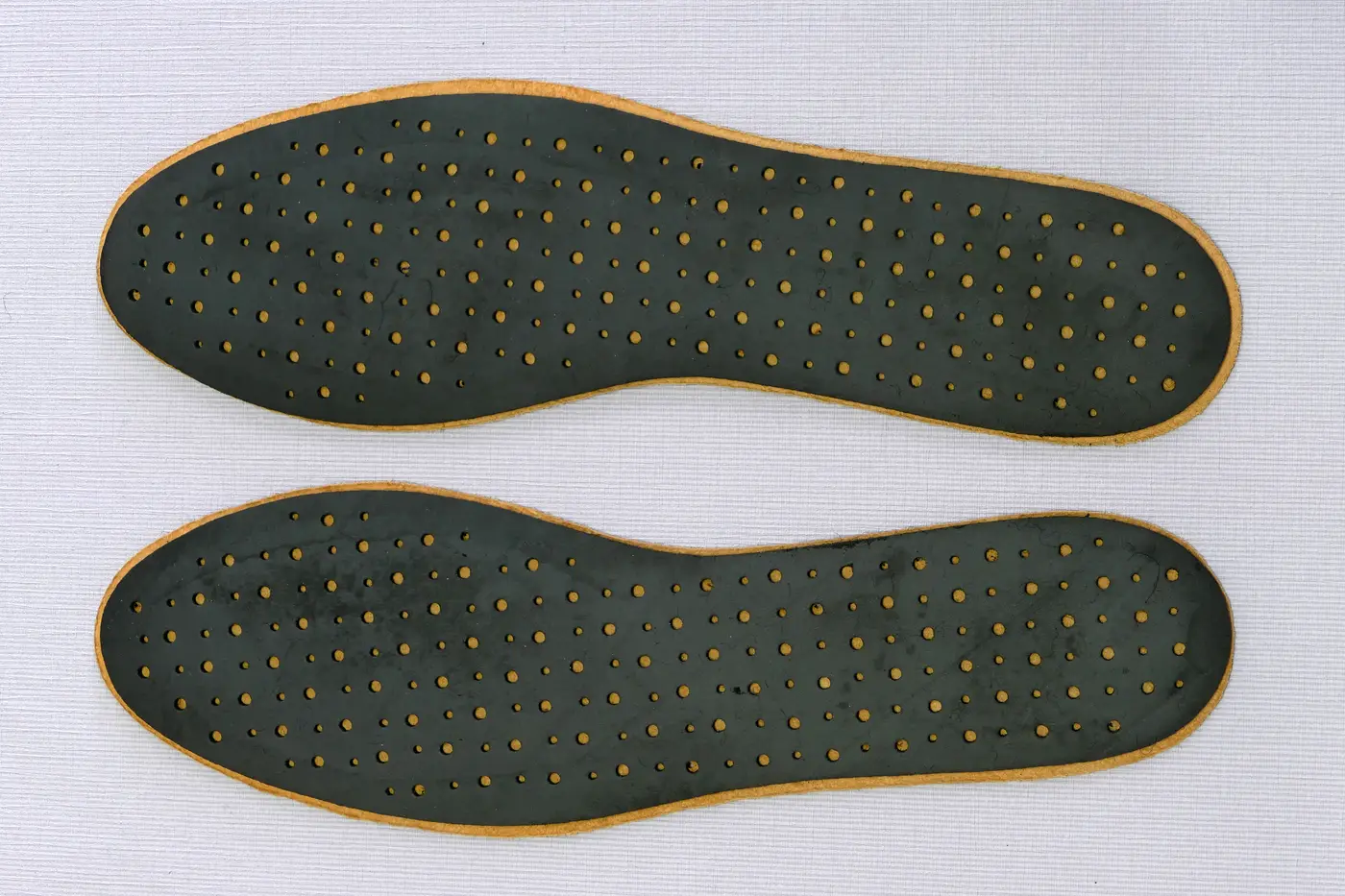
Shoe odor isn’t the shoe’s fault, but the shoe is where it’s stored. The smell gets made on the foot and then settles into the footwear, soaked into the lining, the insole and the foam, one day after another. That’s why a pair can reek even with fresh socks, and why most of the popular fixes don’t work: they go after the smell you notice right now, not the reservoir that keeps feeding it. A few work because of plain chemistry. Others only cover things up. And one of the most popular, the freezer trick, doesn’t do what people think it does.
A smell you can detect in parts per million
We’ve covered where foot odor comes from in other stories, so here’s the short version. The main culprit is isovaleric acid, which forms when certain normal skin bacteria break down an amino acid in sweat, as we explain in how many pairs of shoes you need. PubChem, the chemistry database run by the National Institutes of Health, describes its odor as disagreeable and like rancid cheese, and lists an odor threshold starting at 0.0015 parts per million. In plain terms, a vanishingly small amount is enough for your nose to pick it up.
That one number explains almost everything that follows. If a handful of molecules is enough to smell, a shoe doesn’t have to be soaked to stink. All it needs is a bit of old sweat tucked away somewhere, released a little at a time.
Who makes the smell, and why a mosquito mistakes it for cheese
The chemistry of foot odor started coming apart inside socks. In 1990, a Japanese team led by F. Kanda reported in the British Journal of Dermatology on what could be extracted from the socks and feet of two groups: people with strong foot odor and people with little or none. Using gas chromatography with mass spectrometry, an instrument that separates a mixture into its components and identifies each one, they found short-chain fatty acids, in much larger amounts in the strong-odor group. Isovaleric acid turned up in everyone with foot odor and in no one without it. The experiment had a kicker, too: by incubating sweat and skin oils from the strong-odor subjects, the researchers recreated the smell in the lab, with an acid profile similar to the real thing.
We’ve already met the main bacterium: Staphylococcus epidermidis, a normal resident of the skin that, according to a 2006 study from the labs of the Japanese company Kao, converts leucine in sweat into isovaleric acid. The same study flagged another suspect: on the soles of people with stronger foot odor, the researchers found Bacillus subtilis, a bacterium they linked closely with more intense smell. And in 2015, a study by Unilever and Loughborough University showed that staphylococci made up almost the entire bacterial population on the sole, exactly where volatile fatty acids were highest.
Acids aren’t the only culprits. In 2015, researchers at the Japanese cosmetics company Mandom sniffed 118 armpits and feet directly, identified the compounds coming off them and published the results in Chemistry & Biodiversity. They found that an unpleasant acidic note was common to both, and that the key compound behind it was butane-2,3-dione, better known as diacetyl, the same molecule that gives butter its characteristic flavor. The more of it there was, the stronger the odor, and adding it to a blend of short-chain fatty acids made the blend smell worse.
The cheese part isn’t a figure of speech. In 1996, Dutch entomologist Bart Knols and his colleague Ruurd de Jong of Wageningen Agricultural University reported in Parasitology Today that Limburger, a washed-rind cheese famous for its smell, attracted Anopheles gambiae, the mosquito that carries malaria in Africa, a discovery that grew out of earlier observations of where this mosquito bites people. In 2006, the work earned them the Ig Nobel Prize in Biology, awarded by the magazine Annals of Improbable Research for research that first makes people laugh and then makes them think, for showing that the female mosquito is attracted equally to the smell of Limburger cheese and to the smell of human feet.
A boot doesn’t dry out on its own
The first reservoir is water. In 1998, Kalev Kuklane and Ingvar Holmér of Sweden’s National Institute for Working Life tested boots with steel toe caps on a thermal foot model, a mannequin foot heated to behave like a real one, fitted with a pump that released artificial sweat through three glands at 10 grams an hour. They published the work in the International Journal of Occupational Safety and Ergonomics. While the foot stayed still, only a minimal amount of that sweat evaporated out of the boots. The water went in and stayed there.
Sweat doesn’t reach every part of the shoe equally. In 2019, a team at Loughborough University in England, including A. M. West and G. Havenith, measured sweat output at 14 spots on the feet of 14 women running on a treadmill, with and without shoes, and published the results in Ergonomics. The sweatiest spots were the inner ankle and the top of the foot; the least sweaty were the toes. Barefoot, the foot produced 22 percent more sweat than in shoes. In a second study that year, in Applied Ergonomics, the same group compared two running shoes with different air permeability. The less breathable shoe ran warmer and more humid inside.

So a shoe is a closed box that takes in water every day and lets it out poorly. Whatever doesn’t evaporate stays in the materials.
The lining, the shoe’s sponge
Shoemakers understood this a century ago. In 1920, the Retail Shoe Salesmen’s Institute in Boston published Materials in Shoes, a materials handbook for shoe salespeople with a whole chapter on linings. According to the handbook, a lining’s most important jobs were to reinforce the leather and seams and to absorb moisture from the foot, which helped the shoe keep its shape longer. Linings were made almost exclusively of cotton, woven four different ways that the handbook illustrated one by one: sheeting, duck, drill and twill.
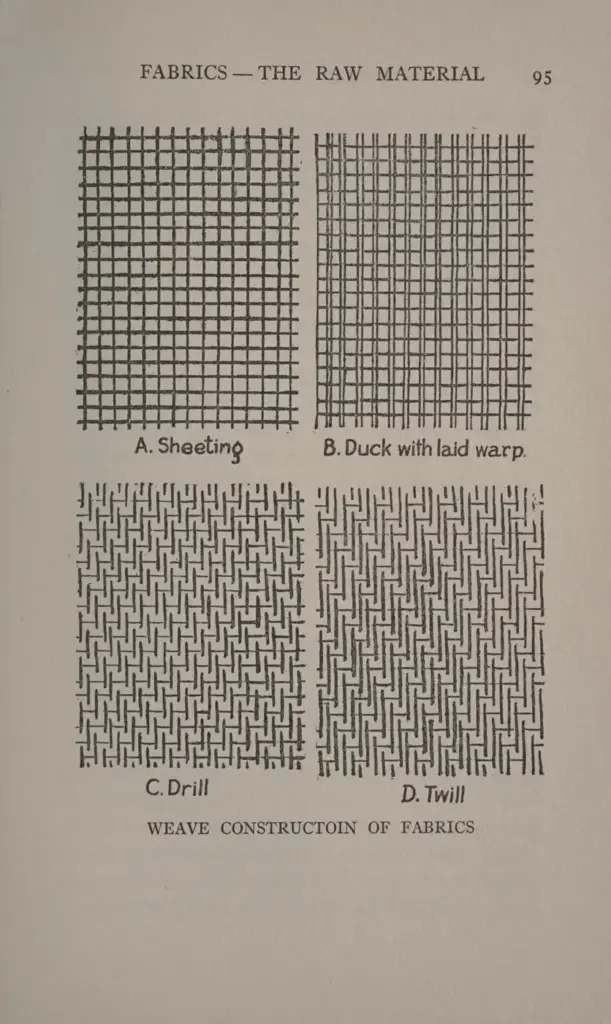
The same book described a trick of the trade. For a while, very light cotton linings had been loaded with starch up to 50 percent of their original weight so they’d seem more substantial. As soon as the foot’s moisture reached them, the starch softened and the lining practically melted away. The handbook figured the cost difference between the worst and the best lining was about 12 cents a pair, and that a shoe with a good lining could wear as much as 20 percent longer.
Whatever soaks up sweat also soaks up what’s dissolved in it. In 2024, R. H. McQueen and two colleagues reported a test in the Textile Research Journal in which six types of fiber were soaked in a synthetic sweat containing odor compounds. Using a mass spectrometer, they measured what each fiber released into the air after 30 minutes, three hours and a day. Above cellulose fibers such as cotton and viscose, they detected fewer ketones and aldehydes than above wool, nylon or polyester at the 30-minute mark. Nylon released the most at first, but by 24 hours polyester was releasing the most. With the acids, the chemical family isovaleric acid belongs to, the fibers barely differed. It isn’t a shoe study, but it describes what happens in a fabric lining well: each material holds on to odor and lets it go at its own pace.
Leather, for its part, is one of the materials that soaks up the most water vapor, as the comparison by Germany’s FILK institute showed in our story on how leather is made. It takes in more, so it has more to give back later.
Insoles in the lab
The footwear industry measures all of this. SATRA, the British footwear research center, has a method called TM9 that measures how much water an insole or lining material absorbs and how fast it gives it up, which SATRA treats as an indicator of how well perspiration will evaporate. Another, TM47, measures water vapor permeability and absorption on a machine that tries to recreate conditions inside a shoe: 100 percent relative humidity at foot temperature.
In 2018, SATRA published a new method, TM360, specifically for odor. A sample of insole material goes into an atmosphere saturated with butyric acid, another acid with a strong, nasty smell, and is weighed to see how much it absorbed. Then clean, dry air is passed over it to see whether it hangs on to the odor, because, as the SATRA Bulletin article introducing the method put it, any absorbed odor has to stay absorbed and not be released. The result is compared with a reference material: carbon.
Activated charcoal, patented in 1974
That reference material has a history. On January 26, 1973, Herbert Lapidus of Ridgefield, Connecticut, filed a patent application on behalf of Combe Incorporated, and on October 22, 1974, he was granted U.S. Patent 3,842,519: an insole made of latex foam impregnated with activated charcoal. The sample recipe used 25 to 32 pounds of charcoal for every 100 pounds of latex. The insole went in latex side down and fabric side up, toward the foot, and the inventor credited its effectiveness to air and vapors circulating through and around the highly absorbent carbon particles as the wearer walked. According to Wikipedia, Lapidus was head of research and development at Combe at the time, and the product launched in 1974.
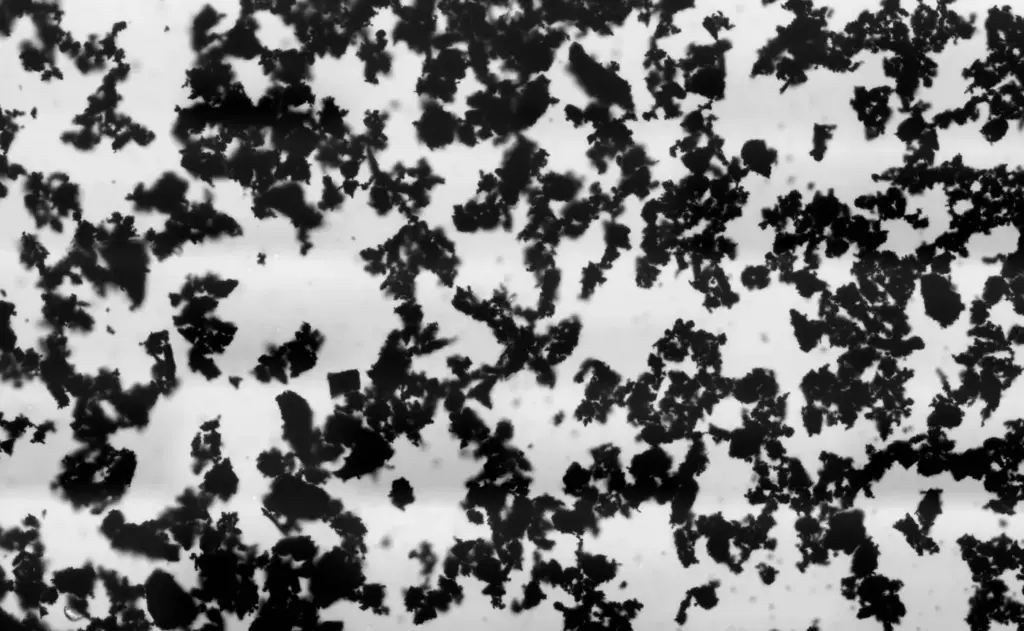
Activated charcoal is carbon processed until it’s riddled with microscopic pores. What it does isn’t absorption, like a sponge, but adsorption: molecules stick to the enormous internal surface of those pores. That’s why it has long been used in water and air filters, as the patent itself pointed out. The patent said the insole substantially reduced or even eliminated foot odor. That’s the inventor’s claim, not an independent test, and we haven’t found published studies measuring how long the effect lasts in real worn shoes before the pores fill up.
Baking soda yes, vinegar no
The home remedy people mention most is baking soda, and in this case the chemistry backs it up. Isovaleric acid is a weak acid, with a pKa of 4.77 according to PubChem, a measure of how readily it gives up its acidic part. Sodium bicarbonate is a mild base. When the two meet, they react: the acid becomes sodium isovalerate, a salt, and water and carbon dioxide are released. A salt doesn’t evaporate at room temperature, so those molecules never make it to your nose.

What the reaction can’t do is reach what it doesn’t touch. The powder neutralizes the acid it comes into contact with on the surface of the insole and the lining, not what’s buried deep in the foam or the seams.
Vinegar is a different story. It contains acetic acid, and one acid can’t neutralize another. What it does is add its own smell, stronger and more familiar, which covers the first one for as long as it lasts. Mixing the two is the worst of both worlds: as we explain in our story on cleaning white sneakers, baking soda and vinegar neutralize each other, and what’s left is mostly water with a little salt.
Dry tea bags, lemon or orange peels and perfumes work, at best, in one of two ways: they soak up a little moisture or they mask the smell with another one. We haven’t found any study measuring them in footwear.
The freezer doesn’t kill anything
Putting shoes in the freezer may be the trick with the weakest basis of all. The USDA’s Food Safety and Inspection Service explains it for food, and the microbiology is the same: freezing to 0 °F inactivates microbes, meaning bacteria, yeasts and molds, but doesn’t kill them. Once thawed, they can become active again and multiply under the right conditions.

A shoe that comes out of the freezer still has the old sweat in its lining and insole, and it goes back to a temperature at which bacteria wake up again. If the smell seems weaker right after, the likeliest reason is the cold itself: odor molecules evaporate less at low temperatures and come back as the shoe warms up. That last point is our own physical reasoning, not a published test.
Dry it, don’t bake it
The only thing that goes after the whole reservoir is getting the water out, and the USDA’s 1952 shoe bulletin is still the best guide we’ve found. Get out what you can, stuff the shoe with crumpled paper so it keeps its shape and dries faster, and leave it somewhere that isn’t too warm. The limit was your hand: if wet leather gets hotter than your hand can stand, it’s almost certain to be damaged. Our story on how to stretch shoes explains why: damp leather shrinks irreversibly at temperatures that in some tannages start around 140 °F.
A removable insole is the best ally drying has, because it exposes one of the parts in closest contact with the foot along with the bottom of the shoe, which otherwise stays covered. Rotation does the rest. A pair that rests a full day between wears has time to release what a pair worn daily keeps piling up, as we explain in how many pairs of shoes you need.
Fabric sneakers that can go in the washing machine are the exception: washing does pull out what drying alone can’t. But the manufacturer decides whether a shoe can be washed and how, and that’s in its care guide.
When the smell isn’t the shoe
Everything above is about the shoe: where the smell settles, why, and what gets it out. If the odor is coming from the foot and sticks around even when you change shoes, that’s no longer a question of materials, and the right move is to see a podiatrist or a doctor.
Sources
- PubChem, Isovaleric acid (CID 10430), U.S. National Library of Medicine: odor, odor threshold and dissociation constant.
- F. Kanda et al. (1990), “Elucidation of chemical compounds responsible for foot malodour,” British Journal of Dermatology 122(6): 771–776.
- K. Ara et al. (2006), “Foot odor due to microbial metabolism and its control,” Canadian Journal of Microbiology 52(4): 357–364.
- D. Stevens et al. (2015), “Spatial variations in the microbial community structure and diversity of the human foot is associated with the production of odorous volatiles,” FEMS Microbiology Ecology 91(1): 1–11.
- T. Hara, A. Kyuka and H. Shimizu (2015), “Butane-2,3-dione: the key contributor to axillary and foot odor associated with an acidic note,” Chemistry & Biodiversity 12(2): 248–258.
- Wikipedia, “Diacetyl.”
- B. G. J. Knols and R. de Jong (1996), “Limburger cheese as an attractant for the malaria mosquito Anopheles gambiae s.s.,” Parasitology Today 12(4): 159–161; and 2006 Ig Nobel Prizes.
- K. Kuklane and I. Holmér (1998), “Effect of sweating on insulation of footwear,” International Journal of Occupational Safety and Ergonomics 4(2): 123–136.
- A. M. West, J. Tarrier, S. Hodder and G. Havenith (2019), “Sweat distribution and perceived wetness across the human foot: the effect of shoes and exercise intensity,” Ergonomics 62(11): 1450–1461.
- A. M. West et al. (2019), “Shoe microclimate: an objective characterisation and subjective evaluation,” Applied Ergonomics 78: 1–12.
- Retail Shoe Salesmen’s Institute (1920), Materials in Shoes, Boston.
- R. H. McQueen, G. T. Eyres and R. M. Laing (2024), “Textile sorption and release of odorous volatile organic compounds from a synthetic sweat solution,” Textile Research Journal 94(21–22): 2392–2405.
- SATRA, TM360: Method for the determination of the odour absorbing properties of insole materials and “New SATRA test method for odour control,” SATRA Bulletin, March 2019.
- H. Lapidus (Combe Incorporated), U.S. Patent 3,842,519, “Deodorizer sheet material” (1974).
- USDA Food Safety and Inspection Service, Freezing and Food Safety.
- F. P. Veitch, R. W. Frey and H. P. Holman, revised by J. S. Rogers, I. D. Clarke and H. P. Holman, Leather Shoes: Selection and Care, Farmers’ Bulletin 1523, U.S. Department of Agriculture (1927, revised 1952).
Image credits
- Leather insoles with a latex foam base: W.carter. Public domain (CC0), via Wikimedia Commons.
- What each trick does to the smell chart: feetkeepers.
- Lining fabrics, Materials in Shoes (1920): Retail Shoe Salesmen’s Institute. Public domain, via Internet Archive.
- Activated charcoal under the microscope: Zephyris. CC BY-SA 3.0, via Wikimedia Commons.
- Baking soda reaction diagram: feetkeepers.
- Isovaleric acid molecule model: Jynto and Ben Mills. Public domain, via Wikimedia Commons.