
The hiking boots vs. trail shoes debate usually gets settled with a stock line: boots support your ankles, trail shoes are more comfortable. Both halves of that line are only half true, and the first half is the risky one. A tall, stiff shaft isn’t an insurance policy, and one lab study said so in so many words: stiffness shouldn’t be equated with safety. What really separates a boot from a shoe isn’t height or looks. It’s four construction decisions: how much the shaft holds you, how much the sole bends, how much the whole thing weighs and what the lining lets through. Each one changes the way you walk, and each one has a backstory.
From nails to rubber
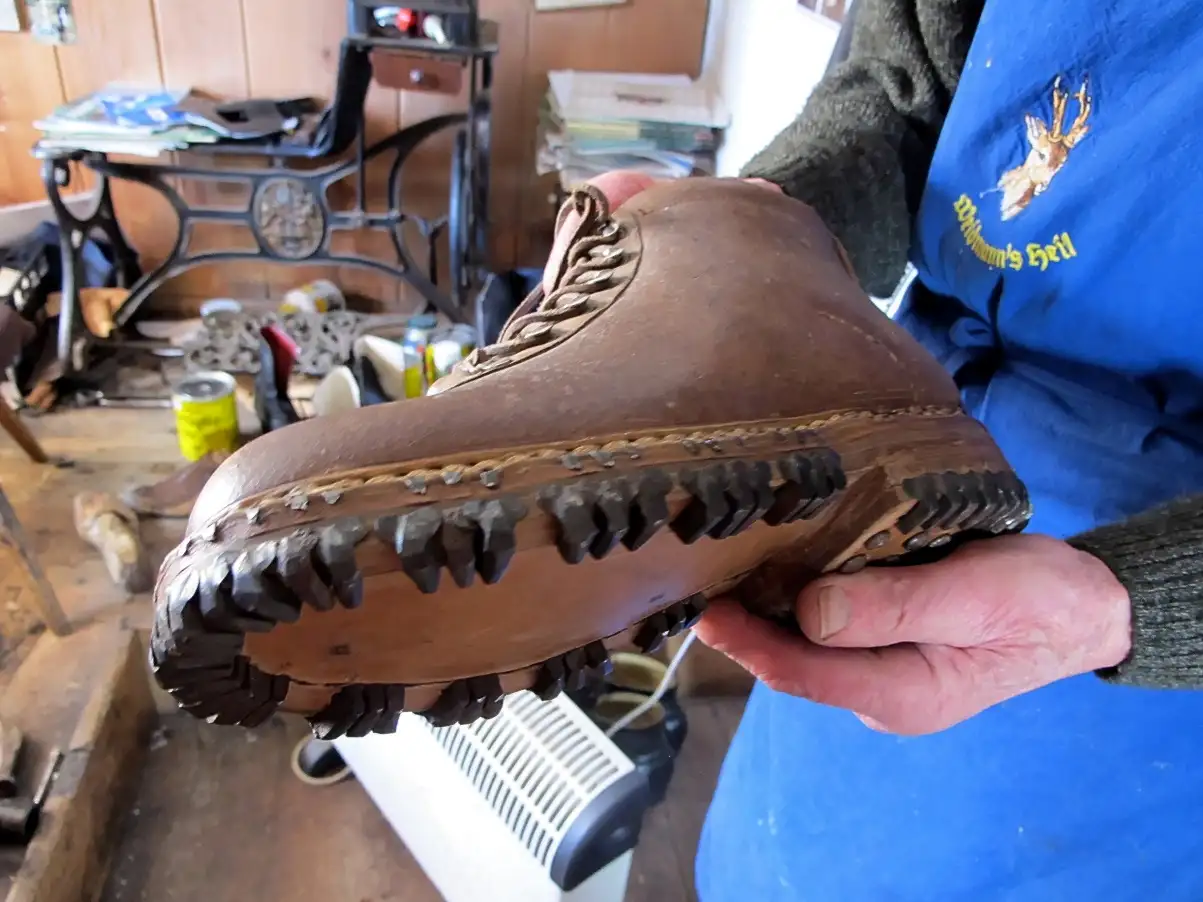
For centuries, mountain footwear gripped rock with iron. Leather boots had soles studded with nails, and one of the most famous kinds has a known inventor. According to Wikipedia, the Tricouni nail was invented in 1912 by Félix-Valentin Genecand, a Geneva jeweler nicknamed Tricouni who was also a well-known climber: there’s a Mount Genecand in Antarctica and a Tricouni Peak in Canada. Used by mountaineers and soldiers alike, the nails improved grip on a wide range of surfaces. Today the whole family goes by plenty of names: hobnails, boot nails, cleats, shoe studs.
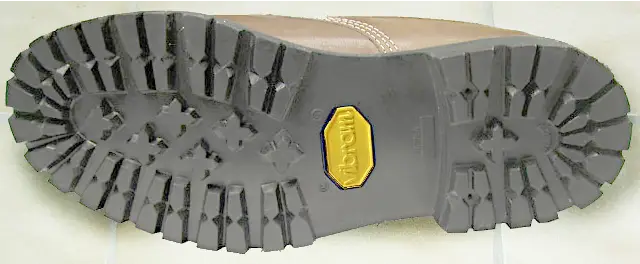
Rubber came to the mountains after a tragedy. According to the company history summarized on Wikipedia, six of Vitale Bramani’s climbing companions died in the Italian Alps on September 15, 1935, and the deaths were partly blamed on inadequate footwear. Bramani set out to design a new sole. Two years later he patented it and brought it to market with a lug pattern called Carrarmato, Italian for “tank tread,” with financial backing from Leopoldo Pirelli of Pirelli tires. It was made of vulcanized rubber and designed to grip a wide range of surfaces and resist wear. In July 1954, the Italian expedition that made the first ascent of K2 wore those soles. The same company would go on, decades later, to make the toe-shoes we cover in our story on heel-to-toe drop: from tank tread to almost bare skin.
The shaft: holding isn’t the same as protecting
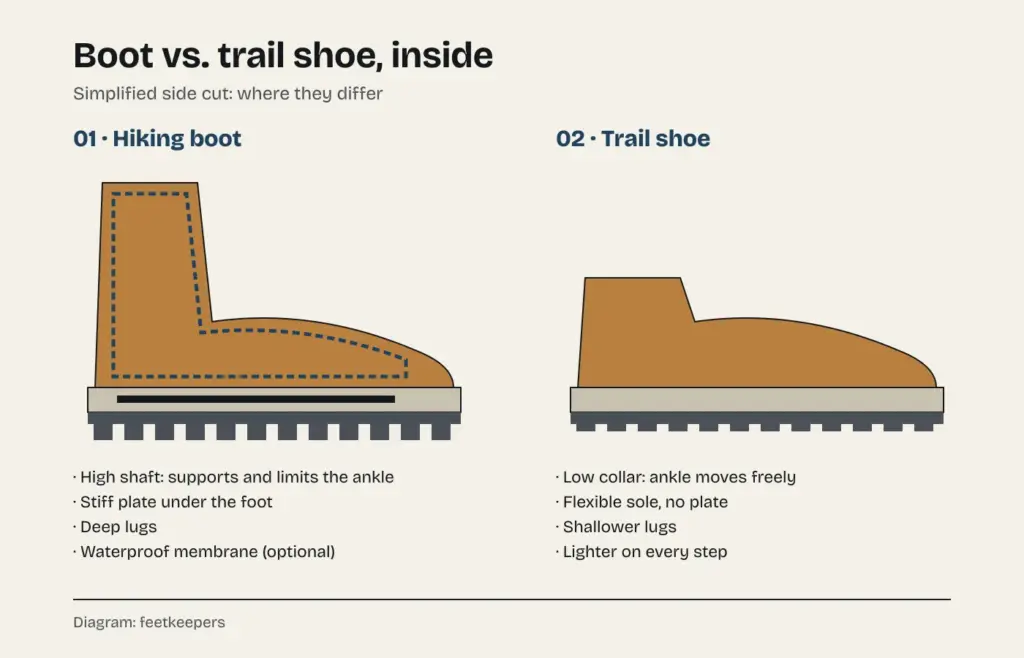
The shaft is the part of a boot that rises above the ankle. Its job is to hold the ankle, and its price is limiting what the ankle can do. In 2010, H. Böhm and M. Hösl published a study in the Journal of Biomechanics in which 15 healthy young adults walked over coarse gravel in two hiking boots that differed only in shaft stiffness: one was 50 percent stiffer than the other. They measured leg motion, forces and muscle activity. Their starting hunch: if the shaft restricts the ankle, the ankle loses some of its ability to push off, other joints have to make up for it, and the joint just below the ankle, the one that lets the foot adapt to uneven ground, may lose some of that adaptability too.
The results undercut the stock line. Walking speed and stability indicators were the same in both boots. But the stiff shaft reduced ankle motion and the energy the ankle absorbed as it braked each step, and the knee had to compensate: muscles contracted more against each other and absorbed more energy. The authors concluded that walking in stiff boots could be less efficient, that stiffness and blocked ankle motion shouldn’t be equated with safety, and that a balance between lateral support and natural ankle motion might be preferable.
Another study reached a similar conclusion from the push-off side. In 2007, I. Cikajlo and Z. Matjačić of the Institute for Rehabilitation in Slovenia compared two boot prototypes of different stiffness with nine people, with and without a backpack, in the journal Ergonomics. To measure each boot’s stiffness, they used a custom-built robot that pressed a foot model inside the boot and recorded how much it gave. The boot with the softer shaft let the ankle move more, which translated into more power at push-off, longer steps and faster walking. The backpack, on the other hand, mainly changed how the pelvis and trunk moved.
The sole: stiff underfoot, flexible at the ankle
The second decision is how much the sole bends. A classic hiking boot carries a stiff plate under the foot, designed so the foot doesn’t bend over every rock on the trail. A trail shoe usually skips it and lets the foot flex. Both choices have consequences for the mechanics we explain in our story on the gait cycle: a stiff sole changes how the forefoot rocker works and how far the toes can bend to tighten the arch’s windlass mechanism.
A team at the University of Wollongong in Australia pulled those two variables apart for the first time. In 2020, J. A. Dobson and colleagues published a study in Applied Ergonomics in which 20 men walked over gravel on a surface built to mimic the floor of an underground coal mine, in four boots combining a stiff or flexible shaft with a stiff or flexible sole. Neither shaft nor sole changed how comfortable the boots felt, but both changed the pressures under different parts of the foot, including the inner midfoot, the heel, the middle metatarsals and the big toe. And when asked, participants preferred one particular combination: a flexible shaft with a stiff sole, citing fit, freedom of movement, walking effort and support.
In 2022, the same team reported in Ergonomics, in a study with another 20 men on two simulated mining surfaces, that knee and hip alignment didn’t change, but the combination of shaft and sole stiffness influenced ankle position and lower-leg muscle activity at toe-off. Their recommendation for miners, with the goal of reducing trips, was to avoid boots with a stiff shaft, whatever the sole’s flexibility.
The same Wollongong team made a point that applies to anyone buying boots. In a 2018 study of 197 miners, they concluded that length alone isn’t enough to fit a work boot: fit at the heel, the instep and the forefoot has to be checked too. We cover their 3D scans of miners’ feet, and why so many ended up in boots that were too long, in our story on steel toe boots.
The lugs: a pattern that wears away
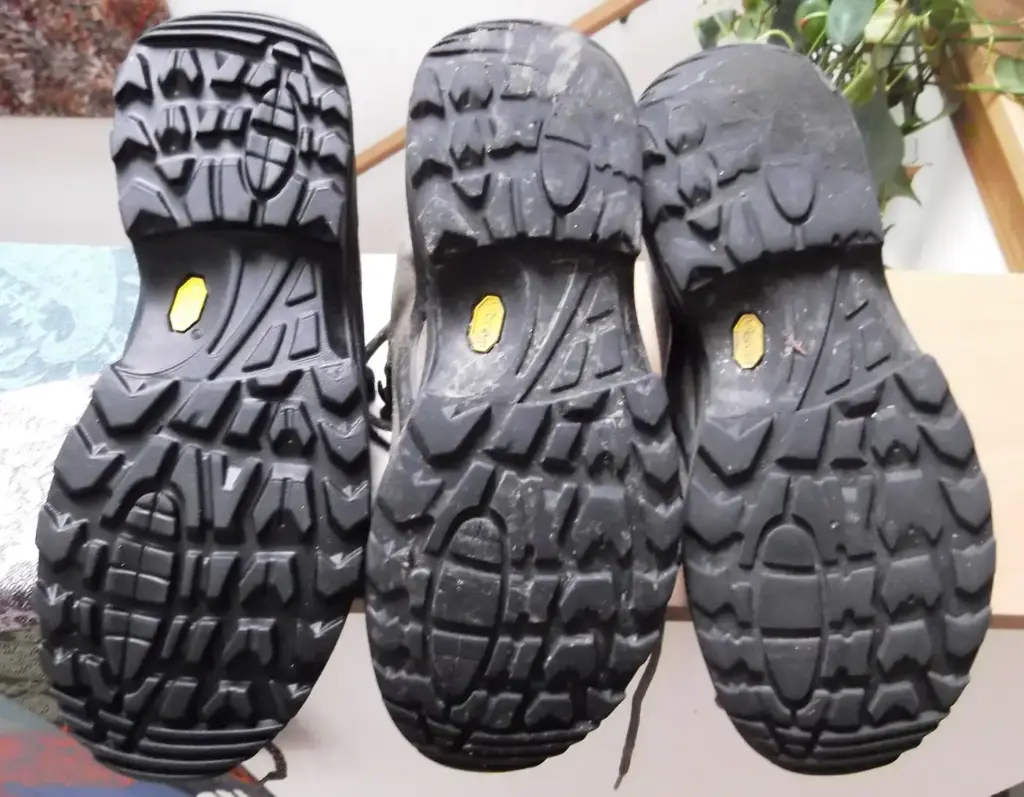
Under the sole, the lugs determine grip. Their depth, shape and spacing affect how they bite into loose dirt, mud or rock, and how much mud gets trapped between them. That was the whole point of Bramani’s tank tread. And every lug wears down.
The photo below shows it better than any explanation. These are three pairs of the same hiking shoe model belonging to a hiker from the Pacific Northwest who, by their own account, had covered 3,300 kilometers, roughly 2,050 miles, between these shoes and a pair of running shoes. They retired the oldest pair after a two-day, 47-kilometer, or about 29-mile, hike on the Pacific Crest Trail. The photo makes it plain how much tread the miles take with them.
Weight, paid on every step
The third decision is weight, and this is where the boot-versus-shoe gap is clearest. In 1969, Richard Soule and Ralph Goldman published a classic study in the Journal of Applied Physiology on the energy cost of carrying weight on different parts of the body. According to the studies that cite it, the same weight carried on the feet cost 4.7 to 6.3 times as much energy as carried on the torso, depending on speed. Over a day in the mountains, thousands of steps long, every ounce of boot gets multiplied. We show it in a chart in our story on shoes for carry-on travel.
The membrane: waterproof outside, breathable inside
The fourth decision is the lining. Plenty of boots, and plenty of trail shoes too, carry a waterproof membrane between the lining and the outer shell. The best-known one has a happy-accident origin story. According to Wikipedia, in 1969 Robert Gore, son of W. L. Gore & Associates founder Wilbert L. Gore, was stretching heated rods of polytetrafluoroethylene, or PTFE, the material in Teflon. Instead of pulling them slowly, he gave them a sudden, accelerating yank, and the material stretched by about 800 percent, forming a microporous structure that was roughly 70 percent air: a network of tiny nodes connected by fibrils, which is exactly what the electron microscope image below shows. That was the birth of expanded PTFE, which would be sold as Gore-Tex. In 1976, Gore received U.S. Patent 3,953,566 for that porous form of the material, and that same year the outdoor brand Marmot became one of its first adopters, in a sleeping bag. Other patents followed, including one in 1980 for a waterproof laminate, the form in which the membrane gets bonded to fabrics for clothing and footwear. Wikipedia also notes that PTFE belongs to the PFAS family of compounds.
The principle is simple: the pores are small enough to block liquid water and large enough to let water vapor through. In other words, the membrane keeps rain out and lets some sweat escape.
That caveat matters, because sweat that can’t get out comes at a cost. In 1999, researchers at Sweden’s National Institute for Working Life used a heated artificial foot to show that sweat building up inside footwear cut its insulation by 9 to 36 percent, depending on the sweat rate and the boot. And the warmest boots lost proportionally more insulation than thin ones. A membrane stops water coming in from outside, but your foot keeps sweating inside, as we explain in our story on how many pairs of shoes you need. On a hot, dry day, that lining can work against you. On a day of rain and mud, it works for you. In a later review in Industrial Health, Kuklane summed up that moisture is the single most important factor in footwear insulation and foot comfort, and that combined with movement it can cut protection against cold by 45 percent.

What actually decides it
Put it all together, and boot versus shoe stops being a question of style. It gets answered by four facts about the hike. The terrain: loose rock, scree and snow call for more plate and more lug; a packed dirt trail calls for less. The load: according to the Slovenian study, a backpack mainly changes how the trunk and pelvis move. The weather: in rain and mud, a membrane makes sense; in dry heat, it may be overkill. And the distance: the more miles, the more every ounce on your feet costs.
And one lab finding for anyone leaning toward boots: according to the studies, a shaft helps with what it holds and charges you for what it restricts. A shaft that lets the ankle move combined with a firm sole underfoot was, in the Australian study, the combination preferred by the people who tried them.
Sources
- H. Böhm and M. Hösl (2010), “Effect of boot shaft stiffness on stability joint energy and muscular co-contraction during walking on uneven surface,” Journal of Biomechanics 43(13): 2467–2472.
- I. Cikajlo and Z. Matjačić (2007), “The influence of boot stiffness on gait kinematics and kinetics during stance phase,” Ergonomics 50(12): 2171–2182.
- J. A. Dobson, D. L. Riddiford-Harland, A. F. Bell, C. Wegener and J. R. Steele (2020), “Effect of shaft stiffness and sole flexibility on perceived comfort and the plantar pressures generated when walking on a simulated underground coal mining surface,” Applied Ergonomics 84: 103024; (2022), Ergonomics 65(8): 1071–1085.
- R. G. Soule and R. F. Goldman (1969), “Energy cost of loads carried on the head, hands, or feet,” Journal of Applied Physiology 27(5): 687–690.
- K. Kuklane, I. Holmér and G. Giesbrecht (1999), “Change of footwear insulation at various sweating rates,” Applied Human Science 18(5): 161–168.
- Wikipedia, “Tricouni,” “Vibram” and “Gore-Tex,” and the references they cite; U.S. Patents 3,953,566 (1976) and 4,194,041 (1980).
Image credits
- Handmade nailed mountain boot, Sarntal Alps: Bbb, with permission of maker Josef Hochkofler. CC BY-SA 3.0, via Wikimedia Commons.
- Carrarmato sole: Hydrargyrum. CC BY-SA 3.0, via Wikimedia Commons.
- Boot vs. trail shoe diagram: feetkeepers.
- Worn soles: brewbooks. CC BY-SA 2.0, via Wikimedia Commons.
- Expanded PTFE membrane under the microscope: original author on French Wikipedia, enhanced by Abrev. CC BY-SA 3.0, via Wikimedia Commons.
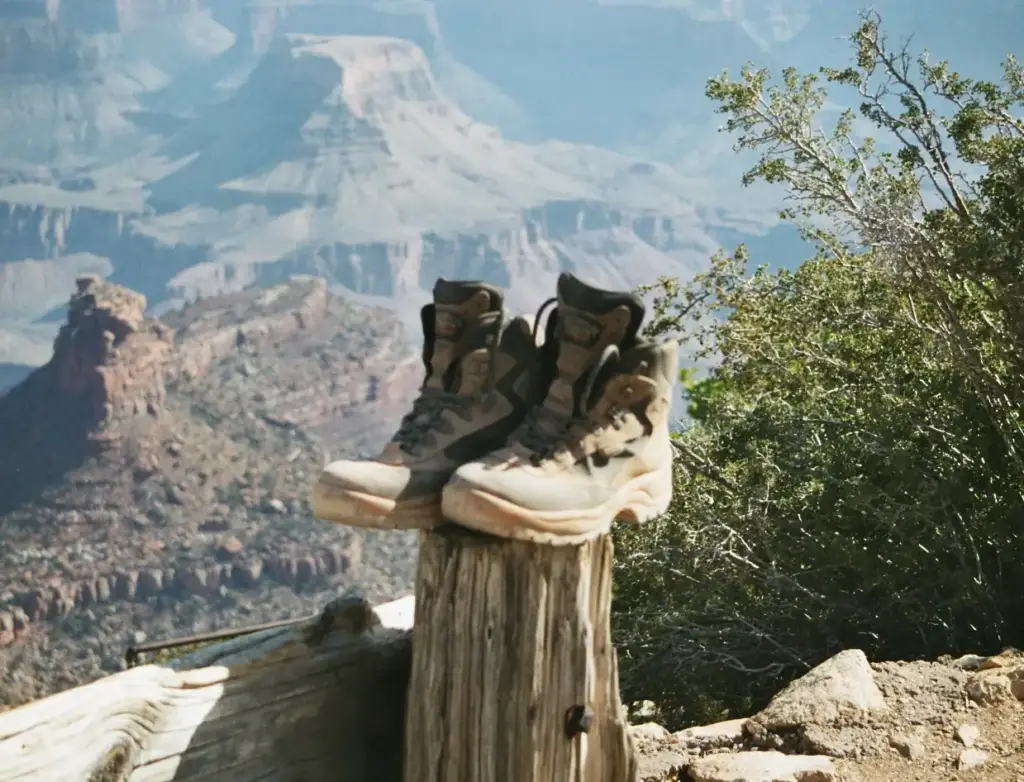
- Boots above the Grand Canyon: Jensre. Public domain, via Wikimedia Commons.