
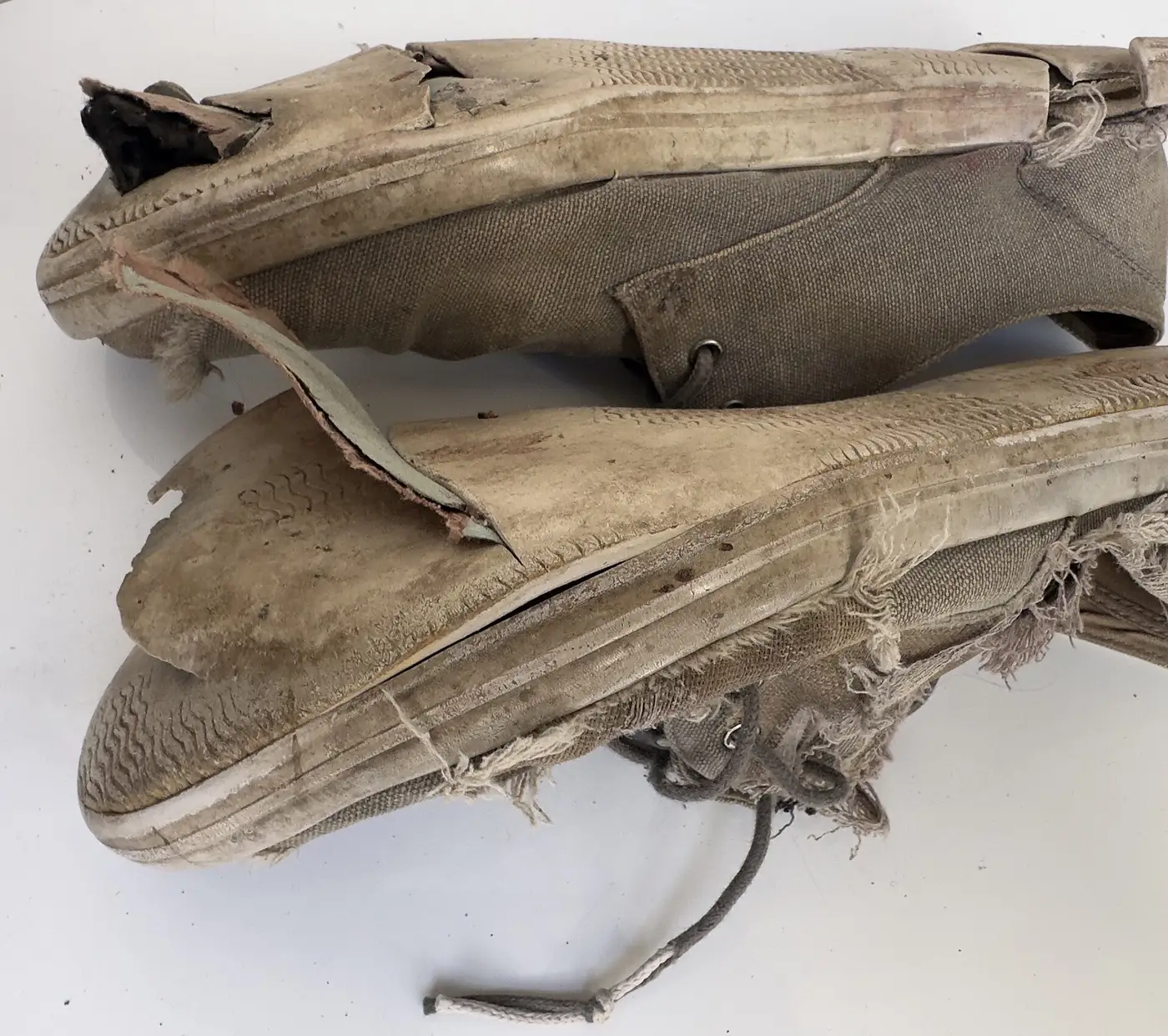
Why white sneakers turn yellow has an annoying answer: white was never a permanent state, only a ceasefire. A white sole is a plastic carrying a package of additives that starts fighting light, oxygen and city air the day it leaves the factory. It always loses that fight. Sometimes it takes months, sometimes decades. The yellow isn’t dirt sitting on the surface. Most of the time it’s chemistry that has happened inside the material, which is why a pair can yellow without ever leaving the box, and why scrubbing does so little.
We covered textile yellowing, chlorine bleach and the phenolic yellowing that hits white clothes in how to clean white sneakers. This piece picks up what that one left out: the soles, foams and glues, which are usually the first parts to go cream-colored.
Yellow is missing blue
To understand yellowing, start with light. A surface looks white when it reflects nearly all the visible light hitting it, every color at once. If something in that surface starts soaking up the violet and blue end of the spectrum, what reaches your eye is no longer the full mix. It’s short on blue, and light that’s short on blue looks yellowish. Your sneakers aren’t being dyed yellow. They’re losing blue.
Molecules that absorb part of the light are called chromophores. A new sneaker has very few in its sole and foam. As it ages, oxidation of the polymers and their additives creates new ones. The sequence described both in polyurethane foam research and in the solar-panel studies we’ll get to below is consistently similar: off-white first, then yellow and, if the process keeps going, brown.
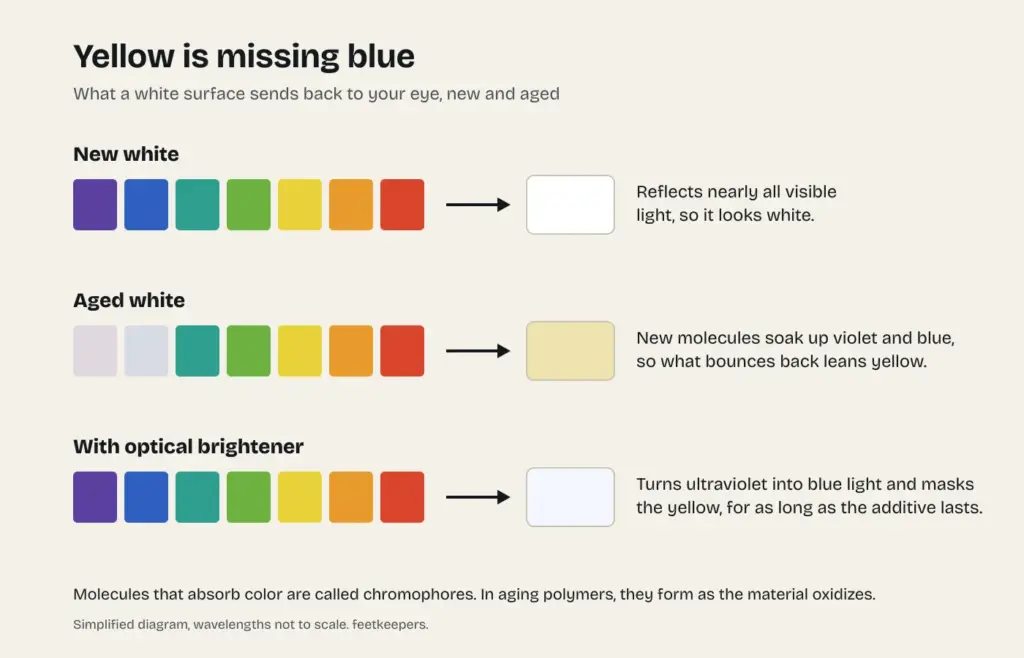
The industry has hidden this for a long time with the same optical trick laundry detergents use: optical brighteners. These fluorescent compounds absorb invisible ultraviolet light and give it back as visible blue light. That extra blue makes up for what’s missing, so the surface looks whiter than white. The catch is that the brightener is also a molecule that wears out in light, so the trick has an expiration date.
UV light and polyurethane
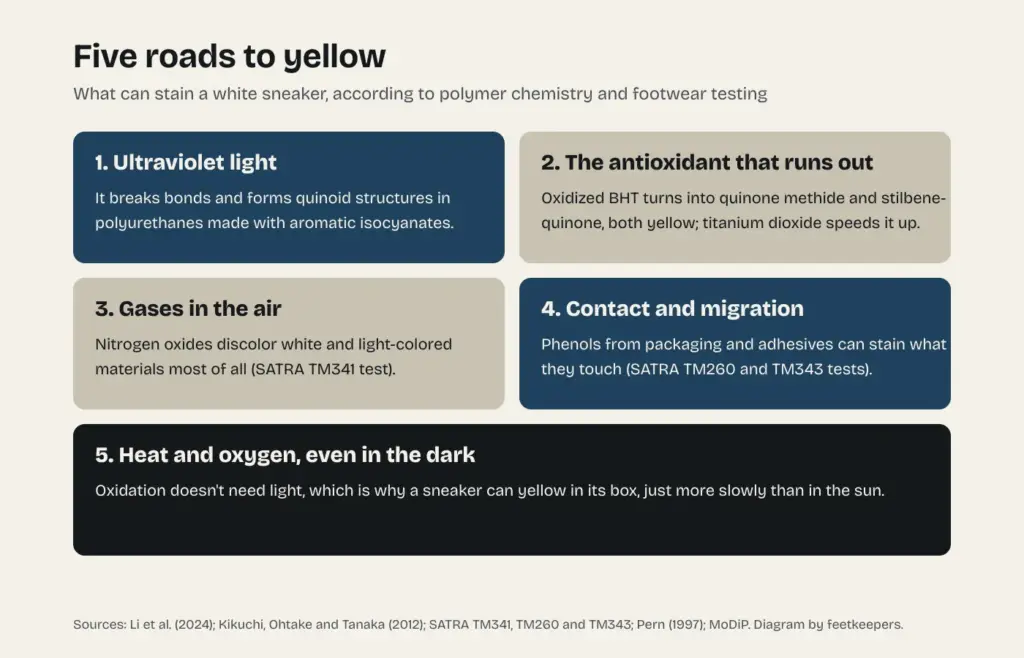
A lot of a sneaker’s soles, midsoles, coatings and synthetic uppers are polyurethane, and not all polyurethanes age the same way. Polyurethane is made by joining two ingredients: a polyol and an isocyanate. According to Wikipedia, the most commonly used isocyanates are the aromatic ones, TDI and MDI, which are more reactive and generally cheaper than the alternatives, and they go into flexible foams, rigid foams and elastomers such as shoe soles. In chemistry, “aromatic” has nothing to do with smell. It means the molecule contains a benzene ring, a hexagon of six carbon atoms.
That ring is what turns yellow. A team from several Chinese institutions, including the Chinese Academy of Sciences, summed it up in 2024 in the journal Molecules: aromatic isocyanates tend to form quinoid structures under ultraviolet light, and those structures cause yellowing. A quinoid structure is a version of the ring with its double bonds rearranged, and it absorbs right in the blue. The fix they mention is the industry’s standard one: aliphatic isocyanates such as HDI, which have no aromatic ring.
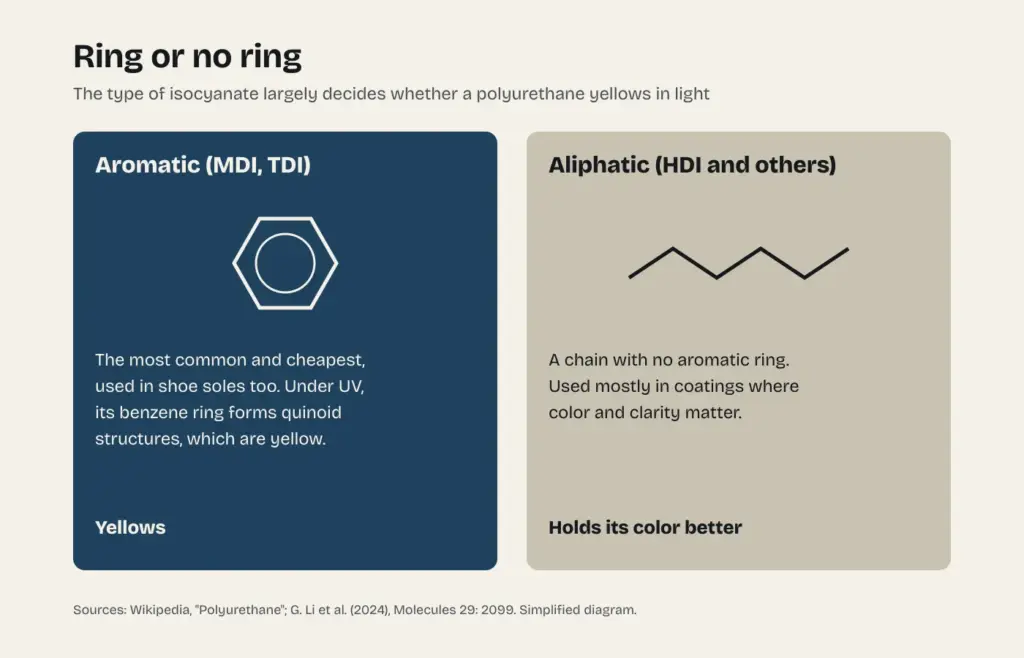
So if the alternative exists, why isn’t every sole made with it? Wikipedia offers the clue: aliphatic isocyanates are used in smaller quantities, mostly in coatings and other applications where color and clarity matter, precisely because aromatic polyurethanes tend to darken in light. The aromatic kind is cheaper and more reactive, and for a sole that’s headed for puddles, color usually isn’t an engineer’s top priority. The same source says polyurethane foam made with aromatic isocyanates goes from off-white to yellow to reddish brown when exposed to light, and that apart from the color change, light is generally accepted to have little effect on its properties. A yellow foam isn’t necessarily broken. It’s old on the outside.
The antioxidant that sacrifices itself
Polymers carry antioxidants to slow oxidation, and one of the classics is BHT, a phenol with a long name that also shows up in plastic packaging. An antioxidant works by sacrificing itself: it reacts with free radicals before they can attack the polymer chains. The trouble is what’s left behind.
In 2012, Takako Kikuchi, Yoshito Ohtake and Keiji Tanaka, of Japan’s Chemicals Evaluation and Research Institute and Kyushu University, published a heat-accelerated test of that antioxidant in the journal of the Society of Rubber Science and Technology, Japan. As BHT oxidized, it produced quinone methide and stilbenequinone, two yellow compounds, and the system discolored. The reaction sped up when BHT was paired with hindered amine light stabilizers, another common additive, and the oxidation could be catalyzed by titanium dioxide. The test was done in solution, but the authors reported similar results in polymer materials.
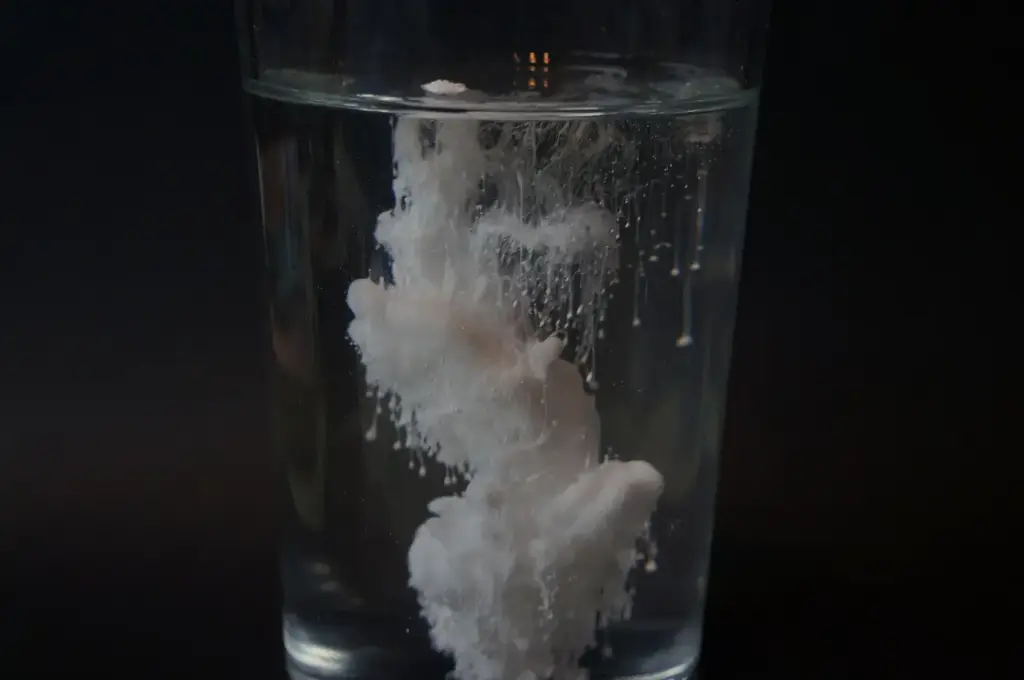
The titanium dioxide detail comes with some irony. It’s the white pigment, the powder that makes paint, plastics and plenty of soles white. The ingredient that supplies the white can help make the yellow when it meets certain additives. Nobody designs a sole to turn yellow. Yellowing often comes from a mix of additives that were each doing their own job just fine.
Yellowing in the dark
Opening a box that sat on a closet shelf for years and finding bone-colored soles has an explanation: oxidation doesn’t need light. Oxygen and time are enough, and heat speeds it up. Light adds to it, but it isn’t required. In 1997, chemist F. J. Pern of the National Renewable Energy Laboratory compared heat-only aging with heat plus light in sheets of EVA and found that photothermal degradation was greater than thermal degradation. Greater, not the only kind.
Museums know this well. MoDiP, the Museum of Design in Plastics at Arts University Bournemouth in England, documents a 1980s high heel with a foamed polyurethane sole. Oxygen in the air had oxidized the foam, which is especially vulnerable because of all the surface area inside it, leaving it brittle and deeply cracked. The museum notes that discoloration is typical of the material, though it wasn’t visible on that piece. For storage, it recommends darkness and low humidity, 20 to 30 percent relative humidity, and, where possible, an oxygen-free enclosure, which takes up a lot of space and needs monitoring. That’s a museum’s recipe for a collection piece, not advice for your closet, but it lays out the mechanism: cutting light and humidity slows the clock, and only removing oxygen actually stops it.
There are invisible enemies in the air and in whatever touches the shoe, too. SATRA, the British footwear research center, has a specific test for each. TM341 measures how readily a material discolors in an atmosphere containing nitrogen oxides, the gases from car exhaust and gas heaters, and SATRA notes it matters most for white and light-colored materials. TM260 assesses yellowing caused by hindered phenols found in some packaging, and flags textiles and polyurethanes as the most sensitive. TM343 is a contact storage test that checks whether one material discolors another when they sit together, and it applies to the adhesives used to bond shoe parts. That’s the test behind a familiar sight: yellow showing up right along the line where the sole meets the upper. The glue ages, and it migrates.
The California solar plant that turned brown
The most dramatic yellowing story involving a sneaker foam didn’t happen in a sneaker. EVA, the ethylene-vinyl acetate copolymer used in many midsoles, as we explained in EVA vs. TPU vs. PEBA, is also the clear material that encapsulates the cells in silicon solar panels. The formulation is different, but the base polymer is the same.
In the late 1980s, the Carrisa Plains solar plant in central California started losing power. According to a paper presented in 1991 at the IEEE Photovoltaic Specialists Conference by engineers from the Electric Power Research Institute and Pacific Gas and Electric, the plant, rated at 5.2 megawatts, had been degrading since 1986 at roughly 10 percent a year and by 1990 routinely produced less than 3 megawatts. More than 90 percent of its trackers had V-shaped mirrors that concentrated sunlight on the panels, and that design had sped up the browning of the modules. The clear EVA had turned brown.
The crisis sent scientists at the National Renewable Energy Laboratory to work on the problem starting in 1990. In his 1997 paper, Pern explained that the UV absorber in commercial formulations broke down in light, and that the rate at which it disappeared tracked the appearance of the chromophores that stained the EVA. Loss of the absorber and the shift from light yellow to brown followed an S-shaped curve: almost nothing at first, then a rapid acceleration, then a plateau. Glass that filtered out UV below 350 nanometers cut the discoloration sharply, and switching stabilizers and curing agents cut it even more.
We didn’t find an equivalent published study on EVA midsoles, so the comparison has limits. But the underlying lesson matches the polyurethane story: protective additives get used up, and once they’re gone, the material stains fast. That fits a very common complaint, the sneaker that looked spotless for years and then went yellow in a single summer.
Worst case: clear soles
Translucent soles, the kind you can see the tread pattern through, have a reputation for yellowing first. We found no published scientific study on them specifically, so what follows is basic physics, not a measured result. An opaque white sole carries pigment, usually titanium dioxide, which scatters light at the surface and hides some of what’s happening underneath. A clear sole has nothing to hide behind: any chromophore that forms anywhere in its thickness shows. And because light travels through several millimeters of material before bouncing back to your eye, the absorption adds up along the whole path. A little yellow spread through half an inch of clear rubber is far more visible than the same yellow in the skin of an opaque sole.
Bleaching the yellow back out, and its limits
If yellow is new molecules absorbing blue, the way to remove it is to break those molecules apart. That’s what oxidizing bleaches do, and the most famous version came from vintage computers, not sneakers. According to Wikipedia, the ABS plastic of 1980s computer cases yellows under UV light and heat through photo-oxidation, which breaks polymer chains and leaves the plastic yellow and brittle. Hydrogen peroxide on yellowed household plastic showed up in newspaper home-repair columns as early as 1964, but it caught on in March 2008, when CBM Museum Wuppertal, a German computer museum, posted its success soaking yellowed case parts in hydrogen peroxide for five days. That summer, members of the English Amiga Board, including chemist Dave Stevenson, added an oxygen activator called TAED and stressed the role of UV light. They named it retr0bright. According to the same source, the method has since spread to restoring collectible sneakers.
The problem is that bleaching isn’t the same as making something young again. Wikipedia notes that the long-term effectiveness is unclear, that some people have seen the yellow come back, and that there are concerns the process only bleaches plastic that’s already damaged. The example it cites is an informal test, not a scientific study: in 2015, the YouTube channel Tech Tangents treated a 1999 game console case while taping off part of the surface, and when it was checked again in 2025, the treated areas were more yellow and blotchy than the untreated ones. One case doesn’t prove a rule, but the chemistry fits: the oxidizer breaks down the visible chromophores, it doesn’t rebuild broken chains, and whatever caused the yellow is still there. Polyurethane that’s falling apart from moisture, the hydrolysis we covered in how long sneakers last, won’t be fixed by any bleach either.
Why some pairs yellow and others don’t
In the end, whether a white sneaker yellows early or late depends much more on its recipe than on its owner. The type of polyurethane matters, aromatic or aliphatic. So do the antioxidants, light stabilizers and brighteners, and how they interact. So does whether the sole is opaque or clear, which glue was used and what the shoe sat next to in the warehouse. Then come light, heat, humidity and the air of a city full of traffic.
None of that is on the label, and no brand publishes the formula. That’s why two nearly identical white pairs can age at very different speeds on the same shelf. What we do know is that perfect white is a chemical balance designed to last long enough, not forever. And when the brightener and the antioxidant run out, the sole shows the color that was waiting underneath all along.
Sources
- G. Li, B. Duan, G. Leng et al. (2024), “Preparation of Yellowing-Resistant Waterborne Polyurethane Modified with Disulfide Bonds,” Molecules 29(9): 2099.
- T. Kikuchi, Y. Ohtake and K. Tanaka (2012), “Discoloration Phenomenon Induced by the Combination of Phenolic Antioxidants and Hindered Amine Light Stabilizers,” Nippon Gomu Kyokaishi 85: 283-288.
- F. J. Pern (1997), “Ethylene-vinyl acetate (EVA) encapsulants for photovoltaic modules: Degradation and discoloration mechanisms and formulation modifications for improved photostability,” Die Angewandte Makromolekulare Chemie 252: 195-216.
- H. J. Wenger, J. C. Schaefer, A. L. Rosenthal, B. Hammond and L. Schlueter (1991), “Decline of the Carrisa Plains PV power plant: the impact of concentrating sunlight on flat plates,” Conference Record of the IEEE Photovoltaic Specialists Conference: 586-592.
- MoDiP, Arts University Bournemouth, “Polyurethane (PU) 3,” conservation case study of a 1980s shoe.
- SATRA, TM341: Oxides of nitrogen discolouration test; TM260: Phenolic (elusive) yellowing of textiles; TM343: Contact storage test for discolouration.
- Wikipedia: Polyurethane and Retrobright.
Image credits
- Worn canvas sneakers: Wolfmann. CC BY 4.0, via Wikimedia Commons.
- Titanium dioxide in water: Pixelmaniac pictures. Public domain (CC0), via Wikimedia Commons.
- Color, isocyanate and yellowing-cause diagrams: feetkeepers.