

Shoes on power lines have a meaning everybody thinks they know and almost nobody has checked: drugs are sold here. It’s one of the most repeated urban legends in America, and every time someone has actually asked the police, counted the shoes and talked to the people who threw them, the explanation has frayed like an old lace. What’s left is better than the myth: a custom with centuries of history behind it, a city that kept count of every pair, and a question without one answer, because each pair can be up there for a different reason.
There’s even a word for it: shoefiti, a mash-up of shoe and graffiti, the act of tossing a pair of shoes tied together by the laces until they catch and wrap around a power or phone line.
How a pair ends up up there
The technique is simple, but there’s physics in it. You tie the two laces together, grab the pair by the knot, spin it and let go toward the wire. Two weights joined by a cord and spinning through the air are basically a bola, the weapon South American gauchos threw to tangle an animal’s legs. When the cord hits the wire, both ends keep swinging around it and wrap it up. That’s why a pair doesn’t fall at the first gust and can hang there for years. One listener who told his story to Chicago public radio remembered that the sneakers a friend flung over a wire around 1970 stayed up until the lace finally broke weeks later.
The staying power isn’t an accident, either. Sneaker laces are built to take yanking, as we explained in how to lace shoes, and according to Wikipedia, a leather shoe is estimated to last 25 to 40 years outdoors. We covered how soles and foams age in how long sneakers last.

The drug myth, put to the test
The most popular version says hanging sneakers mark a drug spot. There are variations, collected in internet slang dictionaries: that they flag a crack house, or that the shoes are “high” like someone who’s been using. We couldn’t find a source that documents any of them.
The most thorough reporting on the subject was done in 2015 by journalist Meribah Knight for Curious City, a series on Chicago’s public radio station WBEZ. She talked to kids in the neighborhoods, sociologists, a South Side priest and Cobe Williams, a community outreach worker with years in some of the city’s toughest areas. The Chicago police declined to comment. Of the people who had a theory, not one linked the shoes to drugs. Robert Aspholm, a social worker and University of Illinois at Chicago doctoral student writing about Chicago gang dynamics, and a childhood shoe-tosser himself, called it an urban legend, especially the drug-spot part, because nobody advertises what they’re doing in a way that sets them up to be arrested.
Police elsewhere have said much the same. In 2003, the police chief of Ironton, Ohio, told the local paper that the city had no official gangs and that the shoes were just neighborhood kids playing around. In Barcelona in 2021, the Catalan and city police told the fact-checking outlet Verificat that they knew of no link between hanging shoes and drug sales or other crime, and Spain’s national police said the same.
Aspholm also offered a reason the myth hangs on. The shoes show up mostly in marginalized neighborhoods, and those same neighborhoods often have open-air drug markets and violent deaths. All three happen in the same place, so people connect them. Showing up together doesn’t mean one causes the other.
What the people who threw them say
So if it isn’t drugs, what is it? What WBEZ found is that it depends on who, where and when. One caller said that at 14, around 1970 in Cleveland, he was walking with his gym shoes tied around his neck when a friend, “perhaps not the best friend in the world,” started pretending he’d toss them over the wire, and then did. Another, Juan Molina, lost a bet and his buddies climbed a pole to hang his shoes; another time he threw up his own soccer cleats out of spite after surviving a soccer camp his parents had forced on him.
The darkest version came from a prison. Knight reached Patrick Starr, a former high-ranking member of the Bloods in Kansas City in the 1990s who was serving a life sentence in Missouri and coaching other inmates on cutting ties with gangs. Starr told her that back then, his crew hung shoes on the lines to show they ran the block. He asked around the prison yard and came back with answers that changed with each man’s hometown: for the Chicago guys and many from St. Louis, the shoes memorialized young men from the neighborhood who’d been killed, gang members or not; men from smaller Missouri cities told him they marked a killing by the crew’s leader. It turned into such a popular topic, Starr said, that it became yard talk.
For sociologist Randol Contreras, who grew up in the South Bronx and wrote a book about stickup crews and drugs, it was simpler: every neighborhood he lived in had sneakers on the wires, and he tossed an old pair himself because that’s what the guys did for a laugh. Aspholm compared it to graffiti or tagging, a way for a kid who spends all day outside to leave a mark.
Other explanations float around without much evidence. In 1996, the reader-question column The Straight Dope, in the Chicago Reader, collected a few, according to Wikipedia: soldiers tossing their boots after basic training or when leaving the service, kids celebrating the end of the school year, or people getting rid of shoes they didn’t like. Hollywood helped cement the picture. In the 1997 film Wag the Dog, shoes thrown over wires and into trees become a supposedly spontaneous tribute to a made-up sergeant shot down behind enemy lines in Albania, and in Tim Burton’s Big Fish, a little girl in a town where everyone goes barefoot tosses the hero’s shoes onto a wire.

The city that counted
The most valuable part of WBEZ’s work isn’t the stories, it’s the numbers. Chicago logs residents’ requests to remove shoes from wires, and in the seven years before the report, city workers had received at least 6,000 of them. The requests covered everything from a pair of cowboy boots to a stranded rubber ducky. According to city spokesman Mike Claffey, requests dropped 71 percent between 2008 and 2014: more than 1,100 in 2008, and only 111 in the first half of 2015. Data from all the 311 calls about shoes showed the same trend, with requests concentrated on the South and West sides and a pocket in the far northeast around Rogers Park. ComEd, which maintains the lines in Chicago’s alleys, didn’t keep records, but its technicians saw few on the North Side and far more on the South Side.

Los Angeles went further. According to Wikipedia, a 2003 newsletter from then-Mayor James Hahn cited fears among many residents that the shoes marked drug sites or, worse, gang turf, and said city and utility workers had launched a program to take them down. That the city treated it as a problem doesn’t prove the shoes meant drugs. It proves people believed they did.
The question behind the WBEZ story came from Matt Latourette, who grew up in Chicago’s Belmont Central neighborhood and saw shoes on the wires all the time in the ’70s and ’80s. When WBEZ talked to him, he lived in suburban Aurora, where the power lines run underground, and he hardly ever saw them anymore. No overhead wires, nothing to hang shoes from.
Why shoes, of all things
If you want to mark a spot or pull a prank, why a shoe and not a cap or a T-shirt? Anthropologist José Mansilla, of a Barcelona-based urban conflict research group, offered Verificat a cultural explanation: shoes touch the ground, so they stand for dirt, for what’s disposable and rejected. In both the Judeo-Christian tradition and the Arab world, he said, shoes carry a sense of impurity, something we got into in why people are embarrassed by their feet, which makes it easy to link a pair hanging overhead with something bad.
That symbolism goes way back, almost as far as the oldest shoes in the world, and it isn’t always negative. In the Book of Ruth, the way to seal a deal in ancient Israel was to pull off your shoe and hand it over, and in Psalm 60, God declares, “over Edom will I cast out my shoe,” a way of claiming that land. The shoe stood for taking possession and for giving it up. Since the 19th century, writers have used that idea to explain a very British wedding custom: throwing old shoes after the newlyweds. Charles Dickens put it in David Copperfield in 1850, when Mr. Peggotty shows up with “an old shoe, which was to be thrown after us for luck.” In 1887, The New York Times called the custom so old that memory couldn’t reach its beginning. And in 1896, clergyman Peter Ditchfield wrote, as Wikipedia quotes him, that throwing the shoe probably started as a symbol of the father giving up his authority over the bride and passing it to the groom.
Shoes thrown in anger have their political version too, from the pair hurled at George W. Bush in Baghdad in 2008 onward; that story deserves its own piece. And sports have the gentlest version of all: “hanging up your cleats” means retiring.
Shoe trees, boot tossing and white shoes
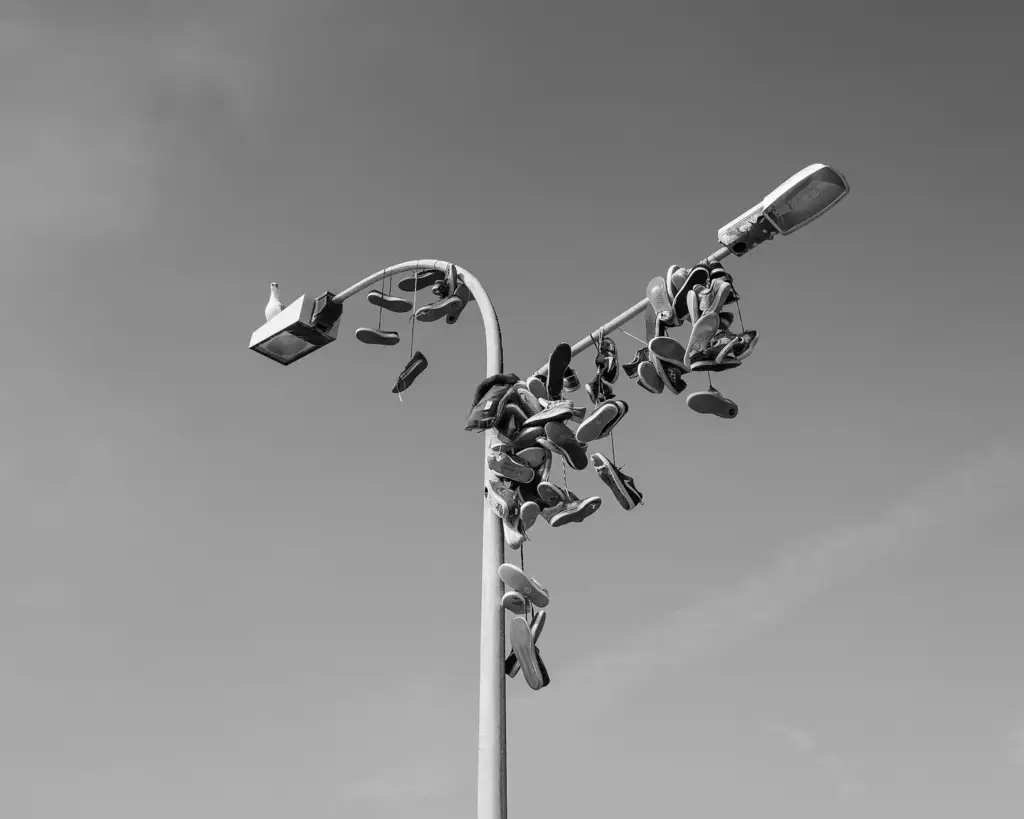
Shoes don’t just go on wires. In plenty of places they go in trees, and according to Wikipedia, some American shoe trees have become landmarks, including one in Minneapolis. Street lamps work too, like the one pictured.
Throwing footwear as far as you can is even a sport. According to Wikipedia, welly throwing, or wellie wanging, a contest of flinging rubber boots, seems to have started in England’s West Country in the 1970s and spread through British village fairs. The first record Guinness recognized was 173 feet, set by Tony Rogers in Wiltshire in 1978. The current records belong to Finland: 209.9 feet by Teppo Luoma and 134.1 feet by Sari Tirkkon, both in 1996. There are associations in Helsinki, in several English villages and in Taihape, New Zealand, which has held a Gumboot Day every Tuesday after Easter since 1985.
And there’s a newer, serious use that’s no joke at all. In 2016, family, friends and safety activists in Montreal hung a pair of white shoes from a lamppost at the intersection where Concepción Cortacans had been fatally struck by an SUV. Since then, ghost shoes have marked places where pedestrians were killed across the U.S. and Canada, much like the white ghost bikes for cyclists. In October 2017, Milwaukee put up a pair for each of the 17 pedestrians killed in the city the year before, the first such memorial in the U.S.
The real danger is getting them down
Hanging shoes do carry a real hazard, and it has nothing to do with what they mean. It’s the wire. In 2003, a spokeswoman for American Electric Power told The Ironton Tribune that hanging items create a hazardous situation because power lines are dangerous, that something heavy enough can break a line and electrocute people, and that you should always assume a line is energized. The sensible move is to report it to the electric, phone or cable company, or the city, and not go after it with a stick.

A fading mystery
Put it all together, and the most accurate answer to the question in the title is that shoes on power lines can mean almost anything, and almost never what the legend says. A cruel prank, a lost bet, the end of a school year, a memorial to a friend, a crew saying this block is ours. There’s no evidence they advertise drug sales, and the police who’ve answered the question say they don’t.
What the numbers do show is that the custom is fading, at least where someone counted. With wiring going underground and a generation spending more time on screens than on street corners, sneakers on the wires may end up as what they already are in old photos: a piece of neighborhood memory. Each pair still up there tells a story. It’s just rarely the one we tell about it from the sidewalk.
Sources
- M. Knight (2015), “Shoes on a Wire: Untangling an Urban Myth,” WBEZ Curious City, Chicago, August 5, 2015.
- The Ironton Tribune (2003), “Shoes on power lines likely not gang signs,” April 22, 2003.
- Verificat (2021), “Los zapatos colgados en cables significan que se vende droga: ¿mito o realidad?” Time Out Barcelona, December 28, 2021.
- C. Dickens (1850), David Copperfield, Project Gutenberg.
- The Bible, King James Version, Ruth 4:7 and Psalm 60:8.
- Wikipedia: Shoe throwing (The Straight Dope 1996, James Hahn’s 2003 newsletter, The New York Times 1887 and Ditchfield 1896), Welly throwing and Ghost shoes.
Image credits
- Shoes on a power line at dawn in Edmonton, Canada: Nick Wiebe. CC BY 2.5, via Wikimedia Commons.
- Sneakers on a wire in Vitoria-Gasteiz, Spain, 2013: Zarateman. Public domain (CC0), via Wikimedia Commons.
- Shoe tree in Miranda de Ebro, Spain: Zarateman. Public domain (CC0), via Wikimedia Commons.
- Street lamp with sneakers in A Guarda, Spain: Jules Verne Times Two. CC BY-SA 4.0, via Wikimedia Commons.
- Shoes on a 132 kV line at the Roskilde Festival: Kristian Mollenborg. CC BY 2.0, via Wikimedia Commons.
- Chicago chart: feetkeepers.